
OFF-TOPIC (76)
By:
July 17, 2026
Off-Topic brings you over-the-transom, on-tangent essays, dialogues and subjective scholarship on an occasional, impulsive basis. For this round, a first-time revisit with fav graphic lit of my youth, when life strikes twice…
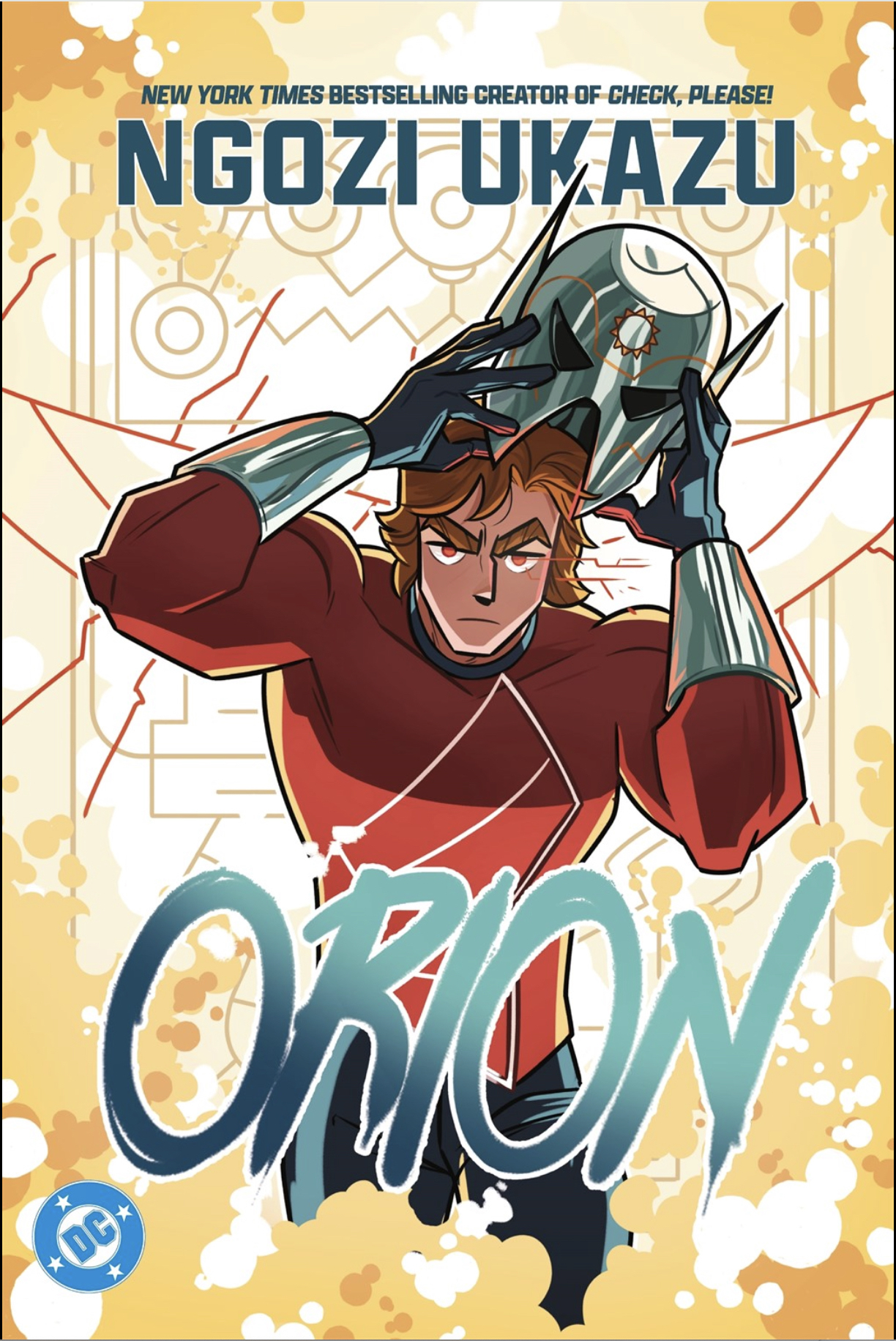
It’s the nature of action heroes that their surface is all we need to know — but what do they need to know? While some icons are defined by their impervious catchphrases, their “Make my day”s and “Yippee-ki-yay”s, the protagonist of Jack Kirby’s epic New Gods comic is described early in its first issue with a caption saying “Orion’s face is a cloud which has hidden all paths leading to himself.”
Kirby, a giant of his artform revered by fans and demeaned by management, a brawler from the Lower East Side and a lifetime PTSD’d veteran of WWII who was meant only to create, spilled his inner life out onto the pages of the Fourth World saga (of which The New Gods was a pivotal part), albeit as analogy: a psychodrama of his impoverished childhood, encounters with bigotry, economic struggles and embattled belief in decency, re-writ as a cosmic conflict of free will against deified tyranny. But the warrior Orion has remained the most closed-off of his characters, taken by subsequent writers, if not at his surface value, then in his metaphorical shorthand as a conflicted soul who has no enemy worse than himself — rich enough as drama, but not entirely fair to this character who seems alive to many of us. The fullest exploration of those paths within him is mapped at last in Ngozi Ukazu’s graphic novel Orion.
Early inheritors of the Fourth World mythos made the mistake of “humanizing” these larger-than-existence, archetypal characters, construing Kirby’s grandeur as bombast and diminishing cosmic personas to typical midcentury neurotic superheroes-with-problems. Ukazu is one of the few (and best) later reinventors to realize that our human heartaches and rivalries are as eternal as our 300,000-year history, and as monumental, to us, as any global crisis; she has the eye and ear to home in on the New Gods’ emotional anguish and keep it both relatable and operatic.
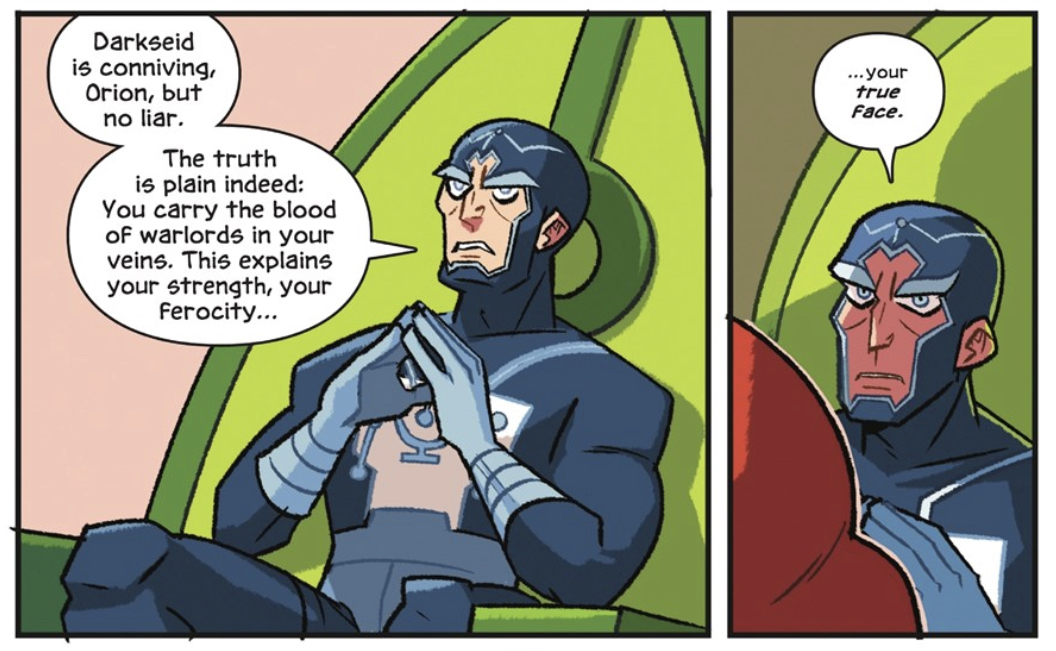
This is only apt, since, as I’ve written elsewhere, emotions, not explosions, were the map that Kirby himself followed; his drama hinged on Scott Free’s personal history as a child soldier born on idyllic New Genesis but raised on hellish Apokolips, Orion’s divided psyche as a beloved champion born on Apokolips but ill-fittingly brought up on New Genesis; cut short, Kirby’s series all ended on emotional climaxes, like Orion coming to terms with the fact that he is the son of Apokolips’ ruler to close out New Gods, and Scott and the Apokolips-born Barda bridging the two peoples through marriage in Mister Miracle’s last issue.
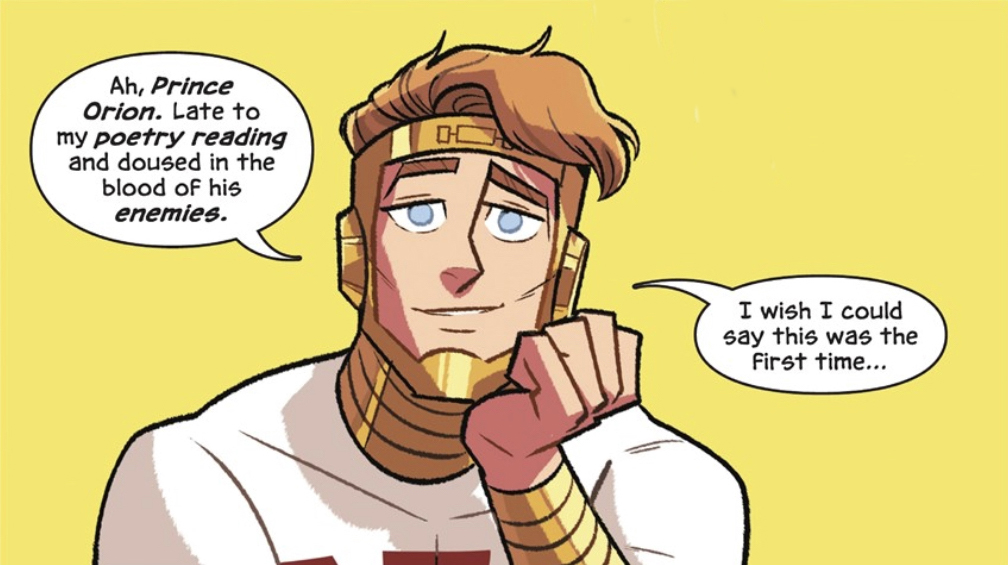
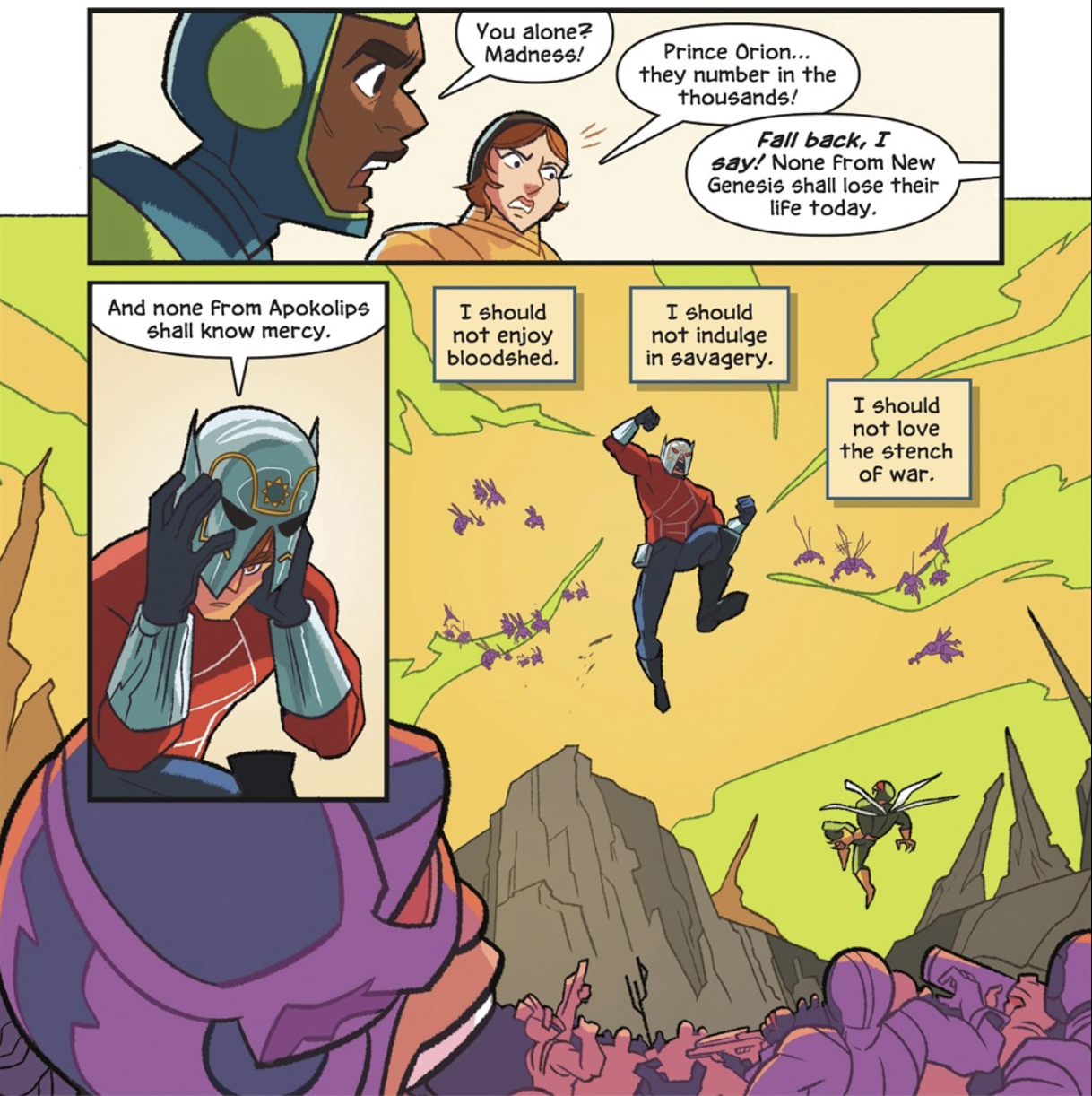
Ukazu has a resume that makes her ostensibly surprising and fundamentally ideal for this material, being first known for the sassy, poignant (and way-pre-Heated Rivalry) hockey-based love-is-love story Check, Please!, and then for the masterwork of crossing racial and class divides and learning to love yourself, Flip, as well as the Fourth World book she did prior to this, Barda, in which the title amazonian Apokolips warrior gets her story told from her perspective and takes an odyssey into her own unreached feelings. Ukazu’s animated compositions, for the kinetics of the hockey rink in Check, Please!, and the frenetic activity by Flip’s overstressed and overthinking pre-college students, turns out be scalable to the most awesomely choreographed of Kirby-inspired combat chaos in Orion; the insight and economy with which she conveyed the most nuanced emotions in her rom-com characters is employed to invest us in seeing any player in Orion, however fantastic, as a real person.
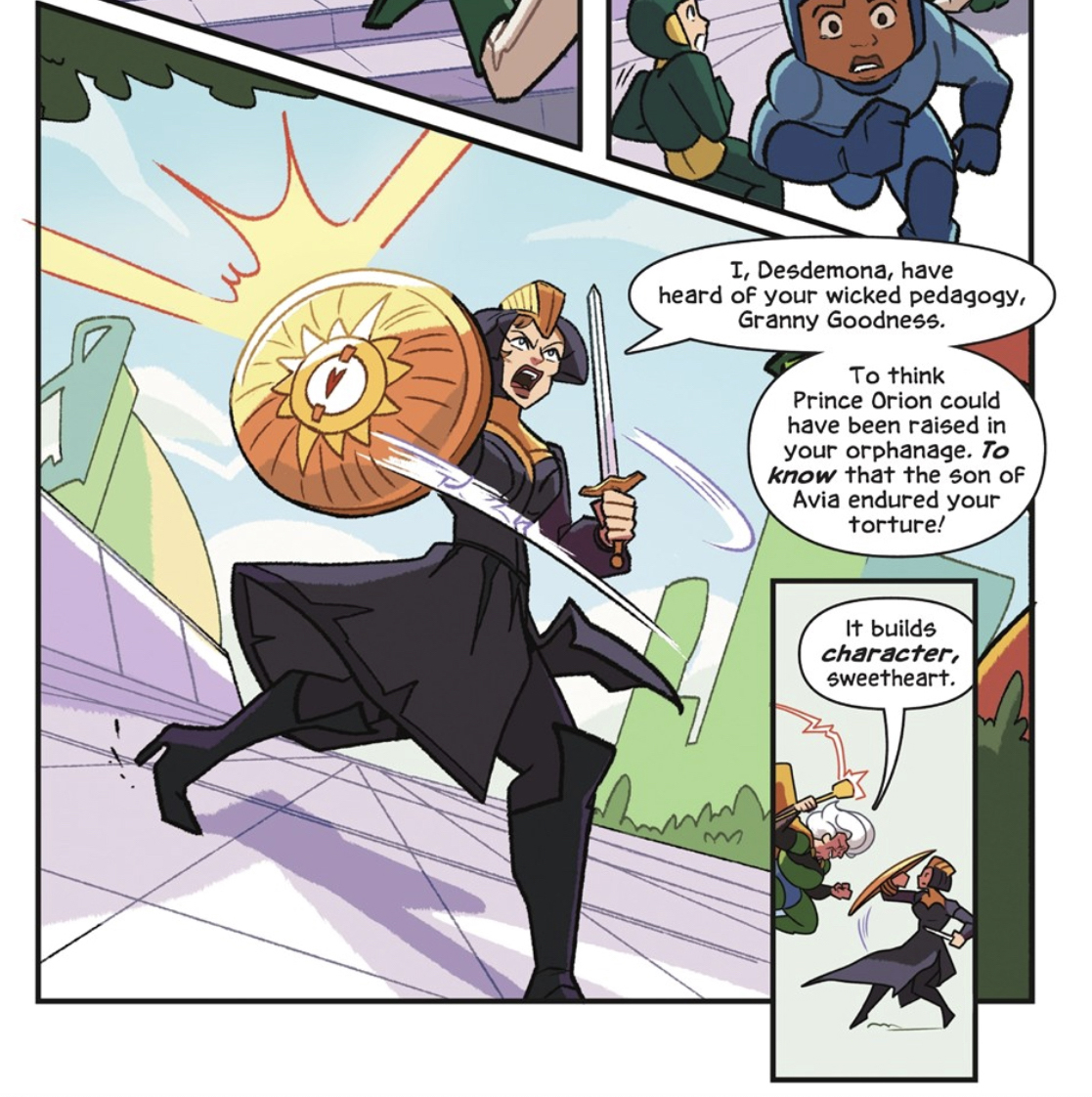
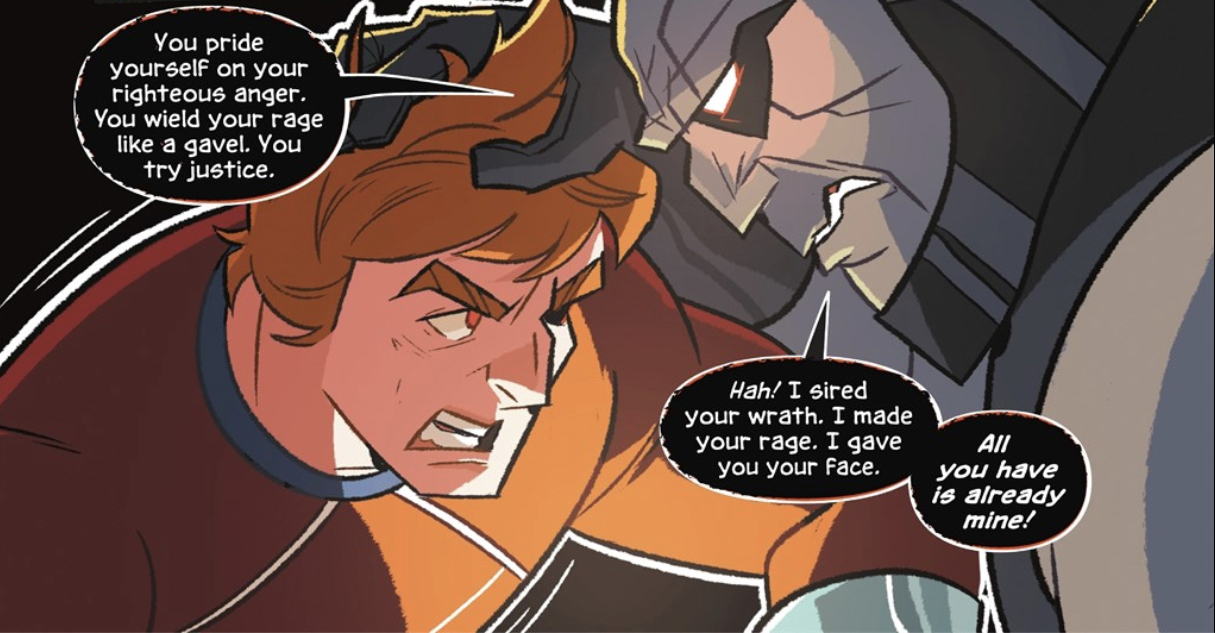
In tune with the original’s graphic and textual brevity, Ukazu compresses and synthesizes events from the whole sweep of the Fourth World saga into a cohesive tapestry, grows new narrative threads from it, deftly integrates some of her predecessors’ canon changes (especially a radical and pivotal one from Walter Simonson’s run), and finds new spaces in moments Kirby himself left abbreviated. The central crisis in the new book is Orion’s realization that he and Scott were switched at birth to ensure a fragile truce between their fathers, the rulers of each other’s opposing realms, and still more troublingly, that this means he is the son (and perhaps heir, in both position and personality) of Darkseid, his most hated foe. Revealed only midway through Kirby’s initial run, this foregrounds an existential trauma that a handful of writers — and all readers — have focused on ever since, and Ukazu gives it dimensions (including the events that led to it and the tolls it took) that we’ve never seen, and which deepen the texture of the tragedy.
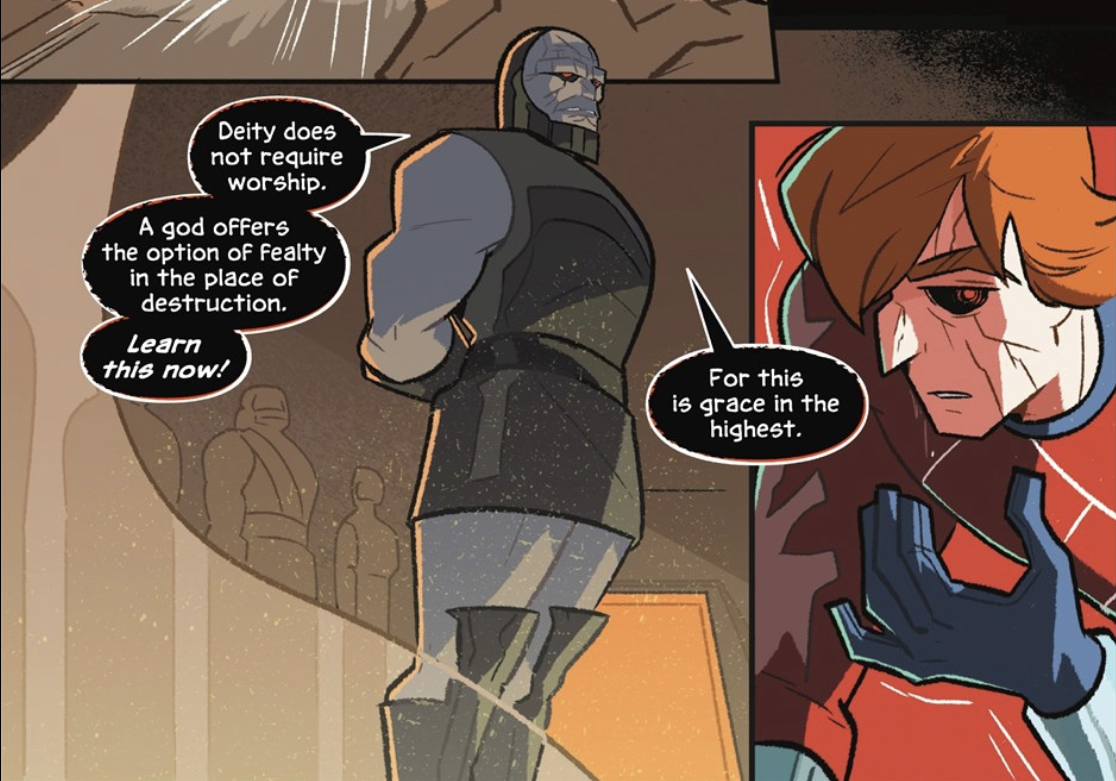
In the course of this discovery’s consequences, she performs the rare feat of weaving in new characters who feel like they’ve been part of the story from the beginning; also revealing some relationships between and among the classic cast and the newcomers which would pleasantly shock Kirby, as they did me; and even revisiting and fleshing out characters we thought had been lost to the past of the established narrative, in inspired and entirely credible ways — I wish I could list some of these for superfans, but they’re too rewarding not to discover for yourself. In this, Ukazu joins a very short and honored list of creators (the others being Simonson, Grant Morrison, Gail Simone, Steve Orlando, and Ram V) who have found new cast-members who seamlessly yet expansively fit. Kirby himself referred to the panoramic Fourth World storyline as a “tapestry” he could reach into for present, past and future elements of (not always released in sequence, and many left unseen); some who take on this canon just mine the existing catalogue, the part of the submerged mountain visible above the sea, but Ukazu gives the impression of having access to the whole tapestry, sharing its source and sensing its destinies.
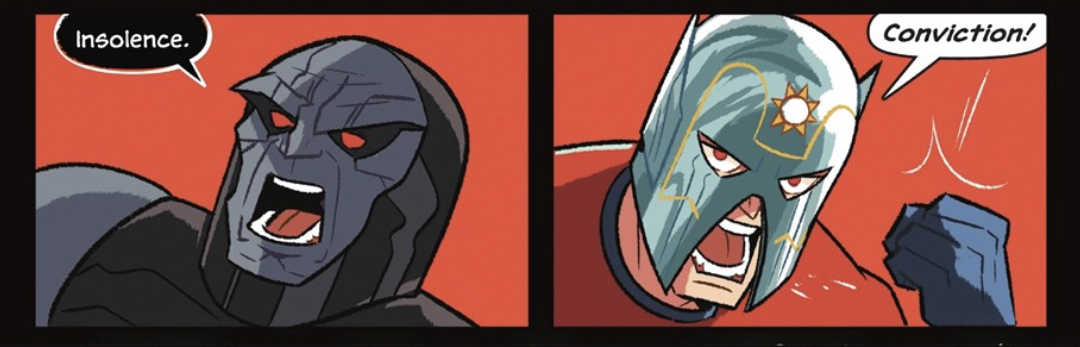
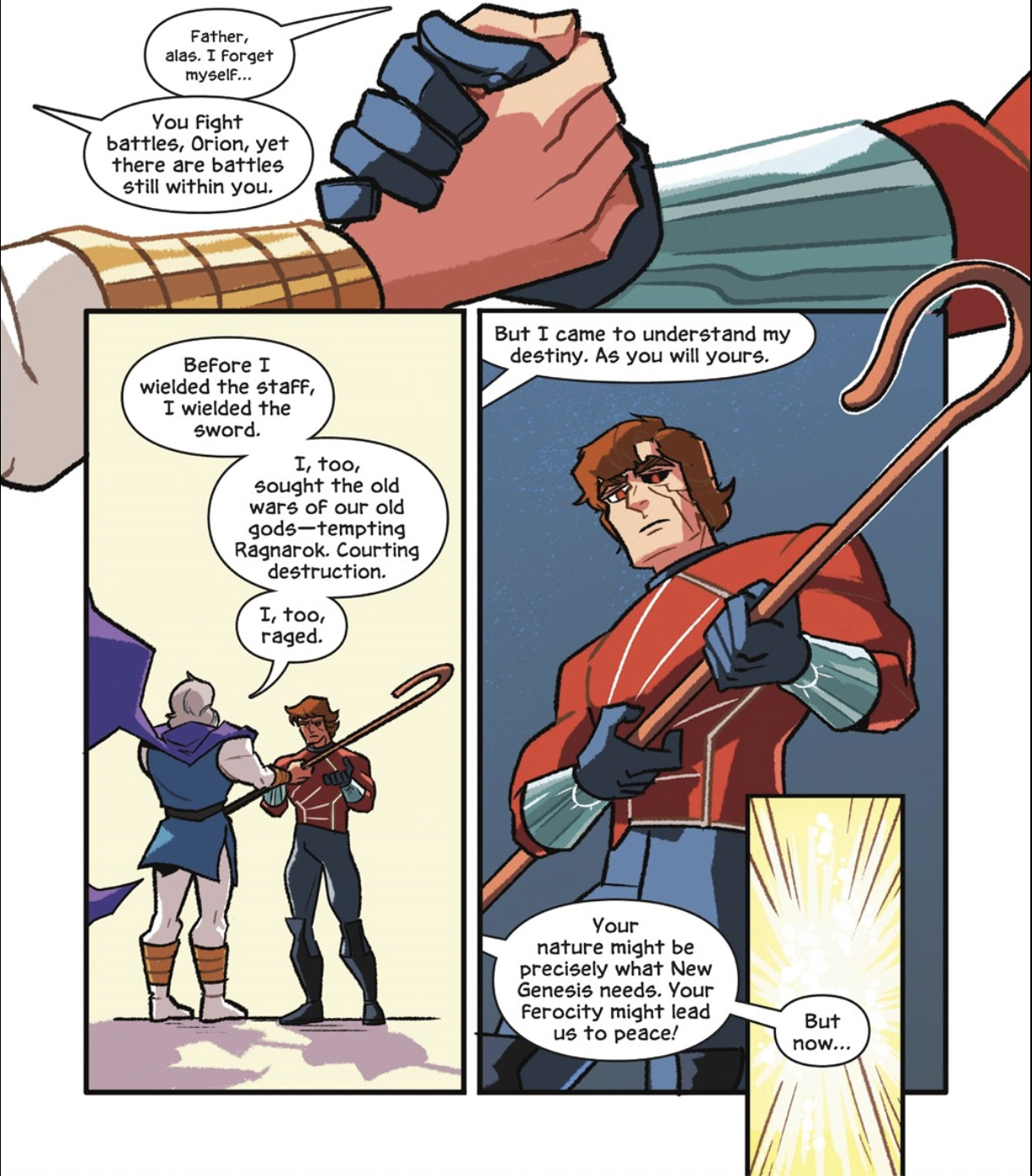
As in Barda, Ukazu deploys lines of dialogue recognizable to followers of the first series, while originating most of the text in the same incantatory hyperbole and scriptural poetry that’s “native” to this story cycle. It almost feels like the old comics were a historical novel about these events and personalities and Ukazu is now excavating the way they “really” happened; we all know how myth accumulates around our real-life national heroes, and there’s no reason that wouldn’t be the natural course for figures who were myth to begin with. A number of threads Kirby spun out and may have resolved later are elegantly knitted home in this book, from the true nature of Orion’s “astro-force” to the occult genetic origin of Apokolips’ population. It may be no coincidence that a book billed as YA, and thus one of the few adaptations aimed at the original comics’ age-range, is one of the closest to their original flavor of wonder and immediacy (and one of the most promising in its new potential).
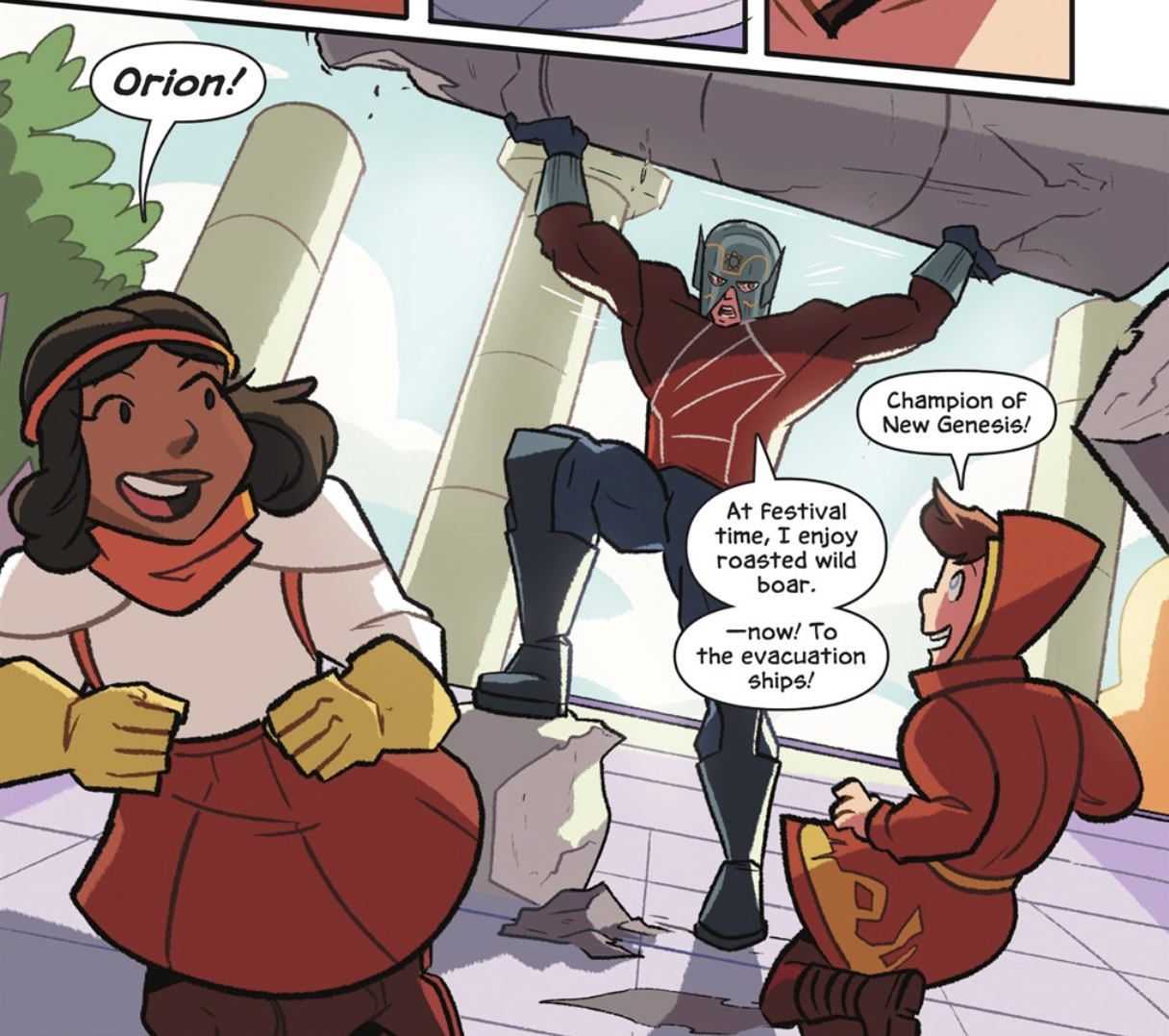
So much is packed in (all fitting perfectly) that the book also feels like the closest thing to the epic climax Kirby would have built to had his initial run on these comics been unbroken. This is especially true with the closure of a certain conflict which, though eventually concluded off-panel and with sudden ambiguity (probably an editorial request), is still the most satisfyingly awesome and high-stakes version we’ve seen yet.
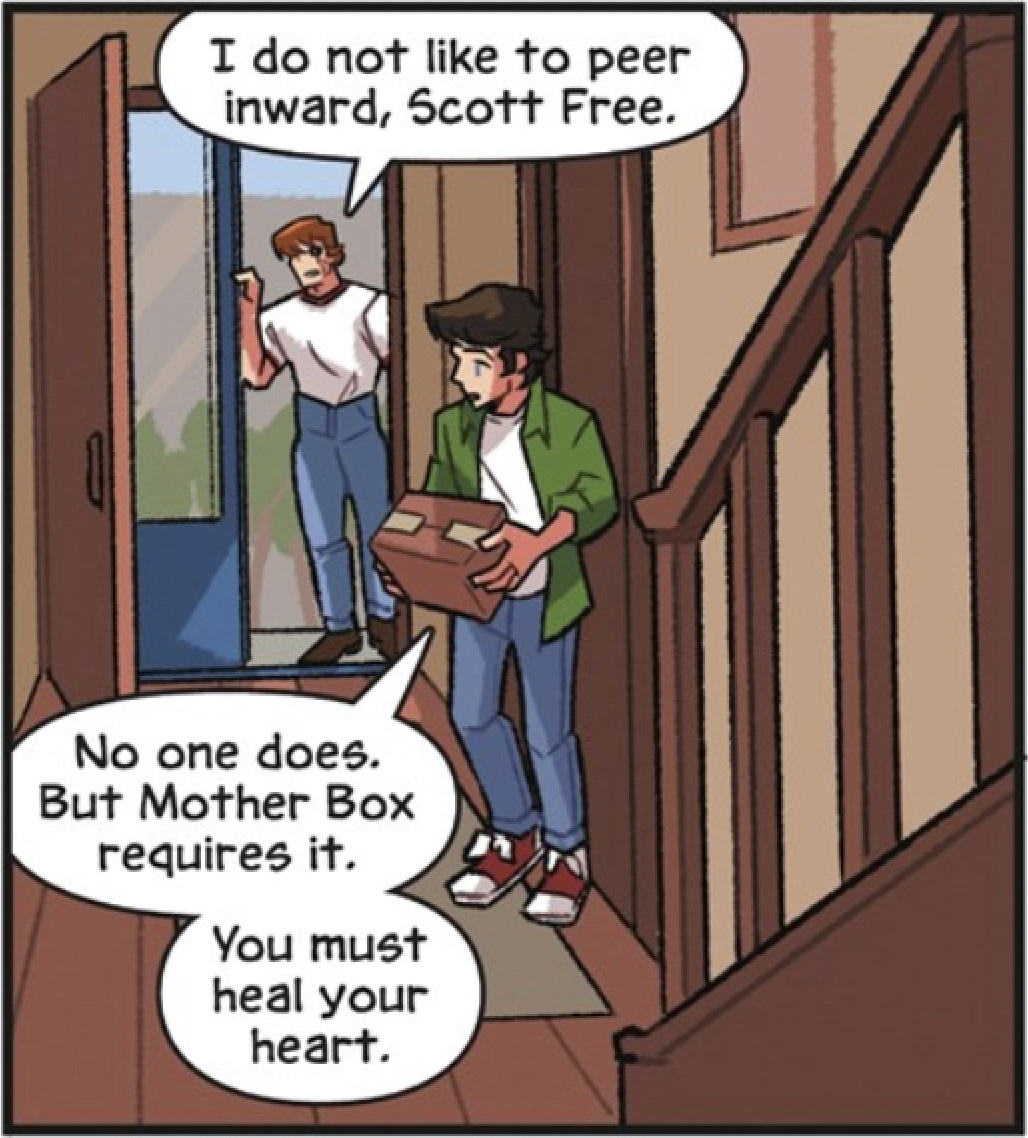
It’s not the only might-have-been that Ukazu brings to life; with its close-focus feeling and panoramic scope, Orion feels like the kind of humane yet momentous movie Ava DuVernay might have made of this material. Unfinished symphonies seem to follow the Fourth World characters around, but Ukazu is composing the next classics.
MORE POSTS by ADAM McGOVERN: OFF-TOPIC (2019–2026 monthly) | textshow (2018 quarterly) | PANEL ZERO (comics-related Q&As, 2018 monthly) | THIS: (2016–2017 weekly) | PEOPLE YOU MEET IN HELL, a 5-part series about characters in McGovern’s and Paolo Leandri’s comic Nightworld | Two IDORU JONES comics by McGovern and Paolo Leandri | BOWIEOLOGY: Celebrating 50 years of Bowie | ODD ABSURDUM: How Felix invented the 21st century self | KOJAK YOUR ENTHUSIASM: FAWLTY TOWERS | KICK YOUR ENTHUSIASM: JACKIE McGEE | NERD YOUR ENTHUSIASM: JOAN SEMMEL | SWERVE YOUR ENTHUSIASM: INTRO and THE LEON SUITES | FIVE-O YOUR ENTHUSIASM: JULIA | FERB YOUR ENTHUSIASM: KIMBA THE WHITE LION | CARBONA YOUR ENTHUSIASM: WASHINGTON BULLETS | KLAATU YOU: SILENT RUNNING | CONVOY YOUR ENTHUSIASM: QUINTET | TUBE YOUR ENTHUSIASM: HIGHWAY PATROL | #SQUADGOALS: KAMANDI’S FAMILY | QUIRK YOUR ENTHUSIASM: LUCKY NUMBER | CROM YOUR ENTHUSIASM: JIREL OF JOIRY | KERN YOUR ENTHUSIASM: Data 70 | HERC YOUR ENTHUSIASM: “Freedom” | KIRK YOUR ENTHUSIASM: Captain Camelot | KIRB YOUR ENTHUSIASM: Full Fathom Five | A 5-part series on Jack Kirby’s Fourth World mythos | Reviews of Annie Nocenti’s comics Katana, Catwoman, Klarion, and Green Arrow | The curated series FANCHILD | To see all of Adam’s posts, including HiLo Hero items on Lilli Carré, Judy Garland, Wally Wood, and others: CLICK HERE