
OFF-TOPIC (74)
By:
April 1, 2026
Off-Topic brings you over-the-transom, on-tangent essays, dialogues and subjective scholarship on an occasional, impulsive basis. For our first full column of a mostly unwritten year, we take the newest measure of a career work in progress…
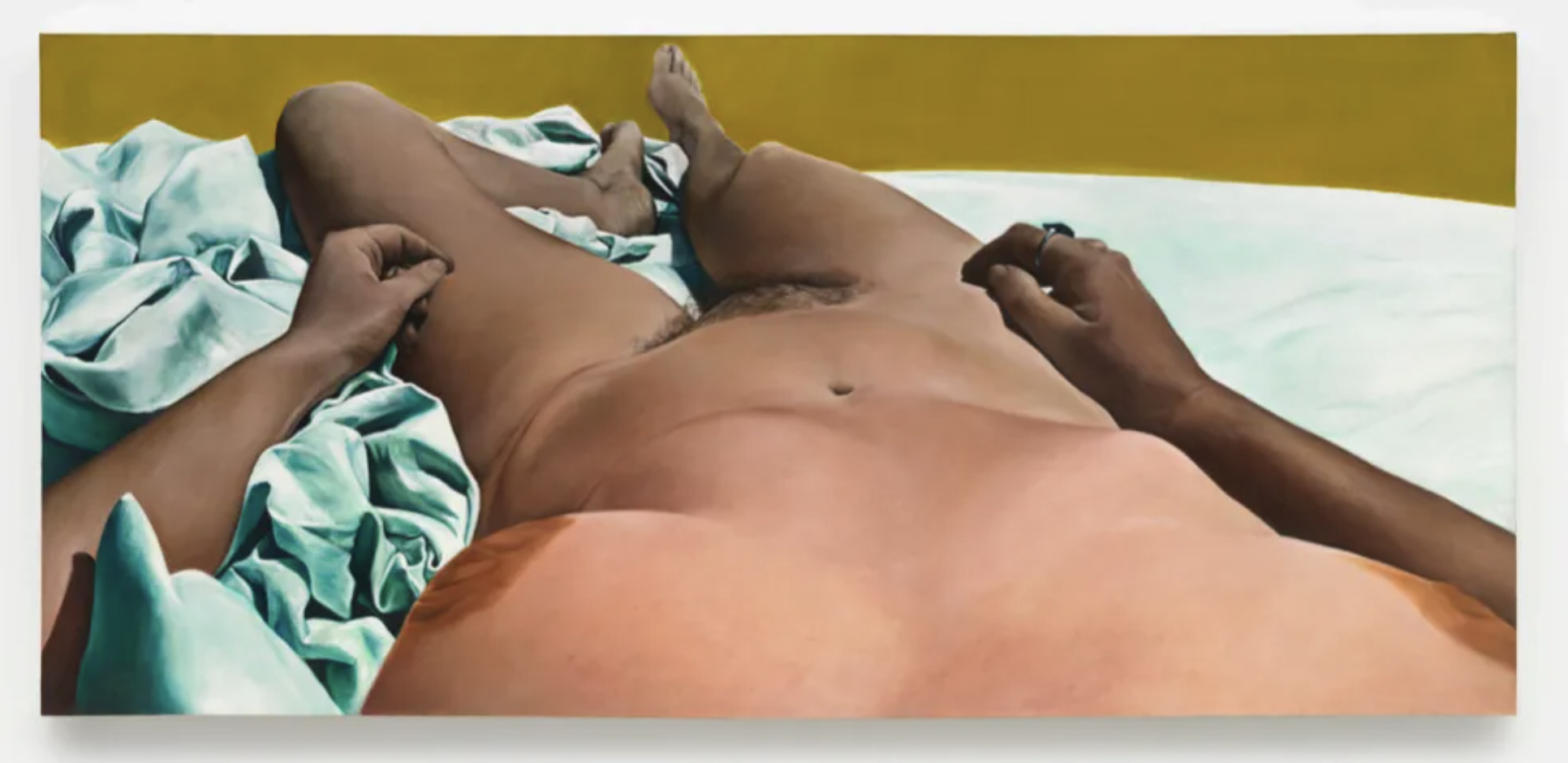
I always learn a lot in a room full of Joan Semmel’s selves. She has, famously, been her own subject for most of five decades, changing places with both the object of male figure-painters throughout the centuries, and with the painters. Her signature method, one of those innovations which turns a corner in cultural history through a simple idea that had eluded everyone before her, was to picture her own nude image as seen through her eyes looking down the length of her body, identity reserved for herself but identification created with all who are seeing the image from within her point of view.
It was as if all those armless and headless female torsos of “classical” tradition were taking things into their own hands and thinking for themselves. This was an outlook only conceivable with the advent of feminism, and a literal perspective perhaps only possible with the aid of the camera; to use photos as reference rather than paint directly from life was another orthodoxy Semmel was breaking, but the aim was not to “capture” a likeness but to liberate an inner individual.
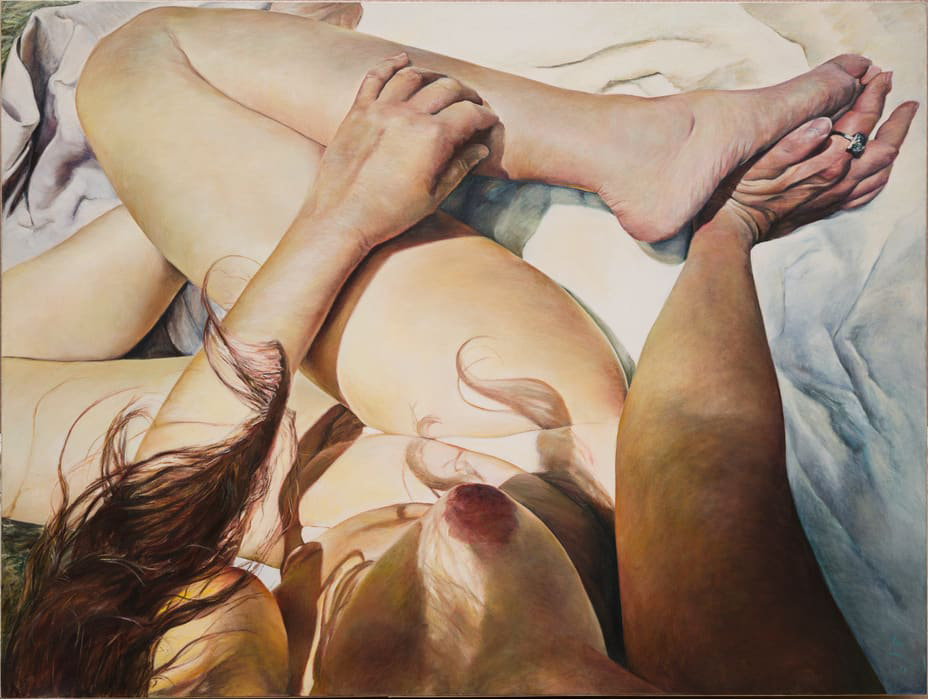
The title of the Jewish Museum’s well-punctuated overview of Semmel’s life studies (and life’s work), In the Flesh, is advised on more than a literal level; many of the selected works are among her best-known and most-reproduced, and of those I don’t think I had seen many in-person (the at-least-double meanings spiral in encounters with this artist’s work); for all its reliance on and reference to mechanical processes, this oeuvre needs to be seen in direct visual contact with the paint.
That “skin” of the canvas, as some painters call it, has a transubstantiative sense here; in a telling wall-quote Semmel remarks on how the physicality of the act of painting carries on an exchange with the tactile quality of the paint itself, and to that point these images not only serve as representations of the organic; viewed in the originals they feel like organisms, Semmel’s color and texture playing across them with a rampant natural prerogative even as she remains superlatively in control of (or attentive to) her overall compositional coherence and concept.
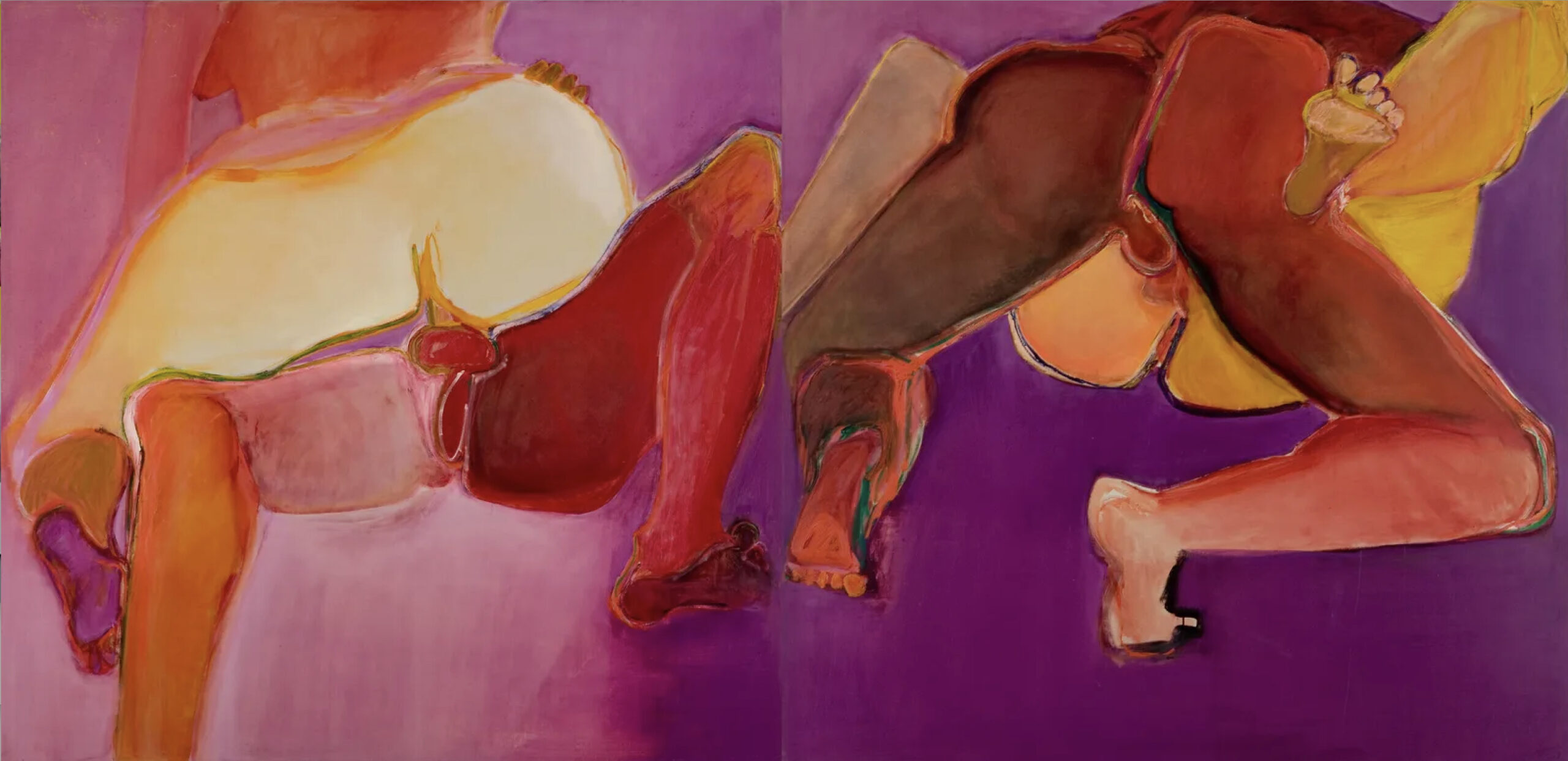
That interplay of sensation and consciousness is of course central to her considered examination of the spontaneous paths of sexuality and the bodily odyssey of aging. Her first transgression in the art establishment was to create large-scale scenes of couples having sex in depictions which, for all the fanciful skin-colors of their subjects and dreamlike neon voids of their settings, were too real for the tastes of the time. As “explicit” as the products of the then-contemporaneous “sexual revolution” were, Semmel was imagining an implicit dynamic, at once both more raw than many typical images and more honest than those marketing sexuality were ready to accept. The figures are not identifiable (the start of an almost lifelong program for Semmel), and your sense is of their shared experience, not isolated exhibition.
With the artist’s whole timeline surveyed in one place, revelations and historical rhymes rise into view. All of Semmels’ “Erotic Series” images are seen from the feet up, whereas her breakthrough “Self-Image Series” subjects were seen from the head down; the body’s testament remains paramount but the interrogation of its impressions and implications by the mind (inseparable but unseen) had begun.
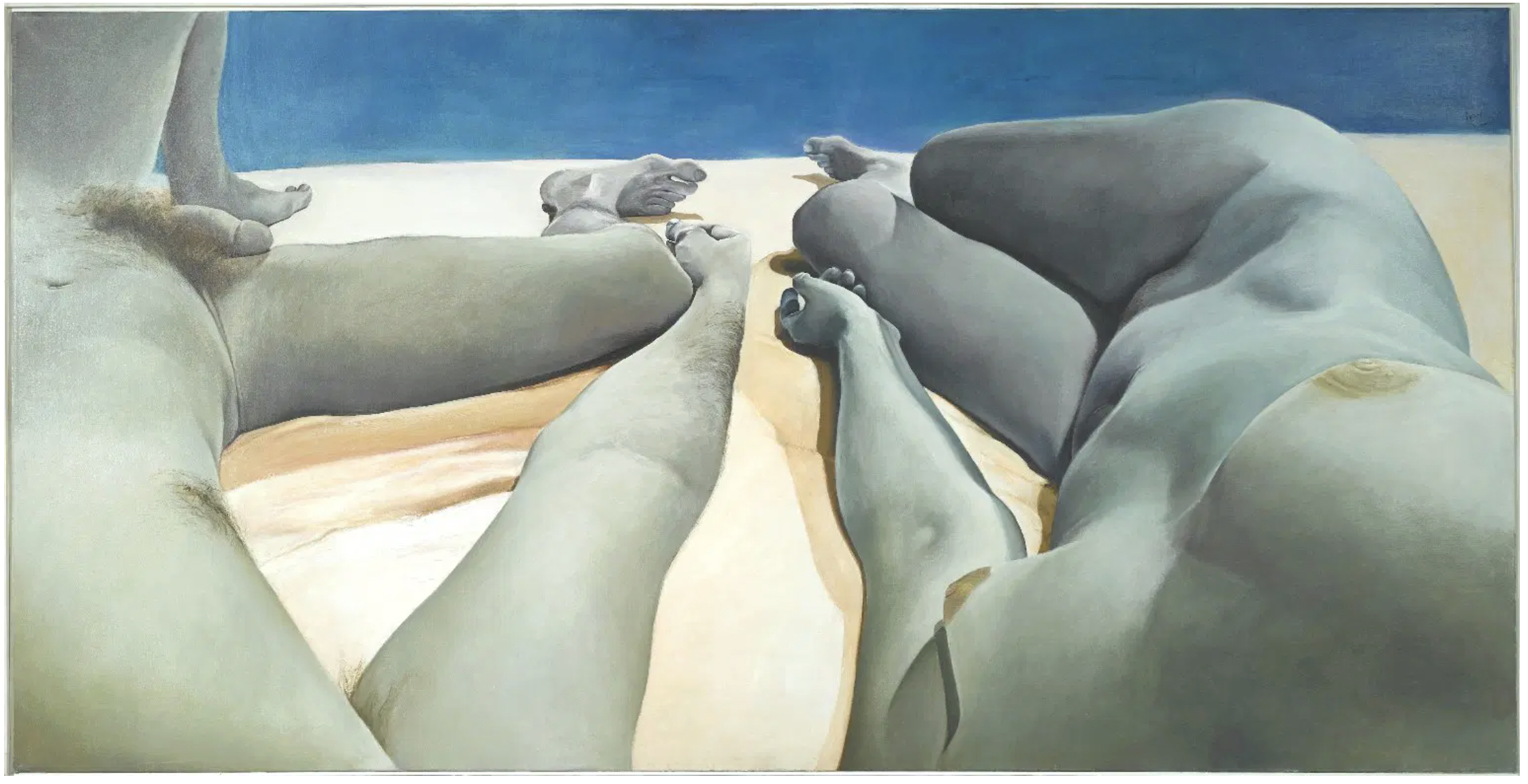
Speaking of seen, among the many available revelations in this selection, only now did it strike me how much the male removes himself from the presence of his gaze — Semmel’s inclusion of male partners in the “Erotic” paintings eliminates a remove that defines the unequal power of pornography, and a glance at the dates on the paintings reminds me that Semmel was directing her self-affirming gaze at not just her body but another male companion’s (Intimacy-Autonomy, 1974) a year before she possessed herself fully in the now equally epochal Through the Object’s Eye from 1975 (an entire manifesto in a title, and — it is most noticeable in-person — prosceniumed with an atmospheric backdrop whose color recalls the gilding of religious icons).
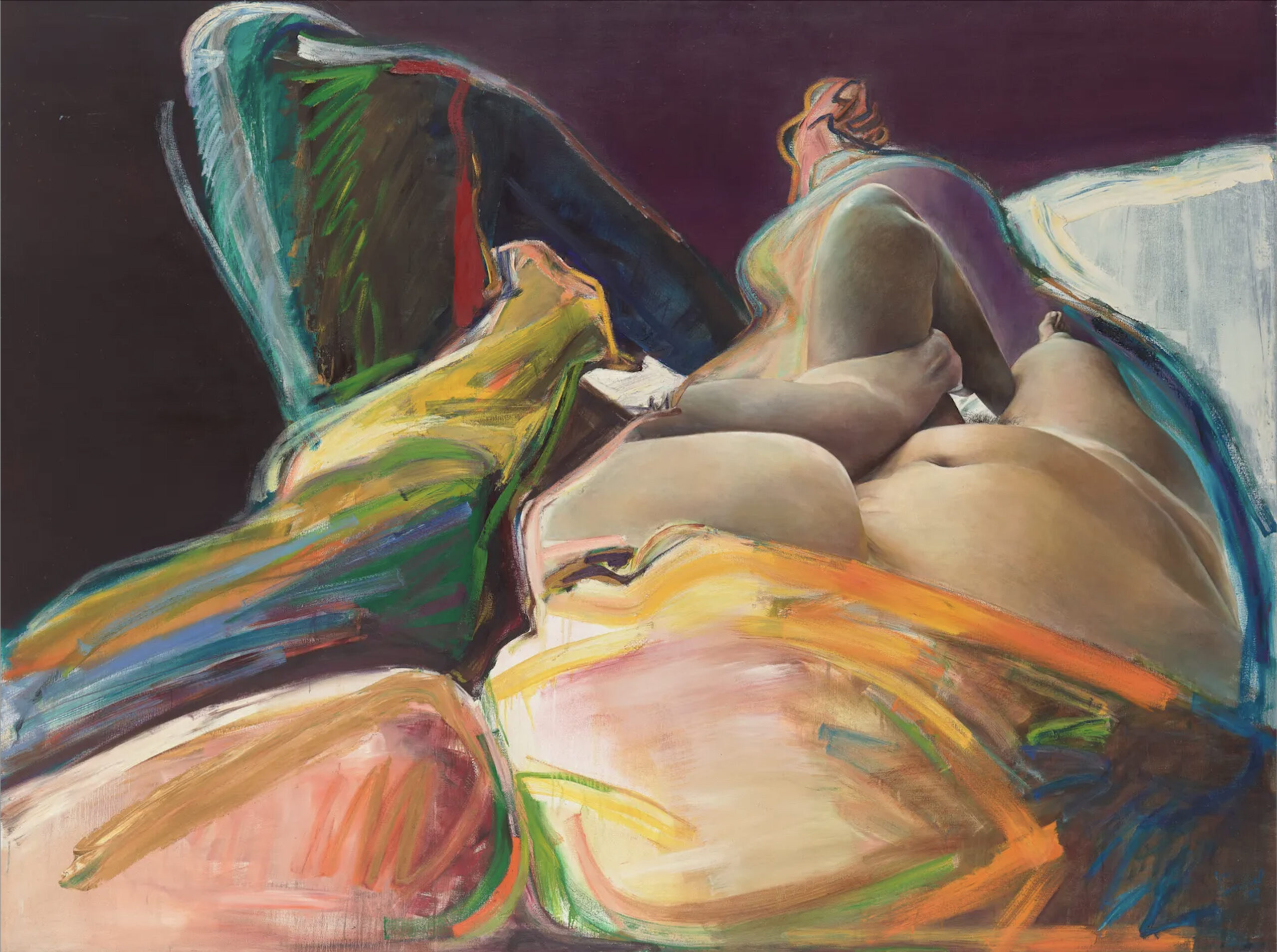
There are other echoes across the ocean of her oeuvre. I’ve likened the heavy impasto outlines and volumes with which she overlays one of her photorealistic body images in Purple Diagonal (1980) to the roughly contemporaneous “neo-expressionist” style taking hold at the time, but Semmel was already anticipating this technique in the contours of Flip-Flop Diptych (1971). A stylistic universe away but characteristically adjacent, the purple color field surrounding Flip-Flop’s figures recurs 48 years later around Semmel’s recumbent form in Skin in the Game (2019).
By the time of that latter work, Semmel’s face has occasionally appeared in her own visual life story, and significantly she only (or most extensively) introduces it when it becomes a record of unfixed humanity just as her body has become a vessel for transformation. A work like the straightforwardly titled Transitions from 2012 (the only straightforward feature of it), tracing the artist’s stroboscopic progression through seconds and years of existence, creates transcendent ambiguities between the beginnings and endings of each form, a metamorphic state in which no definition is set, no physiognomy — and by implication, no identity — is settled.
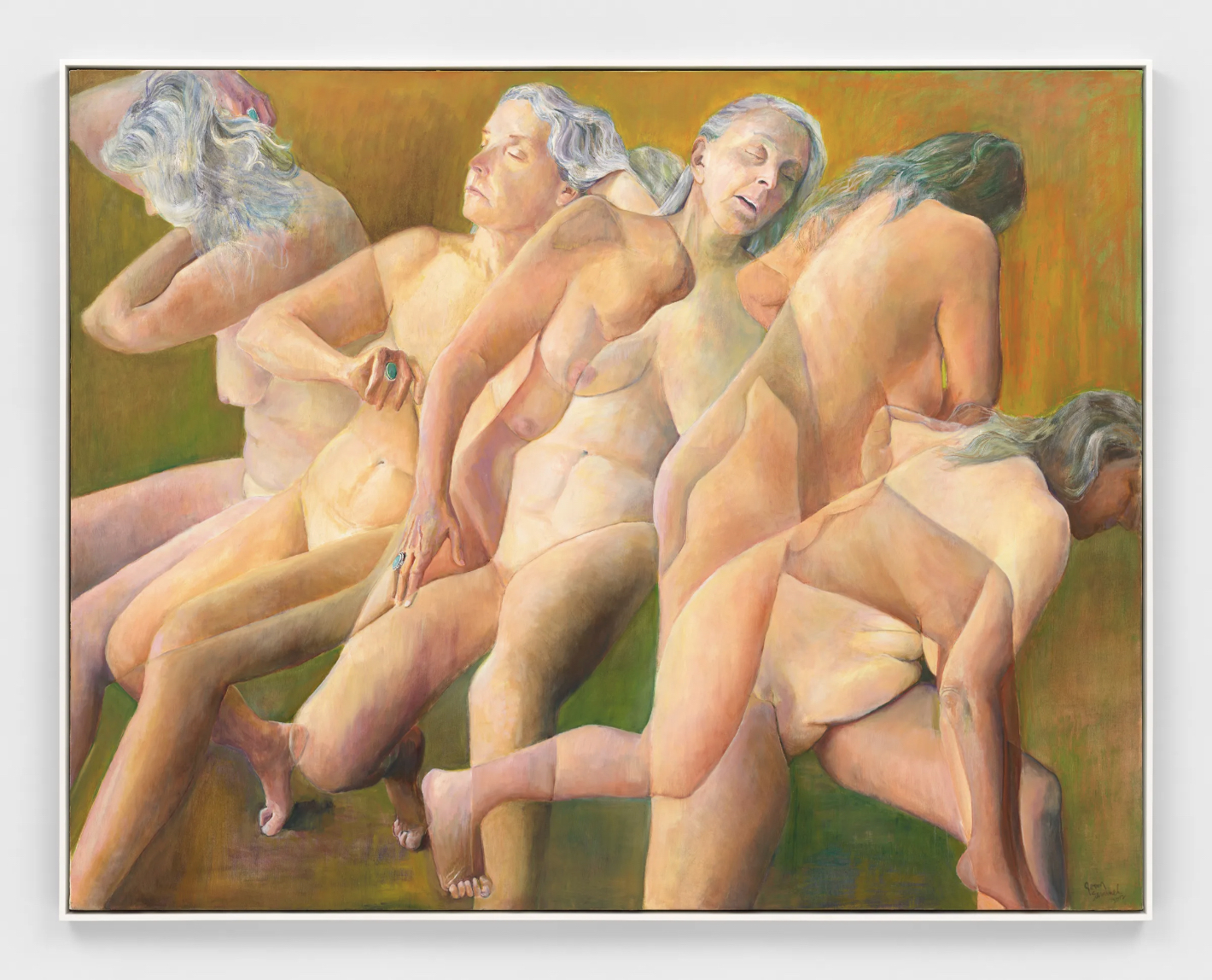
The exhibition, arranged in the round, perpetuates this feeling of immortal motion; it leads you to start the circle from Semmel’s more recent works to her earliest, with sightlines between most of them (at the center is a fascinating nucleus of works from the Museum’s collection that Semmel selected to trace affinities with, departures from and influences both on and from her own oeuvre, which lends a sense not of single orbits travelled but rings expanding from each new pebble dropped into the stream of collective creativity).
Semmel has always had a calligraphic eye for the shapes the body can take, and in that activating view her paintings convey the life around the pose, seen both individually and in the aggregate. Viewed in each other’s company, these single figures for me formed a ballet; Semmel has preserved the motion as much as the moments.
Though her discerning observation makes the incidental iconic, the impression is not one of frozen frames but of flow. The trace of Semmel’s hand has always been prominent in the depictions of her body — even in an image of seeming stillness and photographic clarity like Sunlight (1978) there is within the expanses a sense of the painter’s immediate gesture working across the canvas, like the pulsing of blood and transit of neural electricity beneath our deceptively resting skin.
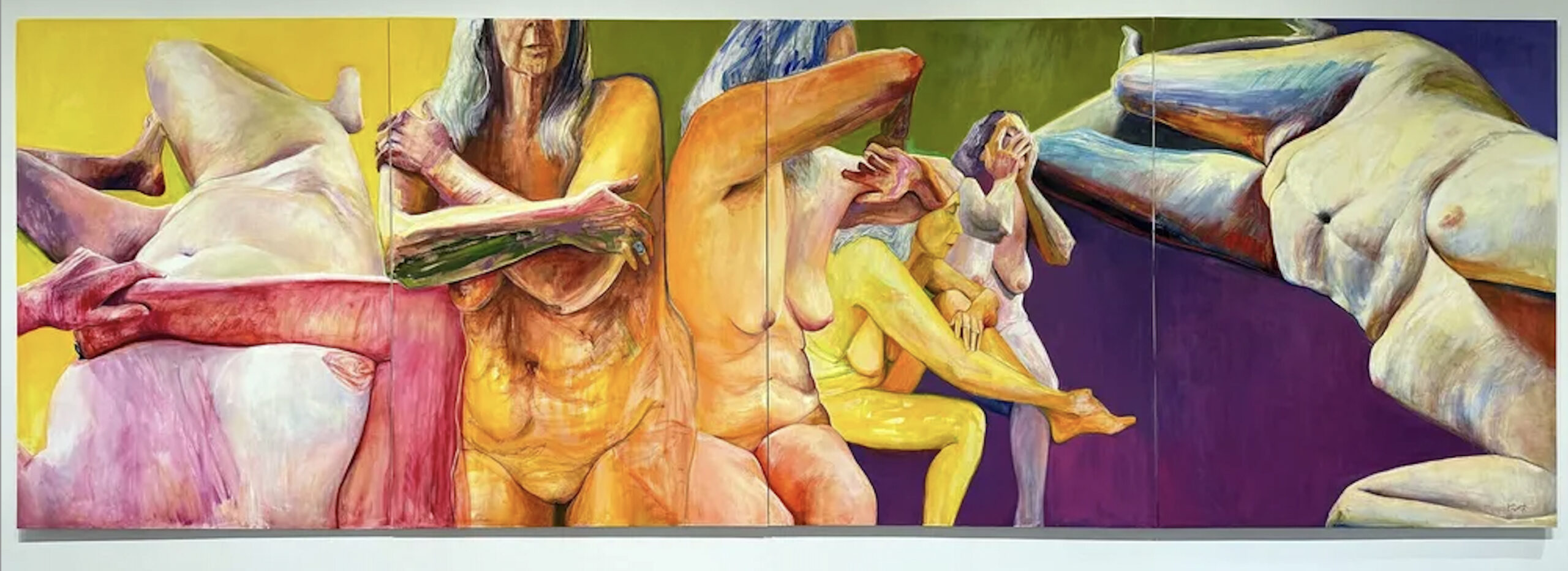
There is a literal transparency, to match her customary honesty, in Semmel’s works now. Once built from flesh-like paint layers, newer works like Skin in the Game, made of overlain washes, almost seem to go beyond material pigment to be constructed of veils of light itself; the elemental essence of what can be perceived. This is not a light we “go into,” it’s one we carry and may have the good fortune to share. The book of Joan remains very much open, an autobiography in human frames, whose text it takes all of us to fill in.
All artwork © 2025 Joan Semmel/Artists Rights Society (ARS), New York
MORE POSTS by ADAM McGOVERN: OFF-TOPIC (2019–2025 monthly) | textshow (2018 quarterly) | PANEL ZERO (comics-related Q&As, 2018 monthly) | THIS: (2016–2017 weekly) | PEOPLE YOU MEET IN HELL, a 5-part series about characters in McGovern’s and Paolo Leandri’s comic Nightworld | Two IDORU JONES comics by McGovern and Paolo Leandri | BOWIEOLOGY: Celebrating 50 years of Bowie | ODD ABSURDUM: How Felix invented the 21st century self | KOJAK YOUR ENTHUSIASM: FAWLTY TOWERS | KICK YOUR ENTHUSIASM: JACKIE McGEE | NERD YOUR ENTHUSIASM: JOAN SEMMEL | SWERVE YOUR ENTHUSIASM: INTRO and THE LEON SUITES | FIVE-O YOUR ENTHUSIASM: JULIA | FERB YOUR ENTHUSIASM: KIMBA THE WHITE LION | CARBONA YOUR ENTHUSIASM: WASHINGTON BULLETS | KLAATU YOU: SILENT RUNNING | CONVOY YOUR ENTHUSIASM: QUINTET | TUBE YOUR ENTHUSIASM: HIGHWAY PATROL | #SQUADGOALS: KAMANDI’S FAMILY | QUIRK YOUR ENTHUSIASM: LUCKY NUMBER | CROM YOUR ENTHUSIASM: JIREL OF JOIRY | KERN YOUR ENTHUSIASM: Data 70 | HERC YOUR ENTHUSIASM: “Freedom” | KIRK YOUR ENTHUSIASM: Captain Camelot | KIRB YOUR ENTHUSIASM: Full Fathom Five | A 5-part series on Jack Kirby’s Fourth World mythos | Reviews of Annie Nocenti’s comics Katana, Catwoman, Klarion, and Green Arrow | The curated series FANCHILD | To see all of Adam’s posts, including HiLo Hero items on Lilli Carré, Judy Garland, Wally Wood, and others: CLICK HERE