
OMAC YOUR ENTHUSIASM (10)
By:
May 6, 2026
One in a series of enthusiastic posts, contributed by 25 HILOBROW friends and regulars, analyzing and celebrating our favorite… Seventies (1974–83) sci-fi novels and comics! Series edited by Josh Glenn.
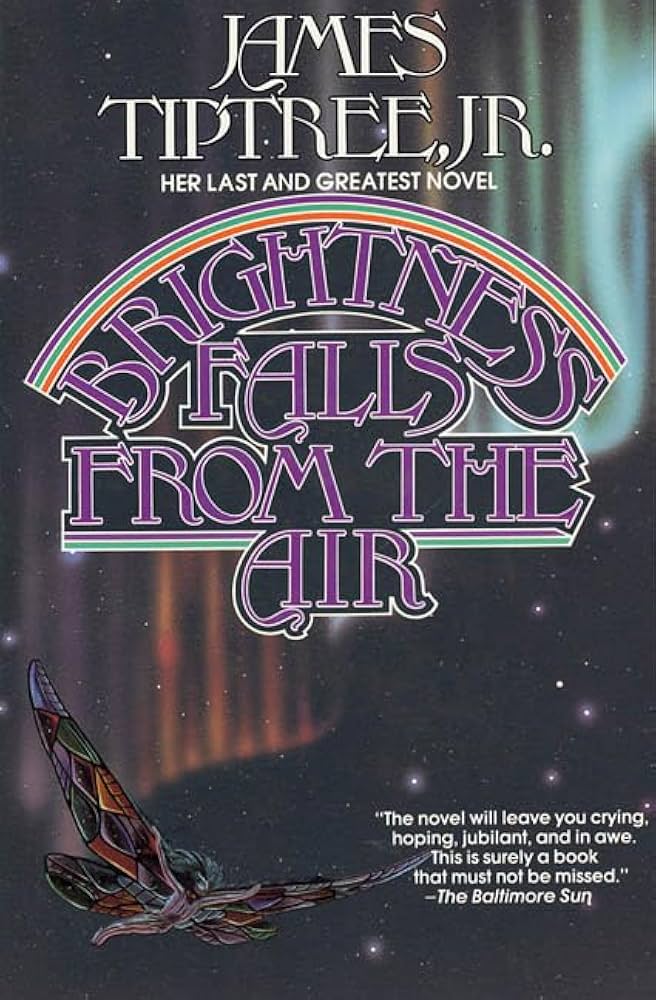
BRIGHTNESS FALLS FROM THE AIR | JAMES TIPTREE JR. | 1985
James Tiptree, Jr. got famous, fast, within the closed world of people who read a lot of science fiction, thanks to short stories from the late 1960s and 1970s. One, “The Girl Who Was Plugged In,” gets plugged today (accurately) as the first cyberpunk. Another, “The Screwfly Solution,” imagines a plague that makes men murder women, not so unlike our world of rape culture and femicide. All — whether published as Tiptree, or as Alice Sheldon’s other pseudonym, Raccoona Sheldon — put her efficient, elegant prose (think Willa Cather in space) at the service of her double vision: uncompromisingly feminist, but suffused by her tragic sense of life.
Tiptree’s characters fight, at once, patriarchy and biology, and accept — sometimes heroically (see “The Only Neat Thing to Do”) — their own sense that they have to die. After her own death, feminist and queer creators named an award “encouraging the exploration & expansion of gender” after her. It’s now the Otherwise Award; you can look up why they renamed it). She’s remembered as brilliant, and literary, and messy, and controversial, and (in life and art) sad.
But she tried hard to be less sad: to entertain. She also loved Star Trek, the original series, and briefly wanted to write for it. Instead, she wrote a novel, her second and last, that’s clearly Tiptree, and finally sad, but also a lot like a Star Trek story, with a whodunit, and a beautiful mystery planet, and space opera elements, and — since it’s Tiptree — a whole theory about the nature and purpose of art.
Almost all of Brightness Falls from the Air takes place on the planet Damiem, where the delicate, winged, peace-loving Dameii live. It’s hard to reach, harder still because till recently interstellar gangs caught and tortured the Dameii to produce a powerful narcotic called Stars’ Tears. Just a few non-Dameii — Kip and Cory, a couple, and Doctor Bram, who has a crush on Cory — live there now, conducting research and keeping the Dameii safe. The spreading corona of a particular nova, “the third shell of the Murdered Star” — a once-in-a-lifetime beauty, the Aurora Borealis times a thousand — will reach Damiem soon. A few space travelers show up to see. Some have permits; some say they got there by accident. They’re a mixed lot: a troupe of teenagers in a galactically popular reality show, with their manager; a disagreeable young scientist, and his ailing supervisor; a lost Aquaman from a water world; an orphaned cabin girl; a princess accompanied by her immobile, severely disabled sister (they share a telepathic link).
Everyone’s got a secret; everyone’s got a source of shame. “Everyone is the crying type,” as Bram explains, “if it hurts bad enough.” In twos and threes, in expeditions and sickbay encounters and flirtations, their secrets come out, a cyclopedia of balked hopes and dented dreams and ways of making do, framed by the beauty of Damiem, and the promise of science fiction generally: we can imagine other ways to live. “The light of Damiem makes all things beautiful beyond their counterparts on other worlds.”
But we still have to handle what’s real. On Tiptree’s planet that means bad intentions — is somebody hiding a plot to smuggle Stars’ Tears? It means mortality, and disease. It means sexual desire that won’t go away and can’t find appropriate objects. It means “the shame, the Human crime” of domination and empire. And, eventually, it means double-crossing, and disguises revealed, and murder.
Short story specialists cannot always set up a complex plot and stick the landing. But Tiptree does. By the end, we find out what “was reality,” and why it’s so hard to face. Our suspects and would-be detectives get chances at temporary salvation, and glimpses of eternal magnificence, and ways to think about sacrifice, sex, purpose, youth, old age, and “the core of the great work of art itself.” To say much more would be giving too much away. It’s an adventure upholding the best Trek values, a tale in the aftermath of a just war (Sheldon helped beat the Nazis), and a tragedy with action sequences. It’s also a way to think about why we need art, and fiction, and fictional otherworlds. With or without them, we die. But in them, we get a chance to experience beauty, and to support one another, before it’s all over for good.
OMAC YOUR ENTHUSIASM: INTRODUCTION by Josh Glenn | Mark Kingwell on RIDDLEY WALKER | Carlo Rotella on THE FACE | Sara Ryan on DREAMSNAKE | Matthew Battles on THE WORD FOR WORLD IS FOREST | Ramona Lyons on HIGH-RISE | Adam McGovern on SHADRACH IN THE FURNACE | Deb Chachra on THE HITCHHIKER’S GUIDE TO THE GALAXY | Tom Nealon on DHALGREN | Michael Grasso on FLOW MY TEARS, THE POLICEMAN SAID | Stephanie Burt on BRIGHTNESS FALLS FROM THE AIR | Nikhil Singh on SABRE | Gordon Dahlquist on VALIS | Miranda Mellis on THE DISPOSSESSED | Marc Weidenbaum on SOFTWARE | Peggy Nelson on THE TRANSMIGRATION OF TIMOTHY ARCHER | Josh Glenn on ENGINE SUMMER | Mimi Lipson on A SCANNER DARKLY | Douglas Wolk on THRILLER | David Hirmes on ARZACH | Anthony Miller on THE SHOCKWAVE RIDER | Annie Nocenti on JIMBO | Seth on MR. MACHINE | Alex Brook Lynn on JUDGE DREDD | Joe Alterio on THE INCAL | Jason Grote on JOSIE AND THE ELEVATOR.
JACK KIRBY PANELS | CAPTAIN KIRK SCENES | OLD-SCHOOL HIP HOP | TYPEFACES | NEW WAVE | SQUADS | PUNK | NEO-NOIR MOVIES | COMICS | SCI-FI MOVIES | SIDEKICKS | CARTOONS | TV DEATHS | COUNTRY | PROTO-PUNK | METAL | & more enthusiasms!