
CAHUN YOUR ENTHUSIASM (14)
By:
February 18, 2026
One in a series of enthusiastic posts, contributed by 25 HILOBROW friends and regulars, analyzing and celebrating our favorite… anti-fascist art! Series edited by Josh Glenn.
CAMOUFLAGE
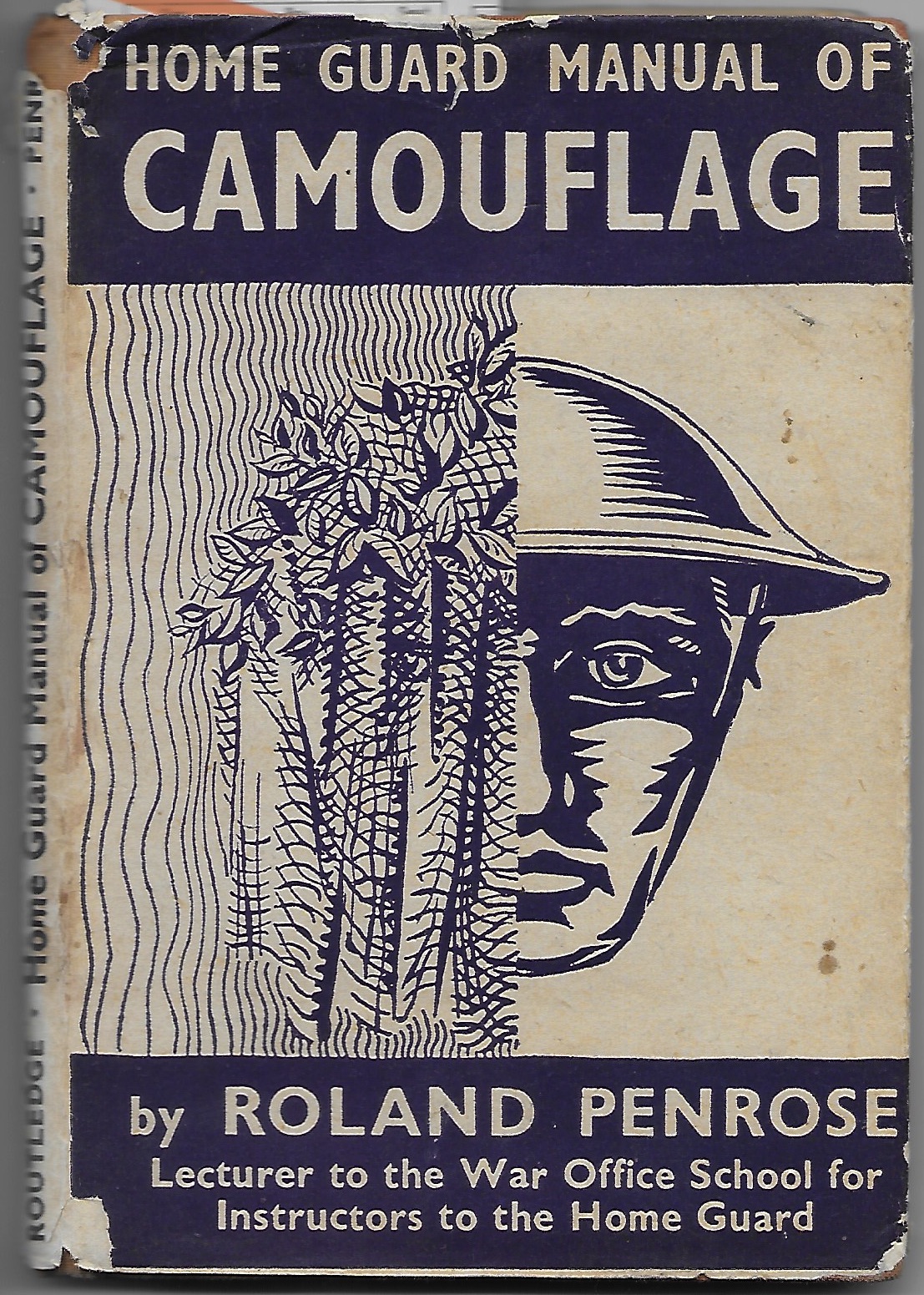
Camouflage, the art of concealment through materials, coloration, or illumination, has been observed in nature at least since Aristotle, but it wasn’t until the mid-nineteenth century that the subject fully engaged scientists. Practical applications were limited at first, the military generally restricting itself to issuing green or olive drab uniforms. During the First World War, Lucien-Victor Guirand de Scévola led a unit that constructed observation posts disguised as trees, but the top brass were skeptical and the technique was not widely applied. Incidentally, the noun comes from the French argot verb camoufler, which means “to disguise something.”
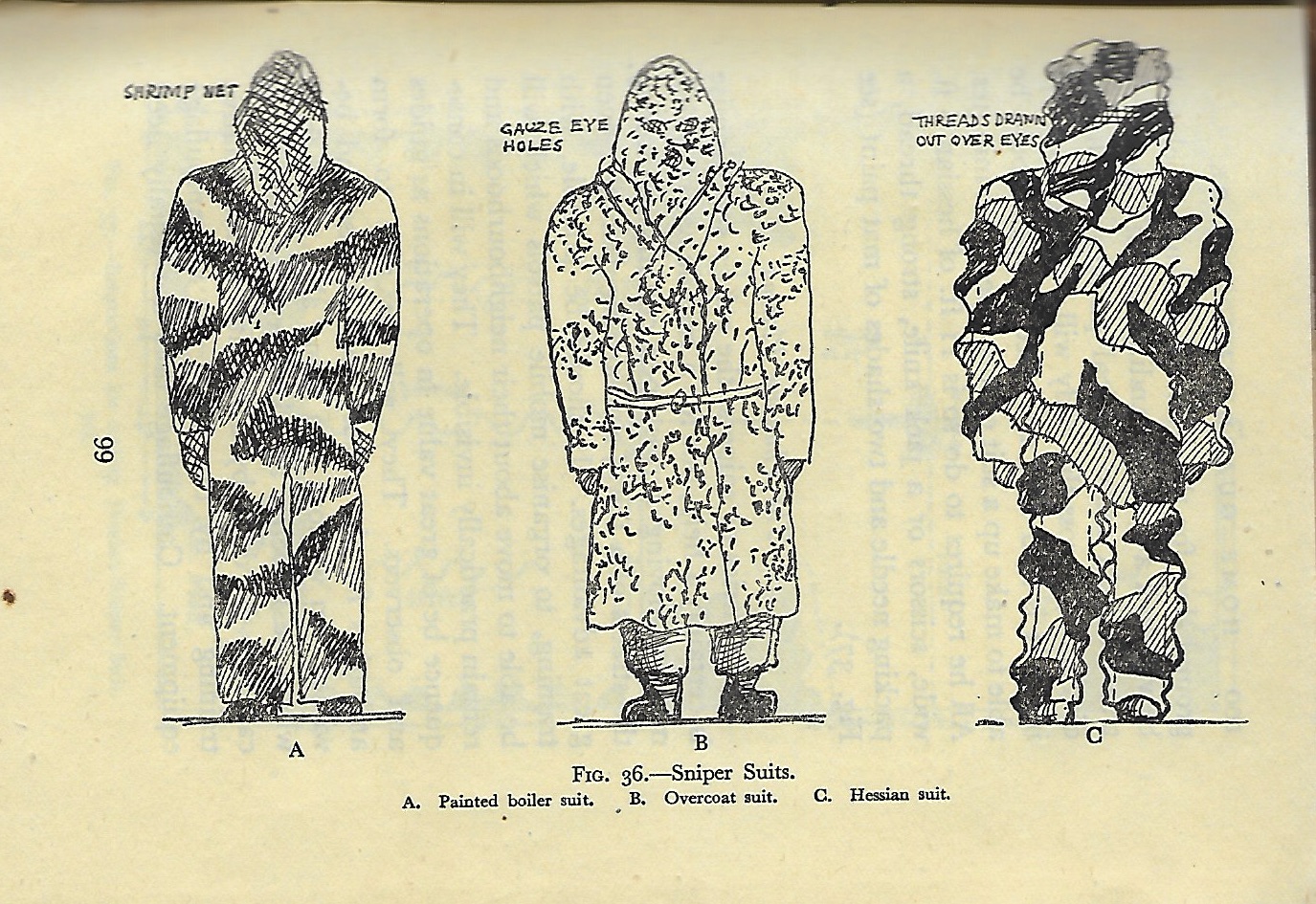
Things were quite different after the German declaration of war in 1940. Camouflage was adopted by all the armies at one point or another, the efforts generally being led by mobilized artists. One such was Roland Penrose, a British Surrealist painter and art dealer and the husband of the photographer Lee Miller. By the time the Home Guard Manual of Camouflage came out in October 1941, he had become a lecturer at a sort of military teachers’ college. His slim 100-page book is impressive in its range and elegant in its concision. With its patient pedagogical tone and rapid pen-and-ink illustrations, it bears a certain resemblance to René Magritte’s philosophical texts, which is probably more than a coincidence.
Penrose is in a rare position, writing a manual of aesthetics with direct material-world effect. He declares that his approach to camouflage will not be passive — yes, concealment is necessary, but even more so is deception. “To bewilder the enemy and mislead him continually” is the mission, and it requires “ingenuity, imagination and daring.” The open-ground theory of battle, the standard for centuries, was conclusively discredited by the Great War; the model is now guerrilla warfare. Penrose explains the concealment of shadows, tracks, vehicles, trenches, and weapon pits as well as of faces, weapons, and uniforms, and he also devotes a chapter to dummies: dummy positions, dummy guns, human dummies.
Natural materials are always a first resort, but have their pitfalls: withering, blowing away. Penrose recommends rubbish: “In places that have been bombed there is usually an abundance of rubble, in fact the more destruction the enemy managed to inflict the more material of this sort we shall acquire.” He also likes nets, which can be laid over anything and interwoven with many other textiles and plants. During his lectures he would show his startled students a slide of Lee Miller lying nude on a beach, concealed by a net. “If camouflage can hide Lee’s charms, it can hide anything,” he would observe.
Penrose’s camouflage was literally antifascist, put into service against the Axis. It also represented an attitude regarding conflict that was directly opposed to fascist instincts. Camouflage required individual initiative, imagination, an eye for colors and patterns, a feeling for nature, an inclination toward mischief, and even a sense of humor. Camouflage went along with guerrilla warfare, the populist military stratagem developed in the nineteenth century by anticolonial fighters such as Abd el-Krim and anarchists like Auguste Blanqui, predicated on the struggle of the small and ill-armed against the mighty. Camouflage furthermore implied a way of living under fascist rule, by removing oneself from sight.
CAHUN YOUR ENTHUSIASM: INTRODUCTION by Josh Glenn | Mark Kingwell on ONCE UPON A HONEYMOON | Lynn Peril on ZAZOUS | Judith Zissman on DIE GEDANKEN SIND FREI | Annie Nocenti on MEDIUM COOL | Mike Watt on FASCIST | William Nericcio on LALO ALCARAZ | Josh Glenn on THE LADY VANISHES | Carlo Rotella on INQUIETUD | Heather Quinlan on CASABLANCA | Adam McGovern on HEART OF GLASS (MAD JENNY) | Matthew Battles on WOODY’S GUITAR | Carl Wilson on PALACES OF GOLD | Ramona Lyons on UPRIGHT WOMEN WANTED | Lucy Sante on CAMOUFLAGE | Adelina Vaca on THE LIVES OF OTHERS | Tom Nealon on THE BARON IN THE TREES | Nikhil Singh on PARIS PEASANT | Mandy Keifetz on THE REVOLUTION WILL NOT BE TELEVISED | Gordon Dahlquist on THE CONFORMIST | Michael Grasso on PYNCHONIAN RESISTANCE | Gabriela Pedranti on THE ETERNAUT | Heather Kapplow on ANTI-FASCIST PASTA | Marc Weidenbaum on (WHAT’S SO FUNNY ’BOUT) PEACE, LOVE, AND UNDERSTANDING | Peggy Nelson on PUPPETS | Sonia Marques on CARNATIONS AGITPROP.
JACK KIRBY PANELS | CAPTAIN KIRK SCENES | OLD-SCHOOL HIP HOP | TYPEFACES | NEW WAVE | SQUADS | PUNK | NEO-NOIR MOVIES | COMICS | SCI-FI MOVIES | SIDEKICKS | CARTOONS | TV DEATHS | COUNTRY | PROTO-PUNK | METAL | & more enthusiasms!