
PLANET OF PERIL (53)
By:
November 2, 2026
One in a series of posts, about forgotten fads and figures, by historian and HILOBROW friend Lynn Peril.
CAREER NOVELS FOR BOYS
I discovered teen career novels for girls the same way I found out about so much other mid-20th-century pop culture —a t a thrift store in the ’90s. It wasn’t until I embarked on this miniseries that I fully realized that teen career novels for boys existed. Was this due to some gendered blindspot that caused me to pass up books for boys and men while eagerly grabbing those aimed at girls and women? I don’t think so, considering all those male-oriented etiquette books, sex ed manuals, and dating guides that I own. In a nutshell, I think there are fewer teen career novels for boys on my shelves because there were fewer of them at those thrift stores.
Not that there were that many more career novels for girls waiting for me, either. It’s pure speculation on my part, but I think teen career novels, for boys or girls, are so hard to find because, with a few exceptions, there weren’t that many in print to begin with. Was there ever a large audience for books dedicated to micro-specific careers like Steady As You Go: Jack Powell’s Adventures with the U.S. Coast and Geodetic Survey (1958) or Opera Ballerina (1948)? Teen career novels are also hard to find because the school and public libraries who likely were their biggest purchasers regularly pruned their shelves, discarding titles as they became obsolete. What hip teenager in the 1970s wanted to read about starting a swing band or selling show cards? (Actually, I’m not sure any hip teenagers ever read these books, no matter the era.)
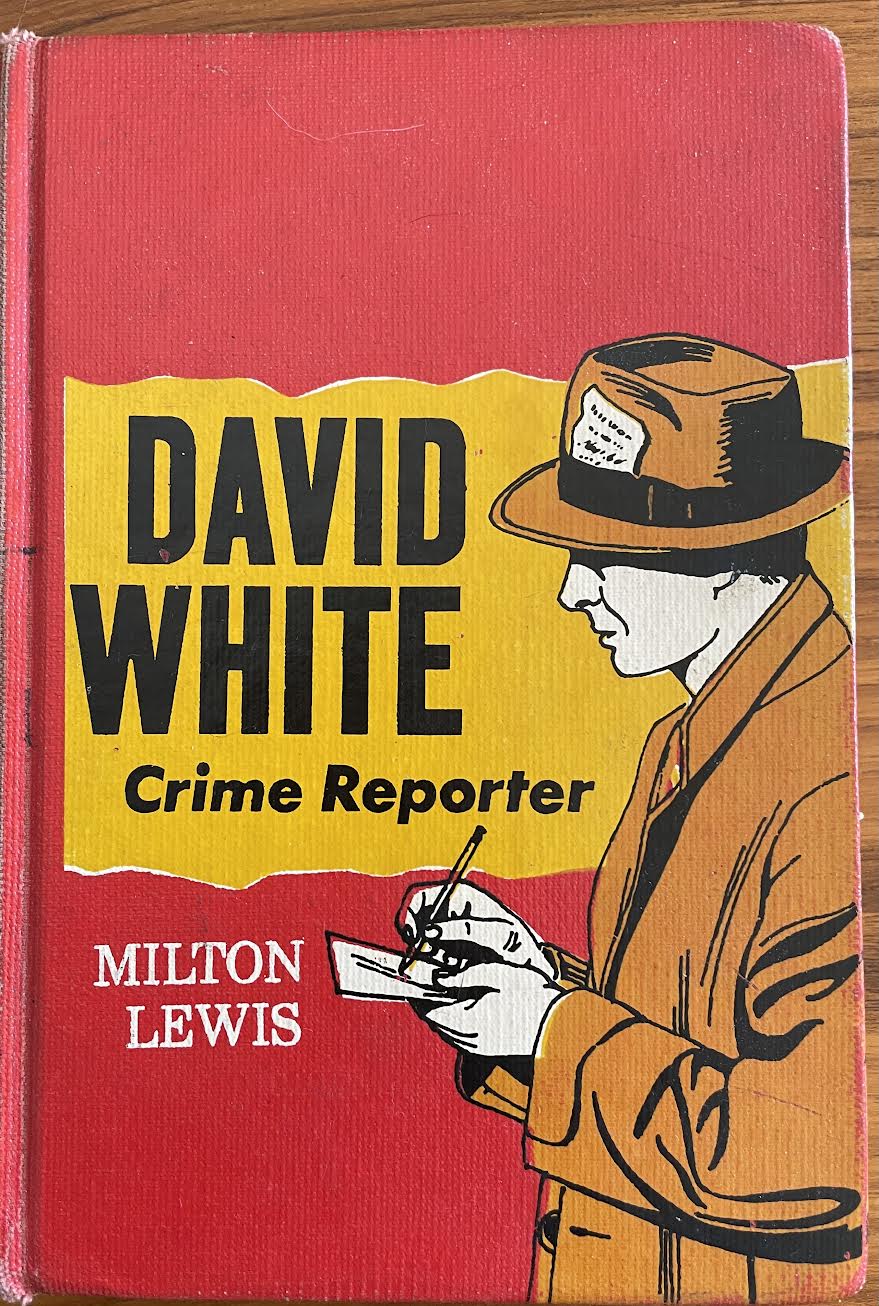
Which brings us to Don Watson Starts His Band (1940), Phil Sterling, Salesman (1951), and David White: Crime Reporter (1958), three teen career novels for boys, all former library books stamped either “DISCARD” or “WITHDRAWN.” Like all good teen career novels, these were written by experts in their fields: Musician and music writer George T. Simon (of the Simon & Schuster publishing dynasty, and Carly Simon’s uncle) wrote about swing music in Don Watson, New York Herald Tribune crime reporter Milton Lewis drew on his resume to pen David White, and Michael Gross invented a character, “Old Zim,” who dispensed nuggets of sales wisdom that I imagine were not unlike those doled out in Gross’s textbook, Money-making Salesmanship (1945).
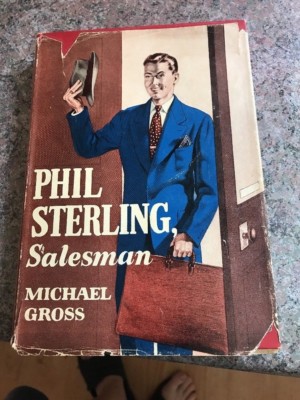
All three books are repositories of antique technology and long-gone job categories, but none more so than Phil Sterling. Phil is from a “cheerful, contented, hard-working, God-fearing” family. He rises from his humble beginning as a machine-shop worker without a high-school diploma to perform the good work of salesmanship.“Please God,” Phil prays before bed at the very beginning of his career, “let me sell forty cards tomorrow, just to prove this afternoon wasn’t just luck.” Amen.
The “cards” to which Phil refers are cardboard signs printed with mottos such as “SATISFACTION GUARANTEED OR YOUR MONEY CHEERFULLY REFUNDED” for merchants to place in their shop windows. Phil discovers he’s good at selling them, then moves on to selling show cards. What are show cards, you ask? When Phil tries to sell his motto cards to a local furniture emporium, the manager says they won’t do. “We use only hand-lettered posters, made up to our specifications, and with our own wording.” These are show cards. “The signs were exquisitely lettered, with ornate borders and initials. Each one was mounted on a heavy, wooden frame, evidently to keep it from warping.” Phil thinks they are “works of art.” They are the creation of Paul Sangster, show-card writer. (By the way, I would totally read a teen career novel about a show-card writer, ideally a woman with a French poodle named Helvetica.)
Then there is the “construction man” who builds 3-D counter displays at Menhold & Kaufman, Color Lithographers, where Phil eventually becomes a successful salesman. Phil watches as the unnamed “artisan” makes “a series of cuts in a sheet of blank cardboard. … After a quick fold or two, he tucked in several tabs and produced a complete display [for perfume], with four steps leading up into the center of it and a circular column at each end.”
There may have been room for these delightful details because teen career novels for boys didn’t have to weld romance stories onto job descriptions the way girls’ books did. On the very first page of The Prettiest Politician (1968), a boy says hi to protagonist Valerie Murman, then waits hopefully for her reply. She ignores him, but it’s clear from the get-go that heterosexual romance is going to play a big role in the coming pages. In Nancy Runs the Bookmobile (1956), Nancy Johnson meets her eventual fiancé, Tad Rivers, on page 51. At the start of of Nurse in Vietnam (1969), flight nurse Lisa Blake is grieving her Green Beret financé, who died in combat. She meets a new love interest on page 31. Sally Merrill of Sally, Army Dietitian (1944) is already married when that book begins and her letters to her husband form part of the text.
Romance didn’t take up undue space in books for boys, but girlfriends and dating do form part of the stories, marriage and fatherhood being markers of successful heterosexual adulthood for men. Granted, with one outstanding exception, these girlfriends are one-dimensional characters making brief appearances. Betty “Stevie” Stevens is the receptionist at Menhold & Kaufman. She exists to support Phil, greeting him every morning at the office “with her warm smile and some little word of encouragement that set the mood for the day.” After a walk to the bus stop, and visits to each other’s homes, they are engaged at the end of the book.
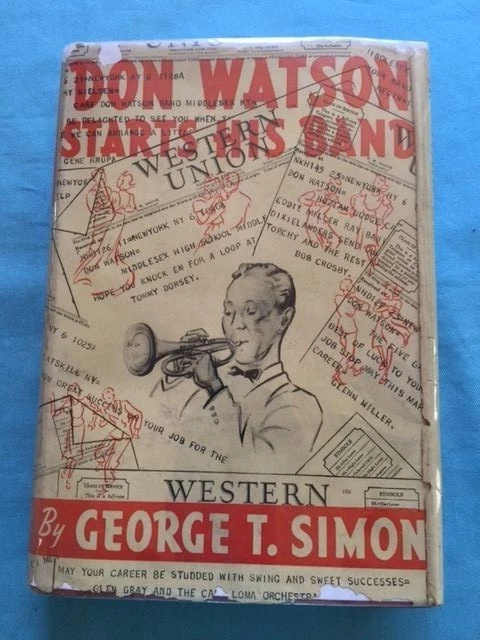
Don Watson Starts His Band is the story of a boy and his trumpet, so it’s not entirely surprising that a girl doesn’t appear until almost two-thirds of the way through that book. Peggy Phillips is a waitress at the Catskills resort where Don’s band has a in summertime residency. Don is attracted by her “reserve” along with “her clear, healthy complexion, her soft light-brown hair, and infectious smile which she seldom bothered to hide.” Even better from Don’s point of view, Peggy has “a natural and sincere understanding of jazz,” something that hadn’t “appeared in the make-up of any other girls he had met.” (Because I read Don Watson and John O’Hara’s Butterfield-8 almost simultaneously, I immediately thought of the character in the latter book who thinks to himself, regarding his requirements for female companionship, “They had to have a feeling for jazz that was as good as you can expect in a girl.”)
Peggy is “crazy” about Coleman Hawkins, and likes Dinah Shore because “she phrased naturally and sang in tune.” She also likes “Henry Wells, the colored singer whom Don was so crazy about, but whom, he thought, nobody else had ever heard of, and her favorite band of all was Duke Ellington’s, a preference which was also Don’s.” She can also sing, well enough to eventually join Don’s band that, it’s implied, goes on to greatness. But the reserve that attracts Don to Peggy in the first place also means she’s shy enough about her own talent that it isn’t threatening to Don.
The titular character in David White, Crime Reporter begins working at the fictional New York Ledger as a copy boy. He’s soon promoted to district reporter or “leg man,” responsible for gathering the facts on “every crime, accident, fire and tragedy” on the east side of Manhattan. It’s up to him to suss out what’s newsworthy and hand that off to a rewrite man. Dave is interested in eventually writing his own stories, so when he learns about what the cops call “full mooners,” the people who wander into the police precinct with wild stories, every night, but especially when the moon is full, he writes it up and submits it to the city editor.
He’s forgotten about it when he gets a message to call Miss Rogers at the Ledger. Suzy the know-it-all switchboard operator fills him in. “That’s Mark Cornish’s secretary, you lucky lad. She’s blonde, blue-eyed and not engaged. Are you dating her now?” Cornish is the Sunday editor and Miss Rogers (“Alice”) tells Dave they are going to run his piece on the full mooners in the Sunday magazine. “That’s a fascinating article, Mr. White—-I enjoyed it tremendously,” she tells him. On the spur of the moment, he asks her out to celebrate his first byline, and she accepts.
So far, this is all very midcentury meet-cute. Deviation from contemporary dating guidelines begins when they meet for lunch at the Ledger’s cafeteria. He’s a bit late and Alice has already gotten her food. “Say — why’d you go and do that?” he says pointing to her tray — per the guidebooks, he should have paid for her food. Alice just laughs, “Oh, don’t be silly. That’s nothing.” When, before this first date is over, he says he is happy to know her, she assesses him with “discerning and quizzical” eyes. He is just lonesome, she says, “and glad to have met a presentable and sympathetic female. I understand it and I won’t take undue advantage of it.”
What transpires from there is unlike anything I’ve read in any other teen career novel, for boys or girls. Alice Rogers is a fully fleshed-out character instead of a stereotype, and thus the reader gets what David sees in her. She is pretty, funny, and spunky, a “no-nonsense type, with a dry and keen humor.” Dave and Alice go to out-of-the-way Italian restaurants in Greenwich Village. They go to foreign movies. Alice even has an entire chapter devoted to her! But because this is a 75-year-old novel for teens, the steamiest it gets is when she plants a kiss on Dave’s cheek—-after they’ve been seeing each other for six months.
In another acknowledgement that women didn’t have to be the submissive helpmeets promoted by the dating guides, Dave spends an afternoon observing policewomen at work. They aren’t glorified secretaries (his initial assumption), but professionals who carry guns and nab pickpockets and perverts in the field. He also learns, as a policewoman with 20 years’ experience tells him, “Equality of the sexes doesn’t exist in the police department!” There is no civil service appointment for them, thus they cannot rise above the rank of “policewoman,” except for an occasional, always temporary, appointment to detective. Men are not held back from full promotions to sergeant, lieutenant, captain, and beyond, with concomitant raises in pay. As David heads back to the Ledger, he realizes he will “have to readjust his thinking” about “the ‘weaker’ sex.”
What to make of the fact, then, that David White also sends out a homophobic dog whistle? One of Dave’s contacts in the detective bureau is working on the “brandy suicide pact” case, in which a middle-aged couple appears to have made a cyanide-laced toast. Their only child is 23-year-old George, “a tall, ascetic-looking youth who was an amateur poet.” The detective finds him suspicious. “Something about that boy that isn’t quite right. Here you have a big, hulking kid of twenty-three, who graduated from college two years ago and has never had a job. He writes poetry! Also, he combs his hair all day long.” This effeminate-coded behavior is, of course, his mother’s fault. “[E]ver since he was a kid, his mother called him a sissy and taunted him because he read books” and complained “that he acted more like a girl than a boy.” His father “didn’t join in” but “was obviously under his wife’s domination,” telling George, “Do what your mother says. She’s right.” No wonder George has killed his parents.
The word “sissy” also appears in Don Watson. Don’s best friend and drummer, redheaded Thomas “Torchy” Nielson is a ruthless proponent of swing, the hip new variety of jazz that Don’s band plays. Torchy uses the latest lingo, calling people who don’t dig swing “ickey” and bands that don’t swing “corney.” Similarly, when another member of Don’s combo makes reference to “a typical sweet band” (one that sticks to the sheet music and doesn’t feature soloists who improvise), Torchy immediately corrects him: “You mean a typical sissy band!” I did a bit of research on Torchy’s slang; “icky” and “corny” (to use their more usual spellings), “sweet band” and “sissy band” were all contemporary terms, though the latter didn’t make Vanity Fair’s 1935 essay on “Hot Jazz Lingo” or similar glossaries from the era, though it does pop up in Billboard. No matter, the implication was clearly that “real men” played swing.
Perhaps because these books were aimed at the white teenage boys who grew up to be the white men who dominated mid-twentieth-century American culture, there are very few characters of color — strike that, there are no non-white characters in these books. Don Watson mentions many black musicians, always with respect and admiration, but there are no black characters. Phil works with “swarthy” Joe Vitelli, who “made a specialty of selling Italian firms, for he spoke the language fluently,” but that’s as ethnic as it gets. David White walks a beat in Manhattan, but seemingly never encounters anyone who isn’t white.
What they lack in racial diversity, Don Watson and Phil Sterling make up with characters who are immigrants and first-generation Americans. Don Harper is an orphan who lives in an upper flat with his Uncle Arthur and Aunt Betty. Their downstairs neighbors are Mr. and Mrs. Gold, a friendly older couple who let Don use their phone. They speak with what seem to be Yiddish accents, and make cutesy mistakes with their English (“jitter-beetle” for “jitterbug”). They are Jewish, as are many characters in the book, and introduce Don to their friend who owns the Haztom Lodge in the Catskills. Don’s best friend and drummer, Torchy (so nicknamed for his red hair and hot temper) is a first-generation American, with an Irish father. Phil Sterling’s mentor and friend, show-card writer Paul Sangster, is an immigrant who received his training in Germany and Austria, before opening his own shop in Vienna. “But Germany had other plans, namely that the day was about to dawn when Germany would rule the world.” He loses “his business, his savings, and his home.” He and his wife make their way to New York, his “portfolio of samples, one of the few things he had managed to salvage” under his arm, and becomes “an American citizen at the earliest opportunity.”
Interested readers can find Phil Sterling, Salesman, and David White, Crime Reporter online. Alas, Don Watson Starts His Band hasn’t been digitized, though inexpensive copies do show up for sale from time to time.
MORE LYNN PERIL at HILOBROW: PLANET OF PERIL series | #SQUADGOALS: The Daly Sisters | KLUTE YOUR ENTHUSIASM: BLOW-UP | MUSEUM OF FEMORIBILIA series | HERMENAUTIC TAROT: The Waiting Man | KIRB YOUR ENTHUSIASM: Young Romance | CROM YOUR ENTHUSIASM: Fritz Leiber’s Conjure Wife | HILO HERO ITEMS on: Tura Satana, Paul Simonon, Vivienne Westwood, Lucy Stone, Lydia Lunch, Gloria Steinem, Gene Vincent, among many others.