
PLANET OF PERIL (52)
By:
October 6, 2026
One in a series of posts, about forgotten fads and figures, by historian and HILOBROW friend Lynn Peril.
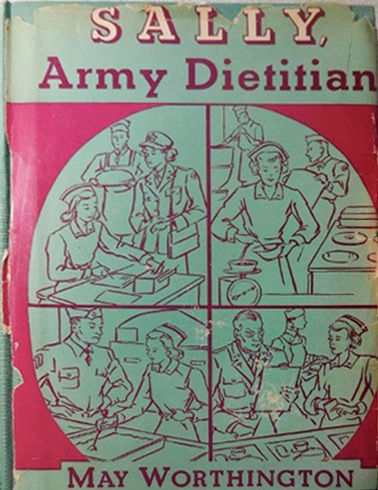
Even by the standards of an odd genre, Sally, Army Dietitian (1944) is an odd duck of a book. The usual mid-20th-century teen career romance novel features a girl or young woman who spends most of the book learning about being a copywriter, or a secretary, or a doctor, then gets married and presumably leaves the work force. In a twist, Sally, Army Dietitian focuses on a married woman who rejoins the work force while her husband is fighting World War II in the Pacific. What also makes the book stand out is its depiction of workplace sexism — not that it’s presented as a problem.
Sally Merrill, formerly Sally Lewis, has a degree in home economics and works as a dietitian. She is the protagonist of a series of books by author May Worthington (later May Worthington Eells, but more of that in a bit). Worthington held a masters degree in institutional management, and directed “public school lunch rooms, tea rooms, and college dining halls,” as do Sally and several other characters in her books.
Hospital dietitians perform important work, and Worthington knew her subject matter well, but even she could not make Sally, Army Dietitian into compelling reading. Kirkus Reviews called the book “completely inane and dull” but nevertheless praised its “picture of life in a large army hospital.” I can attest to the former: characters are flat and there is no real plot to the story. Worthington’s peculiar, choppy writing style doesn’t help things. Most egregiously, for a book published during World War II and set in a stateside army hospital, there’s very little mention of war-wounded soldiers, other than a scene in which Sally and her kitchen crew make strawberry shortcakes for Ward 9, filled with troops just back from the Solomon Islands. Granted, there’s a sign in one of the wards that reads “M.D. U.S.A.” under which a wag has written “Many Die. U. Shall Also,” but that’s as gritty as it gets in Sallyland.
Perhaps the biggest moment of drama comes when Sally returns from leave and the people who are supposed to meet her at the airport don’t show up. They have been in a car accident and, in the days long before cell phones, are unable to contact Sally, let alone call for help. But they are soon located and it’s back to more granular detail about segmented chow trays (“Stainless steel made with compartments. To be used instead of dishes!”) and diets for “sippys,” the kitchen crew’s callous shorthand for patients on liquid diets. (They also call the psych unit the “Goofy Ward.”)
Sally imparts these details in letters to her husband, along with the specifics for becoming an army dietitian. “You must be twenty-one but not forty-five. You must be a graduate of an accredited school of Home Economics with a major in Hospital Dietetics or Institutional Management….,” she writes to Alex, stationed on an atoll somewhere in the South Pacific, his eyes no doubt glazing over as he reads, “you must in addition have taken a training course in diet therapy approved by the American Dietetic Association.”
Alex never appears in the book, but his existence makes Sally a working wife, and Sally, Army Dietitian an anomaly. In Worthington’s previous books, single-girl Sally wrote a food column for the local paper and spent three months at Your Home magazine. “She had loved those jobs” (Worthington liked italics; any emphasis herein comes from the original), but no matter. Mid-20th-century mores dictated that middle-class white women like Sally quit working outside the home once married. The war, however, presented opportunities for married women to work outside the home in the name of patriotism. Even so, Sally can’t quite let go of her ambition. Flying from Chicago to California, she takes a tour of the plane’s galley, and briefly wonders about career possibilities in an airline’s industrial kitchen. “Some girl ought to investigate that chance surely,” she muses, before shooting down her own dreams. “If she weren’t going into the Army and if she didn’t have a perfectly good husband herself. But she was headed for the Army and she did have a husband, so somebody else would have to try that venture, Sally decided reluctantly.”
Casual racism abounds in these pages. Sally is in charge of special diets for the hospital wing, and OKs the menus for the other wards along with the mess officer. Tony is a cook assigned to her kitchen. He is a “dark-skinned young fellow … Mexican? South of some border certainly,” wonders Sally. Another kitchen worker, Wong (we never learn his first name or rank) tells her, “I work my father’s chop suey house in San Francisco long time.” The black women who work in the kitchen at the base’s rec center speak in tones straight out of Gone with the Wind: “Yassum, evahthing is okay.” Sally writes to Alex about “those yellow boys … getting licked sure enough and I’m so proud, so proud that you are helping.” Sally even uses the word “darky” at one point.
Alas, racial stereotypes like these aren’t particularly unusual for the genre. Much less typical are the descriptions of on-the-job sexism and harassment faced by the women at the army base. Sally gets catcalled as she walks through the hospital kitchens for the first time: “Did she hear the word ‘Blondy’? Wouldn’t be the first time she had been called it!” Later, she describes working with the orderlies to her freshly arrived assistant Lucy: “Some are good, some are — you know, fresh — and well, fresh. Found that out the first day.” No further explanation is provided. Sally hitches a ride back to the base with a superior officer and tells him how the mess hall might be renovated. “Men were funny, weren’t they?” she thinks later. “Now even the colonel. He took her idea and passed it out as if it were his very own — and the paint had flown in all directions for days.” Sally does not appear to be upset by any of this.
But, as Worthington makes clear, Sally’s male coworkers are indeed upset about working with women. “[T]his man’s army is going to be ruined with wimmen,” says Sergeant Leary. “Is it true we got another one dumped down on us yesterday?” Other men are willing to put aside their grievances as long as the “wimmen” in question meet their standards of personal attractiveness. “Crackly starched uniforms, slender ankles, hair shining under their little caps. Trim, slim, and snappy. Did his eyes deceive him? ‘I do hate big women and … I’m spared,’” thinks Lieutenant Black. “Orders were orders,” thinks Private Donnelly, “if he had to haul women around the post, he was thankful they weren’t old, nor fat, nor plain to look at. Easier on the eyes.” Sally grins as the two soldiers escorting her back to her quarters after a night subbing at the Service Club tease each other about going on “skirt patrol.” Takeaways for the reader seem to be that boys will be boys, and women who want to get ahead better please the male gaze.
There’s also a surprising — for a tween/teen book published in 1944 — scene where Sally, at the early breakfast shift one morning, overhears a pair of nurses talk about what can only be a hangover. “How was your party?” Fritzy asks Smithy. “Wonderful!,” she replies, “But this morning after is something else yet. How can you eat bacon and eggs?”
Worthington was 60-ish when she married Walter Crosby Eells, an old college friend and educator, shortly after the death of his first wife in 1947. The following year, she followed Eells to occupied Japan, where he served on General MacArthur’s staff as a special advisor in higher education. This sounds benign, even laudatory, but, according to academic Ruriko Kumano, Eells was “a central figure in the ‘Red Purge’ of Japan’s educational system” during the late 1940s and early 1950s, who visited national universities throughout the country “to call for the immediate dismissal of communist professors.” A 1949 editorial in the St. Louis Dispatch quoted Eells in the Tokyo Times: “America’s education spirit is based on the freedom of thought. Communist teachers have no freedom of thought. Accordingly, they should be barred from the faculty of schools in a democratic nation.” As the Dispatch pointed out, “This, of course, isn’t liberty to think at all — it’s compulsion to think in a certain way. And wherever there is thought control there is no freedom, of thought or anything else.”
At the end of Walter’s tenure in Japan in 1951, the Eellses departed on a two-and-a-half year long tour through almost 40 countries. Each of them wrote a book about their adventures, Walter’s Communism in Education in Asia, Africa and the Far Pacific (1954) and May’s These Awakening Lands of the East (1955). The latter is a chirpy, white colonialist travelogue, with attention to food, dress, and racial differences that wouldn’t be entirely out of place in Sally, Army Dietitian. May also kept her eyes peeled for communists. Sailing to Formosa (now Taiwan) from Hong Kong, she and Walter were “most curious about the armed guard (Chinese)” patrolling the afterdeck and the “huge revolving iron spikes … which made it impossible for anyone to clamber up from steerage.” The captain tells them that watchman and spikes are there to provide protection against pirates. “Pirates, think of that. Not Communists. Pirates!” she marvelled.
May Worthington Eels wrote at least one more book about Sally. In Honorable Lunch: Nancy’s Home Economics Experience in Japan (1957), Sally and Alex are the parents of Sally II (called “Twoty”), eight, and Bobby, four. Together, they assist their au pair, Nancy Baker, as she prepares to teach home economics in Japan. Interested readers can find that book online, along with Sally, Army Dietitian and These Awakening Lands of the East.
MORE LYNN PERIL at HILOBROW: PLANET OF PERIL series | #SQUADGOALS: The Daly Sisters | KLUTE YOUR ENTHUSIASM: BLOW-UP | MUSEUM OF FEMORIBILIA series | HERMENAUTIC TAROT: The Waiting Man | KIRB YOUR ENTHUSIASM: Young Romance | CROM YOUR ENTHUSIASM: Fritz Leiber’s Conjure Wife | HILO HERO ITEMS on: Tura Satana, Paul Simonon, Vivienne Westwood, Lucy Stone, Lydia Lunch, Gloria Steinem, Gene Vincent, among many others.