
PLANET OF PERIL (51)
By:
September 5, 2026
One in a series of posts, about forgotten fads and figures, by historian and HILOBROW friend Lynn Peril.
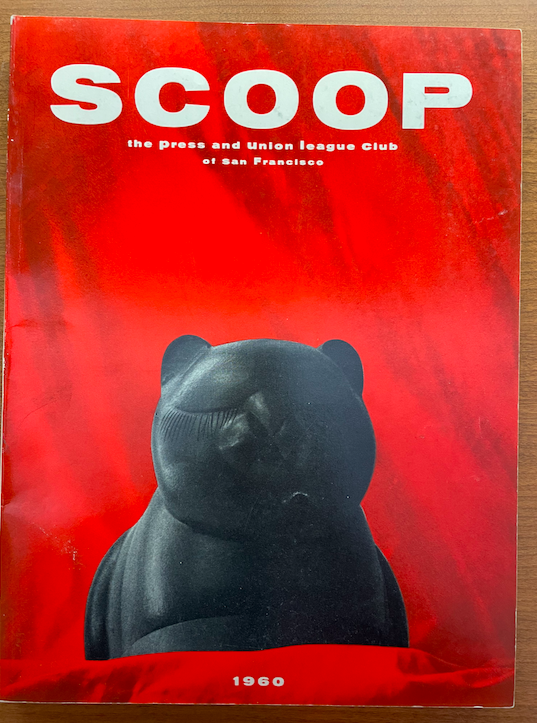
On top of San Francisco’s Nob Hill, on the third floor of the University Club, a small, rounded loaf of a cat statue sits on the bar at the aptly named named Black Cat Bar. This is Tombstone, feline mascot of the now defunct San Francisco Press Club, sculpted in granite by Benny Bufano in 1939. Bufano’s work favored simple, organic shapes — Tombstone might be a black potato that somewhat resembles a cat.
Traditionally, the statue sat on the head table during the Press Club’s “gang dinners.” Club lore held that whatever was spoken behind the cat was off the record. A guest could speak their mind in a roomful of reporters certain in the knowledge that no one would print any scuttlebutt. The omerta even held when, in 1941, the physicist and Nobel-winning inventor of the cyclotron, Ernest O. Lawrence, told the Club “of the possibilities of the atom bomb” but “not a word leaked until the first one was dropped in 1945.” Conversely, if something hit the papers after one of these events, everyone knew that someone in the room was responsible.
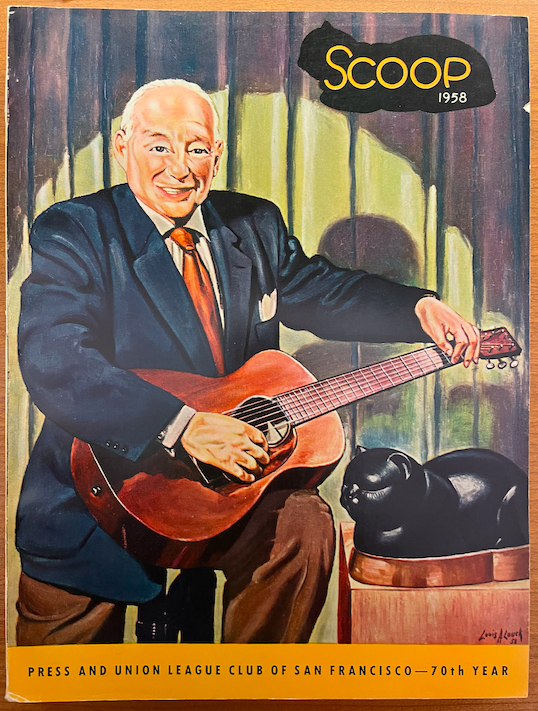
Photos of local and national politicians, sports figures, authors, artists, and celebrities speaking behind Tombstone line the walls of the Black Cat Bar and filled the pages of Scoop, the Press Club’s annual magazine. Robert F. Kennedy, Ronald Reagan, Princess Margaret, Tiny Tim and Miss Vicki were but a few of the bold-face names to visit the press club, where miniature versions of the cat were handed out as keepsakes.
How did Tombstone become the guardian of confidentiality at the San Francisco Press Club? The story is convoluted, with legend and fact deeply intertwined. According to the “cat story” told and retold at gang dinners, each time with more embellishment, members went to check on their headquarters after the earthquake and fire of 1906, only to find a black cat waiting in the ashes of the building. They adopted the furry survivor as a mascot and named it, with a touch of black humor, Tombstone. The cat story held that Tombstone “never said where he had been” during the quake and conflagration. The cat could keep a secret.
Like many great stories, this one isn’t true. By the time of the earthquake, a black cat named Tombstone II had been living at the club for several years already. He was “a country cat, black as the ace of spades, a ratter from way back, and a brute not to be trifled with.” He once survived a six-story fall in a dust chute, uninjured except for losing his claws as he scrabbled to gain a toehold, but he was not fireproof and died in the blaze.
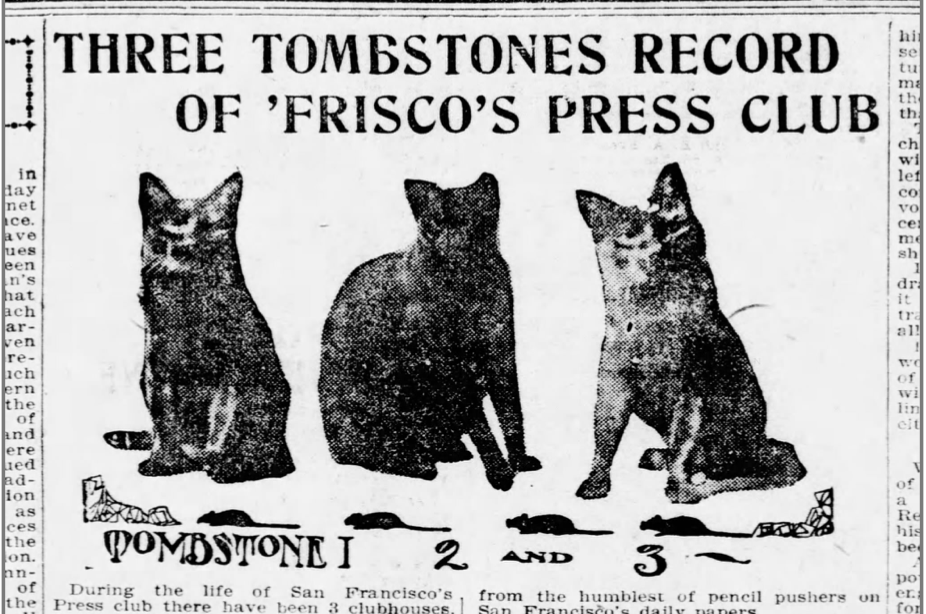
But we’re getting ahead of ourselves. Let’s go back to a cold and rainy San Francisco winter’s night in 1892, when a police reporter coming back from the morgue heard the plaintive mew of a kitten coming from a darkened doorway. Or maybe it was a group of newsmen coming off shift who heard the kitty’s pathetic cries. In any event, the foundling was scooped up and brought along to the Press Club’s headquarters, then located above the California Market on Pine Street. There, “an informal jinks was held, having for its main motive the adoption of the feline waif.” The kitten was baptized with “a large glass of steam beer” and named after visiting journalist Tombstone Thompson, “president of the somewhat grewsome [sic] Whitechapel Club of Chicago.” (A proto-goth offshoot of the Chicago Press Club, the Whitechapel was founded in 1889; its patron saint and president in absentia was Jack the Ripper. Meetings were held at midnight in a triangular room with a large coffin for a table. Lights shimmered “through the eyes and noses of skulls.” Skeletons, murder weapons, and torture devices lined the walls. Like the San Francisco Press Club until 1973, its membership was limited to men only.)
Alas, in early November 1894, a fire swept the California Market, incinerating the Press Club’s rooms and belongings, none so dear to its members as Tombstone I. “From the night of his initiation, Tombstone I was “a full-fledged bohemian … to know him was to love him,” eulogized the San Francisco Chronicle.
Perhaps because there were pro- and anti-cat factions at the club, Tombstone II didn’t arrive until 1902. After a period of adjustment, he was said to have taken to “to club life as a matinee girl takes to chewing gum.” He became “chummy,” kept late hours, and breakfasted “in the afternoon like a true Bohemian,” at least until the unfortunate events of April 18, 1906.
Enter Tombstone III, adopted not long after his predecessor’s demise. But “Toomey” the Third ran afoul of club members when he did what naughty cats do: he sharpened his claws on the furniture. “He has slashed the lincrusta [an embossed wallcovering] in the halls, scratched the redwood panels in the living room, clawed the weathered oak settees and, worst of all, has torn his feline signature in the cordovan leather couch” where a prominent member was “wont to relax his ample person,” reported the San Francisco Call in 1909. The Call said Tombstone III was to be exiled to a new home in Santa Cruz, but here’s where the story gets murky. Four years later, the cat was still in residence at the Press Club, then preparing to move to new headquarters. The San Francisco Examiner reported that a cruel-hearted faction of the membership wanted “to chloroform him, have a taxidermist do the rest, and take along a stuffed Tombstone” to the new place. Others wanted to cremate Tombstone (presumably after he was chloroformed) and inurn his ashes in the cornerstone of the new building. News stories suggest the cat made the move, only to become trapped on the roof, where he was either rescued, tumbled off, or otherwise disappeared around August 1913.
Three months later the San Francisco Chronicle claimed the “Long Standing Row Over Banishment of Tombstone III Finally Is Terminated” and announced the arrival of a pair of black Persian kittens at the Press Club. Was the anti-cat faction having a bout of guilt? It’s impossible to know, but Peter B. Tombstone and James K. Tombstone, named after club members, were said to be “great pets with the newspapermen.” Apparently neither came to a tragic end, for their trail runs cold after this.
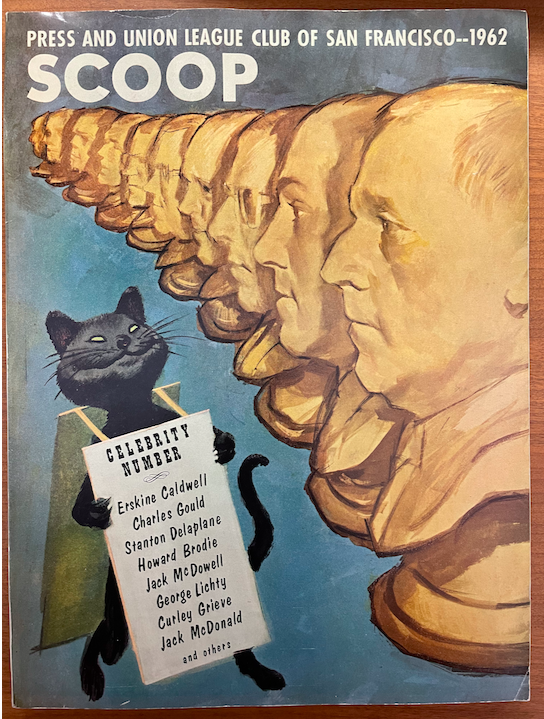
With the exception of a pair of cats, variously called Scotch and Soda or Mike and Ike, who briefly lived at the Press Club some time after its 1951 merger with the Union League Club, there were no more live animals on the premises. They were no longer needed, for the legend of Tombstone had by then coalesced in Benny Bufano’s granite statue.
By 1938, the Italian-born, 40-something Bufano had settled in San Francisco after a lifetime of travel and art-making. His sculptures and mosaics were in museum collections and in public spaces across the Bay Area. Despite employment by the Works Progress Administration, he was frequently short on funds, and often slept on park benches or in his studio, where a benefactor paid the rent. Thus when the San Francisco Press Club offered him free lodgings in exchange for a statue of Tombstone, he gladly accepted the commission — and lived at the club until his death in 1970.
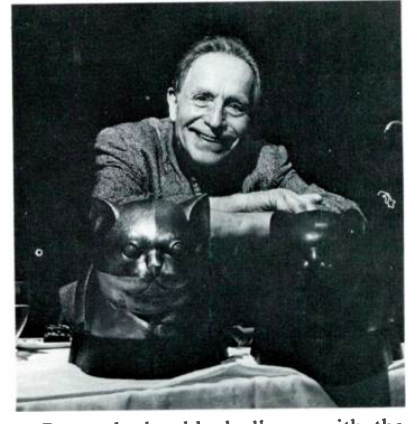
It was at Tombstone’s dedication in 1939 that “old-time vaudevillian” and Press Club bard Will Aubrey first sang a version of his “Black Cat” song:
There are many stupid cranks who prefer the tailless Manx,
But I know one cat that puts them in the shade,
Their pets to me look shabby when I think of that grand tabby,
That black bastard Bufano made. …
I wonder what he thinks as he sits there so serene.
I wonder if he is a he, or if her thoughts are clean.
It seems to have sagacity
Without undue loquacity.
What wondrous perspicacity!
That cat of ebon shade. …
That sly and so imperious
Jet animal so mysterious —
That suave but never serious
Black cat Bufano made!
Two additional Tombstones were cast for the club in 1954, one black and one silvered (the latter for “on the record” talks), four years after the original was stolen after a television appearance at the Mark Hopkins Hotel. (A 1938 news story said the statue weighed 80 pounds, but I’ve been unable to confirm this.) Bufano’s black cat was eventually retrieved from a University of California fraternity house in 1957, disguised with a coat of blue-and-gold paint.
Restored to its original dignified black, Tombstone presided over gang dinners until at least 1997, when the Press Club sold its headquarters at 555 Post Street. The club staggered to an end in 2003, its remaining memorabilia entrusted to the University Club. There it sat in boxes until the Black Cat Bar opened in 2006. Tombstone looks a bit worse for wear these days, but whether this is from the paint stripping or being used as a doorstop or worse while in storage, it’s hard to say.
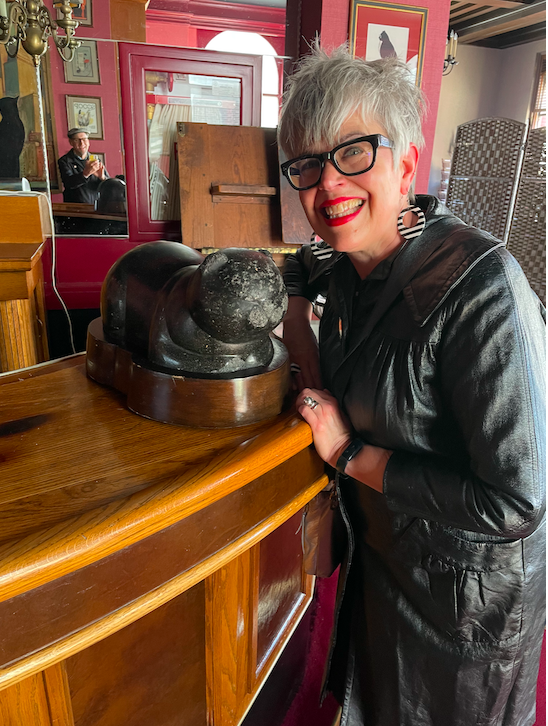
The Black Cat Bar is closed to the public, but the University Club might take you on a tour if you ask them nicely.
MORE LYNN PERIL at HILOBROW: PLANET OF PERIL series | #SQUADGOALS: The Daly Sisters | KLUTE YOUR ENTHUSIASM: BLOW-UP | MUSEUM OF FEMORIBILIA series | HERMENAUTIC TAROT: The Waiting Man | KIRB YOUR ENTHUSIASM: Young Romance | CROM YOUR ENTHUSIASM: Fritz Leiber’s Conjure Wife | HILO HERO ITEMS on: Tura Satana, Paul Simonon, Vivienne Westwood, Lucy Stone, Lydia Lunch, Gloria Steinem, Gene Vincent, among many others.