
PLANET OF PERIL (47)
By:
May 2, 2026
One in a series of posts, about forgotten fads and figures, by historian and HILOBROW friend Lynn Peril.
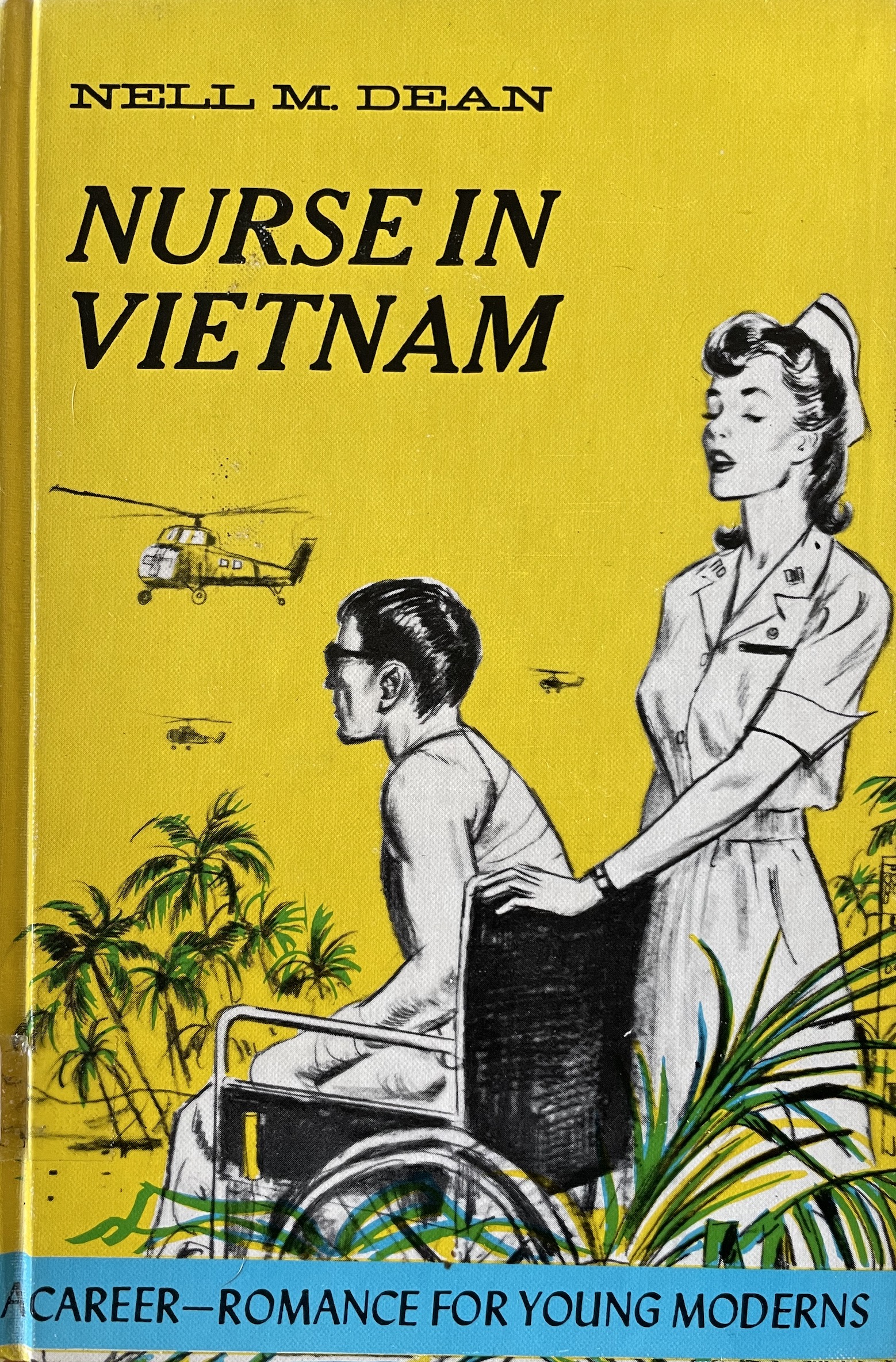
By the time Nurse in Vietnam was published in 1969, bookshelves groaned with the weight of novels featuring nurses as protagonists. There were career novels for young readers like Helen Dore Boylston’s Sue Barton series (seven volumes, published between 1936 and 1952) and Helen Wells’s Cherry Ames (27 volumes, stretching from 1943 to 1968, with some titles penned by Julie Tatham.) There were books like Judy Otis: Student Nurse (1956) and, in what was apparently some kind of crazy nurse/stewardness mash-up, Sue Morris: Sky Nurse (1954).
There was also a plethora of nurse-centric romance novels for adult readers. Perhaps you will be as surprised as I was to discover that at least three of these were set during the Vietnam war and published while the conflict raged — all with the same title, and two during the same year. These were Vietnam Nurse (1966), by Delia Fields (“Natalie was needed by many men, but she needed a very special man in a Green Beret.”); Vietnam Nurse (1966), by Suzanne Roberts (“A volunteer for freedom, she became a captive for love.”); and Vietnam Nurse (1968), by Ellen Elliot (“Thus began a dramatic adventure in which Joanna came face to face with death and love and tragedy and valor.”) I haven’t read these books, but in his 1982 review of Vietnam war literature, John Newman noted that, regarding the two books from ’66, “the view of the Vietnam war as the locale for a sort of extended prom date is certainly unusual.”
Which brings us to Nell M. Dean’s Nurse in Vietnam (1969), a “Career-Romance for Young Moderns” published by Julian Messner. Second Lieut. Lisa Blake is a 21-year-old flight nurse in the United States Air Force. Her Green Beret fiancé, Clint Owen, has been killed in Vietnam, so she signs up for duty in Southeast Asia as a way to deal with her grief. Assigned to the surgical division at Clark Air Force Base in the Philippines, she falls for hospitalized Green Beret, Mace Thomas. Per the front cover flap, Lisa becomes “a competent member of the operating team, but she realized there were times when all the equipment and all the skilled hands in the world could not save lives. In trying to help lonely men live through their horror and pain, her own grief lessened.”
As in many career novels, the romance component ranges from dull to icky. Mace Thomas is bad boyfriend material; his “meet cute” tactic of stealing Lisa’s compact is a giant red flag, as is his later theft of her flight wings. Lisa herself is clearly not ready for a new relationship; it’s only been six months since her financé’s death. She accidentally calls Mace “Clint” on a sightseeing trip to the rice terraces at Baguio in the Philippines. This triggers a huge quarrel, after which they part ways, only to reunite at the Biên Hua leper colony after the medical helicopter Lisa is riding in is shot down in enemy territory. (It’s complicated.) They recommit to one another, even though as far as I can tell she never actually tells Mace that Clint was her fiancé who died in combat. Or maybe Lisa just has bad taste in men. Clint doesn’t sound much better than Mace. He used to call Lisa “dum-dum” and related “his own philosophy of why America was now so deeply entrenched in this struggle to keep men free” in his letters to her.
The book was dedicated to “surgical nurse Lily T. Kapel, Lt. Col. USAF, NC, who will long be remembered by many Vietnam veterans.” Just like Lisa Blake, Colonel Lillian Kapel (she was promoted in 1969) was a surgical nurse at Clark Air Force Base in the Philippines during the Vietnam War. It is likely due to Colonel Kapel that Nurse in Vietnam is more than the “extended prom date” of the two Vietnam Nurse novels.
Instead, Lisa attends at amputations, and stands by as a doctor treats a severely burned patient with a salve he deems would be “valuable in the case of a nuclear attack.” She learns the soldiers’ current lingo: a “jelly doughnut” is a red-haired girl, and getting “waxed” or “greased” means being killed in combat. Her first hospital flight almost ends in disaster when she misjudges the time it takes to get through Saigon traffic. She hires a motorized pedi-cab to get back to the air base, but they come across an accident and she stops to assist the injured person. Thus she is in two kinds of trouble: because of her absence, they’ve held the return flight to Clark for 40 minutes, and in providing emergency first aid she may have unwittingly assisted the Viet Cong. As a result, she is reprimanded by her commanding officer, Colonel Margaret A. Phelps. The book ends before we find out if Lisa receives harsher punishment for being AWOL at the time of the helicopter crash. (Again, it’s complicated.)
Career novels like Ginger Lee: War Nurse (1942) by Dorothy Denning, R.N., or Martha Johnson’s wartime series beginning with Ann Bartlett: Navy Nurse (1942) raised morale during a war in which everyone was involved, either because a family member or friend was in the armed forces or merely because rationing, shortages, and bond drives placed the war front and center in civilian life. But Nurse in Vietnam was published in 1969. That year, on October 15 and again on November 15, hundreds of thousands of people of all ages took part in activities related to the Moratorium to End the War in Vietnam, including high school students who were, one assumes, the book’s target audience.
Hopefully no lazy student based their book report on the review that ran in The Sacramento Union in May 1969. “A young girl’s courage under dangerous wartime conditions, particularly her experiences in the Philippines during the Second World War. Casual reading but lively.”
Not every American was against the war, and Nurse in Vietnam is not an antiwar novel. Words and phrases like “colonialism” and “quagmire” do not appear in its pages. And yet the following exchange takes place on page eight. Lisa travels from the US to Manila by boat. She remarks to the ship’s captain that with “the frightening way the war is escalating the casualties are sure to increase.” He snaps: “Outrageous! Deplorable! … The way the youth of our nation is being shot down like pigeons. Their bodies being torn apart by shrapnel and mortar fire.”
Lisa herself explains to a shipboard friend that Vietnam was “a different kind of war … There aren’t any clear distinctions to the battlefronts … it’s ambush and patrol sweeps and combat jets and helicopters … There can’t be anything more deadly than the guerilla …” Her friend replies that she’s “not nearly as well informed” on the war as Lisa, because she hates “reading those grim newspaper accounts” and often “skip[s] over those stories in favor of the features and editorials and fashions.” It was a far cry from World War II homefront patriotism.
The white people in Nurse in Vietnam have a lot to say about people of different races. In one scene, Lisa discusses “VC Charlie” with a reporter. She thinks Charlie (the nickname for Viet Cong soldiers, which came from the NATO alphabet’s designation for the letters VC, “Victor Charlie”) is “a village boy with wrong ideas.” The reporter lectures her about “those dirty yellow lousy Viet Cong.” The ship’s captain opines that “Asiatics are bum seamen.” Showing newly arrived Lisa around Clark Air Force Base, her roommate warns her that “these Filipinos” are “clever thieves.” Lisa herself later thinks that how nice it would be if more of the “good” Filipinos became doctors.
Despite its flaws, what makes Nurse in Vietnam such a compelling read is that so many of Lt. Lisa Blake’s experiences ring true to women veterans’ memories of their time in service. (You can find such stories at the Vietnam Women’s Memorial website and the website for Vietnam Veterans Memorial Fund.)
One scene was more true to life than the author could ever have anticipated. Lisa explains to the visiting reporter that she works in “a nice safe hospital” unlike the combat nurses in Vietnam, who “live in tents and quonset huts” and “never know if their billets are going to be bombed.”
In an awful coincidence, on June 8, 1969, a 25-year-old Army nurse was killed in a rocket attack on the 312th Evacuation Hospital in Chu Lai, South Vietnam. Lieutenant Sharon A. Lane had only been “in-country,” as members of the military described it, for 45 days. She was the only servicewoman in Vietnam to be killed by direct enemy fire.
MORE LYNN PERIL at HILOBROW: PLANET OF PERIL series | #SQUADGOALS: The Daly Sisters | KLUTE YOUR ENTHUSIASM: BLOW-UP | MUSEUM OF FEMORIBILIA series | HERMENAUTIC TAROT: The Waiting Man | KIRB YOUR ENTHUSIASM: Young Romance | CROM YOUR ENTHUSIASM: Fritz Leiber’s Conjure Wife | HILO HERO ITEMS on: Tura Satana, Paul Simonon, Vivienne Westwood, Lucy Stone, Lydia Lunch, Gloria Steinem, Gene Vincent, among many others.