
PLANET OF PERIL (50)
By:
August 2, 2026
One in a series of posts, about forgotten fads and figures, by historian and HILOBROW friend Lynn Peril.
“Is Your Sub-deb Slang Up-to-Date?” asked Ladies Home Journal in December 1944. Young readers of its column, “The Sub-Deb,” were to give themselves one point for each word or phrase they knew. An attractive girl was a “slick chick,” one with sex appeal was a “ready Hedy” (a la Lamarr). Some of these were downright insulting. “A Girl Who Necks With Everybody” was a “sausage (everybody’s meat)” or a “share crop.” There was no category for “A Boy Who Necks with Everybody.”
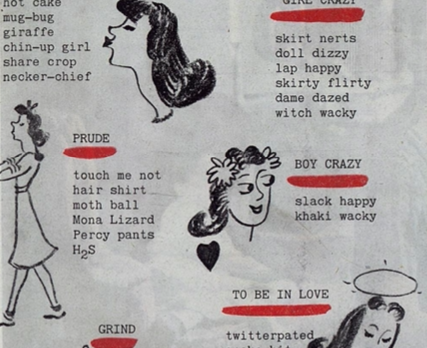
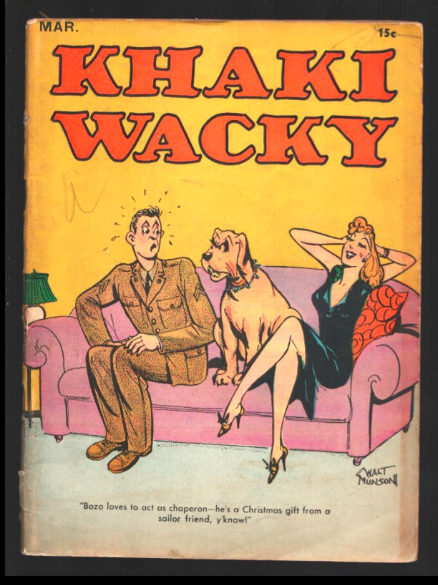
At least one of these phrases makes me think the Journal wasn’t that up-to-date itself. “Khaki wacky” was one of the terms it listed for “a boy-crazy girl,” but in 1944, to be khaki wacky was to be part of a moral panic about young women, their behavior, and venereal disease.
Whether they were called khaki wackies, victory girls, or, in one of the most jaw-dropping portmanteaus of all time, patriotutes, they were young women who allegedly slept with servicemen to raise the latter’s morale. They were not professional sex workers, but what Ladies Home Journal called “bobby socks amateurs.” As Brooklyn magistrate judge Jeanette G. Brill explained to the New York Times: “‘They label themselves the Victory Girls … They think that the boys are here today but may be dead tomorrow and they reason: ‘We’ll give them all they want.’”
Writer Harry T. Brundidge observed these “restless, war-excited, uniform-dazzled teen-age girls” wandering the streets of an unnamed midwestern city in a lurid 1944 article for Cosmopolitan: “I saw hundreds of these girls from thirteen up, cute in short skirts and blouses, hair bows and saddle-oxfords, but lip-sticked and rouged like their professional sisters, roaming the streets, awaiting the first ‘Hiya, babe!’ from any uniform to be picked up. … I saw scores of them in bus and railway stations, in twos, threes, and fours — kid camp followers from all over the nation.”
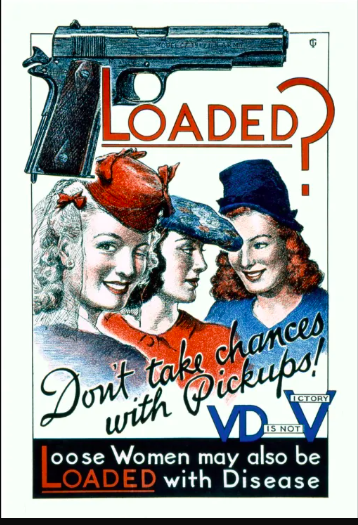
These young women were, according to authorities at the federal, state, and local levels, responsible for spreading venereal disease throughout the armed forces. “Teen-age delinquent girls” were responsible for “85% of infections in both army and navy,” reported the assistant surgeon general of the United States in 1943. The following year, the president of the International Association of Chiefs of Police blamed “khaki-wacky pickup girls” for “92 per cent of venereal disease infections among servicemen.” Another article from 1944 (“Patriotutes No. 1 Peril to Home-Front Health”) noted that there were enough sailors with VD “to man a fleet of 12 battleships, 6 carriers, 24 cruisers, and 80 destroyers,” and enough infected soldiers “to form 26 complete combat divisions.” In short, hundreds of thousands of servicemen were kept from active duty because of venereal disease. (Keep in mind that, while penicillin was introduced in 1944, it was in short supply; without it, a VD cure might take as long as 18 months.)
Also sure to raise eyebrows were statistics regarding very young girls. “Chastity and Syphilis” was not the title of the worst female buddy movie ever, but a handwringing 1944 Journal article that wondered, among other things, whether modern labor-saving devices and big meals would lead to larger sexual appetites. In the meantime, “juvenile girls … avid to show soldiers a good time” were running amok and spreading disease. “Last year, 11,000 girls between the ages of eleven and fifteen acquired syphilis. One fifth of all who acquired it were under twenty.”
While shocking, such numbers may not have been totally accurate. According to historian Amanda H. Littauer, “federal officials fueled the fires of public panic by blaming twelve-to-sixteen-year-old girls” for increased VD rates. The data for this was “fragmentary” though useful for “marshaling public support” for the the Federal Security Administration’s Social Protection Division which, since 1941, had sought to curb prostitution and female “sexual delinquency.” In fact, Littauer continued, “the vast majority of sexually active girls and women who came into contact with police, court, or health authorities [during the war years] were young adults between the ages of eighteen and twenty-seven.”
By now, you may be wondering why the servicemen themselves weren’t blamed for spreading VD. Just as there was no category for “A Boy Who Necks With Everybody” in the Ladies Home Journal quiz, so too was there no inverse word for “patriotute.” In the words of historian Marilyn E. Hegarty, “servicemen were not expected to take a vow of abstinence.”
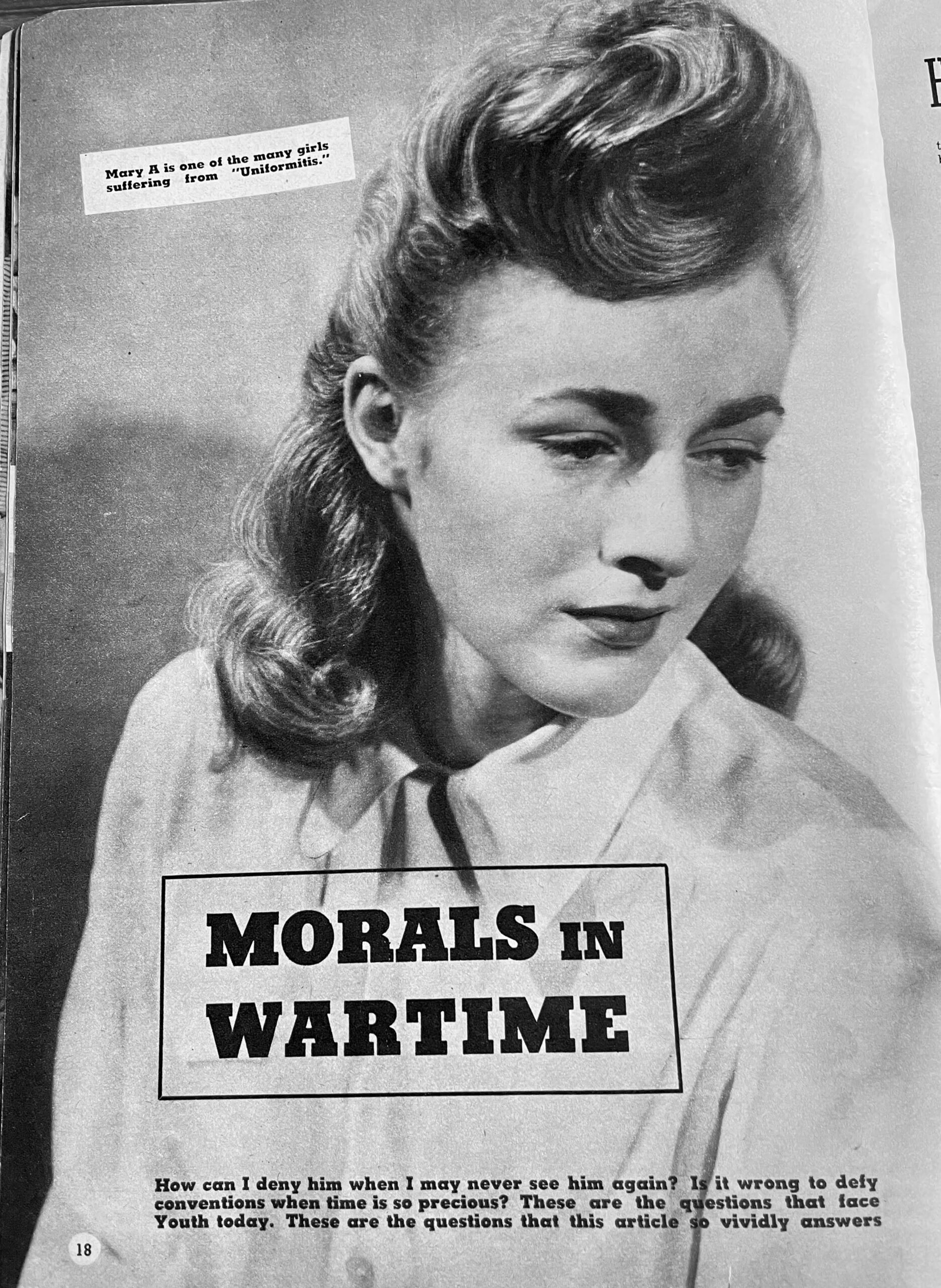
But girls and women (all of whom were assumed to be straight and cis in the mid-20th century) were supposed to remain virgins until their wedding nights. “Mary A.” was one of the examples of what not to do in “Morals in Wartime,” a cover story in So Your Man Is in the Service, a one-off publication from 1942 that purported to be “A Manual for War Wives, Sweethearts, and Mothers.” A romance magazine at heart, it followed in the footsteps of its sibling publication, Real Story, by providing melodramatic “real life” scenarios. Mary was “one of those quiet girls who never had a beau,” until, that is, a “camp with 20,000 men sprang up” near her town, and Mary went a little khaki wacky:
Men in uniform swarmed in. Handsome, sun-tanned boys with a gleam in their eyes and a hunger to talk to a girl. And Mary, who had never before spoken to a man without a formal introduction, found herself talking to strangers, as did all the girls in town.
At the new USO Club, where Mary went to “help out,” she was surrounded at once with eager young men, who wanted to dance with her. And Mary, who usually sat out most of the dances when she went to a party, was besieged with partners.
It was “the beginning of Mary’s developing ‘uniformitis.’” Before long, she was swept away by a wolf in uniform, “and forgot the useless conventions — as he called them” [italics in original]. Mary didn’t catch VD or get pregnant, but nonetheless “she knew she had lost something that was vital to her self-respect.” (Actually, Mary got off easily. Helen R. met Tom, “a very sensitive lad,” while he was on ten days’ shore leave. They became engaged, and Helen got knocked up. Tom, sensitive lad that he was, committed suicide when he found out about the pregnancy. “For one moment of ecstasy — this. If only she had been strong,” thinks Helen in retrospect.)
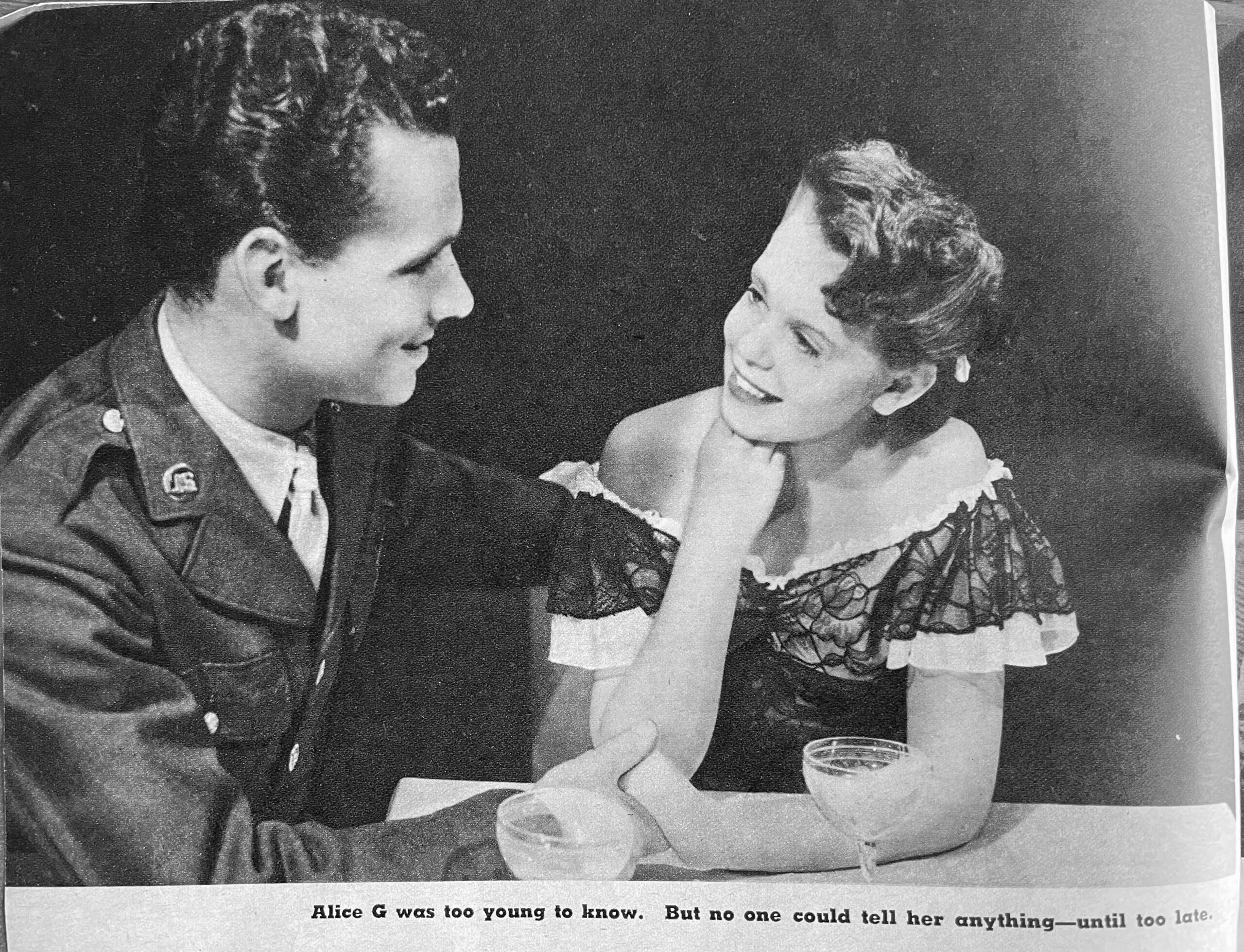
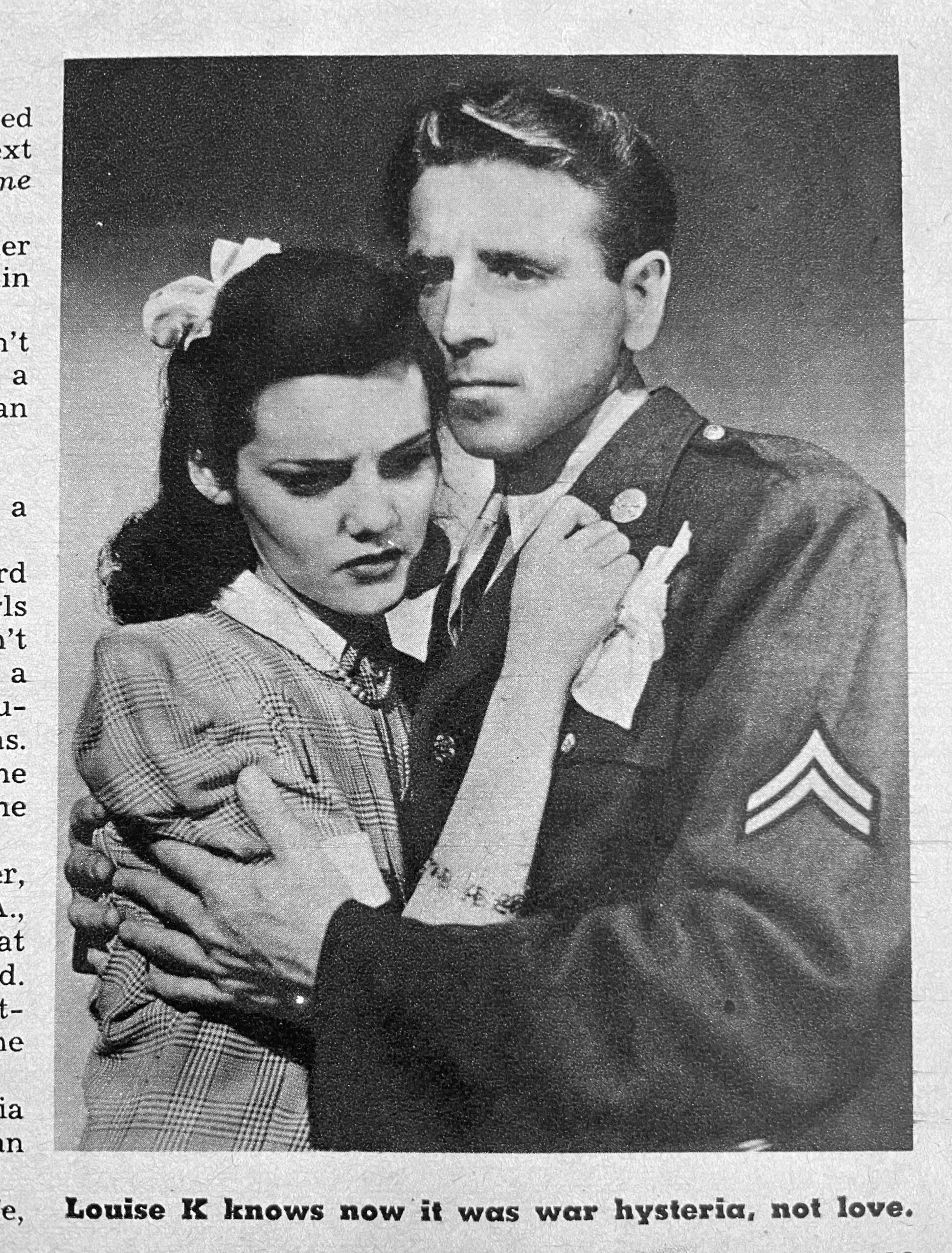
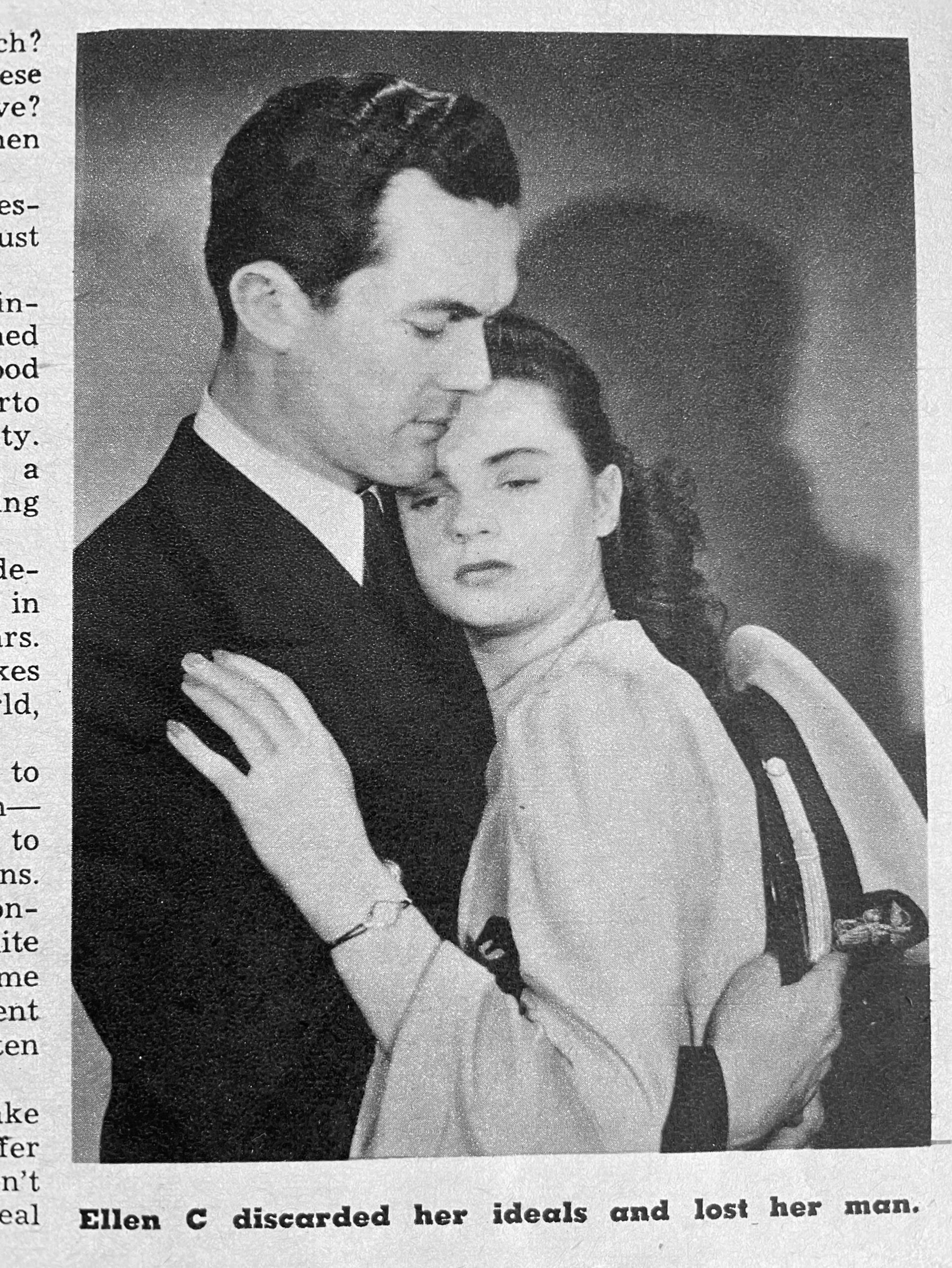
Speaking to a man without a formal introduction, let alone going on a date with one, was strongly forbidden female behavior in the mid-20th century. “Don’t be a pickup date,” counseled Maureen Daly in a 1947 installment of “The Sub-Deb.” “And that includes boys in drugstores, dance halls, on street corners, at roller rinks — even boys round your own neighborhood. You should know something about a boy before you accept a date with him!” Girls who resorted to so-called “pickups” with strangers were “immediately typed — just another girl who isn’t too particular …. And a boy will never forget that yours started as an ‘on the hoof’ friendship.”
The prohibition was even stronger during the war years, when temptation abounded. As Daly explained in her teen guidebook, Smarter and Smoother (1944), for “every boy who leaves town a new one comes in — the one in uniform. He may be studying at army school, stationed at a nearby training station, or just be in town on a three-day pass.”
He doesn’t know you — not yet — so it’s up to you go out to find him. At the time it may sound like a good idea. You aren’t sure which sailor or soldier you are looking for, but, with so many of them around town and lonesome, you can almost have your pick — or, rather, they do the picking, but it’s up to you to at least look eager and approachable.
There was an undefined line between “eager and approachable” and “floozy.” According to Daly, the problem began when girls looking for male company took “a slow walk down the boulevard, a short wait in a railway station, or a single seat near the back of a movie theater,” then became “overly eager to the point of being aggressive. One boy isn’t enough — not when there are so many to be had. They have gone berserk on the ‘this is war’ and ‘we’re only young once’ angles.”
In many cases this pickup system has almost developed into a racket. Not just on Saturday nights, but any night in the week, these girls turn out on the prowl — in pairs or singles, depending on whether or not they can find a girl friend with the same relaxed attitude.
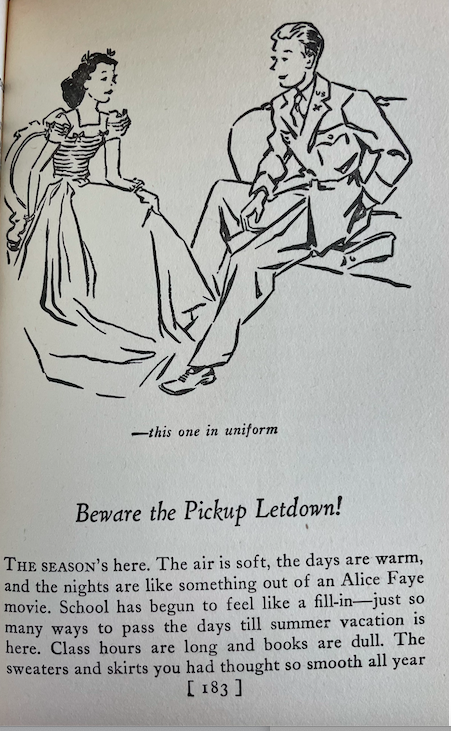
Relaxed attitudes equalled relaxed morals, Daly implied. Then there was “that pickup letdown — that inevitable feeling of cheapness; the realization that fellows only want to know them for what they can get …”
Late in 1944, a female reporter for the United Press syndicate visited “seven teen-aged girls, wearing green and white dimity dresses” among a group of 40 held in protective custody at the Florence Crittenton home in New York, “locked in so they couldn’t return to Times Square as pickup girls.” There, they talked over “their moral errors” with social workers, learned to knit and sew, and were sent home in three or four weeks. “If their parents don’t want them back, jobs are found for them and they live under supervision of a social worker,” said Mrs. Harold Tobin, director of the Florence Crittenton League, which provided services and housing to unwed mothers. Few of the young women coming from Times Square to Crittenton were pregnant, but “a third” of them had VD, marking them as “prime contaminators of soldiers and sailors.” Even so, she thought there was hope for them, “if they receive proper schooling and sympathetic supervision for a long time.”
Asked to comment on that article by The Times Herald, Captain Rhoda Milliken of the Women’s Bureau in Washington, D.C., made one of the very few comments not to lay the blame on khaki-wacky teens with loose morals: “In most cases … it’s the servicemen who pick up the girls. In fact, they are quite capable of doing their own soliciting,” she said.
MORE LYNN PERIL at HILOBROW: PLANET OF PERIL series | #SQUADGOALS: The Daly Sisters | KLUTE YOUR ENTHUSIASM: BLOW-UP | MUSEUM OF FEMORIBILIA series | HERMENAUTIC TAROT: The Waiting Man | KIRB YOUR ENTHUSIASM: Young Romance | CROM YOUR ENTHUSIASM: Fritz Leiber’s Conjure Wife | HILO HERO ITEMS on: Tura Satana, Paul Simonon, Vivienne Westwood, Lucy Stone, Lydia Lunch, Gloria Steinem, Gene Vincent, among many others.