
PLANET OF PERIL (49)
By:
July 4, 2026
One in a series of posts, about forgotten fads and figures, by historian and HILOBROW friend Lynn Peril.
I recently had my first ride in a driverless car. I’d been resistant (for many reasons, some political, some luddite), but there we were in the city on a girls’ weekend. My friend ordered up the taxi and because there were three of us, I hopped into the front seat. Before I knew what I was doing, I chirped, “Hello, Waymo!”
“Hello, Jane,” it replied. She, of course, was the person with the app on her phone.
Misidentification and all, I was enchanted. Of course, I was already used to the GPS’s reassuring voice telling me which turn to take, and I’d once spent a satisfying late afternoon in a tiki bar watching old episodes of Knight Rider, with its talking car, KITT. I even remember My Mother the Car, a 1960s sitcom in which Jerry Van Dyke’s mother is reincarnated as a 1928 Porter, a make created especially for the show, which was canceled after one miserable season.
But visitors to the Auto Show in Birmingham, Alabama, in 1921 had no such technological and cultural touchstones. No wonder they were “surprised beyond words” by the antics of a new model Willys-Knight. “While walking down among the displays, you hear ‘Hello, Jim,’ and you turn to shake hands with some friend but no one is present. Then the words, ‘Fooled you, didn’t I’ come from the Willys-Knight at your side,” reported the local paper.
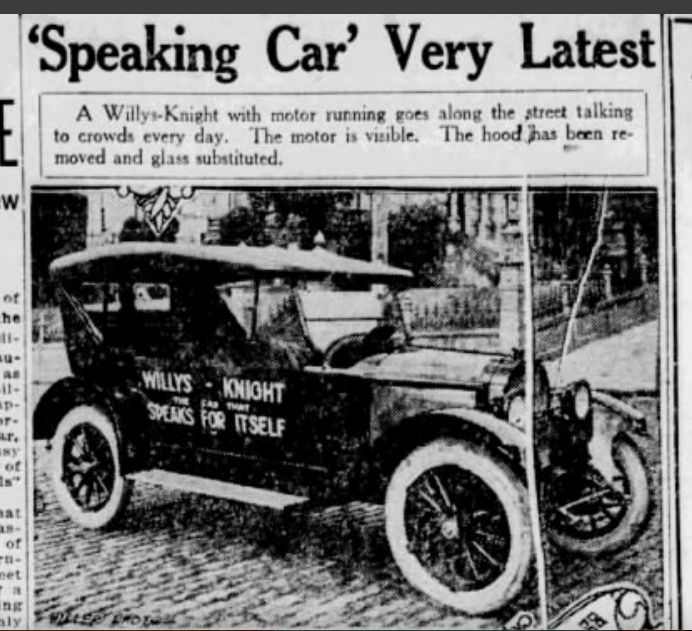
What might be surprising to modern readers is that the Willys-Knight was only one of a flock of seemingly animate cars that criss-crossed the United States in the 1920s and 30s. There were talking Fords, Chevrolets, Dodges, and Chryslers, in addition to a host of long-gone makes and models: Essex, Maxwell, Overland-Knight Whippet, Durant, DeSoto.
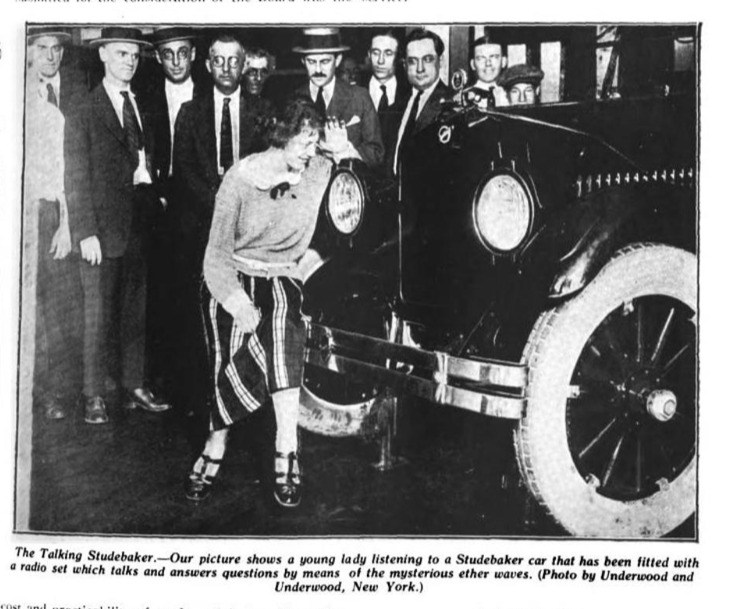
And these vehicles didn’t just chatter. In October 1923, “‘Studey,’ The Talking Studebaker” visited a dealership in Rochester, New York. It was “a regular big six stock car … raised on jacks so its tires do not touch the floor.” A thorough inspection inside and out revealed no wires. “Yet ‘The Talking Studey’ calls visitors by name, jokes freely, flirts with the girls, sings songs, plays all kinds of musical instruments, sounds the horn, ‘winks’ with its headlights and — this is hard to believe — actually tells fortunes!” marveled a local paper.
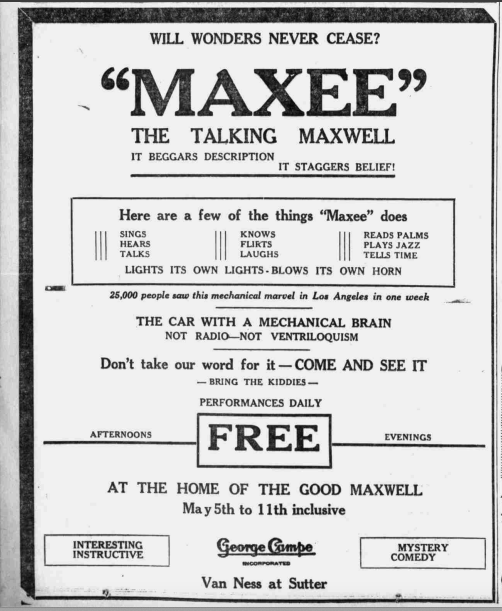
An ad for a May 1924 appearance by “‘Maxee,’ The Talking Maxwell,” listed, a bit redundantly, the things the car was said to do: “Sings, Hears, Talks, Knows, Flirts, Laughs, Reads Palms, Plays Jazz, Tells Time.” The secret was definitely “NOT RADIO / NOT VENTRILOQUISM.” A few months later nearly 500 people visited Maxee in Spokane, where the car called “prominent people by name” and talked with children. It had a “habit of bursting into song, though not always of the best quality” and such efforts were “quickly discouraged.” Nevertheless, “all departed satisfied that ‘Maxee’ had mysterious powers.”
Not every show was so exciting. A talking car at the New York Auto show in 1930 answered questions from the audience in “a voice bearing the authoritative tone of the Dodge Brothers engineering department of Detroit.” The talking DeSoto that appeared at the Chrysler Building in Manhattan in 1939 simply gave its own sales spiel via a concealed phonograph.
Lest you get too excited at the thought of an early technology that somehow led to the autonomous cars of today, let me tell you that this story is ultimately less about science than it is about a pair of showmen who used radio and maybe even ventriloquism (sorry, Maxee) to develop an entertainment spectacle. Ray Parker and Harry Green began their careers in vaudeville. The duo told The Daytona Beach News-Journal in 1941 that they had been partners for 18 years when, about eight years prior to the interview, they “saw the hand-writing on the wall and realized vaudeville was ‘going out.’ Necessity became the mother of invention and the result was their ‘talking car.’”
A reviewer for Billboard was not impressed with “The Mystery Automobile” presented by “Ray Parker and Company” at Loew’s Commodore Theatre in early 1928. “Ray Parker’s offering is meant to be a sensation but, judging from the manner in which he put it over [it will] fall short of creating the expected furore.” Conversation between Parker and the car was “banal” and blanketed by static. “To further demonstrate the mysterious wisdom of his car,” Parker walked into the audience and commenced “a typical mind-reading catechism” wherein the car described “details of clothes, and tells dates conveyed in a whisper to Parker.” In short, it was “the old code business rigged up with an automobile ballyhoo.” (Houdini’s “code business,” for example, substituted words for numbers so that he might communicate them to his blindfolded wife on stage. “Pray” meant 1, “answer” meant 2, and on from there.)
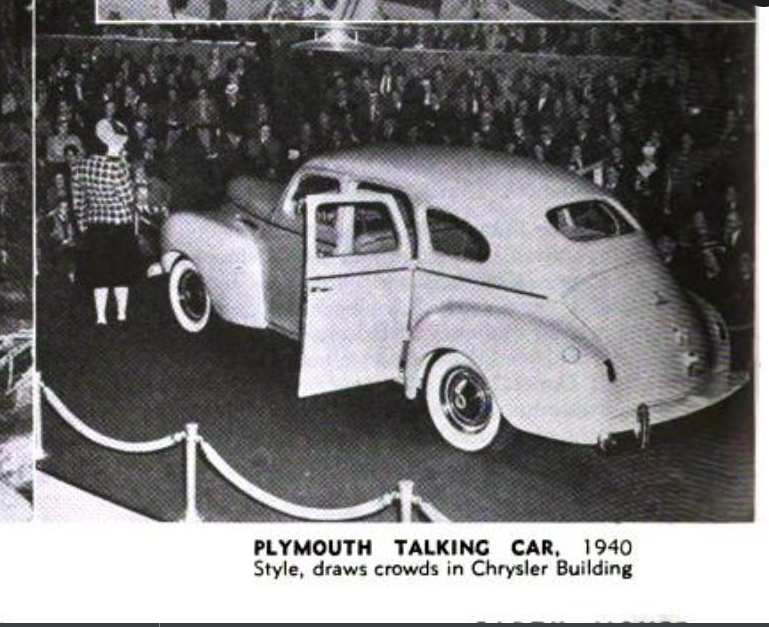
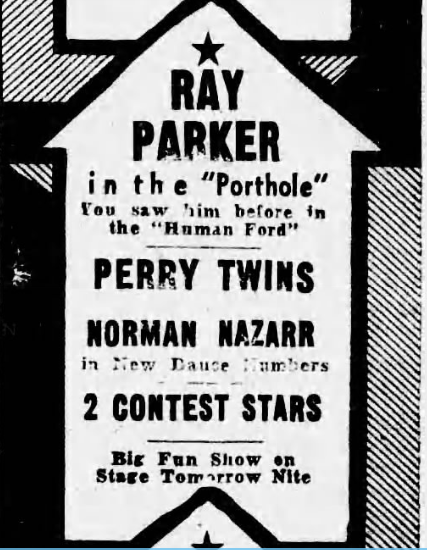
A decade later, Parker and Green had honed their act to perfection. Their talking Plymouth drew enormous crowds to New York’s 1939–40 World’s Fair, where the car appeared in a dedicated theater able to seat 700 patrons. The New York Times reported that 30,000 people “attended performances of the loquacious sedan” on a single day in June 1940; by the end of August, a total of two million people had viewed the car in the approximately 16 months since the fair opened. “At the command of the man in charge it rolls back and forth, opens and closes its doors and hoods, and blinks its headlamps, while a loudspeaker within makes wisecracks at the audience, talks back to the man, reads numbers on dollar bills and watches and tells the brand of lighted cigarets by ‘smelling’ them when offered to the radiator grille,” reported the Times in 1940. “How this magic is performed so mystifies many visitors that they return again and again,” concluded the caption to a press photo.
How did they do it? “The pair of inventors never revealed how the illusion worked,” wrote World’s Fair historian David Cope, “but Harry was never seen during any performance” of the mysterious Plymouth. Perhaps the Portland Evening Express came close to the truth when it described an appearance by a talking Chevrolet in 1934: “From the interior of the machine, through an amplifier, comes the voice of a man speaking into a microphone on the balcony overhead.”
Parker himself told The Montreal Star in 1933, with perhaps a touch of the old ballyhoo, that his “$2450 talking car” depended on “kathode [sic] rays, a combination of photo-electric cells and television” as well as “broadcasting and receiving by remote control.’” More specifically, he told The Vancouver Sun in 1944 that “the driverless car would start up and go ahead or backwards at his command” by means of “radio remote control.”
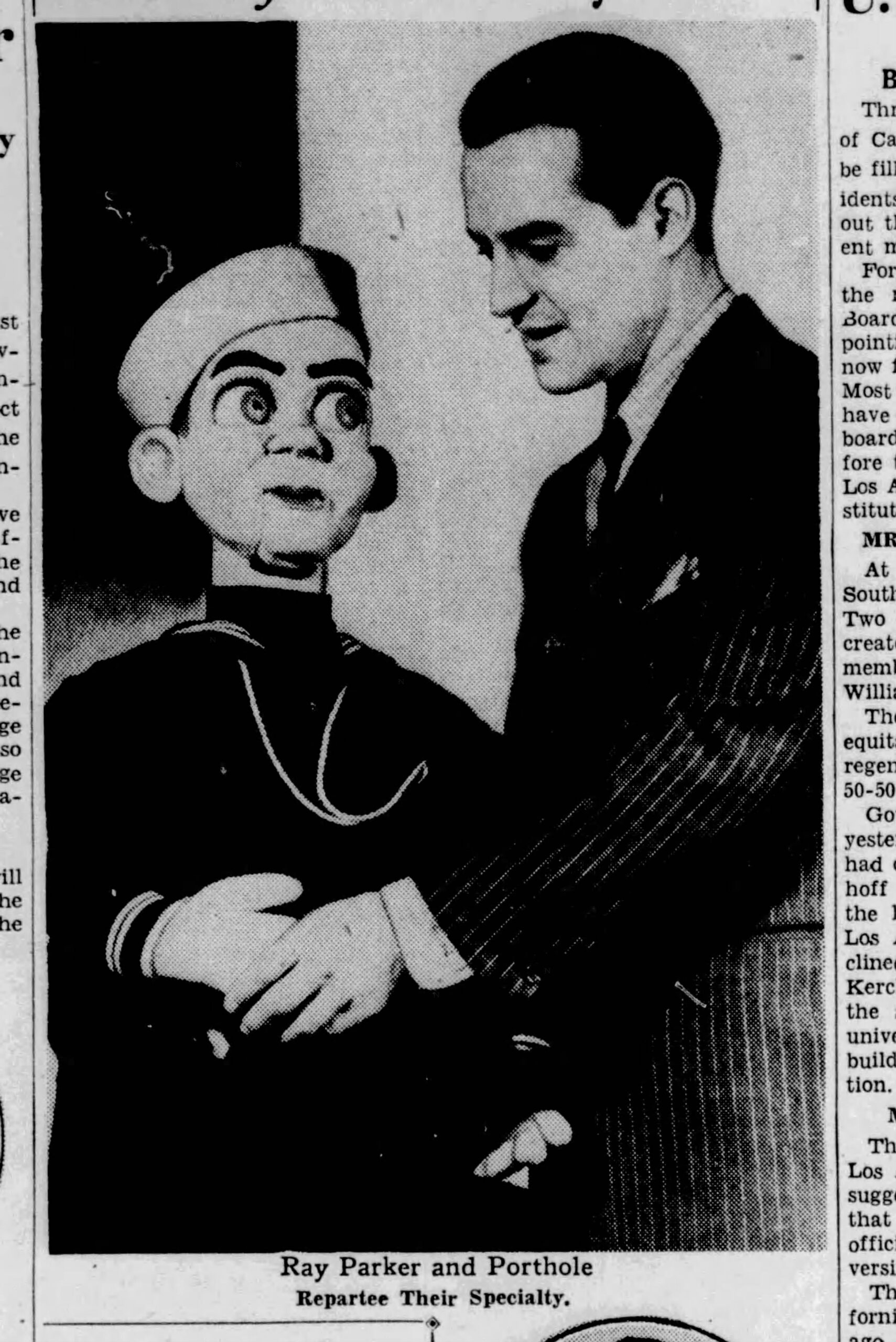
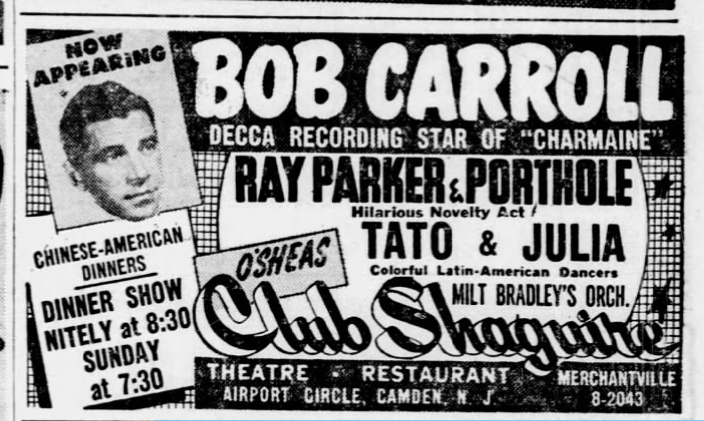
Another clue to the talking car act might be found in Parker’s sailor-suited ventriloquism dummy, Porthole. “Scientific Blockhead Knows All the Answers” was the title of a 1944 article in The Vancouver Sun, reporting on a local appearance by Parker and Porthole. The shtick would have been familiar to anyone who visited the talking Plymouth at the World’s Fair. At some point during the show, Parker left the dummy on stage, went into the audience, and asked Porthole to describe what was in an audience member’s pocket. After some banter, Porthole correctly named the initials engraved on a man’s watch. Parker then asked Porthole to, among other things, “tell him the serial number on a dollar bill.” Parker said “the dummy’s insides” were “a mass of radio tubes and intricate mechanisms” that remained “a trade secret.” “I’ll tell you this much,” Parker said, “it’s mostly radio remote control. There are some photo-electric cells in the little guy too.”
The trade secret may well have been Harry Green. During the World’s Fair’s off-season in 1939, Parker and Porthole appeared at a club in Cincinnati, where an enterprising entertainment reporter “discovered Harry Green … doing all the wise-cracking backstage. However, our snooper wasn’t snoopful enough to learn how they do the telepathy stunt in which Parker holds up a dollar bill and Porthole, or rather Green, calls off the serial number.”
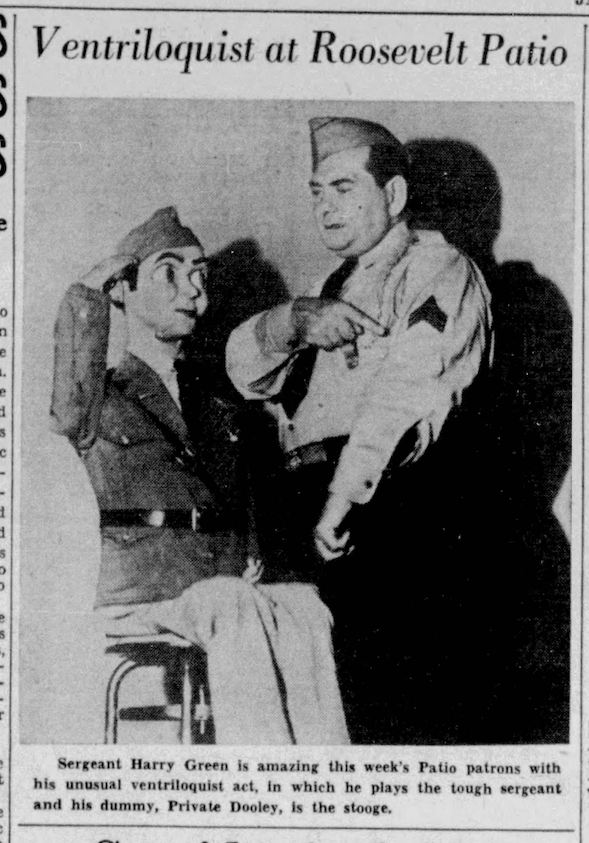
Here’s one more thing to ponder regarding this odd little show-biz tale. While Ray Parker was on the road with Porthole, Harry Green, now stuffed back into his World War I uniform and calling himself “Sergeant Green,” was performing with his dummy, “Private Dooley.” The Detroit Free Press cried foul in 1942. Private Dooley was actually Porthole, the paper maintained, now decked out in olive drab and working with Harry Green instead of Ray Parker. “About a year ago, Parker brought [Porthole] to the Club Royale … The show made a hit, because Parker used to leave the wooden image and circulate among the audience mindreading and kibitzing as though the doll were real.” Harry Green now owned the dummy and “used to work with Parker, and in fact devised the act.”
Judging by ancient newsphotos, Porthole and Private Dooley do seem to have at least a passing resemblance. On the other hand, they both look like creepy ventriloquism dummies. One also has to wonder if Ray Parker was working backstage when Sergeant Green and Private Dooley were in front of the curtain. In any event, the era of mindreading, wisecracking cars was over. Porthole and Ray Parker (and perhaps Harry Green backstage) performed at least until the mid-1950s, as their names appeared in smaller and smaller type.
MORE LYNN PERIL at HILOBROW: PLANET OF PERIL series | #SQUADGOALS: The Daly Sisters | KLUTE YOUR ENTHUSIASM: BLOW-UP | MUSEUM OF FEMORIBILIA series | HERMENAUTIC TAROT: The Waiting Man | KIRB YOUR ENTHUSIASM: Young Romance | CROM YOUR ENTHUSIASM: Fritz Leiber’s Conjure Wife | HILO HERO ITEMS on: Tura Satana, Paul Simonon, Vivienne Westwood, Lucy Stone, Lydia Lunch, Gloria Steinem, Gene Vincent, among many others.