
PLANET OF PERIL (48)
By:
June 3, 2026
One in a series of posts, about forgotten fads and figures, by historian and HILOBROW friend Lynn Peril.
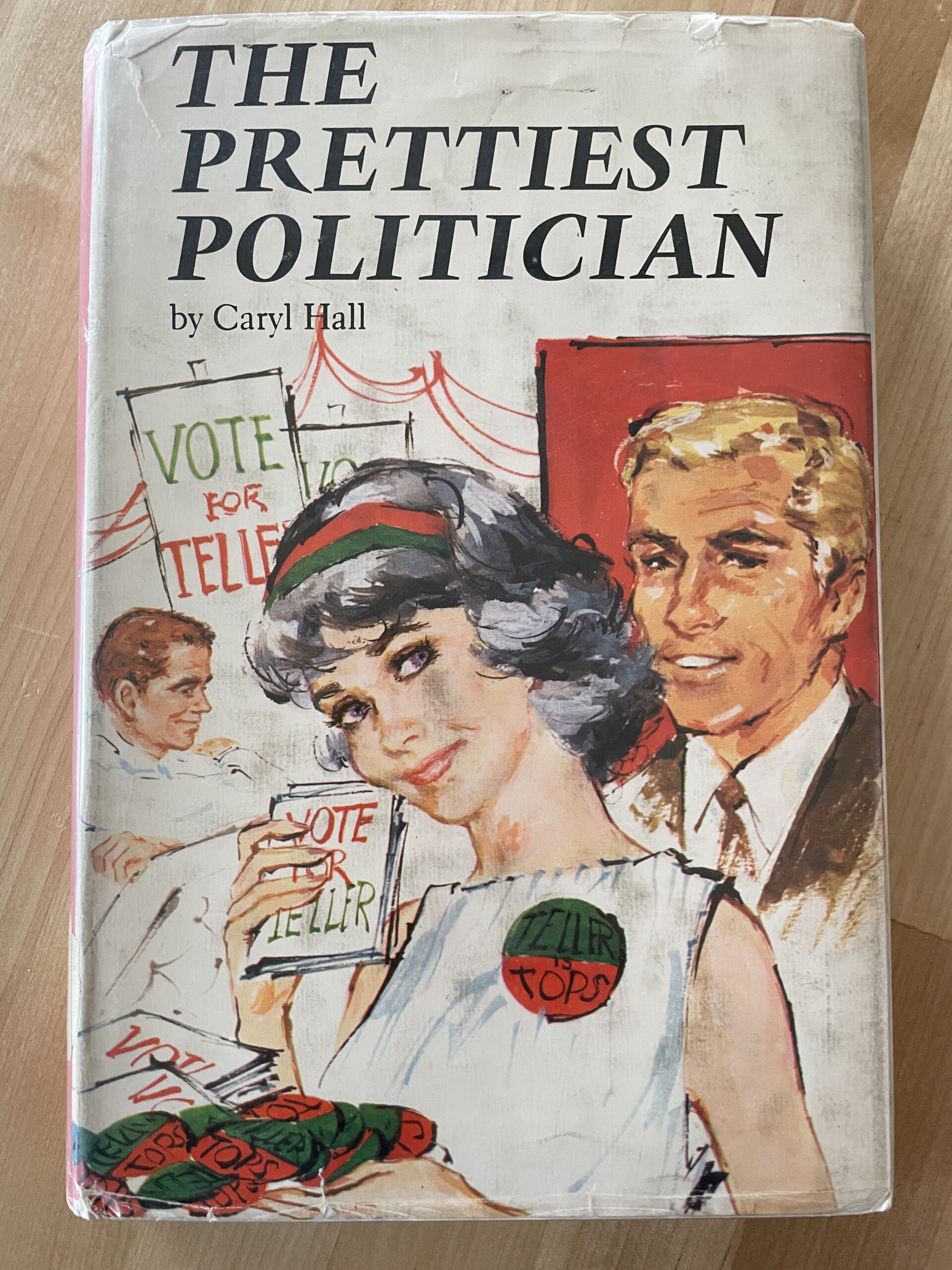
The story is all too familiar. An attractive, 18-year-old volunteer on a political campaign is touched and kissed by the candidate, who is eight years her senior. Soon they are in a relationship. Then, an ethics scandal, hushed up because even a hint of it in the press “could rock the whole party ticket” and demolish “the new image they were building with younger voters.” Throw in some roofies and the plot could have been ripped from today’s headlines. But while pretty boy candidate Rich Teller is eventually forced out of the race for the fictional town of Oakton’s seat in the state legislature, his relationship with teenager Valerie Murman causes nary a ripple of concern in Caryl Hall’s The Prettiest Politician (1968).
College freshman Valerie Murman (Veep superfans will immediately recall the corrupt Georgian president Murman Shalikashvili) knows she is the most beautiful and best-dressed girl on campus. Alas, these assets haven’t kept her from flunking out her first semester. Val’s not dumb, just unmotivated. Her mother is dead and her lumber baron cum civic leader father has asked her only to “maintain the feminine equivalent of the ‘gentlemen’s C’ … and get in the swing of campus social life.” If she attends summer school and makes a B average, she can return to college on probation the following fall (a plotline that falls by the wayside when she spends the summer gallivanting with the candidate).
But what to do in the meantime? The only class Valerie really enjoyed was Political Science, so she visits kindly Professor MacAbee. He recommends that Valerie contact his old friend, Sarah Carlisle, an experienced campaign manager who will be working on the upcoming race for Oakton’s new seat, recently created due to population growth and redistricting. Sarah always needs an extra pair of hands at party HQ, and Valerie needs something to do with what would have been the spring quarter.
But while Val types, answers phones, keeps precinct lists up to date, even knocks on doors, she’s not interested in politics per se. Indeed, as she mentions more than once, she’s not even old enough to vote. Civil rights, the student movement, Vietnam, women’s liberation? None of the issues that an 18-year-old in 1968 might have found very interesting are mentioned in the book. Even generic issues such as “taxes, problems of the cities, welfare, crime” get short shrift, but as hard-working poli-sci grad student and eventual replacement candidate Hank Delancey explains to Valerie, one of Rich Teller’s defects as a politician is that he runs on personality rather than problem solving.
Author Caryl Hall was active in local Republican party politics in the San Francisco Bay Area, and it’s not hard to imagine savvy Sarah Carlisle as her alter ego. It’s also not hard to imagine that Hall kept hot potato topics out of the book because she wanted to provide a nonpartisan civics lesson in campaign mechanics. This was a laudatory goal, but at least in retrospect, it seems to have resulted in some oddly dispassionate characters. One of Sarah’s “mainstay” volunteers is Deanna Stephens. Deanna and her husband Dave, an electronics engineer, are Black. Neither of them seem to be interested in civil rights — this in 1968, the year that Martin Luther King was assassinated and a further Civil Rights Act was passed. (It was also the year that presidential candidate Robert F. Kennedy was assassinated, thus perhaps not the most propitious time for the publication of a book about political campaigns.)
In fact, Deanna is only working outside the home because, as she explains to Val, “We haven’t any children yet, and I couldn’t sit home every day … I thought of taking a regular job but Dave didn’t like the idea.” So she volunteered on a citizens’ committee for a school bond issue, where she met Sarah.
Let’s deconstruct this. Mid-20th-century gender roles presumed that once a middle-class woman had children she would stay home with them. Deanna intends to be a mother, but she isn’t yet, so it’s permissible for her to work outside the home. Volunteering is preferable to “taking a regular job” for pay because this means Dave remains the family breadwinner. Finally, a school bond issue is connected to the education of children, thus well within “woman’s sphere,” and non-threatening to the patriarchal family structure.
Perhaps this is a good moment to point out that there are no women candidates for the seat in Oakton, and the only elected officials mentioned in the book are men.
What really floats Valerie’s boat is the candidate himself, tall, brown-eyed, blonde-haired Rich Teller, “an administrative assistant to the state’s senior United States senator.” Valerie is sent to pick him up at the airport, and the inappropriate chatter begins almost immediately. “You know, you should wear that color all the time — it does great things for your eyes,” he tells her, after she accepts a dinner date with him. “You’re the prettiest politician I’ve ever seen, and that’s an asset in any kind of campaign.” Of course, he gets her phone number, and thus learns her father is mover and shaker Victor Murman.
Despite Sarah’s disapproval of such “ballyhoo,” Rich enlists Valerie to become the “walking epitome of the Teller campaign … young, vital, attractive.” She will need a new dress, “Something simple, sophisticated, and appealingly little girl, all at once,” he says. That way “every male [italics in original] delegate” will remember his name at the upcoming convention.”Better one really beautiful girl than a whole contingent of average types running around.”
Valerie is dressed in her special outfit and headed to the convention floor, arms full of “Teller Is Tops” buttons and pamphlets, when Rich first plants a kiss on her cheek. “That’s taking advantage of a girl without a free hand to defend herself, isn’t it?” he observes, in what is clearly intended as a bit of light-hearted fun.
After a long day handing out Teller swag, Valerie naps, then wanders the hotel after midnight, thinking she can sway more delegates. She approaches a shindig in progress. “Welcome to the swingingest party in our party,” says one man. Another puts his arm around Valerie’s waist. “Come on, little girl, let’s go inside and whoop it up.” She pulls away. He does not pursue her.
Before the reader has time to question why it’s “cute” when the candidate gets touchy-feely, but threatening when a delegate does, Valerie and Rich are dating. It’s clear that he thinks of her as political wife material. “I don’t know how I’m going to afford you and your wardrobe on a legislator’s salary, but it will be worth going bankrupt to watch you dazzle the capitol,” he tells her.
There are warning signs about Rich, but these have nothing to do with the propriety of his relationship with a young volunteer. Deanna and Dave are leery of his ambition and do-what–it-takes-to-win attitude, as is Hank, though he is also nursing his own crush on Valerie. She finally begins to have doubts when a wealthy donor asks her to invite Deanna and Dave to a fundraising party for a new cultural center: “This Foundation is terribly liberal … and having this lovely Negro couple present would, you know, fill the gap,” says Mrs. Blewett. This makes Val uneasy. Rich argues that having “minority representation” at the event is simply “practical politics.” Valerie counters that the Stephenses don’t actually have anything to do with the new project and will be “put on exhibit at the party.” (One might argue they perform a similar function in this book, but I digress.)
Then, at the fundraiser, she overhears Rich talking with two shadowy men. They have given him “a pretty substantial amount of money” in a quid pro quo. “I’m sure we’ll work together just as well after the election as we have during the campaign,” says one. “You gentlemen can be sure that your interests will be fully represented in those matters before the legislature which concern you,” Rich replies. Already reeling, Valerie then hears them discuss a dam project, one in which her father is involved. “A man surely isn’t going to suspect his potential son-in-law of dishonorable motives, is he?” says one of the men.
Valerie is crushed when her boyfriend doesn’t respond. She goes to stalwart Hank for support and advice (he also takes advantage of the moment to tell her he loves her), then rats out Rich to his political mentor, Senator Gunderson. Because this is a 1968 YA novel and not real life in 2026, Rich is sent to political Siberia, instead of up the ladder of officialdom. Hank takes his place as a write-in candidate on the ballot. He loses the race but Valerie decides she might like him after all, and the book ends with them snuggling together on the couch, watching election returns. “You’re probably going to be stuck with a lot of extra-curricular tutoring of one not-so-bright third-quarter freshman when we get back to the university,” she tells him, ensuring that the cycle of ethically murky relationships will continue.
MORE LYNN PERIL at HILOBROW: PLANET OF PERIL series | #SQUADGOALS: The Daly Sisters | KLUTE YOUR ENTHUSIASM: BLOW-UP | MUSEUM OF FEMORIBILIA series | HERMENAUTIC TAROT: The Waiting Man | KIRB YOUR ENTHUSIASM: Young Romance | CROM YOUR ENTHUSIASM: Fritz Leiber’s Conjure Wife | HILO HERO ITEMS on: Tura Satana, Paul Simonon, Vivienne Westwood, Lucy Stone, Lydia Lunch, Gloria Steinem, Gene Vincent, among many others.