
CROSS YOUR ENTHUSIASM (12)
By:
November 11, 2026
One in a series of enthusiastic posts, contributed by 25 HILOBROW friends and regulars, analyzing and celebrating our favorite… creators switching art forms and/or careers! Series edited by Adam McGovern.
JOSEPHINE BAKER, SPY
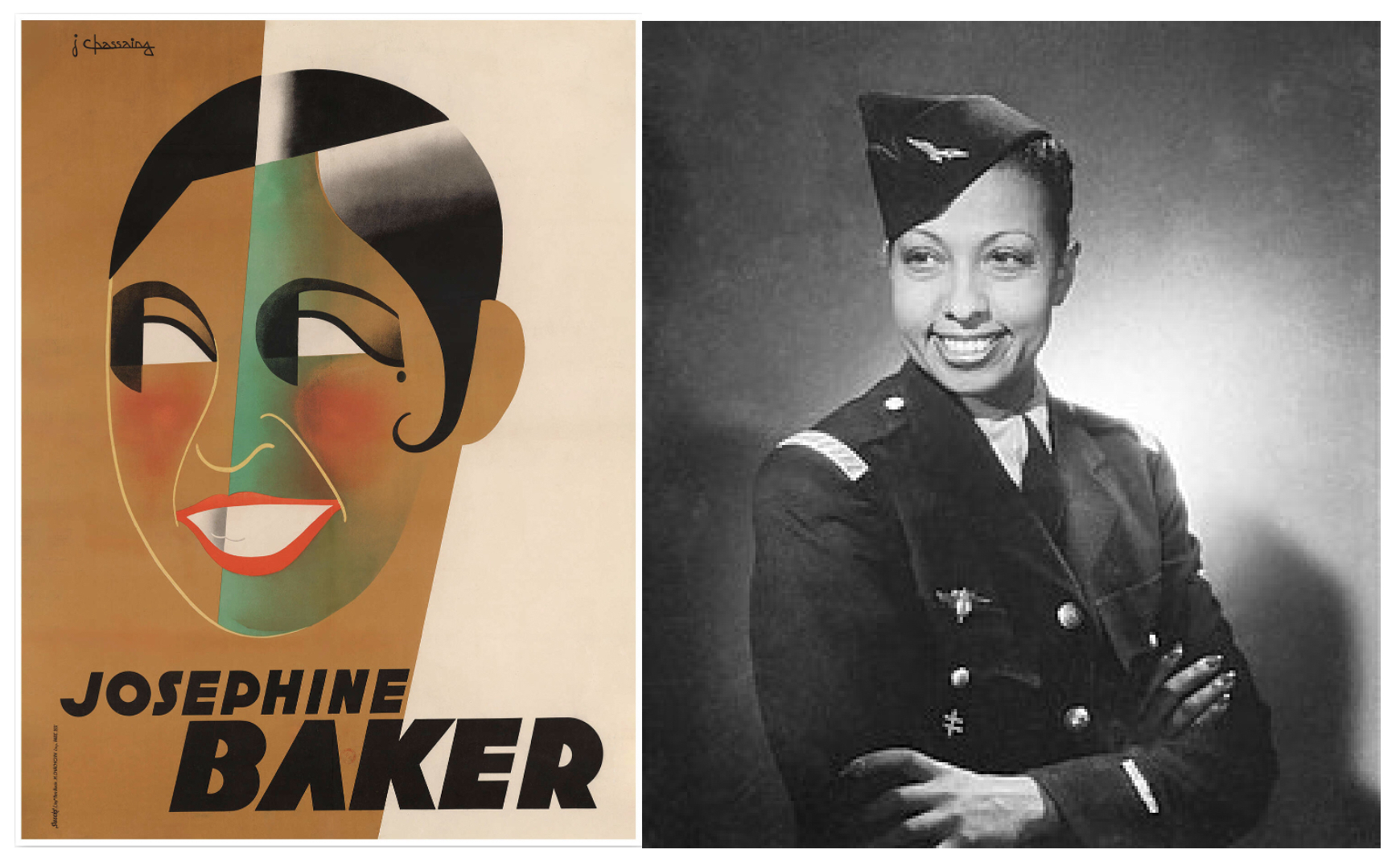
Josephine Baker was so openly transgressive, it’s possible that subtle subversion is what no one expected. Self-exiled from a racist United States, Baker became a sometimes scandalous, always sensational phenomenon of song, dance and film in France in the 1920s; the “first Black superstar,” and the reference-point from which all stylistically groundbreaking, sexually daring, and defiantly assertive performers, from Grace Jones to Beyoncé, build their own revolutions.
To many admirers throughout the decades since, that’s “all” she is, and that’s enough; looking back, Baker seems the embodiment of her original era’s sleek and utopian Art Deco aesthetic, or perhaps the goddess who helped will it into being. Fans from later in the 20th century might have known her primarily as a trailblazer of human rights: She adopted 12 kids all from different races and cultures, to model worldwide mutual acceptance; when returning in triumph to the US, she refused to play segregated venues and got major ones to change their ways; she spoke at Martin Luther King’s 1963 March on Washington and, after his murder, was asked by Coretta to take his place at the head of the movement (though she eventually declined out of concern for orphaning her own children).
Baker was the hero of two distinct life stories — and a third one, which at first no fans were meant to know about: intelligence operative of the French Resistance in WWII. We’ve all seen the literary and movie trope of the performer so convincing they are asked by their government to take on clandestine missions. This ranges from farce like Parker & Stone’s animated-puppet movie Team America to tragedy like the Hoey siblings’ graphic novel The Shadower, and makes such a good story it seems improbable in real life — an assumption that might itself give further psychological cover for the kind of things Baker accomplished.
Her celebrity gained her a passport to the spaces where elites gathered, dazzling and distracting the dignitaries and bureaucrats she would socialize with at embassies and clubs (including those of the Axis powers and the Vichy puppet-state), drawing out military secrets from occupiers and collaborators in the course of what seemed to be cocktail-party small-talk. (That is, when she wasn’t flying missions to discover and report German troop movements and air- and seaport locations, or storing weapons and sheltering Resistance fighters and Jewish refugees at her estate in the south of France.)
Having crossed the Atlantic, she now crossed enemy lines, with the enemy not even noticing it. The mortal risk she ran must have felt worth-it and not-optional alongside her lifetime memory of having witnessed thousands of Black neighbors fleeing the East St. Louis Massacre when she was a child, and perhaps a later determination to stand her own ground. Having faced at-first indifferent audiences and disparaging reviews of the “Negro wench” in her home country, the invisibility of her shrewdness and skill must have been an underestimation she was used to and prepared for. Code-switching is the undercover mission that everyone from a denigrated culture carries out, and assumed identities can be employed to your advantage amidst what others assume about who you are.
After the war, Baker was awarded most of France’s highest military and civic honors, though the full story was not declassified until 2020 and some of the honors took longer than that (like her late-2021 induction as only the sixth woman, and first Black woman, to be commemorated at France’s shrine to national heroes, the Panthéon). Now an icon of Black affirmation, feminist bravery, open sexuality and unashamed (if at times conflicted) queerness, humanitarian resolve and principled dissent, it’s a common cliché to say that, as an antifascist spy, “her greatest role was not on stage or screen.” In truth, her most important role was lifelong: insistently being, and persistently becoming, her truest self.
CROSS YOUR ENTHUSIASM: INTRODUCTION by Adam McGovern | James Scott Maloy on DAVID LEE ROTH, EMT | Lynn Peril on HEDY LAMARR AND GEORGE ANTHEIL, INVENTORS | Crockett Doob on LARS ULRICH, TENNIS ACE | Mimi Lipson on DANIEL DAY-LEWIS, COBBLER | Mariane Cara on BRIAN MAY, ASTROPHYSICIST | Carlo Rotella on CURTIS COKES, FIGHTING ACTOR | Josh Glenn on GEORGE HARRISON, FILM PRODUCER | Crystal Durant on SKUNK BAXTER, DEFENSE CONSULTANT | Adrienne Crew on HENRY ROLLINS, PUNK POLYMATH | Deborah Wassertzug on JOHN LURIE, DISRUPTOR | Heather Quinlan on HARRY NILSSON, COMPUTER GENIUS | Adam McGovern on JOSEPHINE BAKER, SPY | Douglas Wolk on RICHARD McGUIRE, GRAPHIC-LIT INNOVATOR | Jake Zucker on SYDNEY POLLACK, CHARACTER ACTOR | Rani Som on RACHEL POLLACK, SEEKER | Jeff Lewonczyk on ANDY WARHOL, FORMER ANDY WARHOL | Nikhil Singh on ADOLF HITLER, FORMER PAINTER | Holly Interlandi on ADAM JONES, DIRECTOR | Jonathan Pinchera on PETER CAINE, CONSPIRACY STAR | Miranda Mellis on EVE KOSOVSKY SEDGWICK, ACADEMIC WEAVER | Kelly Jean Fitzsimmons on BRENT SPINER, SINGING NOVELIST | Christopher-Rashee Stevenson on QUENTIN TARANTINO, CRITIC | Sangamithra Iyer on MADHUR ANAND, LITERARY ECOLOGIST | Marlon Stern Lopez on GREG GRAFFIN, HARDCORE ZOOLOGIST | Pichchenda Bao on WENDELL BERRY, FARMING POET.
JACK KIRBY PANELS | CAPTAIN KIRK SCENES | OLD-SCHOOL HIP HOP | TYPEFACES | NEW WAVE | SQUADS | PUNK | NEO-NOIR MOVIES | COMICS | SCI-FI MOVIES | SIDEKICKS | CARTOONS | TV DEATHS | COUNTRY | PROTO-PUNK | METAL | & more enthusiasms!