
SKIN DEEP (5)
By:
October 14, 2026
One in a series of posts profiling the artists of the Black Cherry Lane: Presence exhibition, which honors the ancestors and descendants of Cherry Lane Cemetery, a burial ground for free and formerly-enslaved people which is now itself buried under a parking lot, and which the artists are imagining a new life and legacy for.
SKIN DEEP: INTRODUCTION by Adam McGovern | JEROME LAGARRIGUE | MARY EDWARDS | BEVERLY Y. SMITH | TIM OKAMURA | THOMAS DOYLE | YELENA TYLKINA | TAHA CLAYTON | GREG SHEA | LAZARUS NAZARIO
Thomas Doyle’s works are moments frozen under glass, but their lesson is for nothing to escape notice. Working in miniature, his sculptures and tableaux call us to focus in on what could otherwise be overlooked; corporeal figures and scenes that train (and reward) us for seeing emotional truths and tangible metaphors at the scale of the small-screen images we spend our modern lives staring at, but without the flatness and ephemerality that distances our feelings and deflects our thoughts.
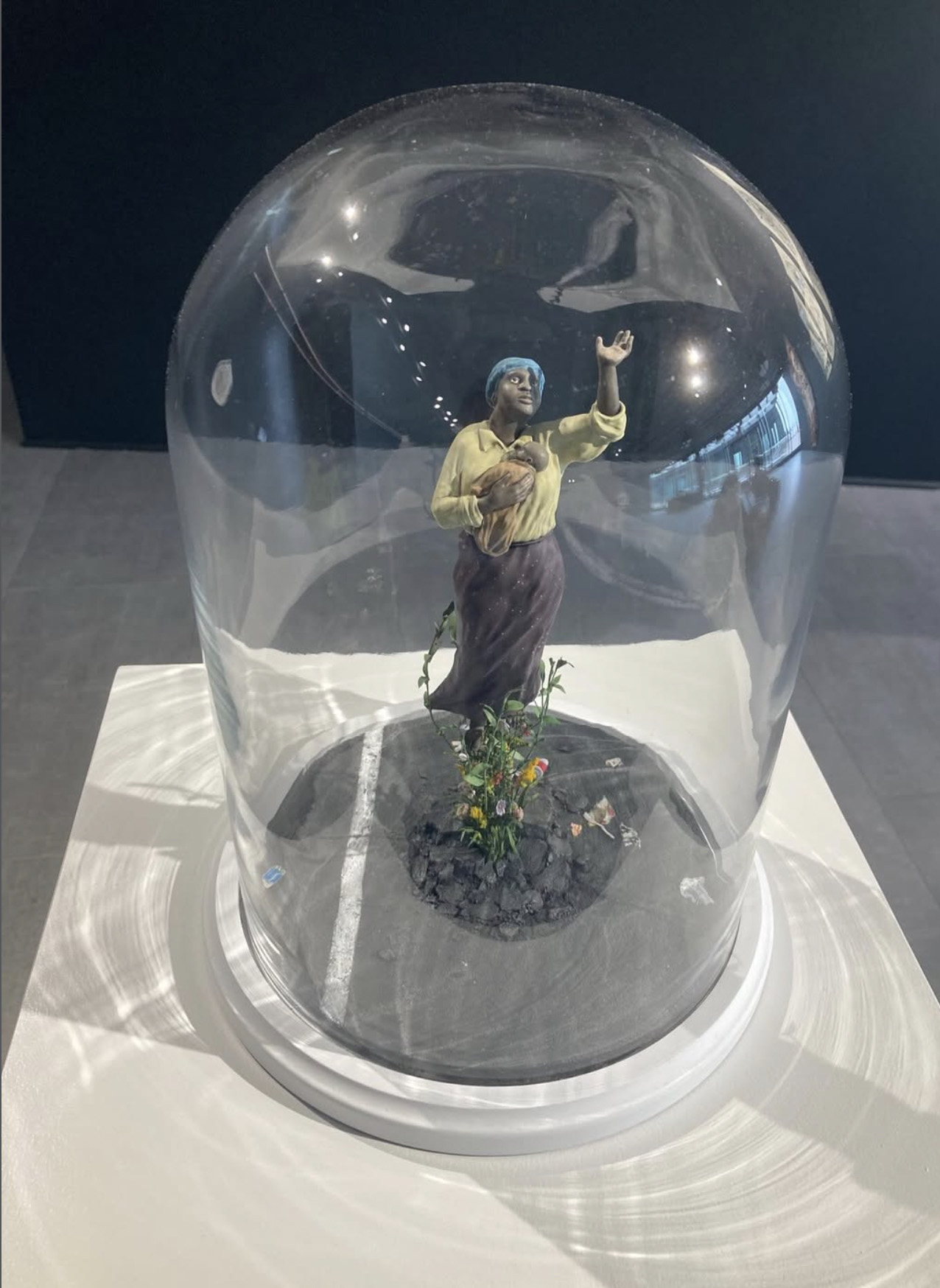
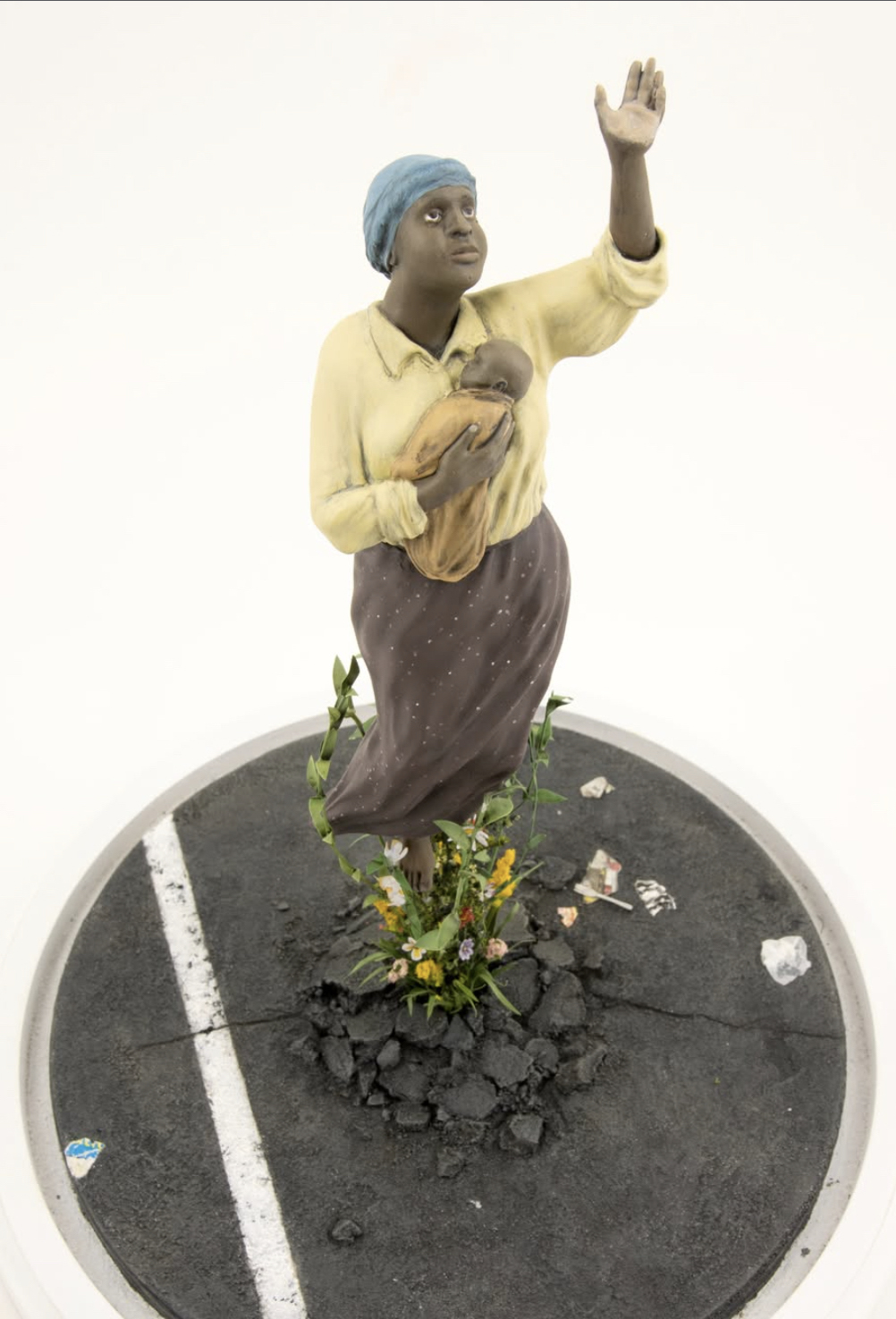
mixed media, 13 x 10 inches diameter (2025)
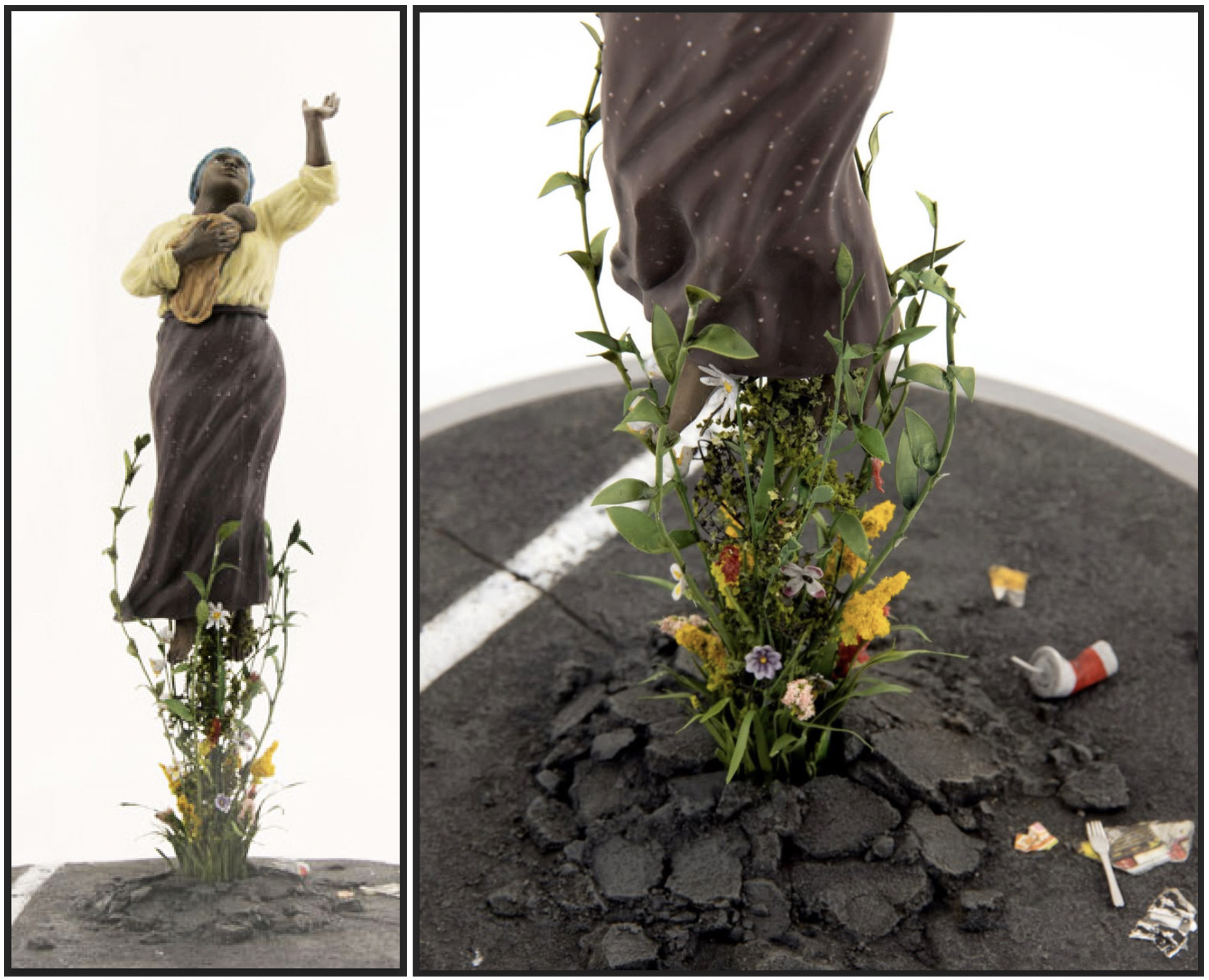
For the Black Cherry Lane: Presence exhibition, he created Ascension, an iconic image of a woman cradling her child with one arm as she grasps toward the heavens with the other, both of them risen up on flora breaking through the asphalt of a trash-strewn parking lot, in a reversal of the burial and coverup their spirits have endured. The figure seems to be from the 19th-century community that once thrived on Cherry Lane, Staten Island, and the setting is from real life (and death), the paving of a stripmall built over possibly hundreds of free and formerly-enslaved people’s graves. The site gets its Miss Liberty, its Motherland, in this image whose power could be held in your hand. I spoke with Doyle about what he has wrought:
HILOBROW: I’m fascinated by the way that you work in a very diminutive form, but, in a piece like this, you convey a gigantic-ness of spirit — how do you see that in terms of this particular work, and your practice in general; what drew you to the miniature, and what do you feel it can encompass?
DOYLE: I’ve worked in miniature for 20 years, and there a lot of reasons, but I find that there’s an intimacy that helps people enter the space; you have to get so close to see all the details, and then you’re sharing something intimate with the work itself. This work is actually the biggest scale I’ve ever done; most of the figures are about an inch tall, [but] she’s maybe 8 inches tall, so, much much larger. It’s still considered miniature, but to make it my regular scale could not tell the story that that tells. A lot of times, when you’re working in a really really small scale, you have to do work outside of the person to tell the story, you can’t focus on a face, because you can’t see the face, it’s too small. This allowed me to work with her pose, and work with the environment and really show her as a person, and [single out] her and her child.
HILOBROW: So I guess you do often work with figures, but they’re not usually as much the focal point?
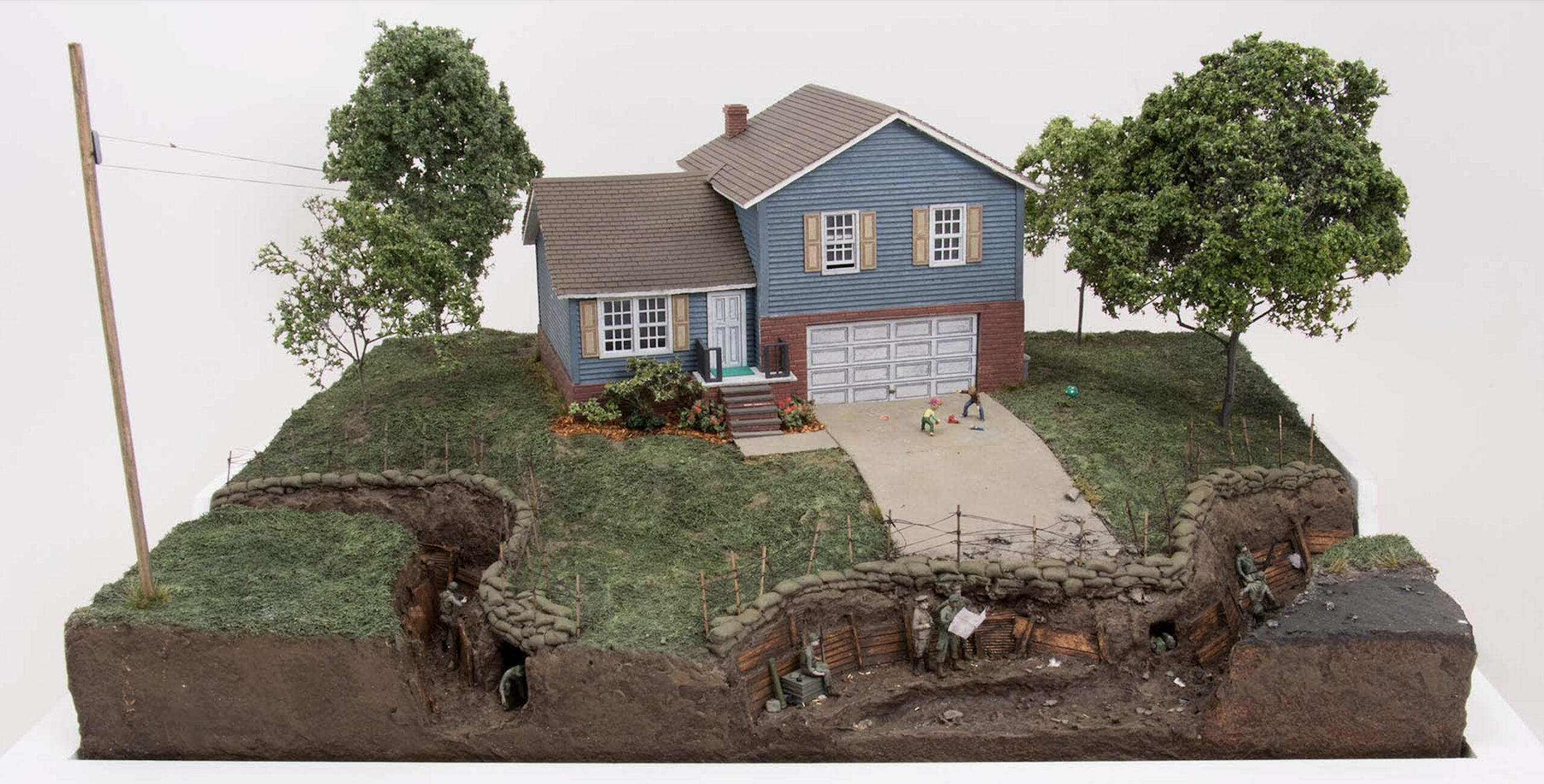
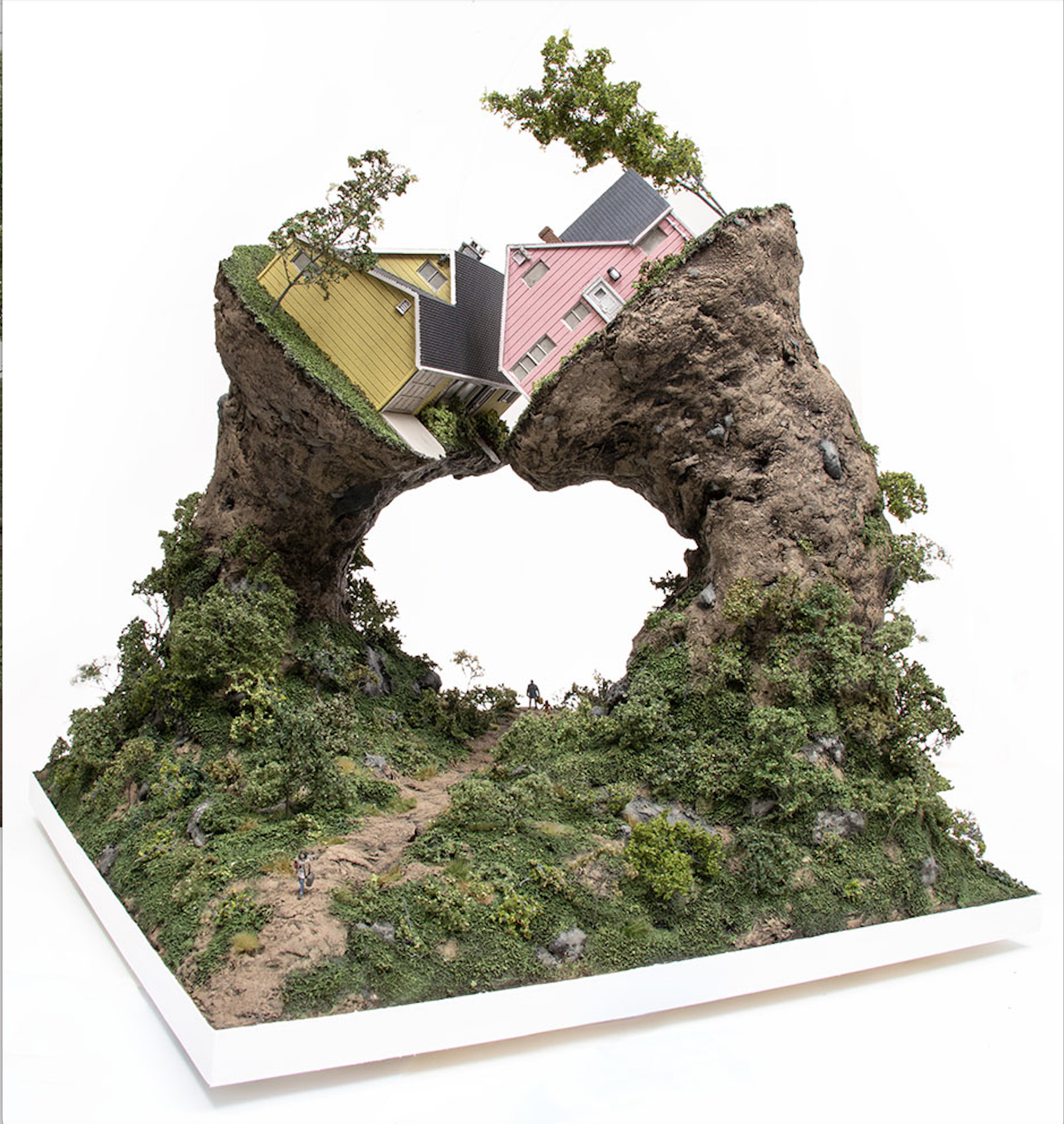
DOYLE: They’re often in the works, but they’re almost, a lot of times there are houses, there are other elements in the work, and it’s almost as if they are tangential, or, they’re supporting the story, they’re very much a part of it, but you can’t get close and have that intimacy.
HILOBROW: So obviously some of it is determined by subject, would you see working at this scale or larger again, or it’s just circumstantial based on what the subject is and what that inspires?
DOYLE: I could see myself working at a larger scale after doing this. There are a lot of reasons I love this exhibition, but one of the reasons that I really loved it is that I tried to, it allows me to push and do something new. Knowing I was doing this, which I had never done before, something this large, it kind of tips you into an area where you can start thinking about new things you will do, now that you’ve done it once. It’s always good to stretch and get pushed into a new direction, and it just opens things up.
HILOBROW: What was your thought process in arriving at Ascension, did you first meet with some of the descendants, or you just heard the concept of the film and the issue and the show…?
DOYLE: I did meet with the descendants on Memorial Day, I went to Sandy Ground and the church service there [a gathering of Cherry Lane descendants with inheritors of Staten Island’s other best-known historic Black community], and a lot of it… I entered this process thinking about the buildings; the churchyard, the church, and thinking about the buildings that are there now, and how do they come together, and in doing that I realized that if you focus so much on those buildings, you’re losing the people. And that’s how I got to where I am; I wanted to juxtapose the land of the now with the people of then.
HILOBROW: Just for my own curiosity, and probably our readers’, what materials do you work in?
DOYLE: She’s sculpted digitally, and then I 3D-printed her in resin; every miniature piece has lots of different things in it; the tarmac is made out of tile grout that’s been painted, the leaves are tiny slices of aluminum foil, a thick aluminum, that’s been painted, and the vines are wire. So it’s just, anything that needs to be made, you figure out a way.
[Keep watching this space for profiles of all the creators contributing to Black Cherry Lane: Presence, and if you’re anywhere near Staten Island between October 1 and 25, come see what they have to reveal for yourself!]