
BRAVE NEW WORLD
By:
October 14, 2026
An installment in EMANATIONS, a series of posts featuring 10 of Josh Glenn’s favorite examples of Radium Age-era fine art that explore a particular proto-sf-adjacent theme. In this case, that theme is DYSTOPIA / UTOPIA. The sub-theme, meanwhile, is…
GOVERNMENT
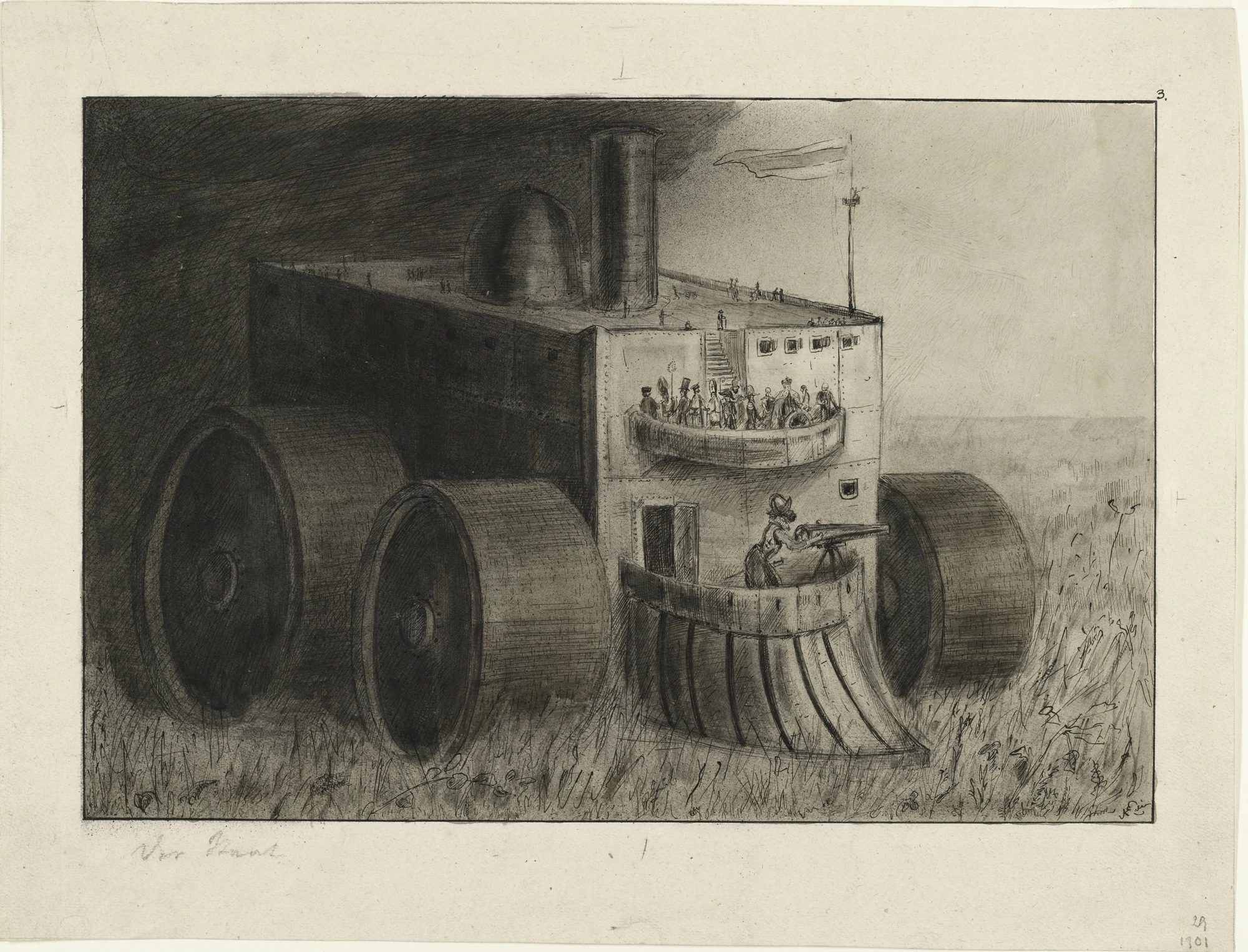
The Austrian artist Kubin’s mental state was a fragile one. In 1897, he was discharged from the military after suffering a profound mental and physical collapse. He enrolled at the Munich Academy, where (before dropping out) the convalescent discovered the Symbolists: Redon, Munch, Ensor, etc. He was particularly influenced, or so his early work suggests, by Klinger and Goya. Beginning c. 1901, he developed a nightmarish visual language communicated via scratchy black-and-white pen and ink drawings layered with soot-colored watercolor washes.
Though most of Kubin’s work expresses psychological phantoms, dreamscapes, cosmic dread, monstrous nature, and death, Government is a political allegory. The artist here imagines the modern bureaucratic state as a juggernaut — that is to say, as inhuman, unstoppable, mechanistic colossus. A massive, grotesque figure — an industrial machine, of sorts — dominates the scene. The “crop” this machine is harvesting, one imagines, is the state’s citizenry — bereft of individual autonomy. The proto-Surrealist psychological impact of this depiction is one of absolute powerlessness and existential dread. Resistance, one feels, is useless.
As mentioned in a previous installment for this series, in his 1909 expressionist novel, The Other Side, which predates Kafka’s similar writings, Kubin would further explore suffocating, irrational bureaucratic control and nightmarish social machinery.
THE ENIGMA OF A DAY
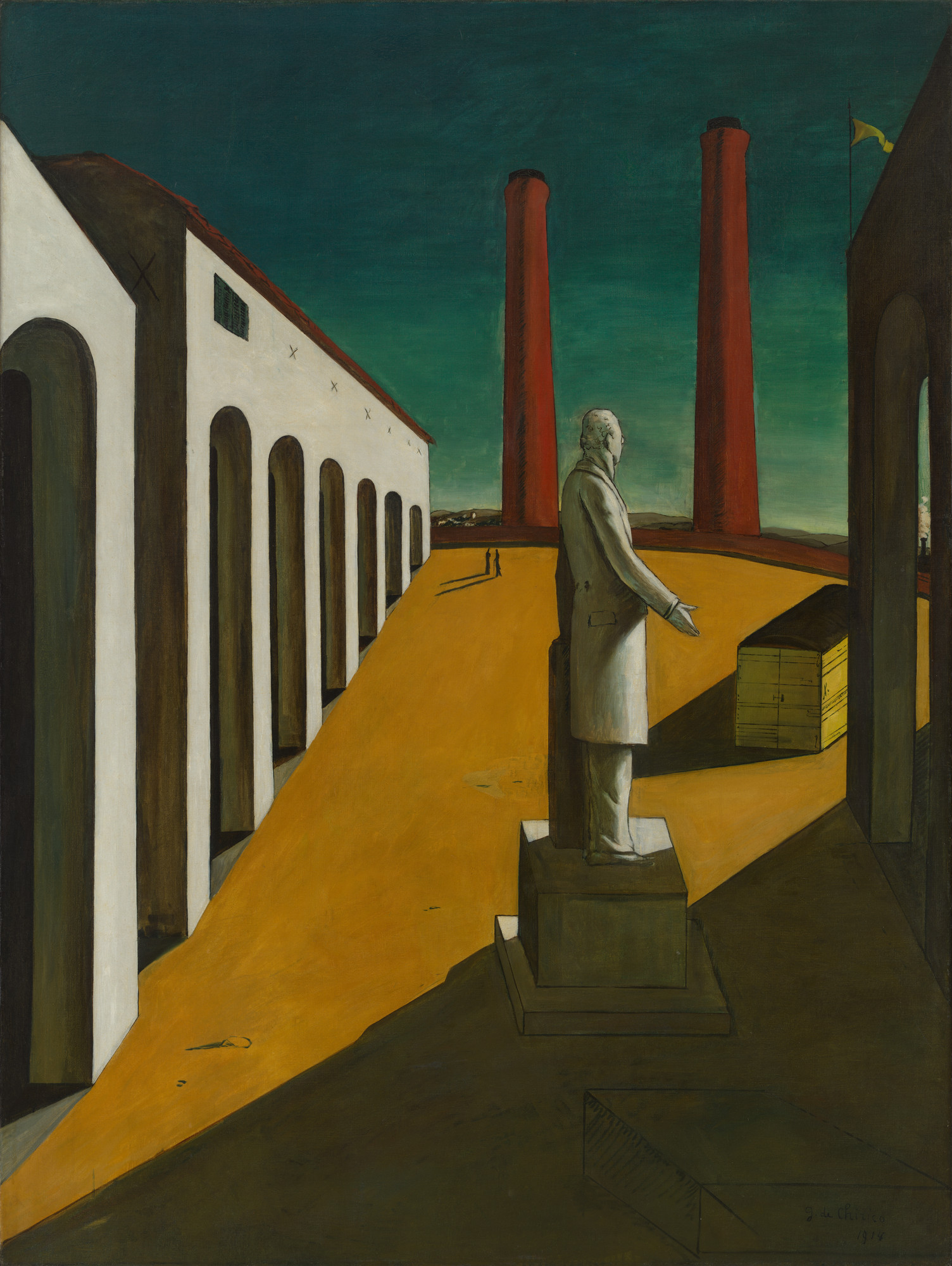
Modern smokestacks towering over an almost entirely depopulated Roman-style piazza featuring sub-bleached arcades, ominous containers, Cubist-esque flattened spatial structures, multiple conflicting vanishing points and distorted perspectives (the orthogonal lines of the arcades recede at a radically steep angle while the piazza floor tilts upward; the real world is made to appear like a stage), exaggerated raking shadows cast by some unseen structure outside the frame….
The atmosphere is one of melancholy and menace. Decades before the Surrealist movement began, de Chirico’s early “Metaphysical” paintings suggest that a hidden, unsettling mystery lurks beneath the surface of the everyday. If this is a dream we’re glimpsing, then it’s an eerie, claustrophobic dream. And if it’s a vision of the future… then what happened here? Did the rest od the population just… go up in smoke?
The towering marble statue — a politician, one assumes; perhaps a military leader — seems to deliver a passionate oration to nobody. Is this a clue?
THE 20TH CENTURY
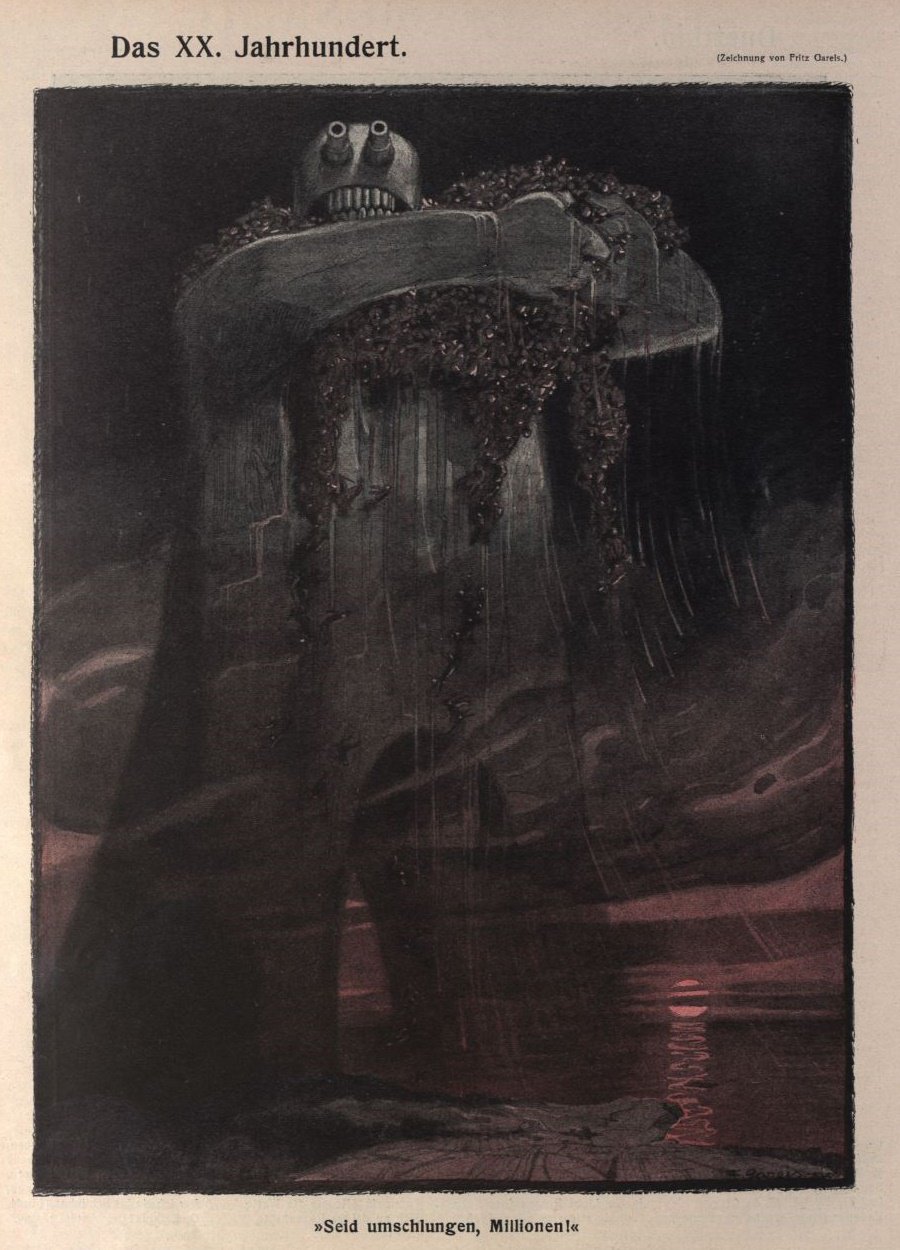
Made by Gareis, an Austro-Hungarian artist, during WWI, this poster (originally published in the Viennese satirical magazine Die Muskete), depicts modern industrialized warfare as a monster massacring people. Its title, “Be embraced, you millions!”, mocks the famous line from Schiller’s “Ode to Joy.”
The figure’s face is grim, expressionless; gun barrels serve as its eyes. Its body, which occupies nearly the entire vertical axis of the composition, and which looms over a scorched, desolate landscape, is a fused mass of metallic plating and weaponry. Neither robot nor giant, this grimacing, unfeeling colossus is a biomechanical horror.
As in Kubin’s “Government” (above), here the bureaucratic modern state is depicted as a mechanical killing / dominating juggernaut. At least Kubin’s mechazoid seems to be controlled by human figures, though. Gareis’s has either gone berserk… or it was never controlled to begin with. What is it doing with the people it’s snatched up and crushed? Is it using them as fuel?
GERMANY, A WINTER’S TALE
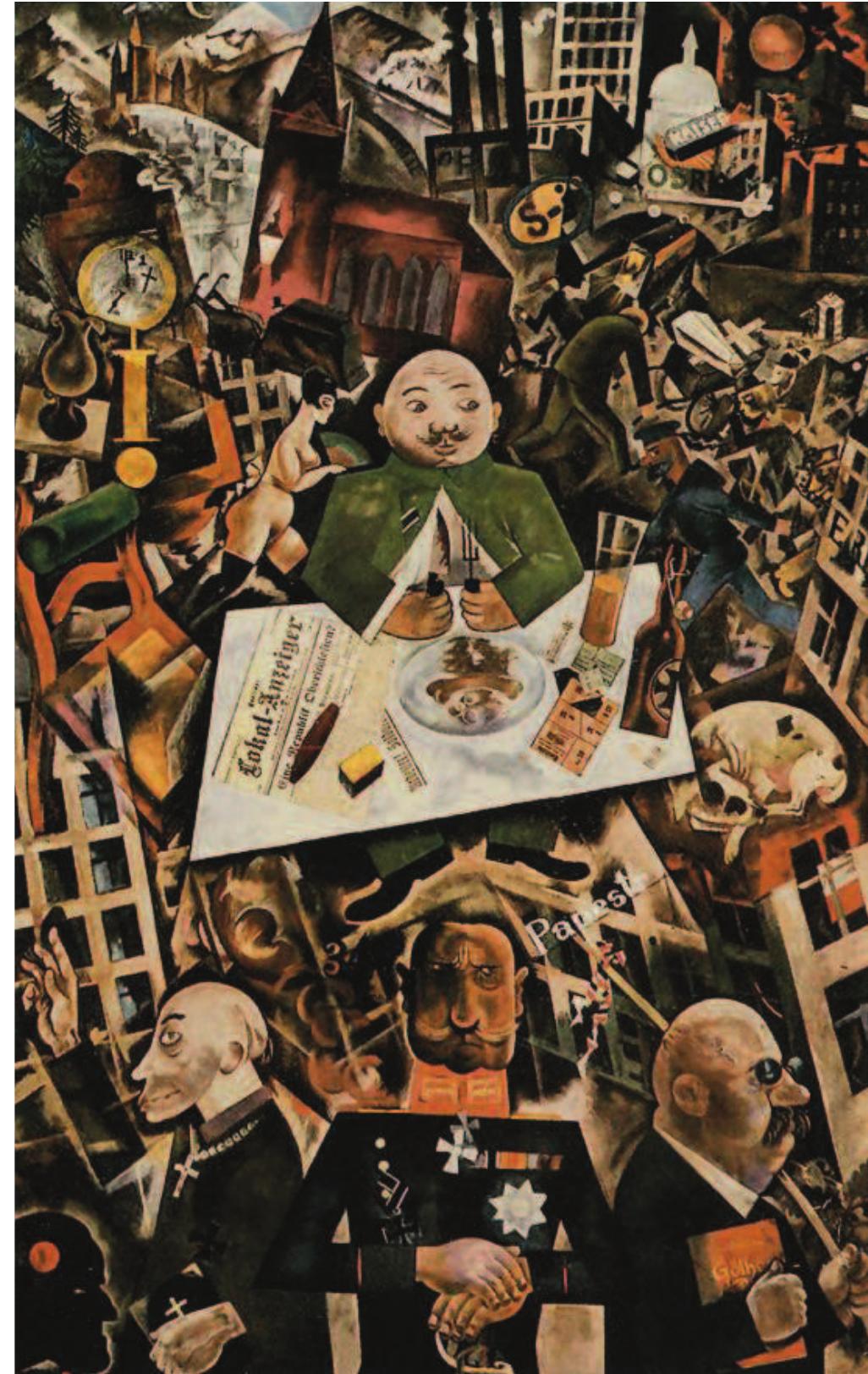
Grosz suffered multiple nervous breakdowns and psychological collapses during World War I due to the trauma of military service. Inspired by the expressive Cubism of the Futurists, while convalescing upon his return to Berlin, and while producing his photomontages, he produced bitter, savage paintings like this one. A marionette-like bourgeois “good citizen” sits obediently and unquestioningly, if a bit anxiously, at his evening meal. Meanwhile, his country is manipulated by a dystopian triumvirate of forces represented by the three figures in the foreground: a hypocritical clergyman, a brutal general, and an sinister schoolmaster who clutches a volume of Goethe. The city — controlled, yet morally vacant, populated by a revolutionary sailor, a prostitute, violent types, and other lost souls — collapses into jagged lines.
The composition’s title references an 1844 satirical poem by Heine (“Deutschland. Ein Wintermärchen”), which criticized German militarism and reactionary chauvinism (i.e., nationalism), and which was immediately banned in the Austrian Empire. Here’s Heine on the Prussian military: “These people are still the same wooden types, / Spout pedantic commonplaces — / All motions right-angled — and priggishness / Is frozen upon their faces.”
Grosz’s painting served as a massive centerpiece at the First International Dada Fair in Berlin in 1920. Because of works like this, the Nazi regime would label Grosz “Cultural Bolshevist Number One.” The original painting is presumed destroyed or lost; it disappeared around 1935 after being labeled “degenerate art.” A surviving watercolor and red pen-and-ink study was later discovered; official reproductions and documentation of the lost painting are held by institutions such as the Akademie der Künste in Berlin.
THE NEW ADAM
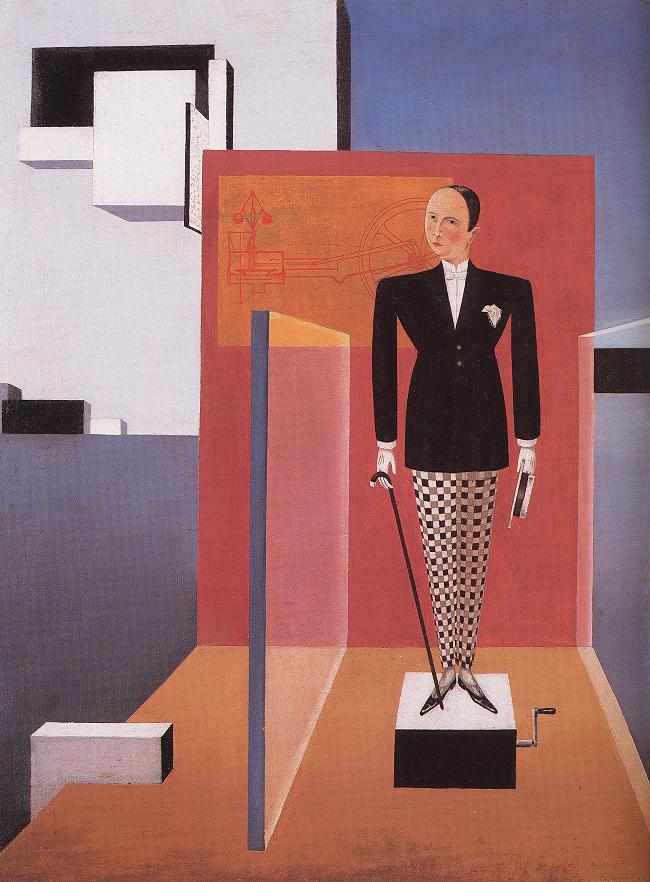
Having spent time in Weimar interacting with Bauhaus artists, in this painting and its companion piece, “The New Eve” (also 1924), the Hungarian artist Sándor Bortnyik challenged the Bauhaus’ naive utopian faith that technological progress and functional design could seamlessly reshape human society. This work’s abstract gemoetric cityscape, and the mechanical diagram on the wall behind the central figure, reference, satirically, both Russia’s Constructivism art movement — which was closely associated with that country’s post-October revolution Bolshevik government — and the functionalist aesthetic of the Bauhaus.
Bortnyik’s title references the “new man” that both Soviet Communism and Italian Fascism, during this period, aimed to develop. More specifically, it references the Weimar-era ideal of remaking the human body, mind, and society to survive and master a rapidly industrializing, mechanized world. Here, the “New Adam,” who poses stiffly on a platform equipped with a wind-up handle, is an extremely fashion-conscious man who is both hollow (like a tailor’s dummy) and fragile like a clockwork puppet. The new man, Bortnyik warns, is becoming mechanical and superficial.
Maximilan Wahlich, on the Weimar-era “new man” ideal:
The “new man” was a construct of a mass society oriented towards rationalization and economization. These developments already harbored initial fascist elements.
The New Eve, meanwhile, features a similarly hollow, easily manipulated female mannequin. (She’s even more machine-like than her male counterpart, an assemblage of tube-like cylindrical shapes.) Both the new Adam and the new Eve are trapped in sterile, highly modern and functional spaces.
There is a suggestion of de Chirico’s Metaphysical art, here, too. There’s something both dreamlike and deeply alienating about Bortnyik’s mise-en-scène, here.
THE MAN WITH A WHIP
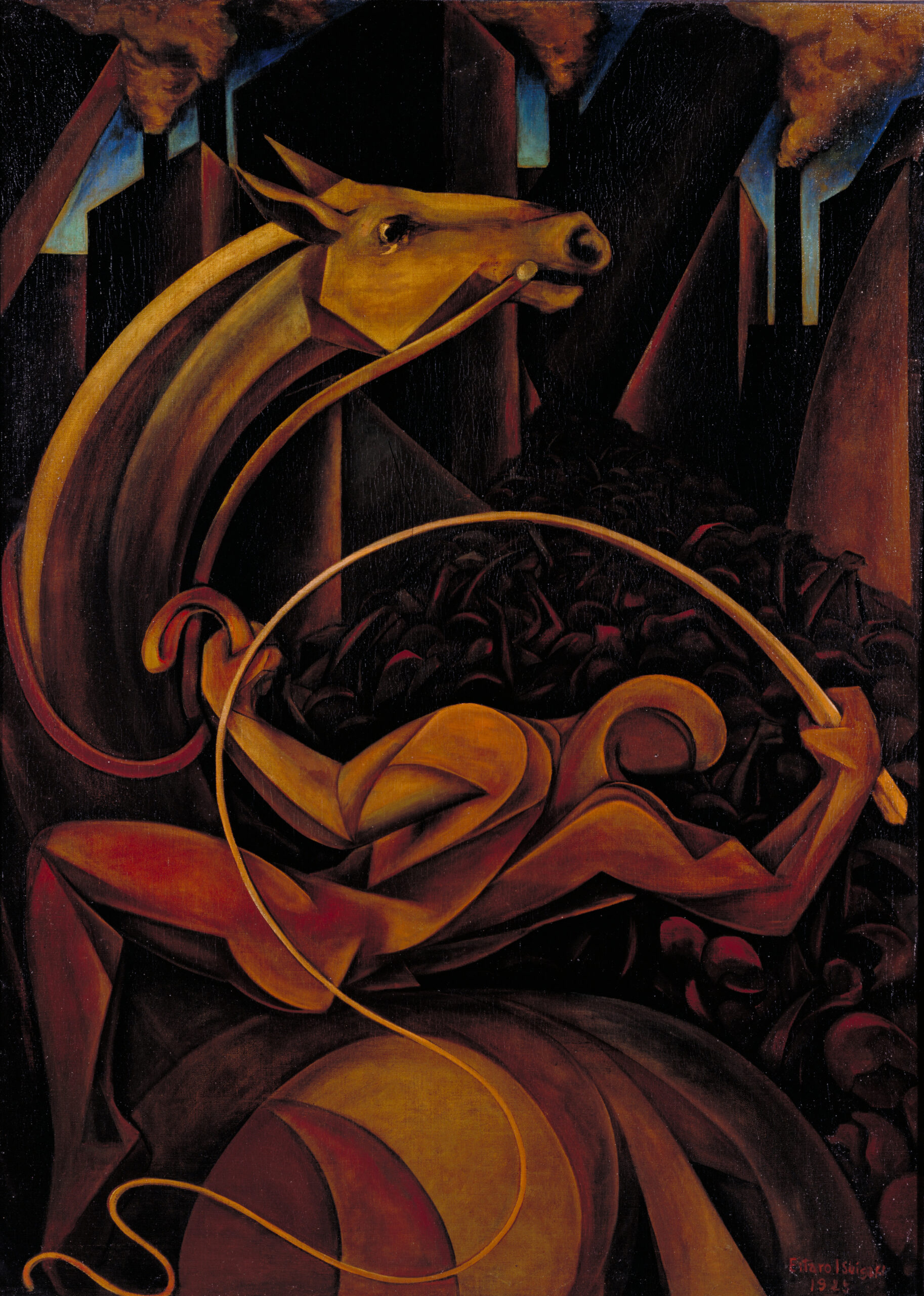
Ishigaki, who came to the US from Japan as a migrant worker, was a committed anti-authoritarian artist and activist. (In 1929 he helped found the John Reed Clubs, a federation of local American organizations for Marxist writers, artists, and intellectuals; Richard Wright, John Dos Passos, Kenneth Fearing, and others joined these clubs.) He is best known for The Bonus March (1932), a Diego Rivera-inspired painting depicting the protest of the so-called Bonus Expeditionary Force.
The Man With a Whip (also referred to as Whipping) was exhibited at the 1925 Society of Independent Artists exhibition; it was the artist’s official American début. It depicts a powerful, menacing man on horseback cracking a whip. A crowd of people are (according to some art historians) chased from their homes; or perhaps they are strikers who’d been protesting outside the smoking industrial buildings that loom in the background. Industrial progress, one understands immediately, has been achieved in the USA at the cost of human exploitation and displacement.
This scene of state-sanctioned violence and authoritarian control, and of capitalist oppression and the displacement of the working class, is rendered in a style that is Cubist — the man and his horse are composed of sharp geometric forms — but at the same time sinuously dynamic, animated, forceful. Critics at the time praised its “American” avant-garde style.
METROPOLIS
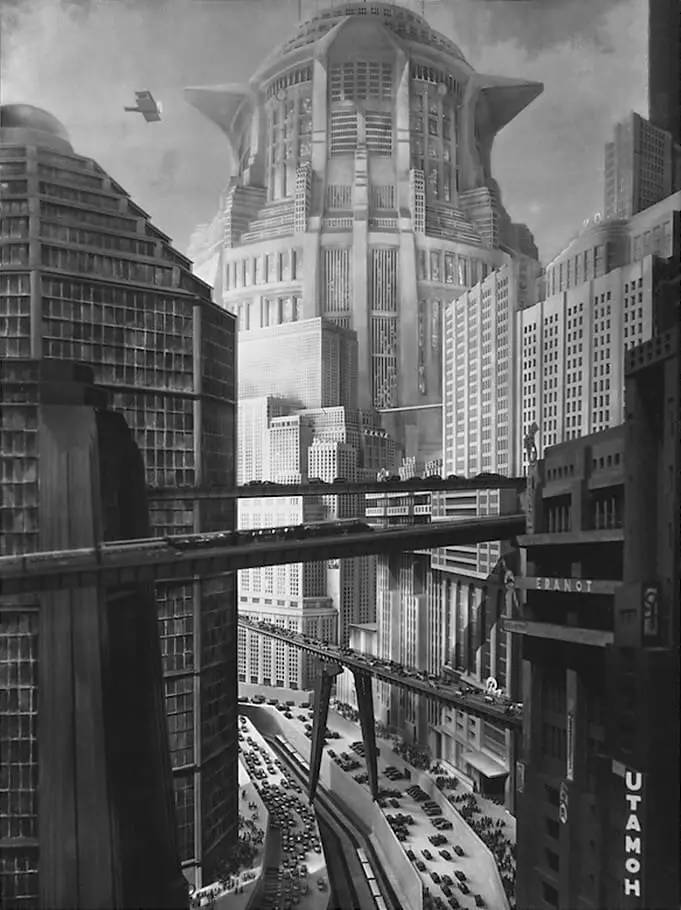
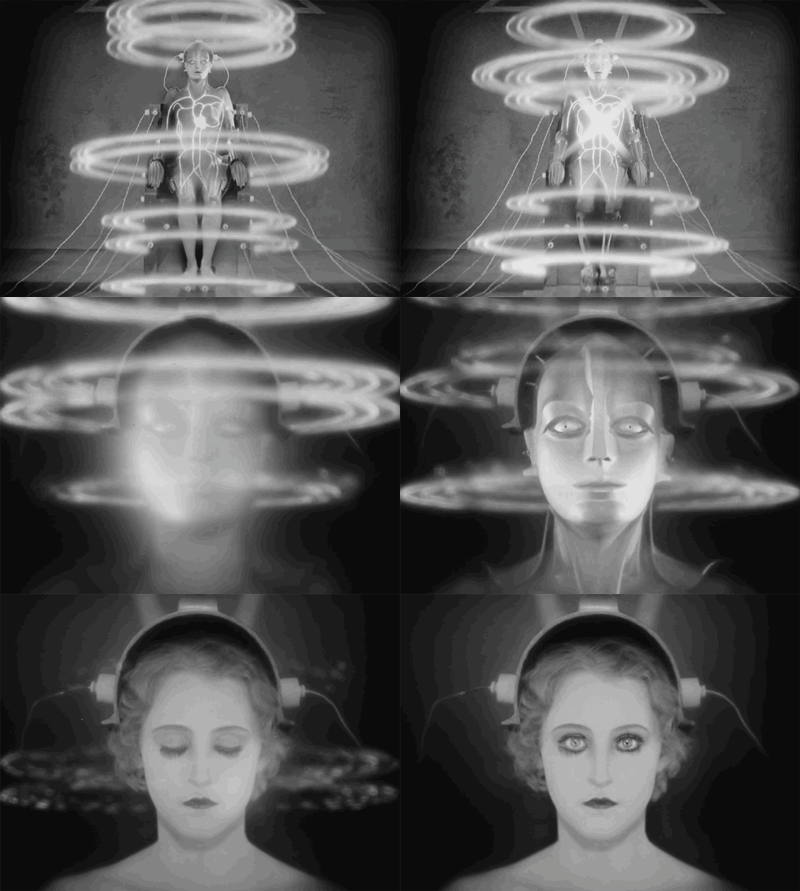
Fritz Lang’s 1927 film Metropolis is widely regarded as the first true dystopian movie. Though it may seem like cheating to include it in this survey of dystopia-themed fine art, the movie’s set design — built under Otto Hunte, Erich Kettelhut, and Karl Vollbrecht using massive 1/16th and 1/100th scale miniatures, flat wooden models, and the groundbreaking Eugen Schüfftan mirror process — is iconic. The visual foundation for modern sci-fi cinema — from Blade Runner and Brazil to Batman’s Gotham City — was set by this movie.
The titular hyper-mechanized, rigidly stratified future city dreamed up by Lang and Thea von Harbou — a dystopian city-state in which human beings are subjugated by the technology they operate — is depicted here strikingly. The rigid caste system is represented by the stark opposition between the Deco-style upper world (paradise-like luxury atop towering skyscrapers, inspired by New York City’s imposing geometry) and the Expressionist-style underground (a realm of dark shadows and distorted angles, where thousands of robot-like workers, moving in synchronized lock-step, toil away operating massive, relentless machines).
FROM ABOVE
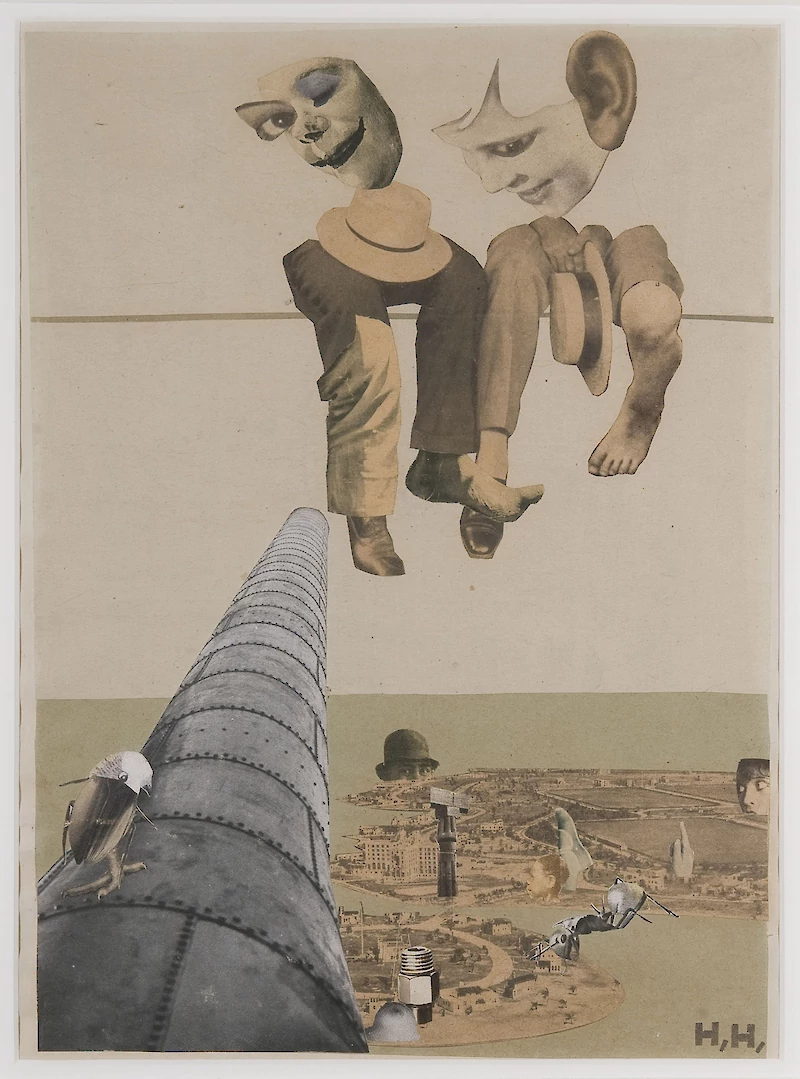
Höch’s Dadaist photomontage From Above offers a socio-political critique of Weimar Germany, and a satire of the emergent mass media. It represents a turning point in her career, as she evolved away from the chaotic maximalism of early Berlin Dada toward a more structured, geometrically precise aesthetic influenced generally by New Objectivity (Neue Sachlichkeit) and Constructivism, and specifically by László Moholy-Nagy and Jan Tschichold.
As the phrase “From Above” suggests, here Höch positions the viewer in an aerial, detached vantage point — we are complicit in the cold, rationalized, panoptic gaze of technological modernity. The work’s elements are organized into sharp, clean lines and intersecting planes, against which are juxtaposed partial human faces and limbs, mixed with mechanical components, architectural grids, and mass-produced media elements. We’re surveilling the shattered, half-roboticized citizen of the rapidly modernizing Republic. A large industrial smokestack / chimney or pipe venting system protrudes like a phallic artillery weapon. The mass-media elements here suggest that our very perception of reality is entirely curated, cut apart, and reassembled by those in control.
The composition’s tilting angles, fragmented structures, and overlapping media clippings work together to create a space that feels volatile and claustrophobic. The structured, utopian “city of the future” has instead manifested — as in Metropolis — as an overwhelming, chaotic labyrinth.
Höch’s work would become a target of cultural purging. From Above would be singled out as an example of “un-German” and “Jewish manifestations” in modern art. Höch, by the way, was not Jewish. However, when asked in 1933 by a German artist cooperative to affirm support for National Socialism and deny Jewish descent, she wrote “nein” on the letter and resigned.
UNTITLED COVER FOR THE CRISIS
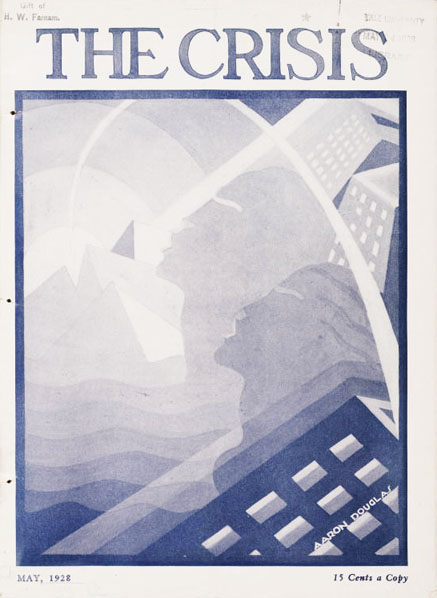
Aaron Douglas, a major figure in the Harlem Renaissance, created several cover illustrations — and interior illustrations too — for The Crisis, the official magazine of the NAACP. At the level of form these works typically connected ancient African civilization with the modern urban experience.
Douglas’s work pioneered a proud African American modernist aesthetic, though there’s often a dystopian subtext. Modern industrial capitalism (signified via towering factories, smoking chimneys, and industrial gears), and its exploitation of Black labor (depicted as silhouettes with bowed heads or strained posture, buckling under the weight of heavy industry or modern civilization). Black men built the mechanism of the modern world, works like this one inform us; and now they’re trapped in its gears.
But there’s good news. Concentric waves or beams of light radiating from a saxophone, a book, or a raised hand, for example, suggest that the jagged, dark geometry of Deco skyscrapers or factories can and will be overcome. Egyptian pyramids or African masks remind us that African Americans are descended from a glorious heritage, and offer hope that African Americans will outlast modernity. (In the image above, the pyramids appear to be emerging, the skyscrapers toppling.) By juxtaposing light and dark, ancient and modern, Douglas suggests that the way forward cannot be separated from looking back; and that no dystopia will last forever.
THE ANNUNCIATION
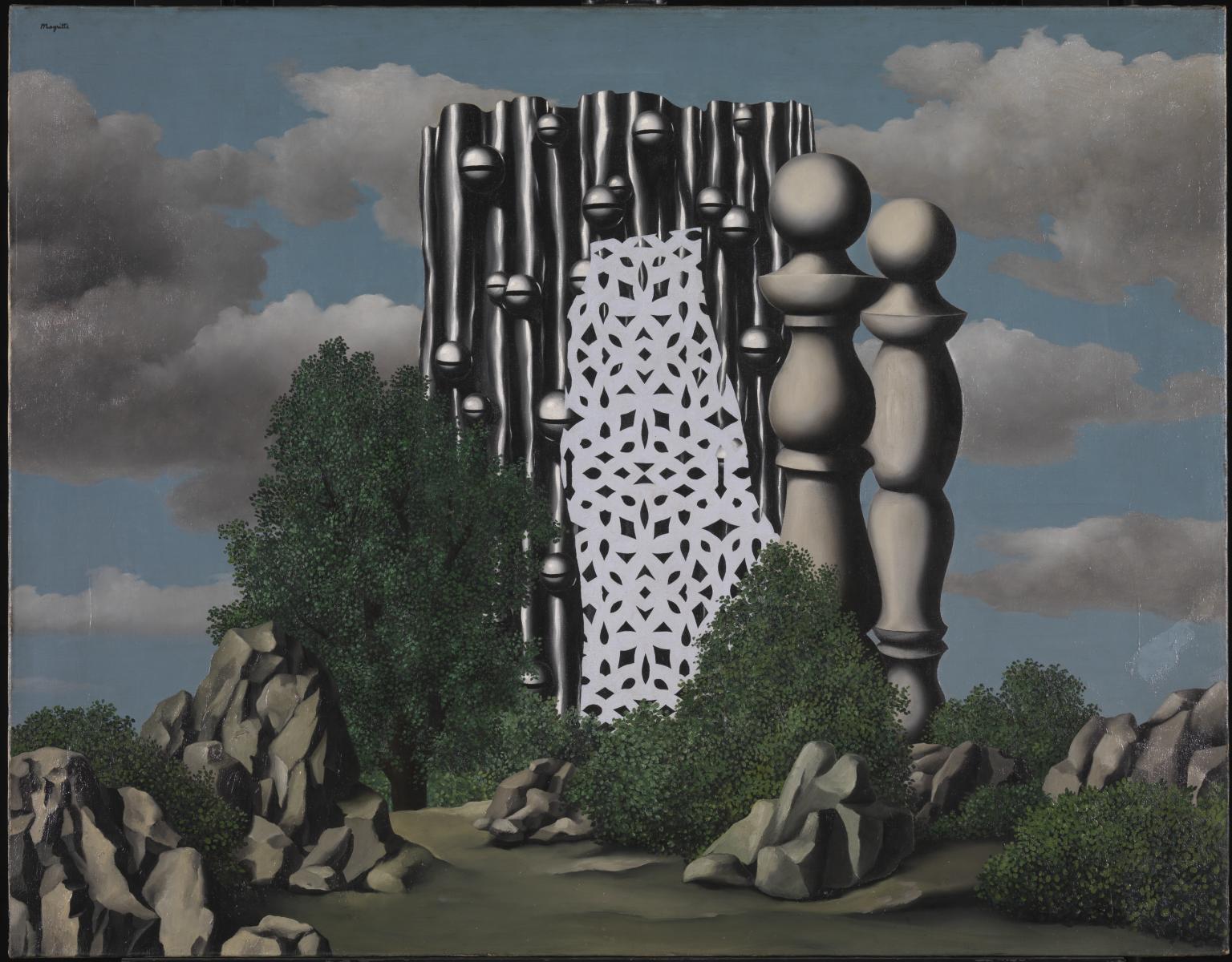
“Annunciation” is most commonly used in Christianity to describe the archangel Gabriel’s announcement to the Virgin Mary that she would conceive and bear Jesus Christ. Magritte’s surrealist painting The Annunciation, which combines ordinary or architectural elements — including oversized wooden balusters (in place of Mary and Gabriel), a massive, grey metal sheet studded with machine-like sleigh bells, and cut-paper shapes — in an impossible, dreamlike way, announce something else.
The imposing, cold metal barrier depicted here, the ominous sense of looming menace, the heavy, grey-clouded sky: These combine to suggest a Metropolis-like totalitarian state, the citizenry of which is surveilled and constrained… or marginalized… or entirely eradicated. There’s an eerie sense of anticipation. We are waiting for an “annunciation” — an announcement from on high. From whatever grim authority created this monolithic structure. But we’re not going to enjoy the news.
PS: Magritte’s painting rates an oblique mention in J.G. Ballard’s 1970 sf-ish non-linear novel The Atrocity Exhibition (1970):
Dr Nathan studied the walls of the empty room. The mandalas, scored in the white plaster with a nail file, radiated like suns towards the window. He peered at the objects on the tray offered to him by the nurse. “So, these are the treasures he has left us — an entry from Oswald’s Historic Diary, a much-thumbed reproduction of Magritte’s ‘Annunciation’ and the mass numbers of the first twelve radioactive nuclides. What are we supposed to do with them?” Nurse Nagamatzu gazed at him with cool eyes. “Permutate them, doctor?”
Josh Glenn’s EMANATIONS series includes the following installments: CATASTROPHE: DECLINE & FALL | DYING EARTH | ECO-CATASTROPHE. COSMIC AWE: DEEP TIME | STARS WHEEL IN PURPLE | IS THERE LIFE ON MARS. DEHUMANIZATION: CYBORG MANIFESTO | MECHANIZATION. & many others.
MORE RADIUM AGE SCI FI ON HILOBROW: RADIUM AGE SERIES from THE MIT PRESS: In-depth info on each book in the series; a sneak peek at what’s coming in the months ahead; the secret identity of the series’ advisory panel; and more. | RADIUM AGE: TIMELINE: Notes on proto-sf publications and related events from 1900–1935. | RADIUM AGE POETRY: Proto-sf and science-related poetry from 1900–1935. | RADIUM AGE ART: Proto-sf and science-related fine art from 1900–1935. | RADIUM AGE 100: A list (now somewhat outdated) of Josh’s 100 favorite proto-sf novels from the genre’s emergent Radium Age | SISTERS OF THE RADIUM AGE: A resource compiled by Lisa Yaszek.