
DYING EARTH
By:
April 23, 2026
An installment in EMANATIONS, a series of posts featuring 10 of Josh Glenn’s favorite examples of Radium Age-era fine art that explore a particular proto-sf-adjacent theme. In this case, that theme is CATASTROPHE. The sub-theme, meanwhile, is…
AN ABANDONED CITY
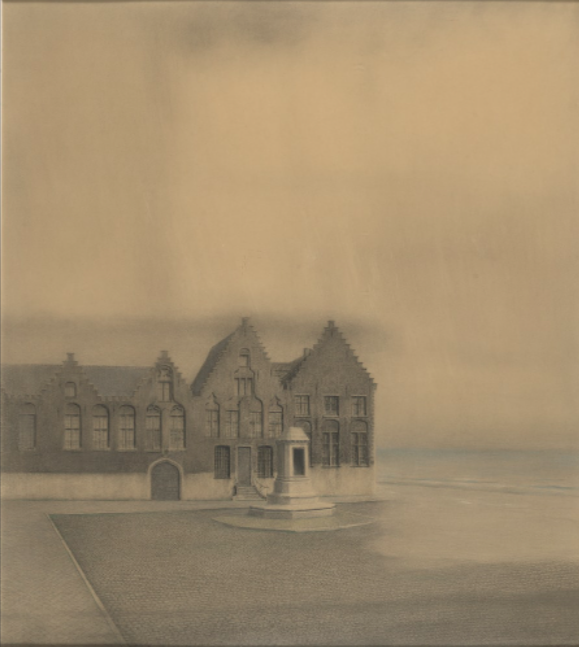
The Symbolist movement was a reactionary one — it represented a reaction against the positivism and utilitarianism of the Enlightenment. Many Symbolist artists and writers (such as the Russian Symbolist Valery Bryusov, say, whose apocalyptic 1907 story “The Republic of the Southern Cross” I included in the collection More Voices from the Radium Age) predicted — devoutly wished for, really — catastrophe, an utter destruction of bourgeois, progress/efficiency-obsessed society and culture. After a period of wars and great suffering, they predicted, a new, spiritually higher era for humankind would commence.
In this pastel Khnopff (1858–1921), a Belgian symbolist painter and one of the founding members of the avant-garde group Les XX, depicts the Woensdagmarkt square (in the historic center of Bruges) as silent and deserted. This is a depiction of the artist’s own memories and emotional state rather than an attempt at realism; the city becomes the artist’s “soulscape.” The base of the Memling statue (a monument to a Flemish Old Master) is there, but the statue is gone; even the city’s history, it seems, has been erased here… along with most of its buildings. The North Sea, or so it appears to me, has inundated the rest of Bruges.
This work, one reads, was influenced by the Belgian Symbolist Georges Rodenbach’s short 1892 novel Bruges-la-Morte, the title of which is self-explanatory. Fun fact: David Bowie’s 2013 song “Dancing Out in Space” takes inspiration from the same novel.
THE PAST
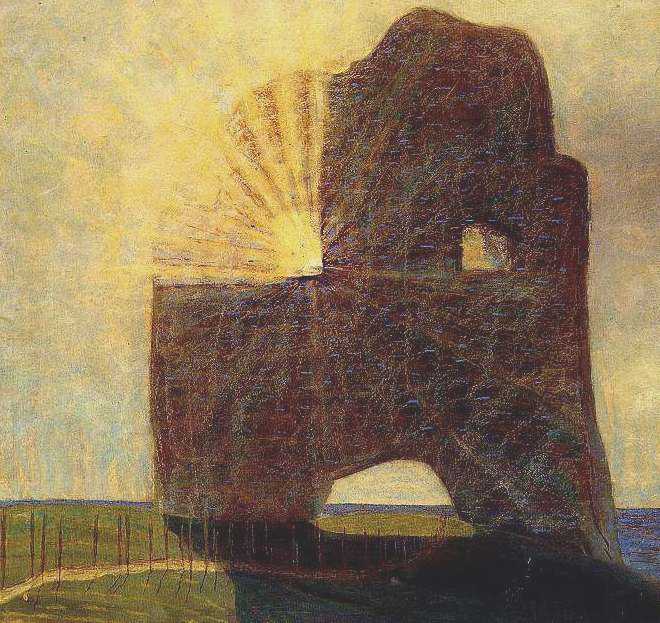
A quietly powerful, deeply atmospheric Symbolist work by the Lithuanian composer and artist Mikalojus Konstantinas Čiurlionis (1875–1911). A monumental dark form, which might or might not be the decaying remnant of something manmade, and which also looks something like a human skull, looms before a luminous sky. It’s a visual meditation on the passage of time, and a Theosophy-influenced reflection on the transition between human life and the spiritual world.
RED CITY
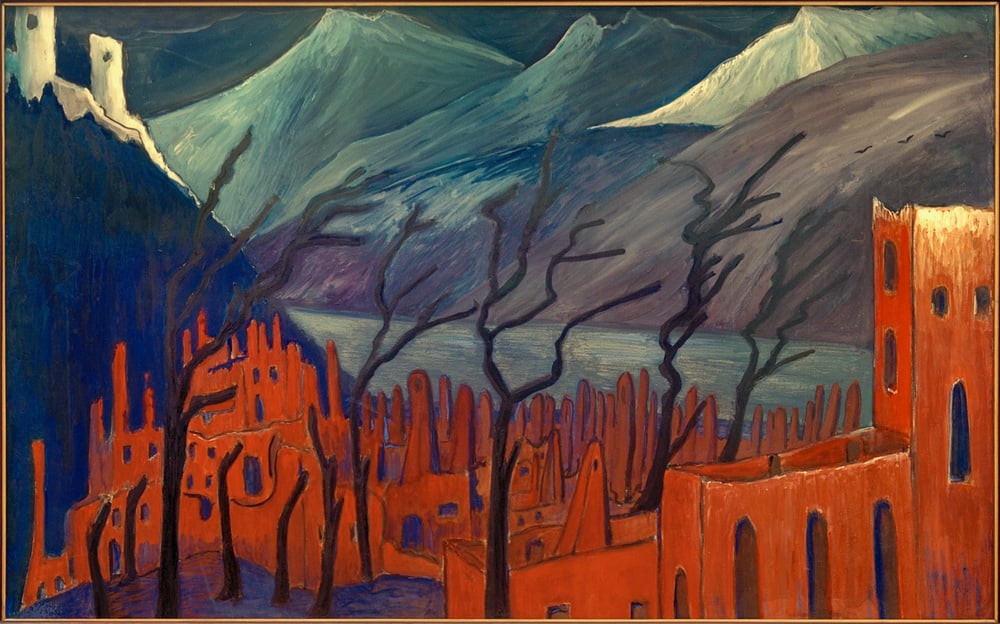
The artist was a friend of Kandinsky’s, and with him helped found a “secessionist” group in 1909; it paved the way for the Blaue Reiter group, which would be created in 1911.
Werefkin’s Expressionist painting seems to depict a future in which industrialization first killed the natural world (the dead trees, the mountains leached of color) and then the human world too. It’s a twilight scene, the end of everything.
Are all of those narrow structures — which rise higher than the one church steeple (seen near bottom right) supposed to be factory smokestacks? If so, no wonder everything has died.
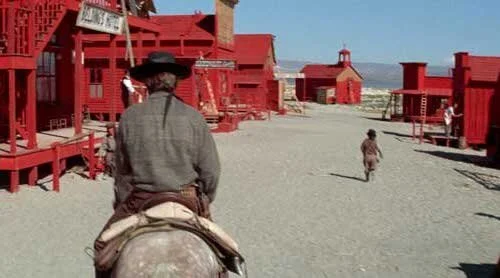
PS: The dead city’s glaring red structures remind me of High Plains Drifter, where a mysterious stranger forces the citizens of a corrupt Western town to paint every building red… and rename the town “Hell.”
DEAD CITY III
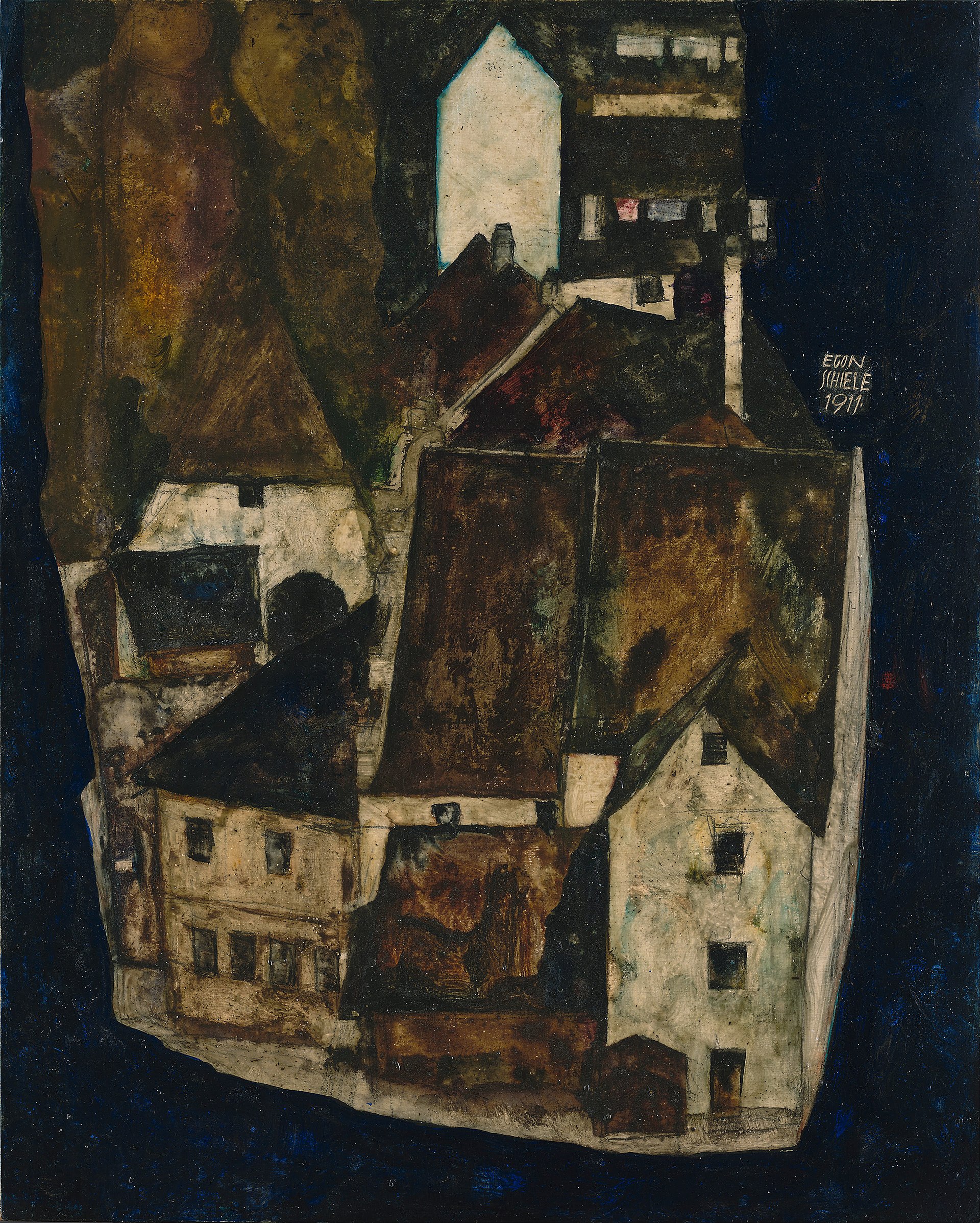
According to the Leopold Museum’s website:
The motif of the Dead City first appeared in 1910 in connection with Egon Schiele’s (1890–1918) first longer stay in Český Krumlov/Krumau, where he spent the summer with his friends Erwin Osen and Anton Peschka. The city of his mother’s birth, with its medieval character, would feature in his oeuvre like no other. The artist described the present small-scale panel painting, created in 1911, as that with the “most serious colors”. The palette is indeed reduced — the dark earthy tones of the roofs overrun the pale white house walls like moss and are only broken up by the cool, blackish-blue surface of the water surrounding the group of houses. In terms of motif, Schiele oriented his depiction on the structure of tightly packed houses crowding the sweep of the Vltava River, choosing the elevated castle plateau as his vantage point. The compacted conglomerate appears deserted; the few traces of human presence, like the washing on the line, make the absence of people felt even more keenly. The Dead City is an allegory of loneliness and isolation.
PS: Schiele’s painting was owned by the the Jewish Viennese cabaret artist and songwriter Fritz Grünbaum before he was murdered in the Holocaust. Its provenance — was it sold by Grünbaum’s family, or stolen from them? — has been the object of high-profile disputes and court battles.
THE SCAVENGER
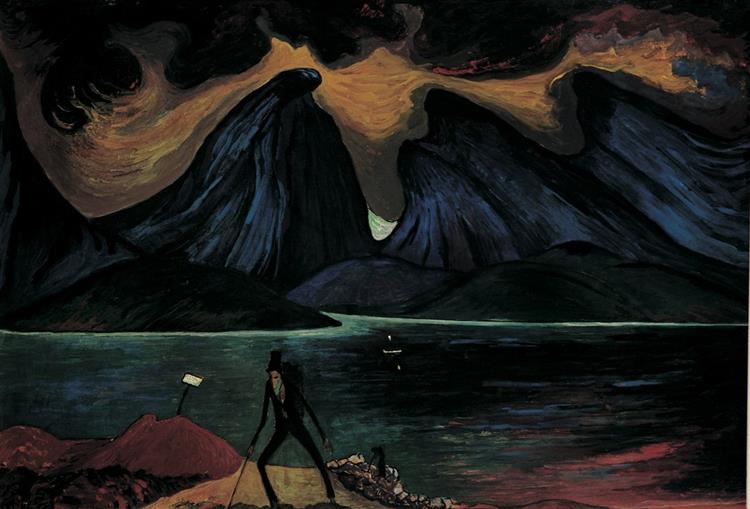
Werefkin was the only artist close to the Blaue Reiter circle whose work focused on social issues — the world of human labour and factory work. Here, solitary rag-pickers (it’s hard to make out the second one, in the background) forage in a vast dumping ground, presumably on the edge of a city.
The apocalyptic aspect of the scene depicted here — it’s a world given over to devastation — is likely inspired by the outbreak of the First World War. Werefkin left Germany for Switzerland, around this time. Her paintings from this period draw inspiration — bold simplification, flattened spatial perspective, strong use of color — from Symbolism, Van Gogh, Gauguin, the Nabis, Edvard Munch, and Ferdinand Hodler.
SEVERAL CIRCLES
HEAVY CIRCLES
BLACK INCREASING
I’ve included three Kandinsky paintings in this installment. I tend to agree with the art historian Pepe Karmel that the abstract stars and planets of Kandinsky’s oeuvre become rapidly less joyous, more foreboding during the early 1920s… and that this shift is attributable to the artist’s changing opinion of the Russian Revolution.
Following his return to Moscow in 1914, Kandinsky felt aligned with the revolutionary energy of 1917. He served as a cultural pedagogue and helped develop art education structures for the Bolshevik government. However, his artistic philosophy centered on internal spirituality, which clashed with communist officials who favored “socialist realism” — art that was realistic, functional, and served propaganda purposes. Confronted with mounting hostility from fellow artists in the new regime, Kandinsky left Russia in 1921 to join the Bauhaus in Germany.
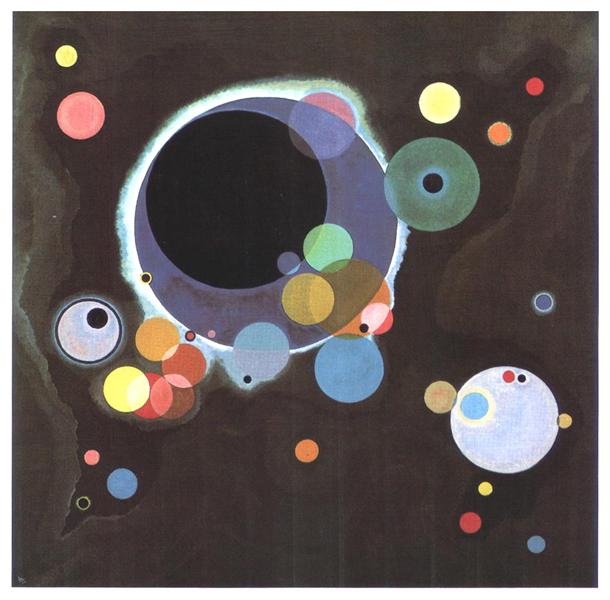
The planets’ and suns’ glowing colors are here shrouded in dark veils.
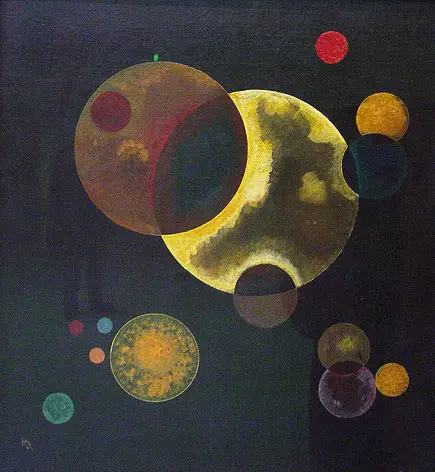
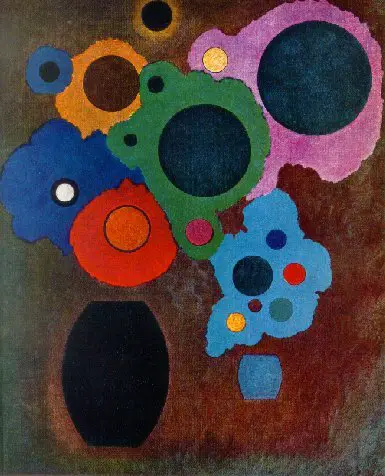
The central, aggressive black form suggests, one reads, “absence of possibility” or a sinister force, while lighter geometric shapes around it may represent hope or dawn. The dusty-smoky background contributes to a tense, somewhat apocalyptic mood.
PREMATURE OSSIFICATION OF A RAILWAY STATION
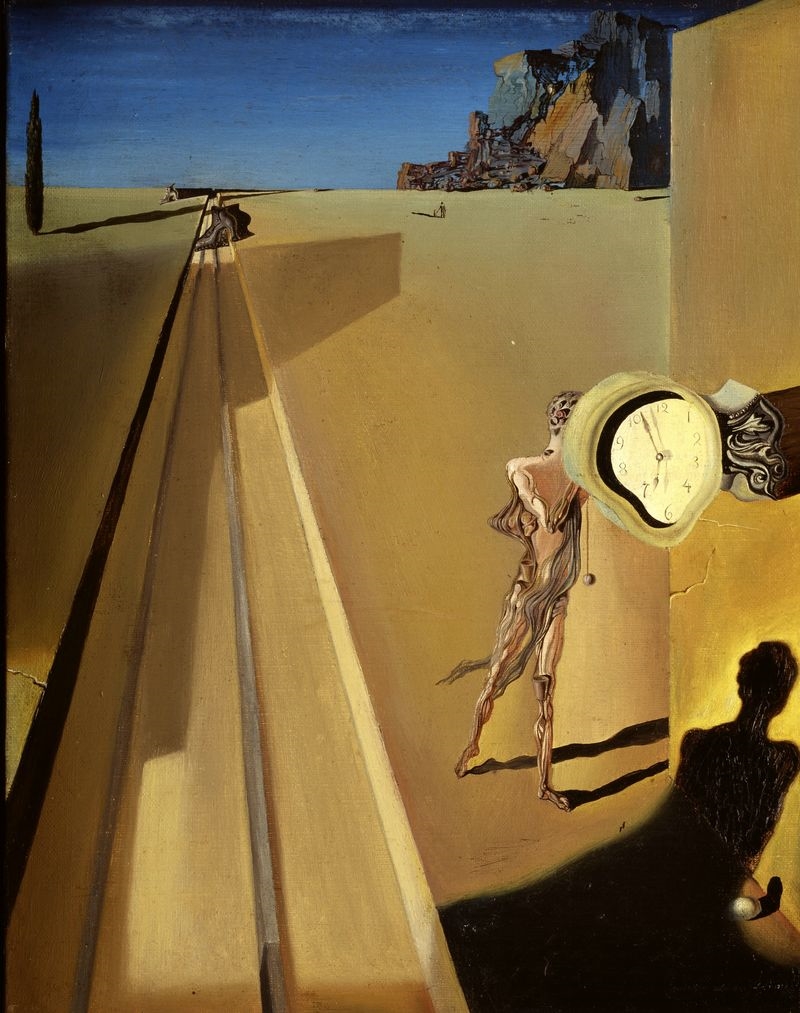
A seminal Surrealist work that explores themes of time, decay, and the subconscious. It is particularly notable for featuring the first appearance of a melting clock, a motif that would later define Dali’s “The Persistence of Memory.”
While a railway station typically represents travel and progress, Dalí presents it as a place of stagnation and disorientation, where the usual rules of time and space are suspended. Compare with Giorgio de Chirico’s The Anxious Journey (1913), a key inspiration for Dalí.
PS: The New Wave science fiction author J.G. Ballard was deeply inspired by Dalí, often citing him as a major influence on his inner landscapes and view of 20th-century art. Ballard wrote the introduction to a 1974 book on Dalí which praised him as a “cultural outlaw” who explored the intersection of psychology, technology, and landscape.
This painting puts me in mind of Ballard’s 1966 novel The Crystal World, in which the universe, its myriad of possibilities, is crystallizing into… sameness. (Note however that the cover of the first edition of The Crystal World is a detail from Max Ernst’s 1943 painting “L’oeil du silence”).
GOTTERDAMMERUNG
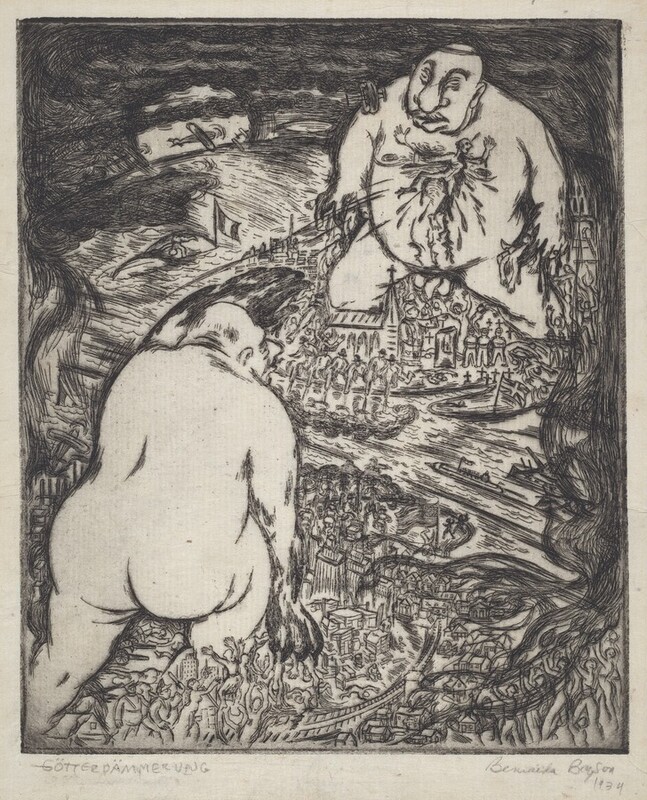
A social realist etching that critiques the economic and social collapse of the Great Depression. The use of such a grand, apocalyptic title suggests that the economic misery of the 1930s was not just a temporary downturn, but the final “twilight” for an unsustainable social order.
Josh Glenn’s EMANATIONS series includes the following installments: CATASTROPHE: DECLINE & FALL | DYING EARTH | ECO-CATASTROPHE. COSMIC AWE: DEEP TIME | STARS WHEEL IN PURPLE | IS THERE LIFE ON MARS. DEHUMANIZATION: CYBORG MANIFESTO | MECHANIZATION. & many others.
MORE RADIUM AGE SCI FI ON HILOBROW: RADIUM AGE SERIES from THE MIT PRESS: In-depth info on each book in the series; a sneak peek at what’s coming in the months ahead; the secret identity of the series’ advisory panel; and more. | RADIUM AGE: TIMELINE: Notes on proto-sf publications and related events from 1900–1935. | RADIUM AGE POETRY: Proto-sf and science-related poetry from 1900–1935. | RADIUM AGE ART: Proto-sf and science-related fine art from 1900–1935. | RADIUM AGE 100: A list (now somewhat outdated) of Josh’s 100 favorite proto-sf novels from the genre’s emergent Radium Age | SISTERS OF THE RADIUM AGE: A resource compiled by Lisa Yaszek.