
GEOPHYSICAL SUBLIME
By:
September 6, 2026
An installment in EMANATIONS, a series of posts featuring 10 of Josh Glenn’s favorite examples of Radium Age-era fine art that explore a particular proto-sf-adjacent theme. In this case, that theme is DISENCHANTMENT / UNSEEN FORCES. The sub-theme, meanwhile, is…
This is a somewhat tricky sub-category… because there’s nothing proto-sf-adjacent, necessarily, in the depiction of sublime landscapes. My criterion: Landscape paintings from c. 1900–35 that depict the raw, untamable, and awe-inspiring power of nature, not merely via the usual vastness, storms, geological features meant to humble the viewer, etc., but via fourth-dimensional perspectives and other alienation techniques that reveal the landscapes’ alien-ness.
SUN OVER SOUTHERN MOUNTAINS
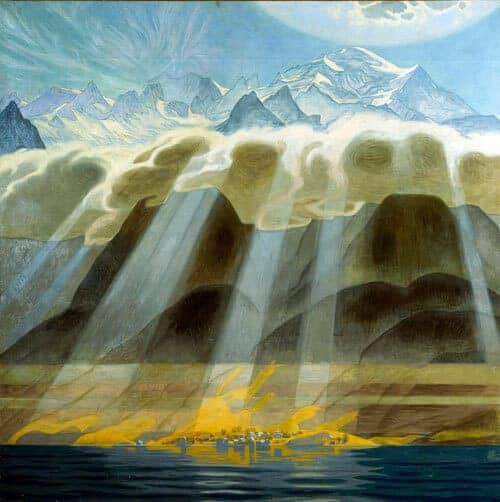
Willumsen’s alpine panorama isn’t intended to be true to life; it is a Symbolist work that deploys towering, luminescent mountains, and a town bombarded by mystical, radiant sunlight, as a metaphor for the human spirit’s capacity to rise above earthly limitations.
“The artist has suborned reality to the mystical effect given by the layering of light and the towering succession of horizons,” we read on the website of a Stockholm gallery. “Nature seems immense, both in scale and spirit, while the shoreside village appears to be burning in the glare of the light, a metaphor for man’s insignificance in the face of nature.”
This shocking admixture of apocalyptic catastrophe and an effort to portray the un-portrayable forces of the universe that help guide and shape human behavior… it’s very proto-sf.
THE CITY ON A HILL
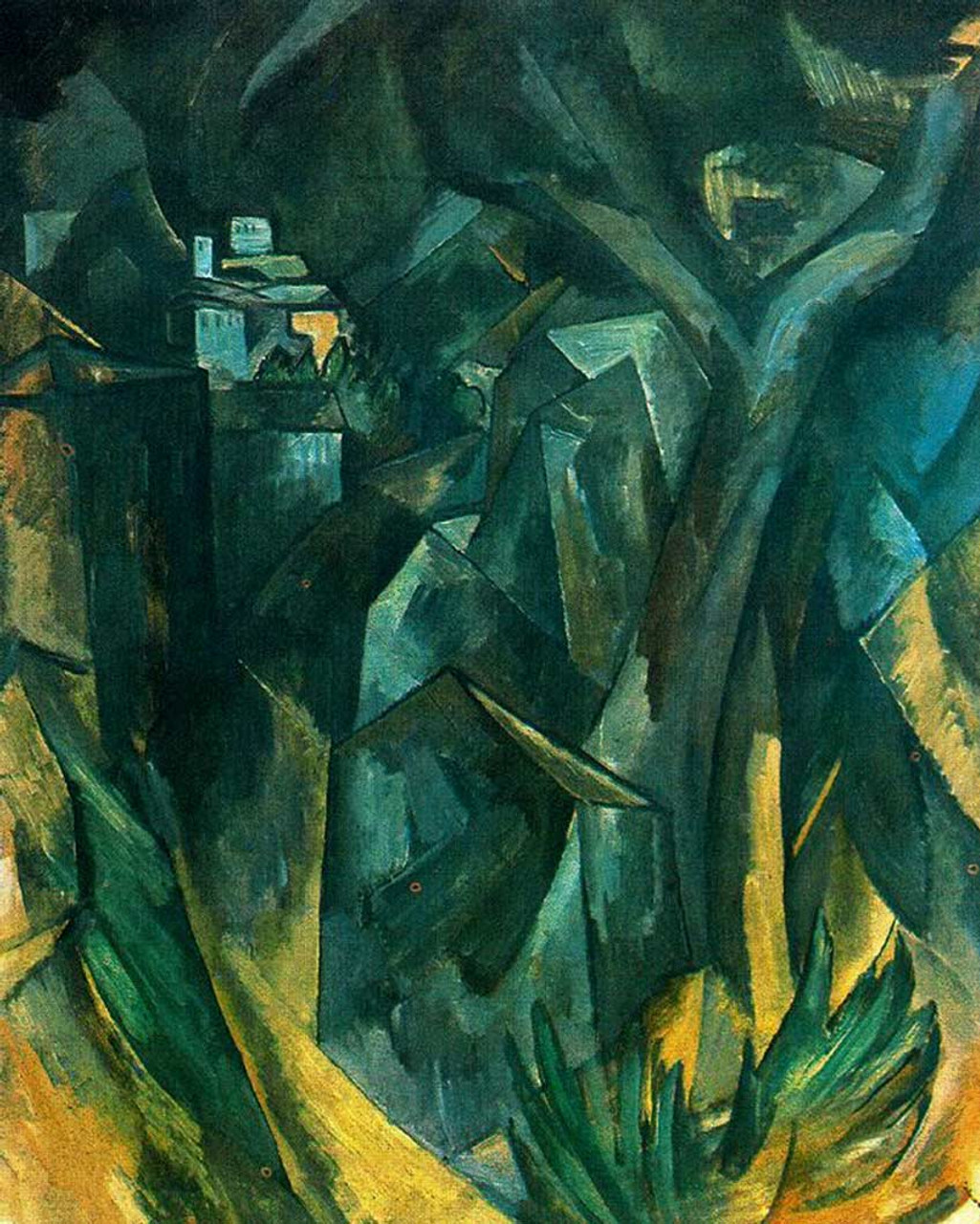
“The City on a Hill” is often described as a foundational Analytic Cubist landscape. Instead of painting an object from a single, stationary perspective, during Cubism’s c. 1908–12 “analytic” phase, Braque and Picasso, joined by Juan Gris, Jean Metzinger, and Albert Gleizes, followed Cézanne in reducing natural scenery to its most basic, underlying geometric volume. By fracturing the landscape into spheres, cylinders, and — yes — cubes, then reconstructing them on a two-dimensional surface, they revealed a hidden structural truth about the way the world we take for granted works.
The houses, trees, and sky overlap and interlock, in Braque’s composition, making the scene we’re surveying feel two-dimensional and three-dimensional simultaneously.
LE CHEMIN
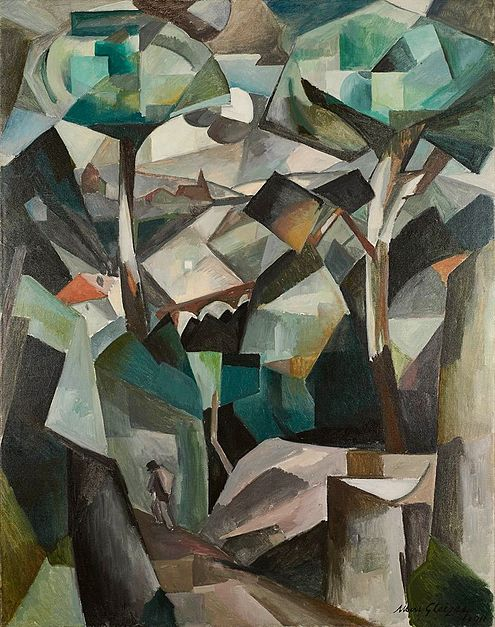
Gleizes’ The Path, Landscape at Meudon (sometimes: Landscape with Figure) was painted around the time that Gleizes and Metzinger were writing Du “Cubisme” (1912), the first major theoretical treatise on Cubism. It introduced Cubist philosophy to the general public, outlined the shift to “multiple viewpoints,” and distinguished Cubist style from traditional art. One thinks of Minkowski’s 1908 lecture explaining Einsteinian special relativity using a four-dimensional “spacetime” continuum.) Gleizes and Metzinger lived and worked in the western suburbs of Paris. They had long conversations, in the summer of 1911, about the nature of form and perception. Traditional painting, they agreed, gave a static and incomplete idea of the subject as experienced in life.
Here we find a traditional landscape scene: A human figure is walking through hilly terrain in the Parisian suburbs, overlooking trees, villas, a bridge over the Seine, a church. But as with Braque’s The City on a Hill, we’re seeing something deeper and stranger in this scene — this landscape’s spatial geometry and shifting planes — than would normally be revealed by our own two eyes, or depicted in a landscape painting.
In his catalogue preface for the Salon des Indépendants in the spring of 1911, Apollinaire wrote of this particular painting:
Il est sorti un art simple et noble, expressif et mesuré, ardent à la recherche de la beauté et tout prêt à aborder ces vastes sujets que les peintre d’hier n’osaient entreprendre.
Why does Apollinaire describe Gleizes’s art as “fully ready to tackle those vast subjects that painters of the past dared not undertake”? The unseen structural / mathematical patterns and relations occurring in nature ought to be revealed by artists; this was a key tenet for Gleizes. although things in the world may appear static, in fact they are dynamic; as seen from different angles and captured at successive moments, things morph. And although things in the world may appear incomplete, in fact they are complete; Gleizes’s painting offers a holistic integration of landscape and figure.
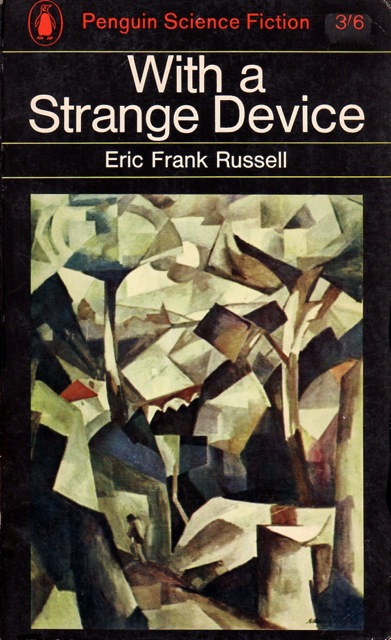
Fun fact:The Path, Landscape at Meudon was used to illustrate a 1965 Penguin edition of Eric Frank Russell’s sf novel With a Strange Device (also published under the title The Mindwarpers).
CUBIST LANDSCAPE
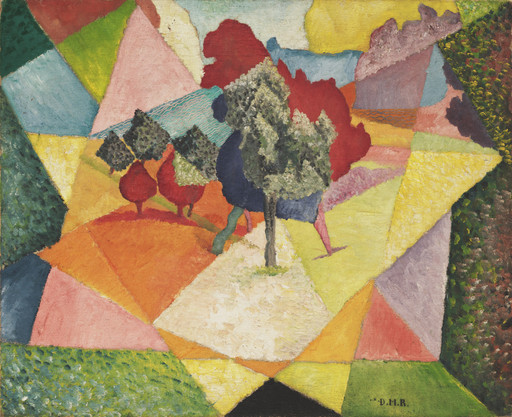
From MoMA’s website:
Cubist Landscape was inspired by a trip Rivera made in 1911 to Spain, where he encountered the olive trees of Catalonia. The serrated blue ridge in the painting evokes Montserrat, a mountain in the region. The work exemplifies the idiosyncratic approach to Cubism that Rivera developed in the 1910s, when he lived in Paris. He saw these early works, which combine a sun-drenched palette with kaleidoscopic planes and abstract patterning, as a way of beginning to forge a specifically Mexican modernism. “My Cubist paintings,” he said, “are my most Mexican.”
HOUSE + LIGHT + SKY MOVEMENT
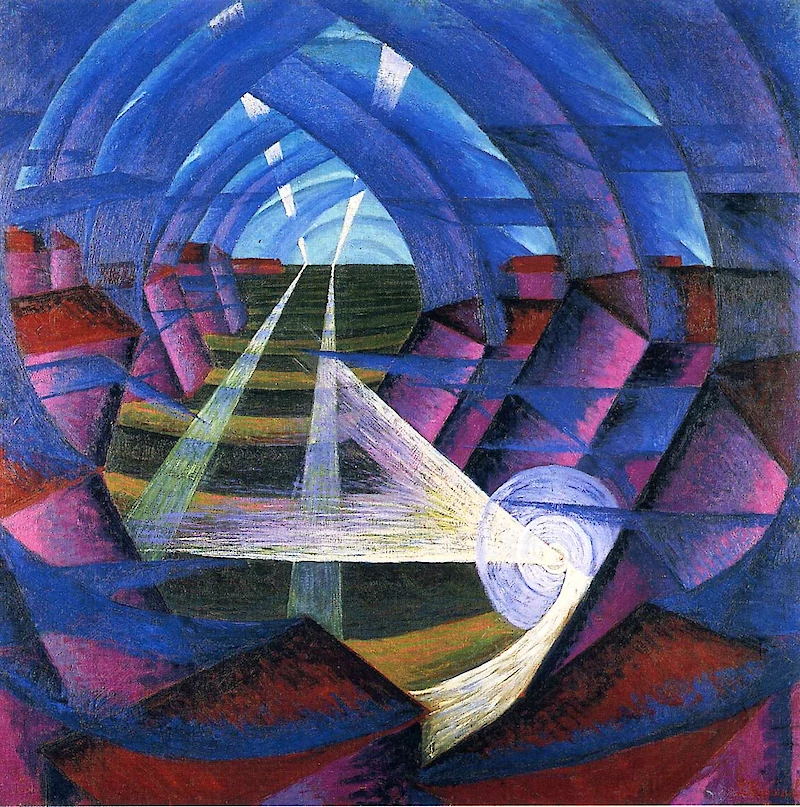
Russolo, a pioneering noise-music composer, was deeply interested in the crossover of senses. The sweeping, pulsating strokes of bright colors in House + Light + Sky Movement are meant to translate light — specifically, or so art historians tend to agree, the break of dawn, where the early rays of the sun pierce the sky alongside the lingering glow of an artificial streetlamp — and meteorological phenomena into a visual music.
Rather than deploying a rigid, traditional perspective, Russolo’s painting bursts with rhythmic, sweeping lines. As with his fellow Italian Futurists, the artist was keen to explore the dynamic intersection of human structures, natural environments, and the invisible forces of energy with which we moderns are surrounded.
LANDSCAPE
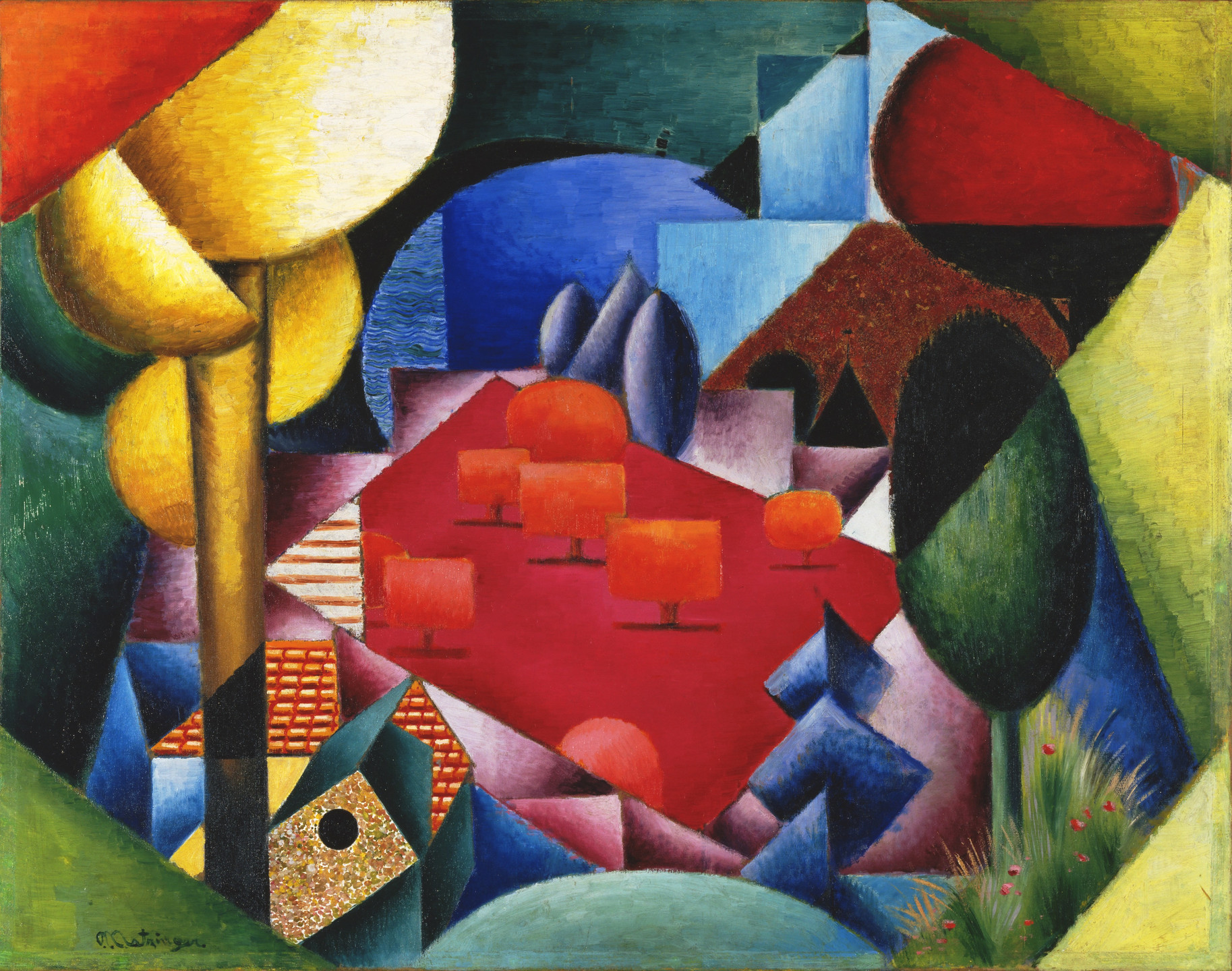
As noted above, Metzinger coauthored Du “Cubisme” (1912) with Albert Gleizes; and the two influenced each other’s experiments in painting during this period.
Here, Metzinger breaks down a French countryside / suburban scene into an array of geometric shapes, vivid colors, and flat patterns. Instead of a traditional horizon line, the painting flattens space by stacking the foreground, midground, and sky on top of each other. Trees, houses, fields, and what appears to be a factory smokestack belching yellow circles of smoke are translated into triangles, parallelograms, geometric blocks. The colors are saturated, almost cartoonish.
Like Gleizes, Metzinger believed that bright colors made avant-garde art more visually dynamic, decorative, and accessible to the general public rather than — as with Picasso and Braque’s paintings — purely analytical and austere.
Metzinger’s explorations in landscapes during his Cubist period — this painting, which hangs in the main Cubism room at New York’s Museum of Modern Art, is one of several art works by this artist all titled, simply, Landscape — represent varied attempts on the artist’s part to break away from traditional, “realistic” single-point perspectives, and instead to explore multiple perspectives and dimensionality.
COMPOSITION #218 (TWO OVALS)
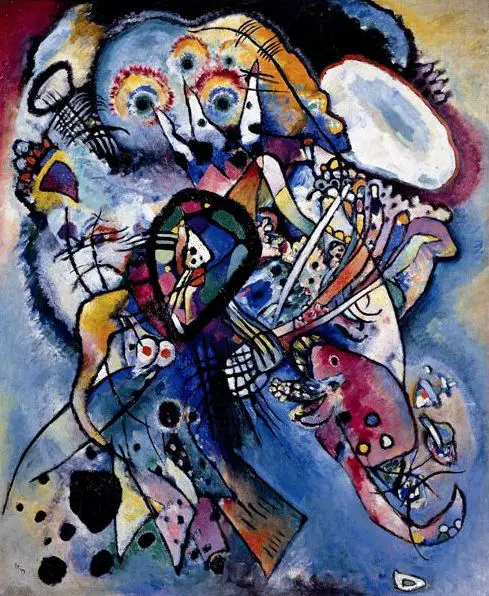
Is this a landscape? To my eyes, it bears comparison to Kandinsky’s The Last Judgment (1912) — which appears in this earlier series installment. It’s yet another variation on the artist’s apocalyptic theme; or to be more precise, it’s another effort on the artist’s part to depict a cycle of destruction and redemption in an abstract way.
The Russian Revolution of 1917 profoundly reshaped Kandinsky’s artwork by forcing him back to Moscow, where he was caught between the utopian euphoria of a new society and intense ideological conflicts with fellow Soviet artists. The Revolution initially matched Kandinsky’s apocalyptic belief that the old, materialistic world was collapsing to make way for a spiritual rebirth. However, by 1919 the Bolshevik state shifted toward utilitarianism and productivism. As he realized that his vision of a “spiritual revolution” was clashing directly with rigid Soviet materialism, Kandinsky’s paintings became more somber, muted, and psychologically complex.
Here we can just barely perceive the hilltop walls, towers, and church cupolas of New Jerusalem. Also: boats and oars, representing the possibility that a cataclysmic transformation / deluge can be survived. Not to mention the Leviathan, forever attempting to swarm out of the ocean and onto land. The chaotic, spinning movement of the forms suggests the upheaval and disintegration of the old world. And the titular ovals act — or so some exegetes have suggested — as visual anchors of divine / cosmic order or containment / protection amidst the swirling chaos of the surrounding apocalypse.
BLUE AND GREEN MUSIC
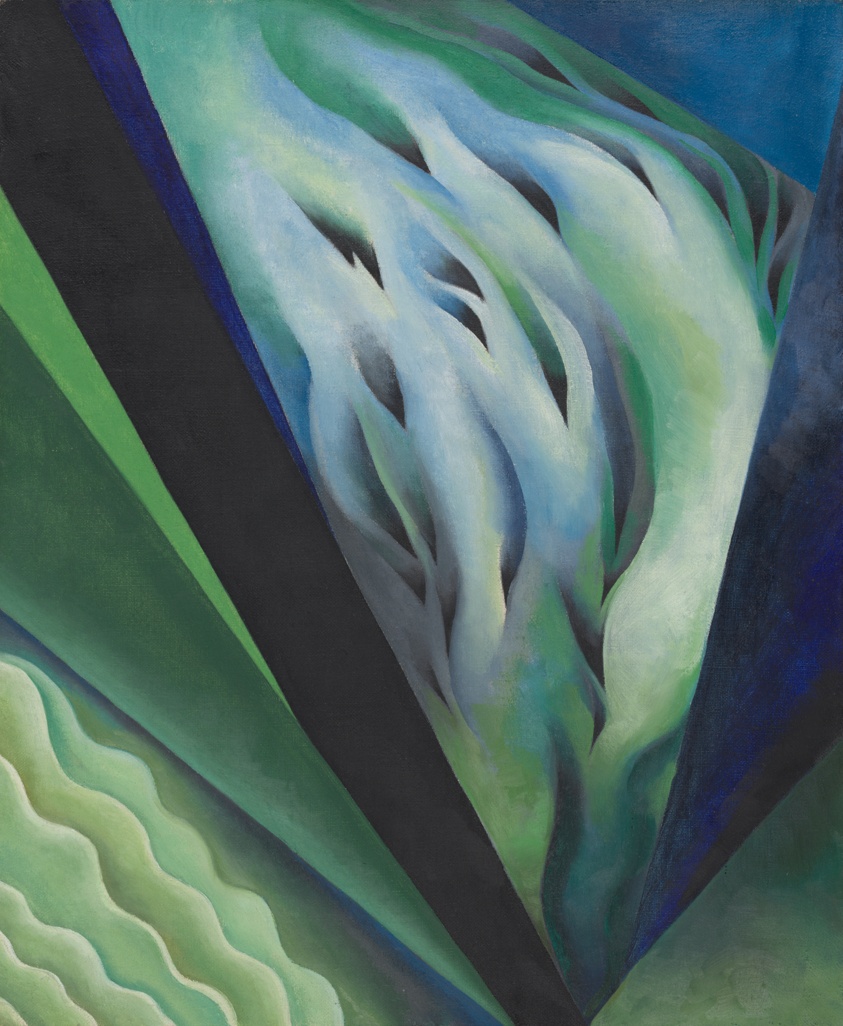
Is this a landscape?
Though this is a “musical” painting (see below), its organic curves hint — to this viewer — at a natural landscape. True, although it hints at the natural world, O’Keefe’s Blue and Green Music does not literally depict a landscape. Flowing, curved forms sweep across the canvas to create a visual beat or tempo. Deep blues and soft greens blend and contrast to set a smooth, atmospheric mood. It’s auditory, musical. Perhaps we should think of it as an abstract internal landscape.
From the Art Institute of Chicago’s website:
Around 1920 Georgia O’Keeffe painted a number of oils exploring, as she later recalled, “the idea that music could be translated into something for the eye.” In Blue and Green Music, O’Keeffe’s colors and forms simultaneously suggest the natural world and evoke the experience of sound. She was drawn to the theories of the Russian Expressionist painter Vasily Kandinsky, who, in his 1912 text Concerning the Spiritual in Art, argued that visual artists should emulate music in order to achieve pure expression free of literary references.
FIRE IN THE EVENING
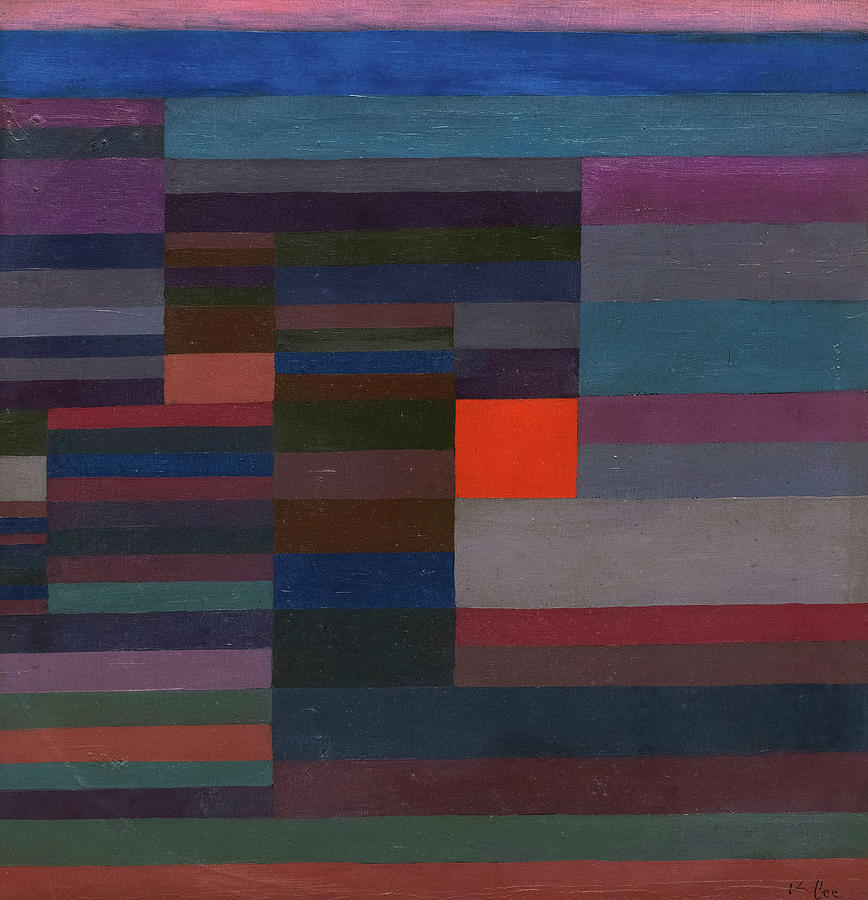
Inspired by Klee’s 1928 trip to Egypt, the stacked bands of Fire in the Evening mimic the Nile Valley’s stratified cliff faces and its long rows of tilled farm fields. Careful shifts in tone and color density give the flat cardboard surface a sense of atmospheric space
The painting’s central, opaque red rectangle evokes a glowing fire, or perhaps the setting sun, in a desert at dusk.
Speaking of his abstract landscapes, Klee said that they “moved far from Nature, and found their way back to reality.”
CUBIST LANDSCAPE WITH RED PAGODA AND BRIDGE
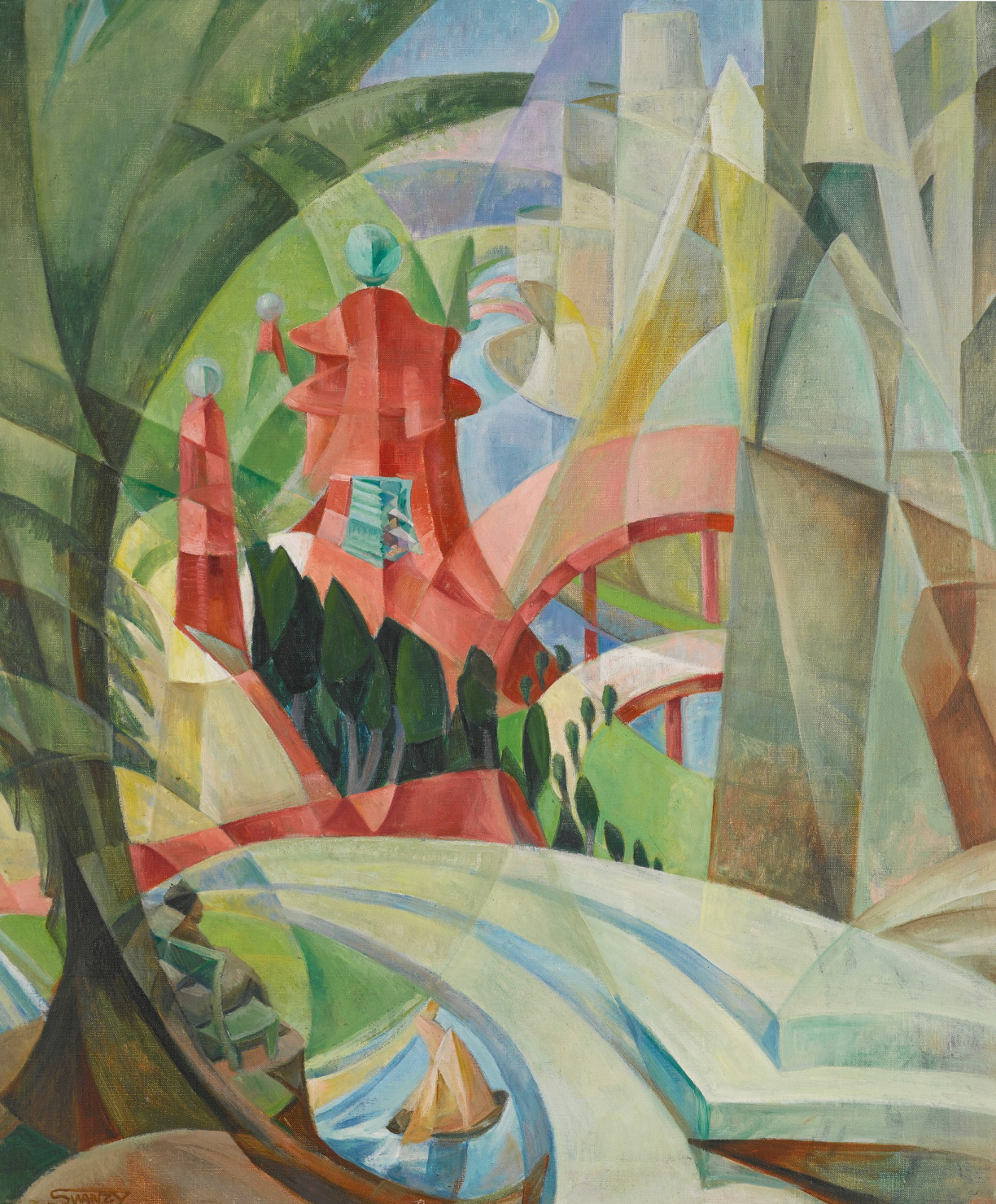
Writing about Swanzy, the first Irish Cubist painter, Dr. S.B. Kennedy writes — for Whyte’s auction house — that “the qualities that shine consistently through her oeuvre are an ability to draw fluently and at times a playful and decorative sense of colour.”
Also:
Typical of her pictures at this time are an emphasis on patterning, fluid brushwork, an even film of paint with little or no impasto and a stress on colour and light. But the upward thrusting movement and dynamic energy which rule over Cubist Landscape with Red Pagoda and Bridge, and which arguably are the real subject matter of the picture, can be compared to other Swanzy compositions of the time such as White Tower, circa 1925-7, and bring to mind the Italian Futurists — notably the architect Antonio Sant’Elia and the painter Umberto Boccioni — rather than the more confining strictures of Cubism per se. The manner in which the tree in the foreground, the pagoda and the bridge reach out through “lines of force” (Boccioni’s phrase) to affect one’s sense of the space around them — the forms to the right, for example, have been abstracted beyond the bounds of representation to become part of the overall dynamic of the scene — must surely owe a debt to Boccioni’s celebrated Development of a Bottle in Space, 1912, and Unique Forms of Continuity in Space, 1913, two of the most radical (sculptural) images of the Futurist period, 1909-19.
But in the hands of Swanzy, these lines of force, rather than heralding a mechanistic “brave new world”, swirl decoratively to become self-contained. Thus the composition is without angst or unease, the mood being one of playfulness and representation — note, for example, besides the pagoda, the tree-lined avenue that leads the eye to it and the woman seated at the lower left casually observing the scene.
Josh Glenn’s EMANATIONS series includes the following installments: CATASTROPHE: DECLINE & FALL | DYING EARTH | ECO-CATASTROPHE. COSMIC AWE: DEEP TIME | STARS WHEEL IN PURPLE | IS THERE LIFE ON MARS. DEHUMANIZATION: CYBORG MANIFESTO | MECHANIZATION. & many others.
MORE RADIUM AGE SCI FI ON HILOBROW: RADIUM AGE SERIES from THE MIT PRESS: In-depth info on each book in the series; a sneak peek at what’s coming in the months ahead; the secret identity of the series’ advisory panel; and more. | RADIUM AGE: TIMELINE: Notes on proto-sf publications and related events from 1900–1935. | RADIUM AGE POETRY: Proto-sf and science-related poetry from 1900–1935. | RADIUM AGE ART: Proto-sf and science-related fine art from 1900–1935. | RADIUM AGE 100: A list (now somewhat outdated) of Josh’s 100 favorite proto-sf novels from the genre’s emergent Radium Age | SISTERS OF THE RADIUM AGE: A resource compiled by Lisa Yaszek.