
BIG ROCK CANDY MOUNTAIN
By:
October 7, 2026
An installment in EMANATIONS, a series of posts featuring 10 of Josh Glenn’s favorite examples of Radium Age-era fine art that explore a particular proto-sf-adjacent theme. In this case, that theme is DYSTOPIA/UTOPIA. The sub-theme, meanwhile, is…
THE JOY OF LIFE
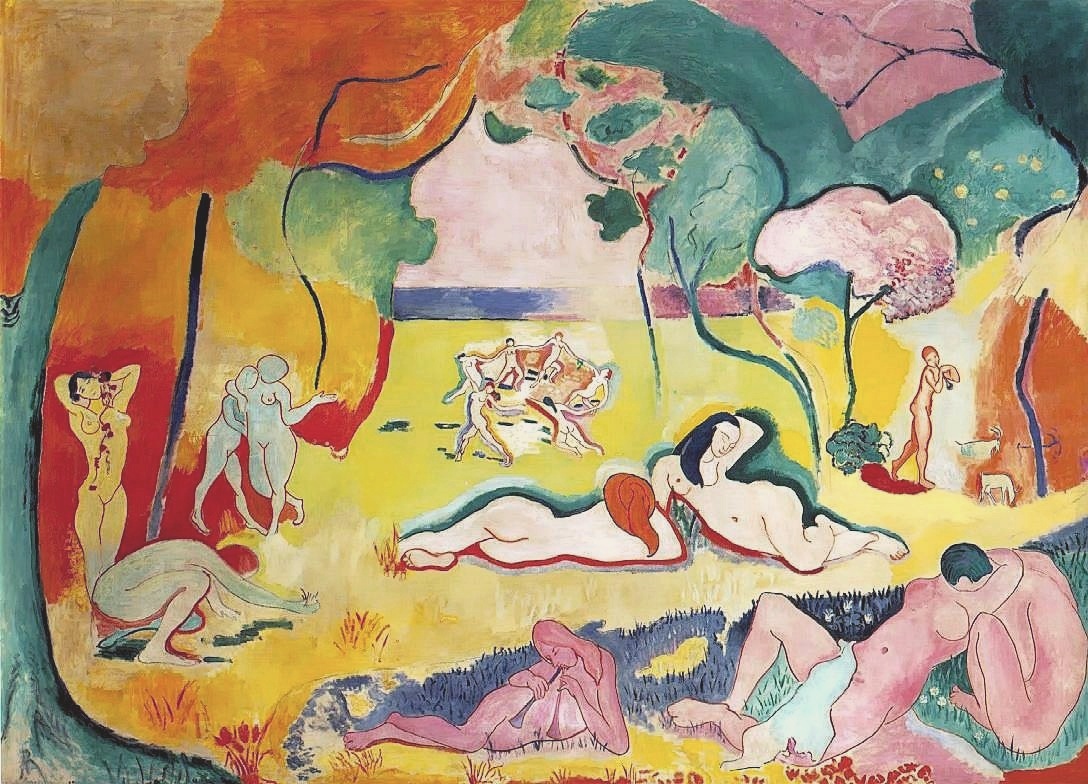
When Matisse’s painting was exhibited at the Salon des Indépendants of 1906, one hears, its use of intense, unblended pigments straight from the tube (including newly available bright cadmium yellows and reds), and its spatial distortions (which broke traditional rules of academic painting, perspective, and representation) caused public outrage. In fact, Matisse’s “Fauvist” works were already controversial; this painting may have been the artist’s considered response to the hostility that he’d encountered at the previous year’s Salon d’Automne.
Relax! The Joy of Life urges us. We’re drawn into a dreamlike, pastoral paradise in which nude figures lounge and cavort. Life is about making music and making love, dancing and grooving on nature. Gertrude Stein suggested that Matisse had “created a new formula for color,” and in this painting the bright pinks, golds, greens, and blues, which don’t mimic reality but instead convey a sense of raw emotion and sensory pleasure, seem to encourage us to break free from the limits placed on our imaginations.
Along with Picasso’s Les Demoiselles d’Avignon, which was directly inspired by this painting, Le bonheur de vivre is regarded as one of the pillars of early modernism.
FORSCHERSTATION — VEGETARISCHE GASTSTATTE
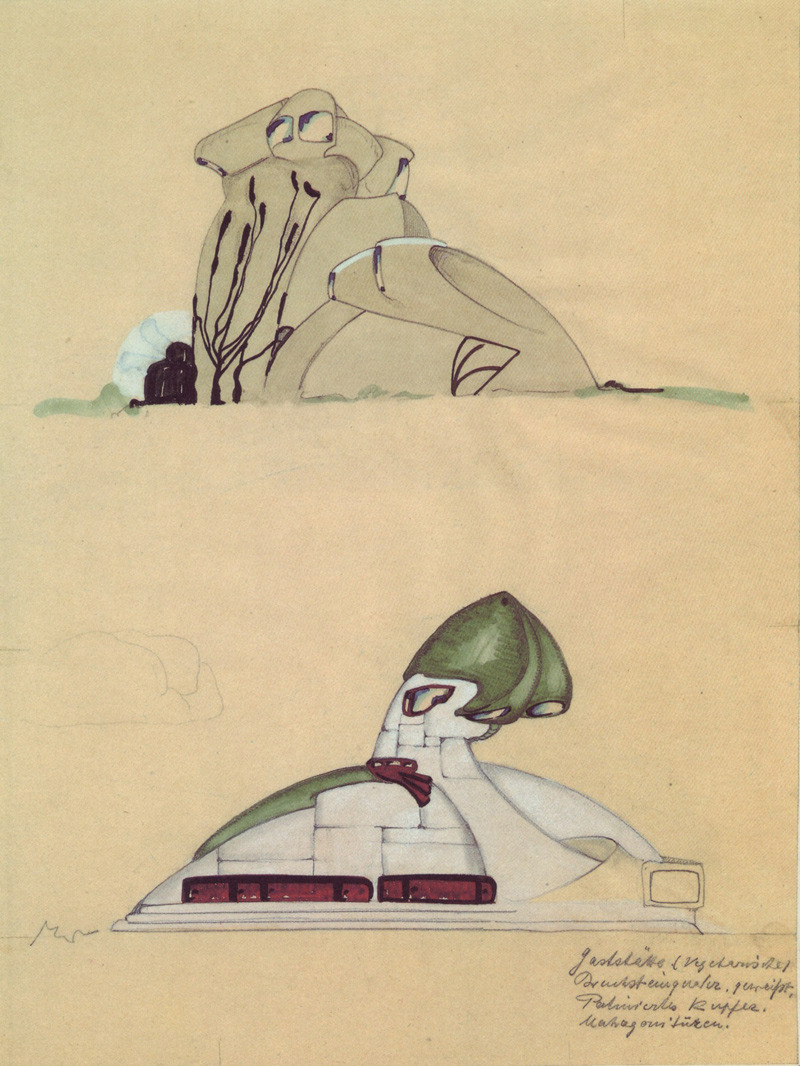
A visionary architect, painter, poet, essayist, toymaker and composer, Hermann Finsterlin realized none of his projects. He played an influential role in the German expressionist architecture movement during the first decades of the 20th century… as a utopian theorist and a romantic socialist. Among those younger architects who formed the “Crystal Chain” (a secretive correspondence club) under the leadership of Bruno Taut, he was the most charismatic.
Having studied natural sciences, Finsterlin styled himself the Darwin of architecture. Which is to say that his conception of architecture was one shot through with biological forms and urges. Quite unlike the Bauhaus architects, for whom a house was a “machine for living,” for Finsterlin a building is a natural living organism. Perhaps a snail, say, or a mushroom.
The drawing shown here, of a proposed Research Station / Vegetarian Restaurant, is today regarded as a foundational example of biomorphic expressionist architecture. Rejecting straight lines, horizontals, and verticals, it suggests a living creature on the move. Architecture, for this dreamer, offers a way for humankind to reconnect with the natural world. Perhaps by spending time at a groovy research lab that is also a plant-based cafe.
DESIGN FOR LIVING ROOM FURNISHINGS
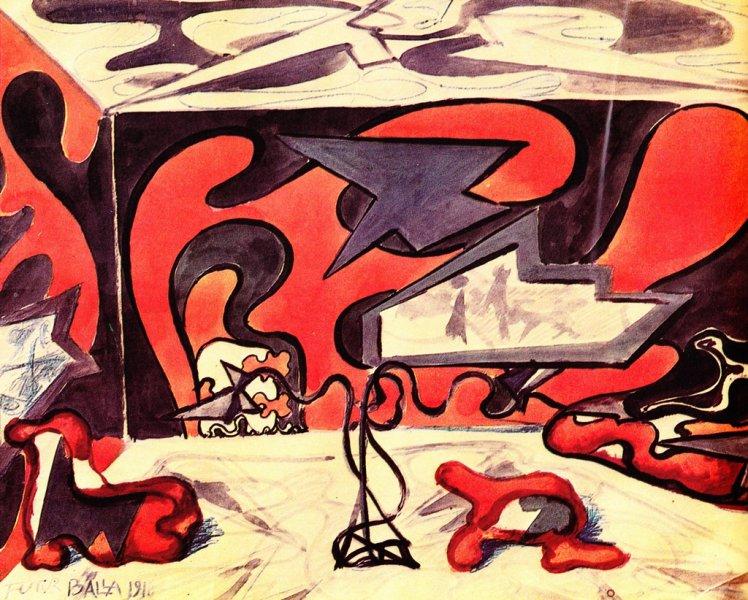
Compared with the aggressive aesthetics of his Futurist peers, I tend to find Balla’s work more eccentric, lyrical, sometimes even whimsical. This statement is in no way intended to excuse Balla’s active embrace (for a while, anyway) of Italian fascism.
With Fortunato Depero, Balla authored the 1915 manifesto Futurist Reconstruction of the Universe, which called for a total transformation of daily life and the environment through joyful, vibrant avant-garde aesthetics. Balla and Depero wanted to extend art into everyday life: clothing, toys, architecture, furniture. (Yes, Mussolini wanted to engineer a “New Man” too.)
Here we find Balla using the bold lines, vibrant colors, and sharp geometric shapes of Futurist art works to reimagine home décor. Out with 19th-century bourgeois furnishings and decorations! Domestic spaces ought to become liberated, kaleidoscopic… trippy, even.
PS: Beginning in 1929, Balla, his wife Elisa, and their daughters Luce and Elica (who were also painters) transformed their Roman apartment into a “total work of art” where they’d live and work for decades.
THE ST. ADOLF-SWISS-TOWER
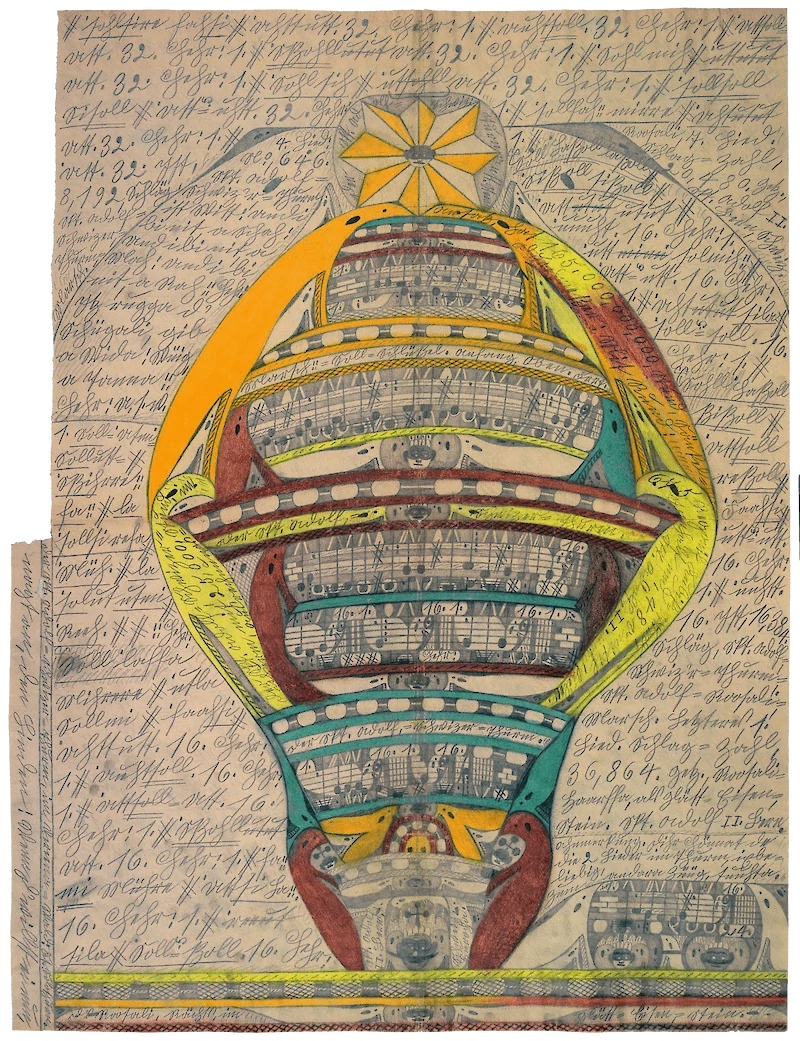
One of the most famous figures associated with Art Brut (or Outsider Art), the Swiss painter Adolf Wölfli created this piece while confined to the Waldau psychiatric clinic in Bern, Switzerland. Using colored pencils, and leaving no area of the paper unfilled, he generated this dense, mesmerizing mix of geometric patterns, numbers, musical notations, and symbolic shapes. It’s a blueprint for an alternate reality — one in which the artist is not a dangerous madman but “St. Adolf II,” a divine planetary ruler and cosmological force who brings structure, music, and geometry to an otherwise chaotic universe.
The titular tower functions as a divine monument and anchor for “St. Adolf,” and the pinnacle of the story he’d been telling for a decade by that point… filling thousands of pages with illustrations.
THE CITY
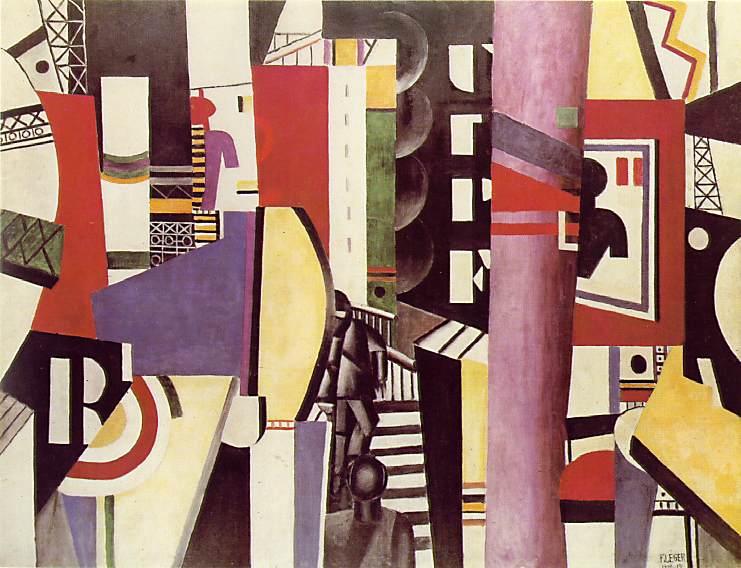
This is the masterpiece, claims art historian Pepe Karmel, of that genre of abstract paintings which depicts the city as a whole.
From the Philadelphia Museum of Art website:
Stenciled letters stand for advertising billboards, a balcony railing signifies the facade of a building, and bits of metal girder denote construction machinery, scaffolding, or electrical pylons. These glimpses of a cityscape are set within a taut framework of vivid hues and clashing shapes, producing visual intensity to rival the modern urban environment. The composition is mural-like in its sweep, flatness, and scale, enveloping the viewer like a theater backdrop or a movie screen.
Not everyone’s idea of utopia, perhaps. Certainly not an Edenic scene — quite the contrary. But I see this cityscape as idealized: vibrant, exciting, inviting. It’s like Balla’s apartment turned inside out, made public — for all to enjoy.
CATHEDRAL INTERIOR
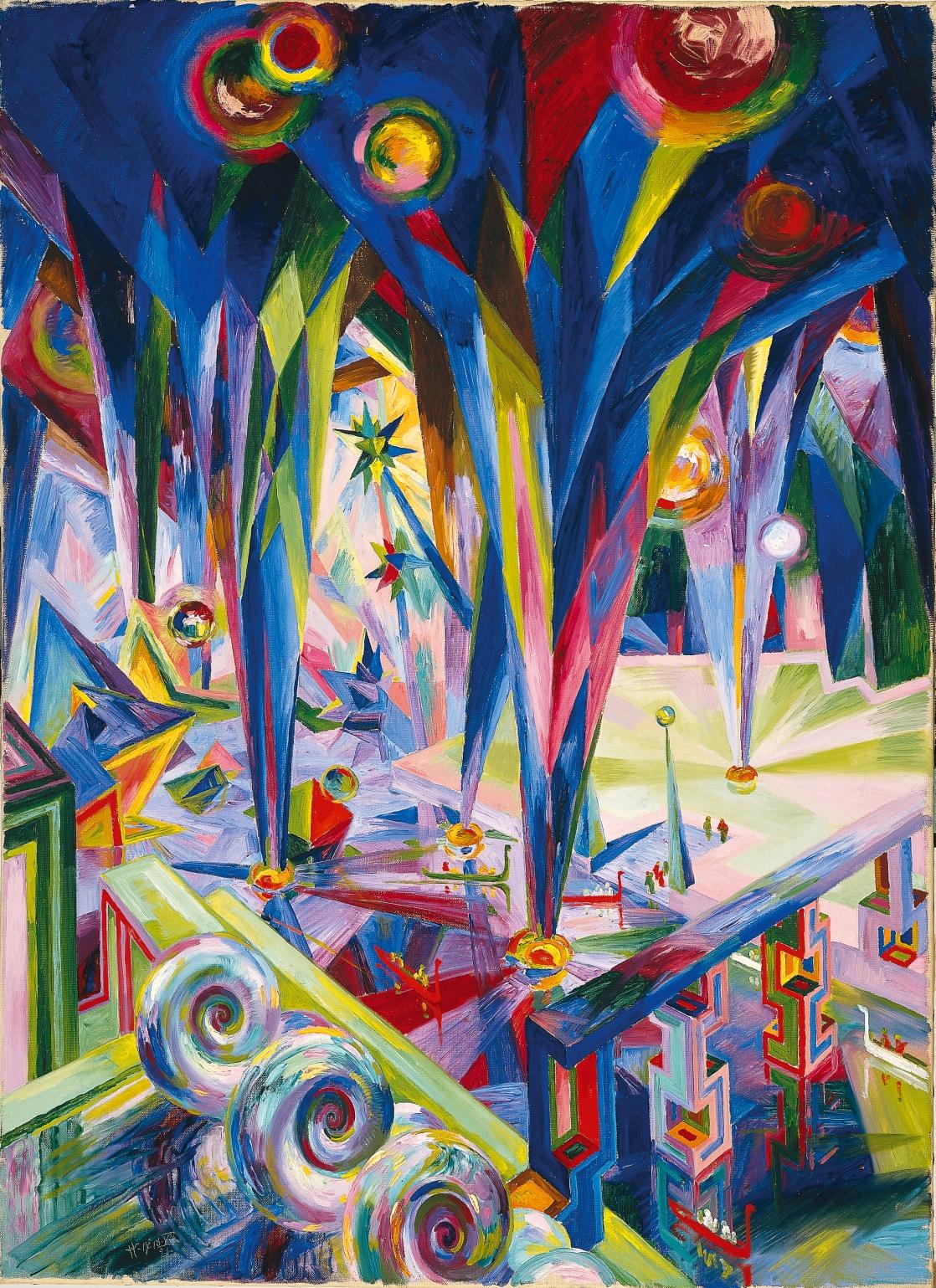
Like Hermann Finsterlin, Wenzel Hablik was a member of “The Glass Chain” (or “Crystal Chain” — sometimes known as the “Utopian Correspondence”) initiated by Bruno Taut. In later life Hablik would recall that at a young age he saw in a specimen of crystal “magical castles and mountains” that would later appear in his highly imaginative depictions of flying cities, crystal chasms, and — in this work — a thrillingly spiritual, otherworldy, crystalline architectural space that he calls a “cathedral.”
UTOPIAN BUILDINGS
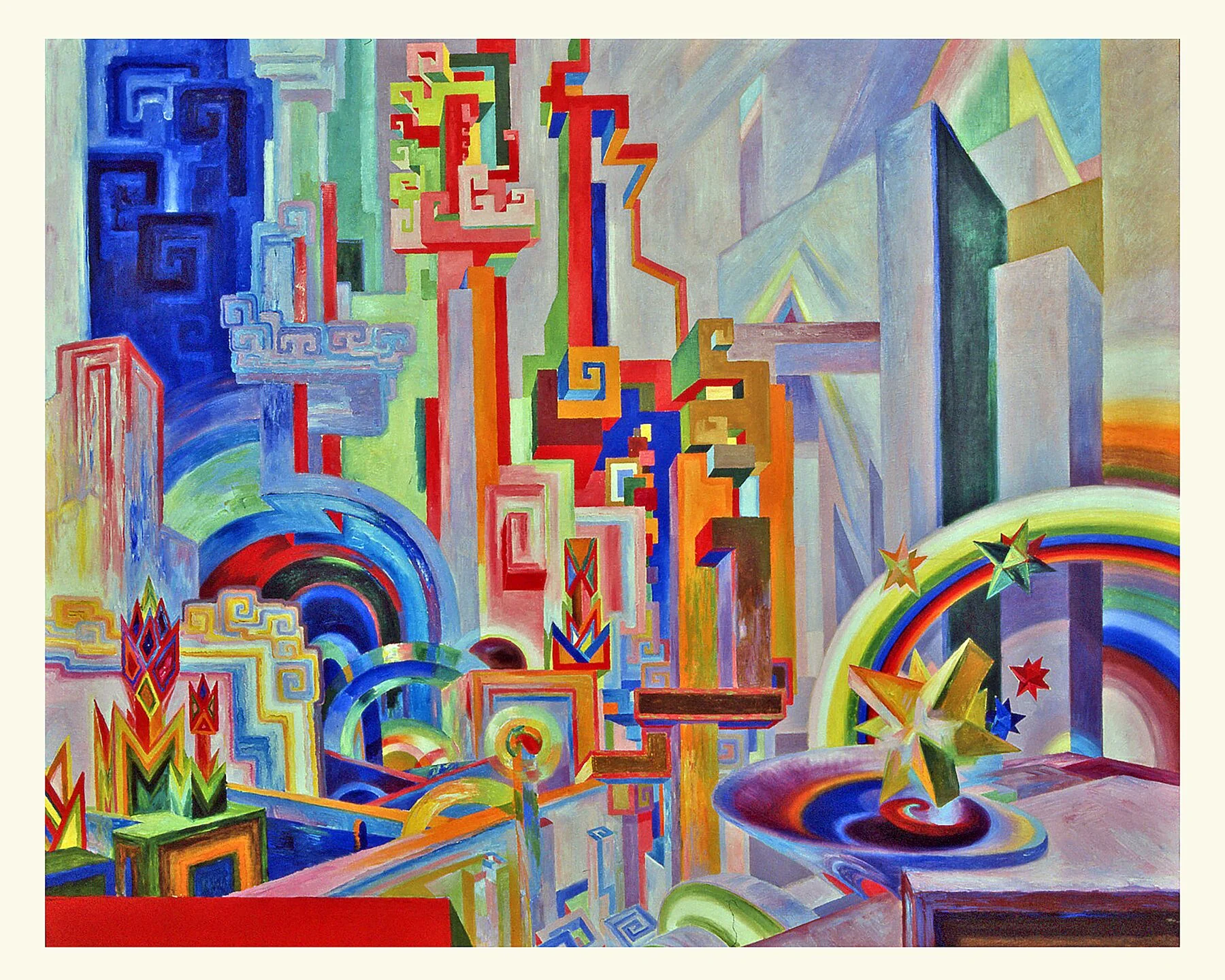
Another excellent Hablik painting. This time an electric vision of a futuristic city composed of multicolored and overlapping geometric shapes, sharp crystalline angles, and prismatic ribbons of light that intertwine and overlap — forming an abstract pattern. Are we on Earth or in outer space? For Hablik, the crystal is the ultimate symbol of nature’s own creativity. Building a living environment modeled after these pure, fractured structures, he claimed, might even elevate human consciousness — guiding a war-torn society toward a better, more harmonious existence.
FAR AWAY
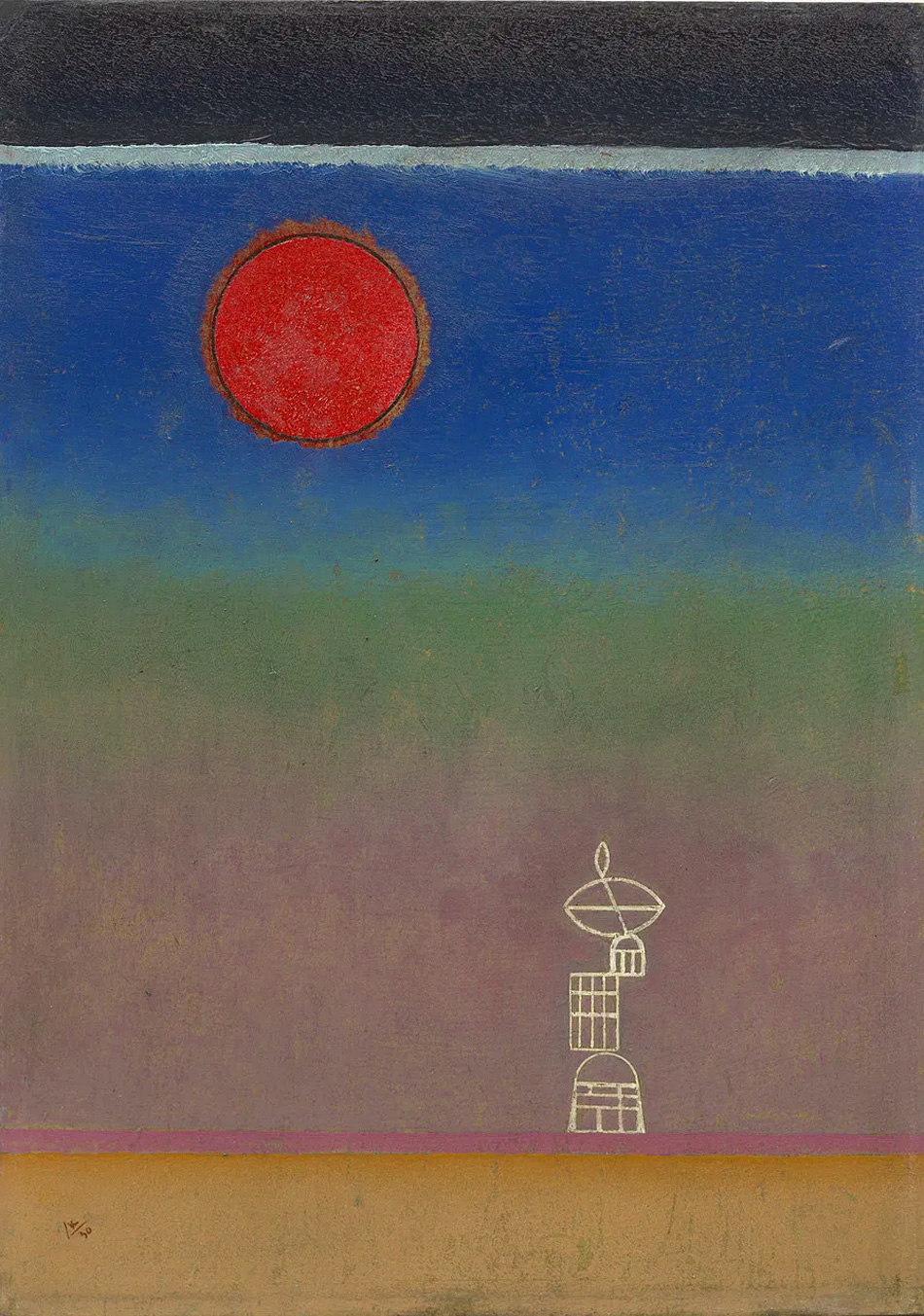
During his late Bauhaus period (1925–33, at which point the school closed under pressure from the Nazi regime), Kandinsky began to transition away from a heavy emphasis on circles, precise angles, and linear structures and towards the more biomorphic, lyrical, whimsical/playful style that would define his so-called Parisian Period (1933–44).
In Far Away, a small oil-on-board painting, we can see this transition in progress: a vibrant, perfect circle dominates the sky like a cosmic sun; it hovers over an arrangement of abstract, geometric shapes. Geometric rigor — Kandinsky treated geometry not as mere math, but as a portal to a spiritual and intellectual universalism — is here balanced by evocative atmospheric resonance.
Speaking of which: “A man standing in the steam is neither close nor far away, he is just somewhere,” Kandinsky had written in a 1913 essay. “The feeling of ‘somewhere’ about the principal center determines the inner sound of the whole picture.” Art historians point to this specific passage to show how Kandinsky created an ambiguous spatial depth that completely detaches the viewer from standard three-dimensional reality. This painting’s title, “Far Away,” and its luminous, shifting gradients of blue, green, and purple, together suggest a wistful utopian longing for a “somewhere” that might be another dimension, a metaphysical ideal, or even perhaps an alien planet. Whichever the case may be, we’re looking at a space far from from the anxieties of 1930s Germany.
DÉCOR DE THÉÂTRE, KAUNAS
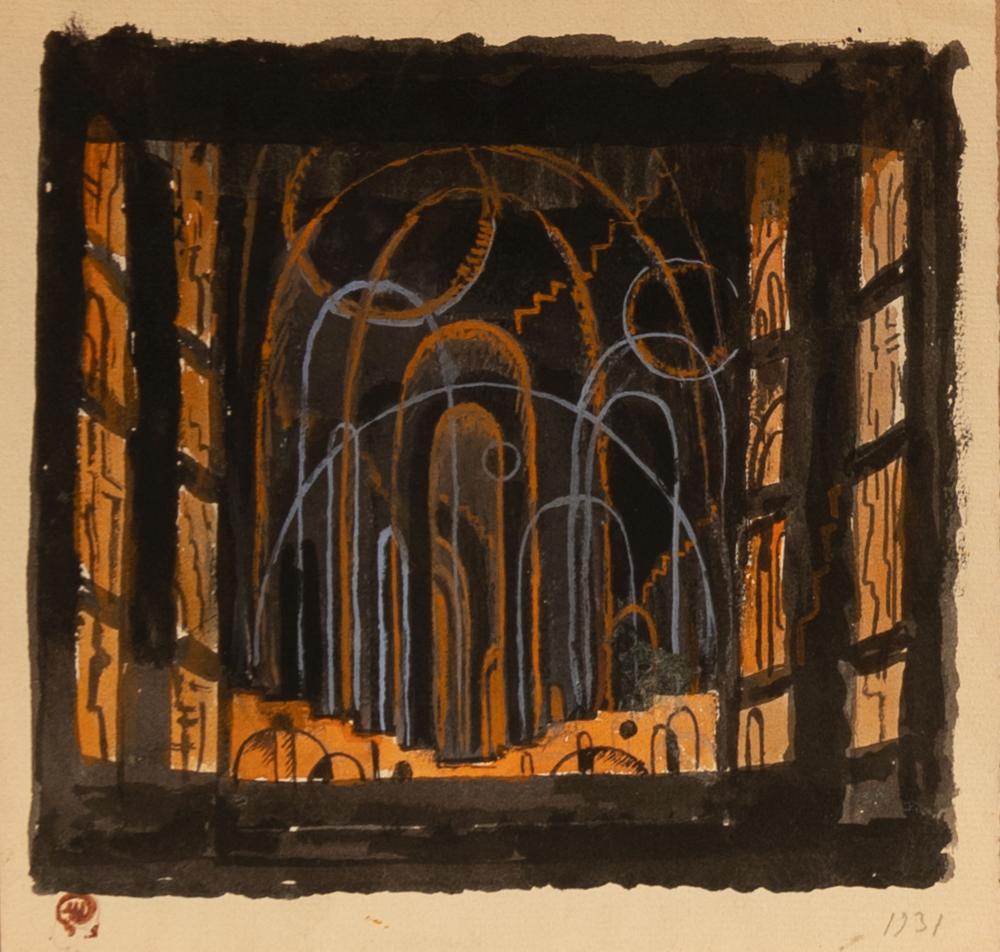
Dobuzinskij, a Russian painter of Lithuanian extraction, arrived in the world of theater in 1907. As a scenic designer, he soon joined the ranks of its reformers, working with both Stanislavski and Diaghilev. (He was also renowned an art teacher; a young Nabokov was one of his pupils.) In 1924, chafing under the restraints of Soviet culture, he relocated to Kaunas, Lithuania, where he ran an art school and worked at Kaunas’s state theatre as scenographer. He maintained meticulous control over every costume element and backdrop.
His theatrical designs for Kaunas, art historians tells us, reflect a sense of personal liberation. (“I have become a Lithuanian citizen,” he wrote to a friend, “and, finally, I am a free man!”) I don’t know whether “Décor de théâtre, Kaunas,” the giddy parabolas of which remind one of Hablik’s utopian architecture, was intended by the artist as a utopian work. But it sure looks that way to this viewer.
SONG OF THE TOWERS
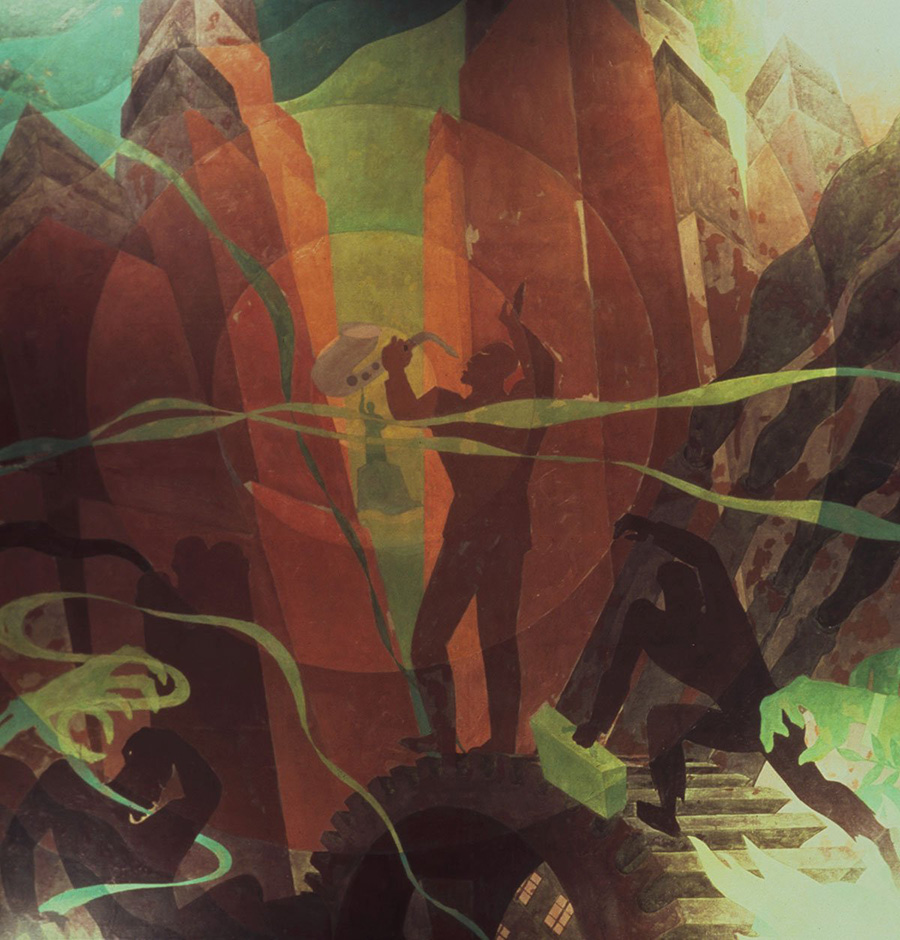
Commissioned under the Public Works of Art Project for the New York Public Library’s 135th Street branch (now the Schomburg Center for Research in Black Culture), Douglas’s “Aspects of Negro Life: Song of the Towers” is part of a four-mural collection both celebrating and lamenting the African American experience within the scope of the American dream.
The painting, which portrays the journey of African Americans moving from rural southern oppression toward the industrial and cultural promise of northern urban life, merges European cubism and Art Deco with ancestral African-centric geometric shapes and silhouettes. At the center, a saxophonist radiates concentric circles of sound waves — symbolizing how jazz (which Douglas believed was a great contribution of African American culture) and Black culture were spreading out to transform the entire world. In the distance, the Statue of Liberty stands in a green haze. Freedom, it seems, may or may not be reachable.
Figures in the composition are depicted climbing upward or breaking free from the grasping hands of serfdom and oppression. But looming industrial gears and urban towers represent the harsh economic constraints and labor struggles that blocked full equality for African Americans. Utopia, to paraphrase William Gibson’s aphorism about the future, is already here — it’s just not equally distributed.
Josh Glenn’s EMANATIONS series includes the following installments: CATASTROPHE: DECLINE & FALL | DYING EARTH | ECO-CATASTROPHE. COSMIC AWE: DEEP TIME | STARS WHEEL IN PURPLE | IS THERE LIFE ON MARS. DEHUMANIZATION: CYBORG MANIFESTO | MECHANIZATION. & many others.
MORE RADIUM AGE SCI FI ON HILOBROW: RADIUM AGE SERIES from THE MIT PRESS: In-depth info on each book in the series; a sneak peek at what’s coming in the months ahead; the secret identity of the series’ advisory panel; and more. | RADIUM AGE: TIMELINE: Notes on proto-sf publications and related events from 1900–1935. | RADIUM AGE POETRY: Proto-sf and science-related poetry from 1900–1935. | RADIUM AGE ART: Proto-sf and science-related fine art from 1900–1935. | RADIUM AGE 100: A list (now somewhat outdated) of Josh’s 100 favorite proto-sf novels from the genre’s emergent Radium Age | SISTERS OF THE RADIUM AGE: A resource compiled by Lisa Yaszek.