
RE-ENCHANTMENT
By:
September 16, 2026
An installment in EMANATIONS, a series of posts featuring 10 of Josh Glenn’s favorite examples of Radium Age-era fine art that explore a particular proto-sf-adjacent theme. In this case, that theme is DISENCHANTMENT / UNSEEN FORCES. The sub-theme, meanwhile, is…
Re-enchantment is the effort to bring back a sense of mystery, wonder, and perhaps even sacred meaning to a modern era that is supposedly characterized — per Max Weber’s 1917 lecture “Science as a Vocation” — by “the progressive disenchantment of the world.” How to fill the vacuum left by departed convictions? How to counteract the cold rationality and grinding efficiency of the era’s mechanism, positivism, empiricism, materialism, and scientism… without invoking superseded belief systems?
The modern era — which has never been modern, in Bruno Latour’s pithy phrase; which has never, contra Weber, been disenchanted — answered these questions in a variety of ways. There was a return to traditional crafts, and an interest in deep-nature connections — the kind of stuff justified by what Adorno would later call the “jargon of authenticity.” But that stuff, for the most part, isn’t science fiction-adjacent; it’s fantasy-adjacent. * (One thinks, for example, of the textile traditionalist William Morris’ epic, influential 1896 fantasy romance Well at the World’s End). Alternative spiritualities, though, and occult investigations? Paradigm-shattering efforts to reconcile the so-called hidden truths of religion with ancient wisdom such as Hermeticism and Neoplatonism… and with the latest scientific research into unseen energies? Radium Age proto-sf would not have been so strange, so alluring and awe-inspiring, without these influences.
* One exception to this rule is the “cozy catastrophe.” A science fiction story in which modern civilization is destroyed, and the protagonist… discovers that they prefer things that way. This sf sub-genre first appears during the Radium Age. (Via the MIT Press’s Radium Age series, I’ve reissued a couple such stories.) And then there’s “science fantasy,” of course….
PS: My RE-ENCHANTMENT sub-category doesn’t satisfy me; it’s too vague, too sprawling. I will likely attempt to divide it into two or three categories.
THE CATHEDRAL

Introduced to spiritualism as a youth growing up in eastern Bohemia in Austria-Hungary (now in the Czech Republic), Kupka developed into a talented spirit medium, or so one hears, before studying art (in Prague, then Vienna). The Symbolist painter and barefoot proto-hippie Karl Wilhelm Diefenbach not only encouraged Kupka to explore geometric figures in his art, but introduced him to the Nazarenes, an early 19th-century art movement whose members wanted to return art to the spirituality of the late medieval German artists, and who believed that inner contemplation should be a principal source of artistic inspiration. Kupka thus arrived at abstraction — he is considered one of abstract art’s pioneers — with the realization, in his words, that “it was possible to experience great joy and excitement in the mere contemplation of colors and lines.”
After moving to Paris in 1896 and having made a close study of the light that shone through the red and blue stained glass of Chartres Cathedral, Kupka created the semi-abstract painting shown here. He aimed to capture the sensation — physical, emotional, spiritual — of light shining through stained-glass windows. It’s a Nazarene-like work, that is, but also a study of the emotional effect of geometric figures and patterns. In fact, the series of which this painting is a part is one that Kupka named (unsentimentally, technically) Vertical and Diagonal Planes.
THE DOVE
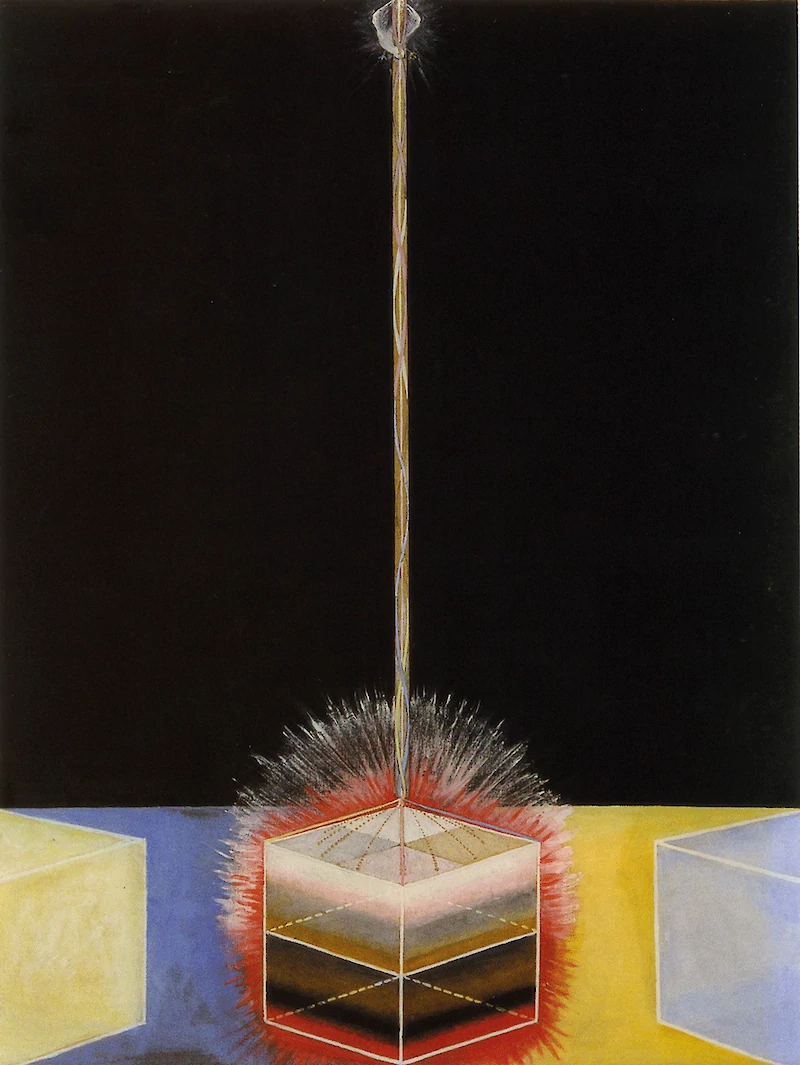
Group IX, No. 3, The Dove was painted as part of Klint’s “The Paintings for the Temple” project. Whereas an actual temple might feature a representation of a dove to symbolize an invisible divine force, Klint’s painting (in which a stylized dove appears at the top of the canvas, seemingly enfolded into a vertical stream of light or spiritual energy) deploys abstract geometry to do so.
The dove, for Klint, or so one hears, represents the higher-order balance of opposing forces — spiritual unity, that is to say, the integration of polarities. The glowing, rainbow-banded cube at the bottom center of the composition represents the physical manifestation of matter and the anchoring of celestial energy into the earthly realm, acting as a geometric symbol for the creation of material form out of divine light. The upper spiritual realm and the lower physical realm are bridged; binary opposites are reconciled in a single, higher state of consciousness.
The painting’s active, glowing colors radiating from the cube draw from Goethe’s Theory of Colors, one hears; Klint is using chromatic balance to signify how cosmic forces stabilize within the material universe. In Klint’s lexicon, spirals — this painting was created decades prior to the formal discovery of DNA’s double helix — denote continuous, if not always linear or straightforward spiritual development, cyclical growth, and humanity’s evolutionary journey toward higher awareness.
This painting, like so many of Klint’s paintings, reflects her deep engagement with alternative sciences, geometry, and theosophical concepts of energy mapping the invisible universe. It could just as easily be slotted into our DIAGRAMMATIC SUBLIME sub-category.
METAPHYSICAL INTERIOR WITH BISCUITS
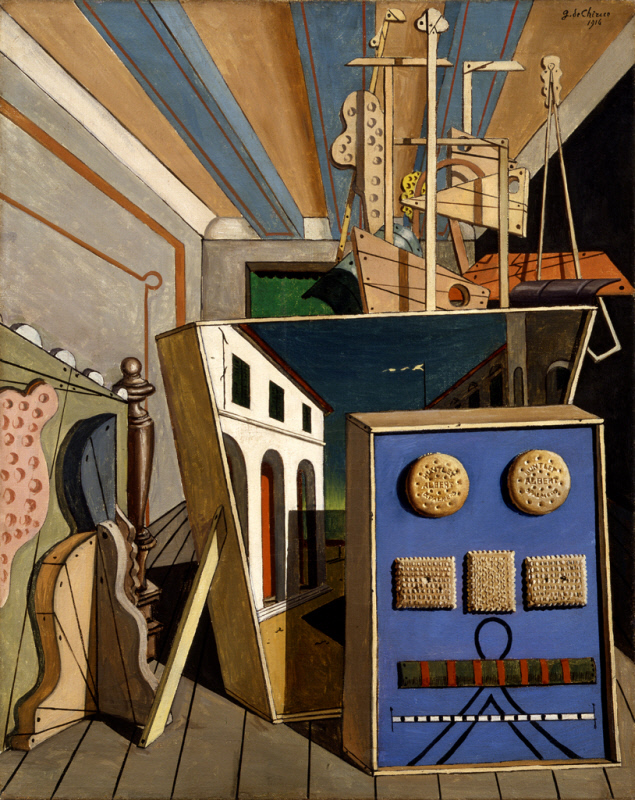
Inspired by the example of the Swiss Symbolist Arnold Böcklin and the German Symbolist Max Klinger, de Chirico inaugurated the so-called “Metaphysical” [per Apollinaire] style of painting in 1910. While recovering from an illness in Florence, the artist experienced an epiphany while sitting in the Piazza Santa Croce, feeling as though he were seeing the world and its architecture for the very first time. His paintings from this point on would explore the hidden mystery of everyday objects, the absurdity of logic, and the dreamlike, uncanny nature of everyday reality.
“Sometimes the horizon is defined by a wall behind which rises the noise of a disappearing train. The whole nostalgia of the infinite is revealed to us behind the geometrical precision of the square. We experience the most unforgettable movements when certain aspects of the world, whose existence we completely ignore, suddenly confront us with the revelation of mysteries lying all the time within our reach and which we cannot see because we are too short-sighted, and cannot feel because our senses are inadequately developed. Their dead voices speak to us from nearby, but they sound like voices from another planet.” — de Chirico
I chose Metaphysical Interior with Biscuits because it’s funny. A panel featuring traditional regional Italian sweet biscuits are mounted onto a flat panel within the composition to resemble — or so critics tend to agree — an abstract or schematic face. This may be the influence of pareidolia on their part; perhaps de Chirico was aiming for this effect?
We might also say that the biscuits are abstract symbols; that the board on which they are mounted is a diagrammatic chart. De Chirico and his contemporaries viewed these hard, highly processed regional biscuits not merely as food, one hears, but as strange, permanent, geological objects — almost like archaeological artifacts or geometric puzzles. Perhaps, then, we are looking at an eccentric commercial semiotician’s workspace.
GOD

I bumped into this sculpture, made of an inverted cast-iron household plumbing drain trap mounted on a wooden miter box, at the New Museum’s “New Humans: Memories of the Future” exhibit this summer. Created the same year as Duchamp’s famous urinal (Fountain), God — one hears — satirizes the industrial age and societal [American society, in particular] worship of technology and plumbing.
Alongside Duchamp’s urinal, “God” (and Elsa’s earlier piece, a rusted iron ring — symbolizing her marriage — found on a New York City street) helped define the “readymade” genre (the term was coined by Duchamp in 1915), where ordinary manufactured objects are designated as art purely by the artist’s choice. Thus shifting the definition of art away from physical craftsmanship and visual beauty toward concept, context, and intent.
The piece’s title is often described as sacreligious humor and/or a critique of the reverence with which industrial technology is held. But there is a certain totemic power to this household U-bend, isn’t there?
INCENSE OF A NEW CHURCH
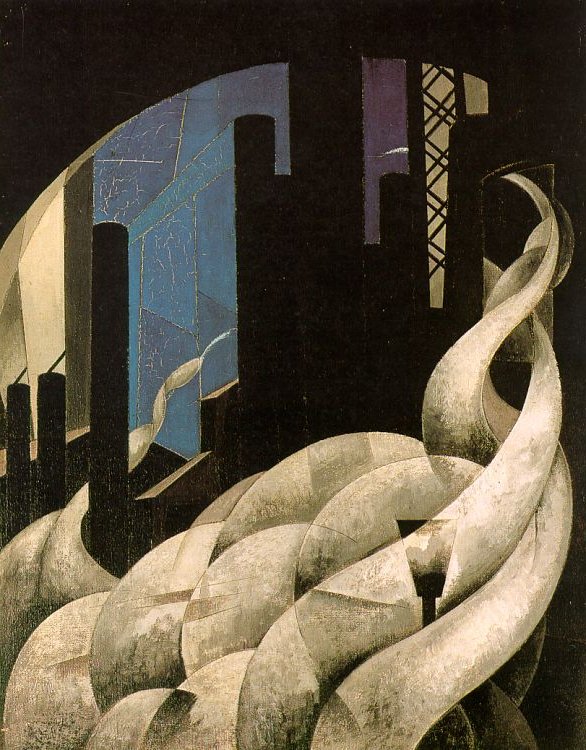
Demuth, an American who studied art in Paris, lived in and remained deeply attached to his hometown of Lancaster, Penn. — the warehouses, factories, and row houses of which his paintings would imbue with a kind of reverential, if semi-ironic import. Along with Georgia O’Keeffe and Charles Sheeler, he was a major contributor to America’s quasi-Cubist Precisionist art movement, which began to evolve around 1915.
Here, we find a factory’s billowing plumes of smoke — an industrial aspect of everyday life that others considered dull or unworthy of high art — rendered crisply, vibrantly, sinuously. Demuth’s title suggests that factory smoke is the modern world’s version of church incense: a bridge between the mundane and the divine, a reminder that certain places are special, a vehicle via which our prayers might rise to Heaven. It’s impossible to believe that the artist actually wanted people to give up traditional religion in favor of a cult of industrial progress… and yet in this panting we don’t really find any trace of critique. It’s a mystery!
MEN SHALL KNOW NOTHING OF THIS
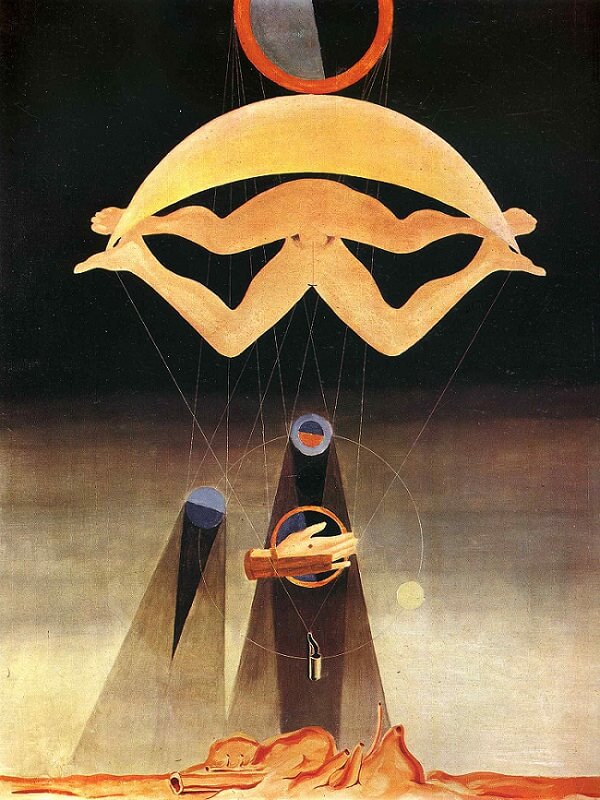
Because he studied psychology and was interested in the alternative realities experienced by the insane, one has to admit it’s likely that this painting — on the back of which Ernst has written “The picture is curious because of its symmetry. The two sexes balance one another.” — is about the hidden psychological desires and rich fantasies explored by Sigmund Freud in the early 20th century. Art historians writing about this painting since the 1970s have pointed to Freud’s 1911 paper “Psycho-Analytic Notes on an Autobiographical Account of a Case of Paranoia (Dementia Paranoides),” an analysis of the delusions — specifically the idea that God was transforming him into a woman — found in Daniel Paul Schreber’s much-discussed 1903 autobiography Memoirs of A Nervous Illness.
Maybe so! But there’s so much going on here. A sacred union between masculine and feminine forces taking place in a strange landscape. A vertically graduated sky. Celestial bodies. Geometric and architectural fragments. A central mass of organic shapes resembling entrails. Human legs interlocked in a symmetrical arrangement. Androgyny, hidden knowledge, and internal psychic conflict are at work here, sure — but Men Shall Know Nothing of This isn’t merely a pictoral transcript of Freud’s case. Ernst is moving away from Dada nihilism here, towards something… strange.
PS: This is a proto-Surrealist, not a Surrealist painting. The Surrealist movement began in 1924 when André Breton published the Manifesto of Surrealism. Ernst was a pioneer and founding member of the movement; his dreamlike and bizarre works would help define Surrealism’s core style.
THE HAND IN THE CLOUDS
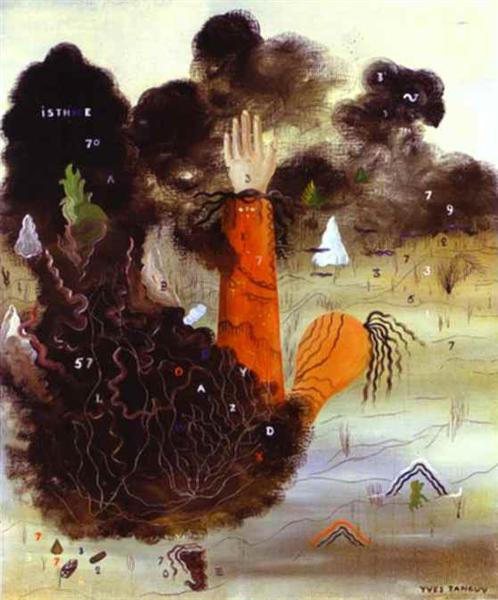
In 1927, Tanguy developed his signature mature Surrealist style (a unique, self-taught technique depicting boundless, dreamlike horizons and — eventually — biomorphic and rock-like shapes) and — because he’d impressed André Breton — enjoyed his first solo exhibition at the Galerie Surréaliste in Paris. Here we find a disembodied hand and forearm sticking up out of what the title tells us is a cloud… but which looks like a sinister shrubbery.
The central image reminds us of a medieval arm reliquary — designed to house a sacred relic, but also to serve as a kind of saint’s-arm-in-absentia, offering blessings long after the actual saint has died. Everything else about the painting — painted by Taguy without any advance planning — is vague, dreamlike. A flat, endless horizon dotted with ambiguous, plant-like shapes bleeds into an overcast sky. Random numbers, letters, and symbols float across our field of view, challenging us to find meaning where there is none to be found. It’s an apocalyptic world, one that can use a blessing.
BLACK CROSS, NEW MEXICO
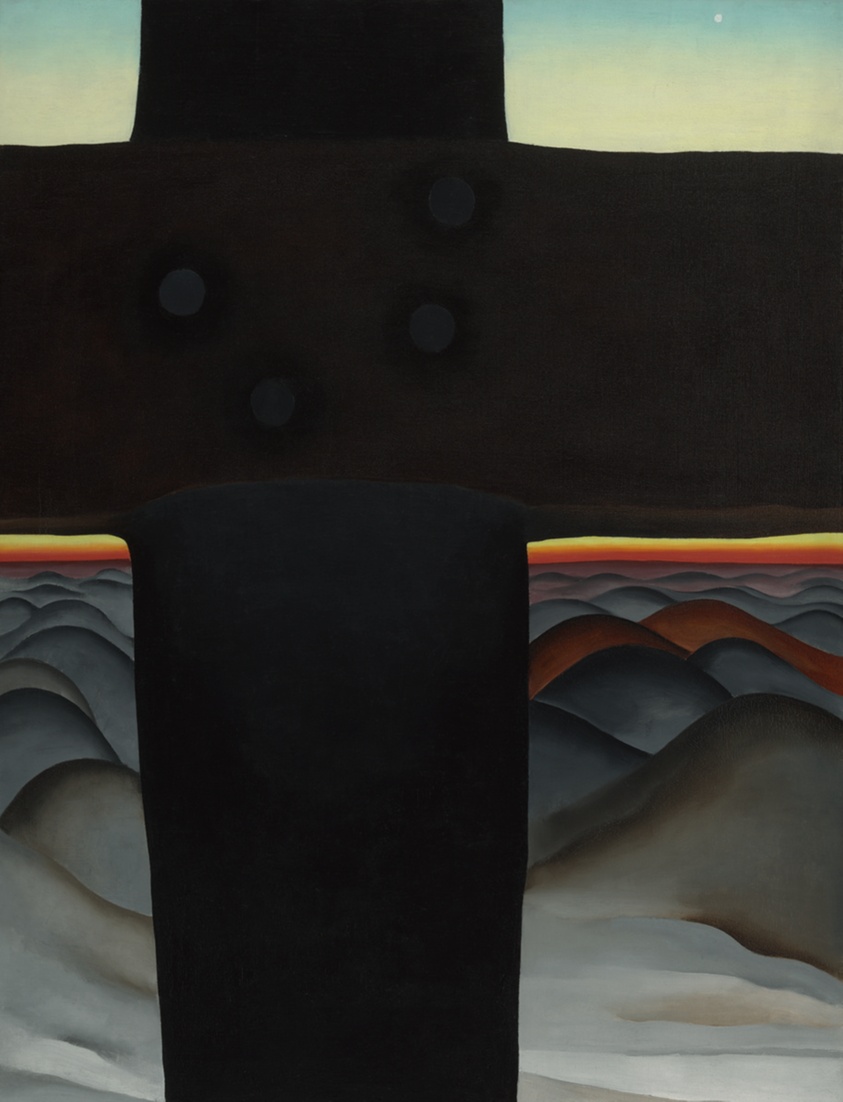
O’Keeffe traveled to New Mexico for the first time in the summer of 1929, finding deep inspiration away from her usual home in New York. She was captivated by the handmade wooden crosses that dotted the Southwestern desert, minuscule in comparison with the vast scale of the region… yet impressive in their somber, gritty way.
In Black Cross, New Mexico, the cross is starkly juxtaposed with the soft, colorful curves of the sunset and hills; both are beautiful and impressive. We’re not being asked to choose between them.
From the Art Institute of Chicago website:
“For me, painting the crosses was a way of painting the country,” recalled Georgia O’Keeffe about the series of compositions featuring Catholic crosses that she created upon visiting the Southwest in 1929. In Black Cross, New Mexico, she contrasted the handmade cross, magnified in scale and isolated flat against the picture plane, with the distant brilliance of the sunset behind the rolling hills.
PS: While some of her 1930s paintings would feature floating skulls and the like, and although her desert scenes may share a dreamlike, uncanny aesthetic with Surrealism, O’Keeffe’s work was rooted in real-world observation rather than in subconscious dreams. She was not a Surrealist.
THE SPHINX
Crali joined Futurism at 19, in 1929 — twenty years after the Italian art movement began. A self-taught painter and a recent devotee of flying, he’d play a significant role in second-generation Futurism’s aeropittura genre. His aviation paintings, which he’d create for the following 70 years, and which showcase his talent for graphic synthesis, bold geometric shapes, and clean lines, may be somewhat poster-like, but they’re thrilling… if also sometimes sinister and/or violent.
Though Crali’s work sometimes depicted military scenes, and although Futurism became closely aligned with Mussolini’s Fascist regime, one hears that Crali was never ideological… or political at all, really. After Germany occupied Italy in 1943, the Nazis named Cralli a subversive — for organizing gatherings that presented works by banned Jewish artists. He was, it seems, strictly interested in depicting kinetic energy and dynamic movement… changing how time and speed were visualized in fine art.
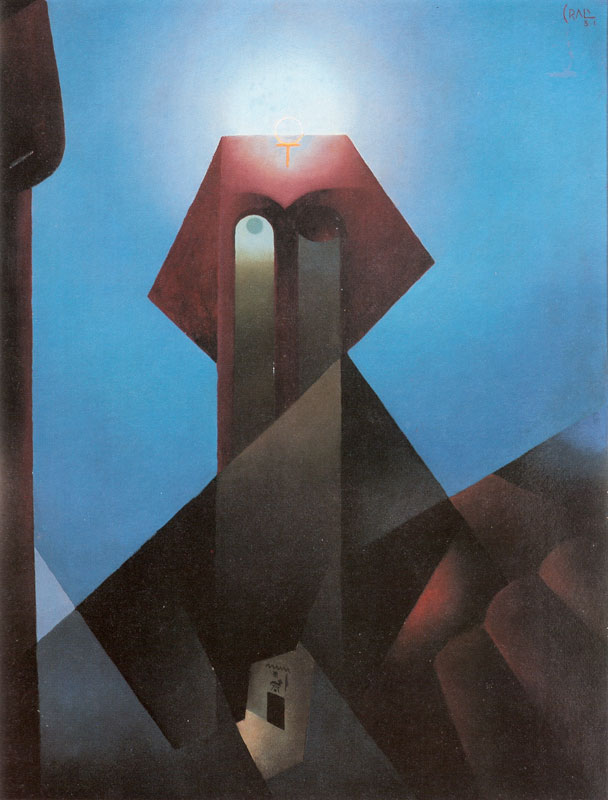
Like the other Futurists, Crali was attracted to a specific subset of radical, late 19th- and early 20th-century irrationalist philosophies (Nietzsche, Bergson, Sorel) that rejected historical stagnation in favor of an ever-changing, fluid mode of being requiring energy and intuition. How strange, then, to find Crali’s contemplative painting of a Sphinx. No dynamic action here; instead, we are confronted with eternal stillness.
Or are we? Although the mood is heavily atmospheric and symbolic, Crali uses Balla-/Boccioni-like lines of force, and geometric abstraction, to synthesize multiple viewpoints. Ground-level perspective on the Sphinx is eschewed for a POV that seems to hover in mid-air. As for Crali’s Sphinx, it’s a science-fictional technology — complete with eye-beams and a glowing ankh-antenna. [Note that the Sphinx features as a kind of ancient alien technology in Radium Age science fiction from Serviss’s Edison’s Conquest of Mars (1898) through L. Taylor Hansen’s “The Prince of Liars” (1930).] Crali’s “lines of force” — graphic trajectories, geometric vectors, shifting planes that in other paintings suggest speed, direction, and the visceral physical sensation of flight — here reveal a mystery. A door to be opened, a riddle to be solved!
HENRY FORD HOSPITAL
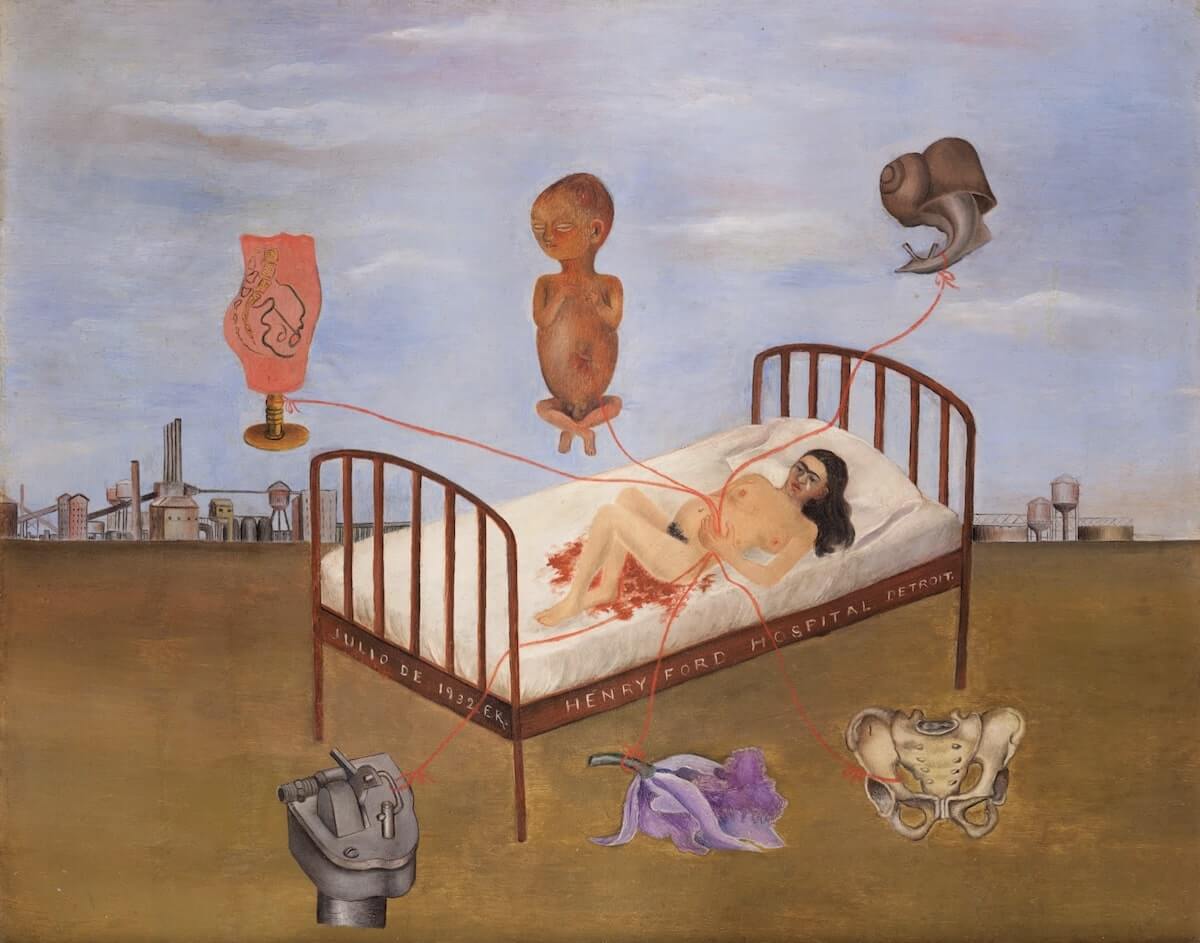
“I never painted dreams,” Kahlo insisted, contra those who wanted to lump her into the Surrealism movement. “I painted my own reality.” In the case of Henry Ford Hospital, that reality was either a miscarriage or an abortion — there are persuasive arguments for both — through which she suffered in the titular Detroit hospital in 1932, just before her 25th birthday.
Kahlo depicts herself in an extremity of pain and grief, isolated in her hospital bed (and in Detroit, far from home), around which float icons related directly or indirectly to her experience: a teaching model of female reproductive anatomy, a snail, a piece of steel-gray medical equipment, an orchid, a pelvis bone. And, of course, a fetus.
The artist is here adapting the format of the traditional Mexican retablo ex-voto — a specific type of retablo (devotional painting) that tells a story about a crisis, illness, or disaster. While an ex voto is created to thank Jesus or one’s guardian saint, however, in this case no one is thanked. It’s a thankless scenario.
Josh Glenn’s EMANATIONS series includes the following installments: CATASTROPHE: DECLINE & FALL | DYING EARTH | ECO-CATASTROPHE. COSMIC AWE: DEEP TIME | STARS WHEEL IN PURPLE | IS THERE LIFE ON MARS. DEHUMANIZATION: CYBORG MANIFESTO | MECHANIZATION. & many others.
MORE RADIUM AGE SCI FI ON HILOBROW: RADIUM AGE SERIES from THE MIT PRESS: In-depth info on each book in the series; a sneak peek at what’s coming in the months ahead; the secret identity of the series’ advisory panel; and more. | RADIUM AGE: TIMELINE: Notes on proto-sf publications and related events from 1900–1935. | RADIUM AGE POETRY: Proto-sf and science-related poetry from 1900–1935. | RADIUM AGE ART: Proto-sf and science-related fine art from 1900–1935. | RADIUM AGE 100: A list (now somewhat outdated) of Josh’s 100 favorite proto-sf novels from the genre’s emergent Radium Age | SISTERS OF THE RADIUM AGE: A resource compiled by Lisa Yaszek.