
IS THERE LIFE ON MARS
By:
June 14, 2026
An installment in EMANATIONS, a series of posts featuring 10 of Josh Glenn’s favorite examples of Radium Age-era fine art that explore a particular proto-sf-adjacent theme. In this case, that theme is COSMIC AWE. The sub-theme, meanwhile, is…
This particular COSMIC AWE sub-category is a bit of a stretch. Only a few Radium Age-era works of fine art, at least as far as I’m aware, seek to depict life on/from other planets. Still… I think I’m onto something.
PS: I am trying, with no small amount of difficulty, to distinguish between IS THERE LIFE ON MARS (a sub-category of COSMIC AWE) and ALIEN INVASION and SCARY MONSTERS (AND SUPER CREEPS) (both of which are sub-categories of UNKNOWABLE ALIENS / SINGULARITY). ALIEN INVASION works of art seem to depict humans who have become terribly strange; SCARY MONSTERS (AND SUPER CREEPS) works of art seem to depict Earth’s monsters.
THE WORLD OF MARS
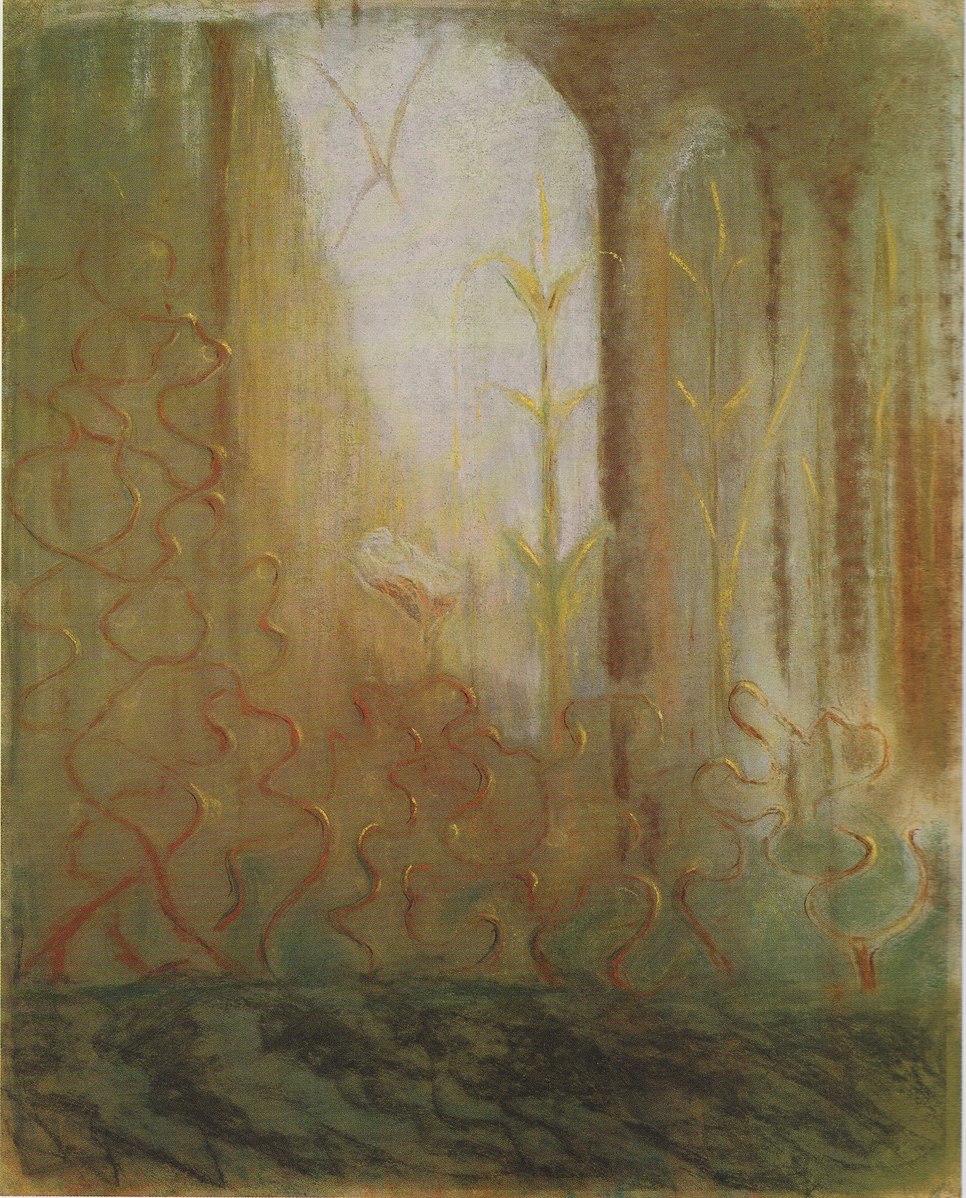
In 1904, Čiurlionis enrolled in the newly established Warsaw School of Fine Arts. Its director, Kazimierz Stabrowski, was a longtime Theosophist; he and Čiurlionis became friends. During his years at the Warsaw School, Stabrowski organized salons (attended by Čiurlionis as well as, for example, the esoteric poet and playwright Tadeusz Miciński, and the future Indologist Stanisław Franciszek Michalski) at which the topic of conversation often included Theosophy, as well as oriental religions, Spiritualism, and parapsychology.
In 1905 at the Warsaw School, Čiurlionis exhibited a ten-part series of allegorical pastels collectively titled “Fantasy” (I’ve also seen it titled “Fantasies”). Among these, the paintings Composition and The World of Mars in particular are said to have been influenced by the French astronomer, leading Theosophist, and influential scientific romance author Camille Flammarion. One of whose books, La Planète Mars et ses conditions d’habitabilité (1892) is a two-volume, exhaustive summary of three centuries’s worth of astronomical observations of Mars. Flammarion here argues that Mars is an inhabited world, supports Schiaparelli’s theory of Martian “canals,” and speculates that Martians are superior in intelligence to humans. He also suggests that Mars must have its own flora that we Earthlings would find odd; Martian vegetation was likely red, rather than green, he opined, and adapted to a drier, thinner atmosphere than ours.
In Čiurlionis’ The World of Mars, we find eerie reddish vines twisting and winding their way upwards. Along with tall yellowish plants, plus columns or tree-like plant structures. (I’ve seen these columns described as a “ruined nave,” and maybe that’s so… but the columns do look like tree trunks to me.) Also… in the sky at top center… is that a pterodactyl-type flying creature?
THE CREATURE FROM MARS
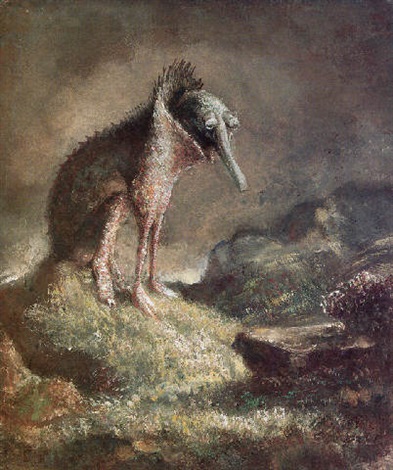
I don’t know if Kubin, a Symbolist painter from Austria (who was influenced by artists like Odilon Redon, Edvard Munch, and James Ensor), was a Flammarion reader, but he too seems to have become excited by the imagination-sparking possibilities of life on Mars. In this pastel and gouache work on cardboard, he offers us a grotesque, quite melancholic alien creature — who may have found its way to Earth, if I’m reading the painting’s title correctly.
As with all Symbolist art, this work is not so much a proto-sf illustration as a psychological projection of the irrational, fantastical, morbid “nightside” of the human subconscious.
Fun fact: In 1909, Kubin — who’d illustrated works by Edgar Allan Poe and E.T.A. Hoffmann — would publish The Other Side, a work of dystopian science fantasy in which an illustrator is invited to a utopian kingdom… that unravels into chaos, plague, and decay. Ernst Jünger, Thomas Mann, and Franz Kafka were admirers, or so one hears, of Kubin’s novella.
THE WAR OF THE WORLDS
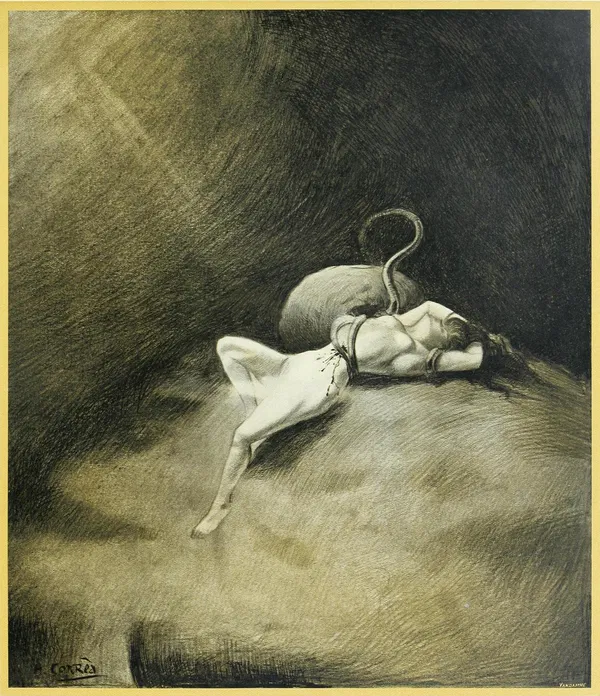
Not fine art, so including this illustration is cheating. But what an illustration! Corrêa (1876–1910) was a Brazilian illustrator who moved to Brussels in 1900. In 1903, he executed a series of 132 notable illustrations, 32 of which were full-page plates inserted in a French language edition of H.G. Wells’ The War of the Worlds.
At The Public Domain Review, we read, of this particular image:
The image of a blurry woman, erotically posed, being attacked by a Martians’ tentacles — which introduces Chapter Two — may contain a reference to Hokusai’s The Dream of the Fisherman’s Wife.
PS: In 1914, when Germany invaded Belgium, Corrêa’s studio was looted and several of his drawings were stolen or destroyed. Then in 1942, during World War II, some of his illustrations were lost when the ship transporting them to Brazil sank, torpedoed by a German submarine.
See this website for more of Corrêa’s extraordinary work.
NUDE FIGURE
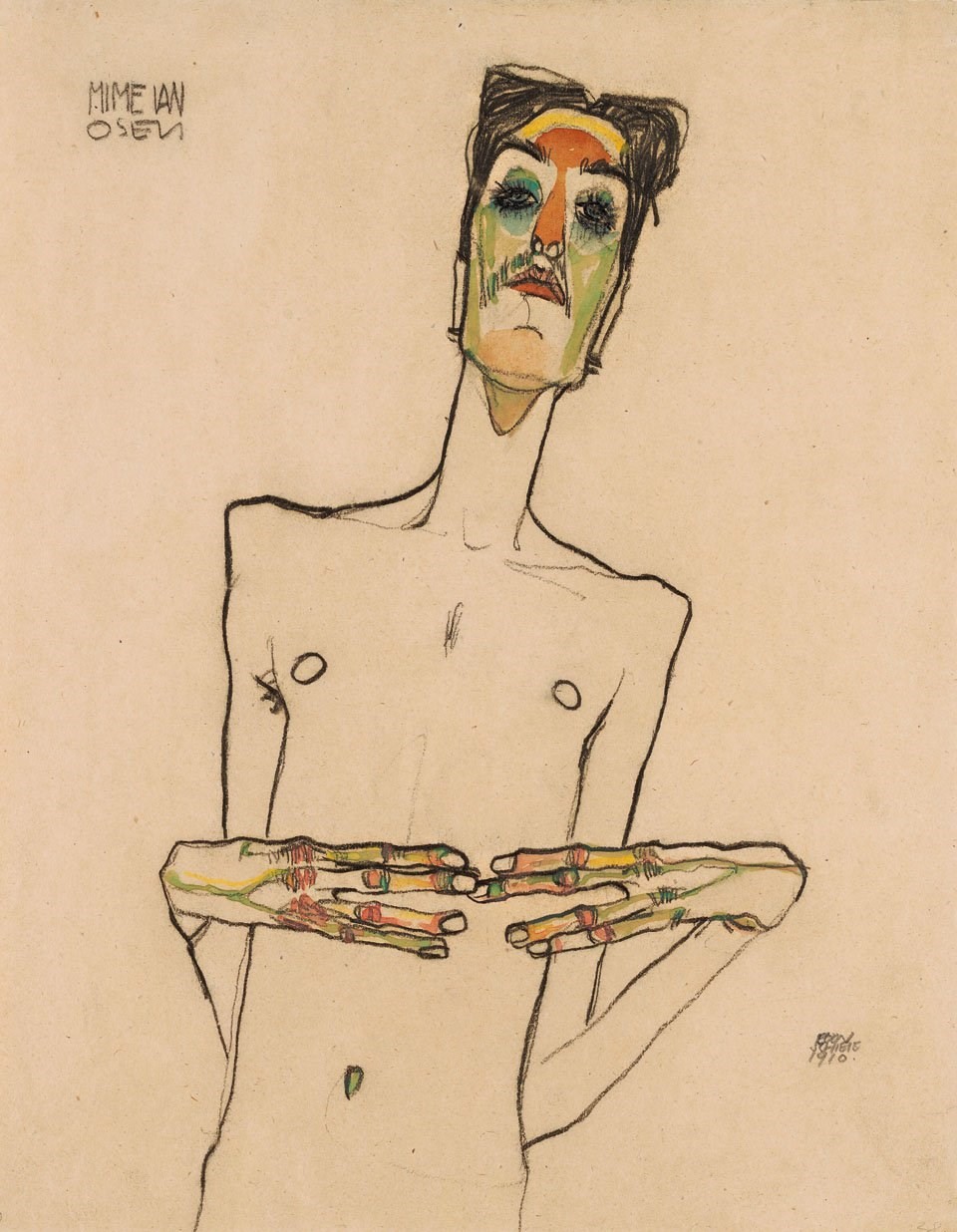
I don’t know that Schiele was attempting to depict an alien being, here. However, David Bowie became acquainted with Schiele’s work when living in Berlin in the 1970s. His LP covers from the period are inspired by Schiele’s positioning of limbs and figures. (Compare Schiele’s Self-Portrait as Saint Sebastian (1914) with Bowie’s 1979 Lodger cover.) Bowie’s portrayal of the title character in the 1976 film The Man Who Fell to Earth was deeply influenced by Schiele’s raw, emaciated, isolated characters.
BENDING FIGURE
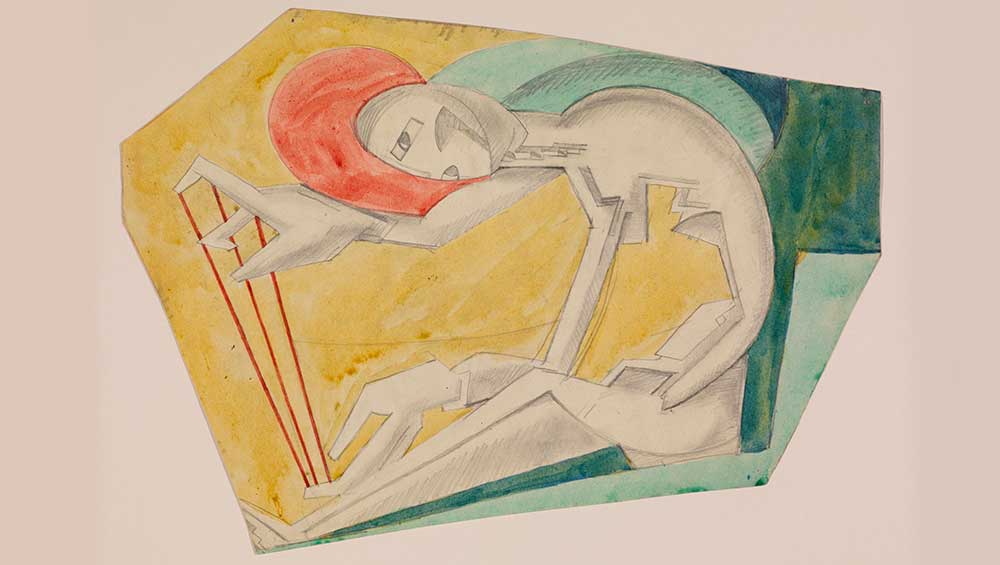
Saunders (1885 – 1963) was an English painter associated with the Vorticist movement; she and Jessica Dismorr were the movement’s only female members.
One hears various theories about the figure in this painting. It’s a puppet-master; or a puppet. It’s a self-portrait of the artist. It’s a human form at the mercy of a colossal machine; it’s an automaton. But anyone with eyes in their head can see that in fact it is a “grey alien” — though of course the notion of these creatures wouldn’t be popularized until the Betty and Barney Hill abduction in 1961.
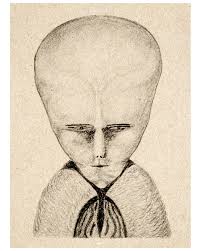
Please note that in 1917, the occultist Aleister Crowley described a meeting with a “preternatural entity” named Lam that was similar in appearance to a modern Grey. While living in New York, Crowley engaged in a magickal experiment that some claim created a channel allowing extra-dimensional entities to enter our universe. Below: Crowley’s drawing of Lam.
RED LANDSCAPE
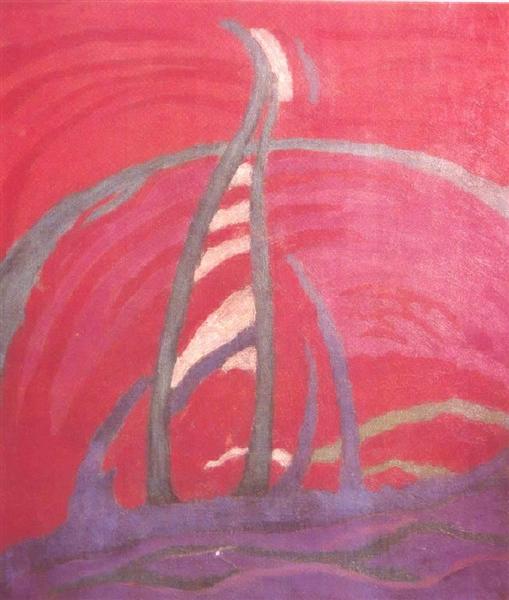
Mattis-Teutsch (1884–1960) was a Hungarian-born sculptor, art critic, poet, and painter — best known for his Seelenblumen (“Soulflowers”) cycle, paintings from c. 1917–24 in which we can see him transitioning from transition from expressionist landscapes to pure abstraction. Red Landscape, created during this same period, is part of his Landscape series; influenced by the ideas of Kandinsky and the Blaue Reiter group, he viewed landscape painting as a way to express the universe’s imperceptible forces — vibrations, or rhythms — and the interpenetrability of objective world-stuff and subjective emotions.
This is not a painting — literal or figurative — of an alien world, then. But that’s certainly what it looks like. The red sky, purplish terrain, and undulating tentacle-like fauna…. In fact, all of his landscape paintings from this era look like depictions of other worlds, but this one — which lacks any terrestrial reference to mountains or trees, say — most of all. If this is a “spiritual” landscape, then this artist’s spirit apparently yearned for a world transformed… or else utterly alien.
ECHINODERMS
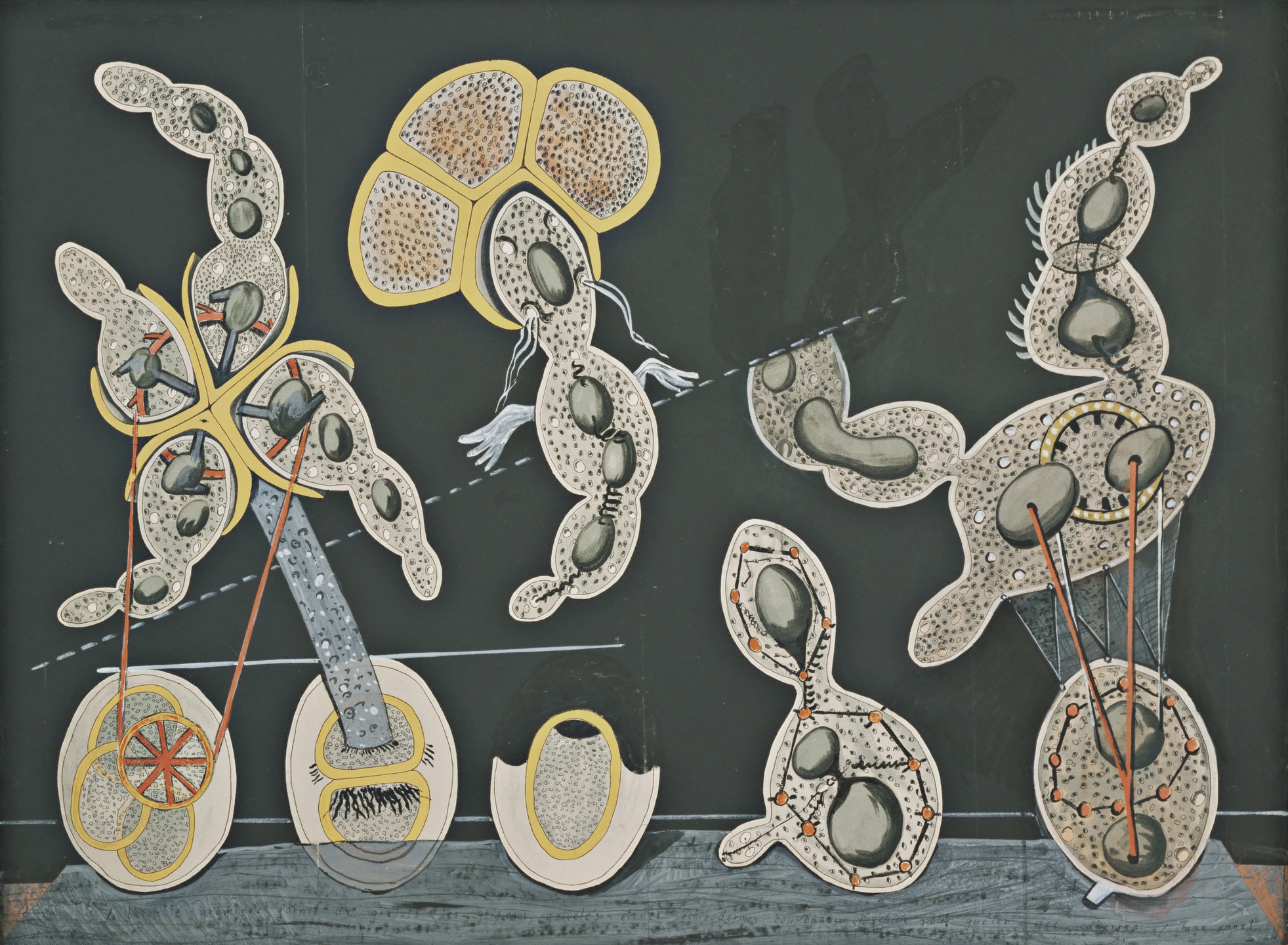
Ernst painted over a commercial scientific chart, inverting it, and focusing on images that likely showed mitosis in grass cells (gramineous), creating a sense of “living fossils” or organic-mechanical hybrids.
This art work puts me in mind of D.H. Lawrence’s 1929 anti-utopian poem “Wellsian Futures”:
When men are made in bottles
and emerge as squeaky globules with no
bodies to speak of,
and therefore nothing to have feelings
with,
they will still squeak intensely about their
feelings
and be prepared to kill you if you say
they’ve got none.
FIFTY-THOUSAND-YEAR-OLD WOMAN ON MARS
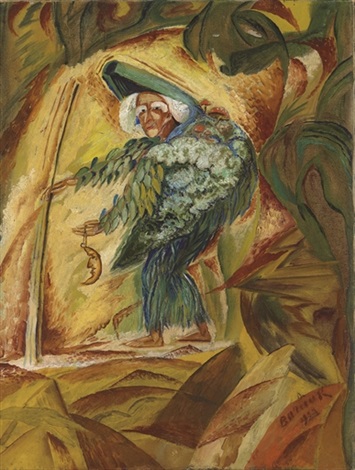
The Ukrainian poet, artist and publicist David Burliuk (1882–1967) has been described as “the father of Russian Futurism.” His work — like that of his friend and associate, the poet Velimir Khlebnikov — explored themes that align with Radium Age proto-science fiction, particularly regarding the future, technology, and cosmic exploration. Burliuk was a member of Khlebnikov’s “Society of Chairmen of the Globe” (or “Union 317”), a group that aimed to govern a utopian “State of Time.:
In this cryptic work, a hunched, elderly woman in a bird-like costume, which seems to be sprouting a few mushrooms, hobbles along a forest path. She is surrounded by somewhat fantastical foliage; she carries a crescent moon pendant. She smiles at us a bit crookedly, as though to say, “I don’t know what this painting means either.”
In 1918, Burliuk fled Russia and began a journey to the United States, a process that took him through Siberia, Japan, and Canada. He arrived in the USA in 1922 — the year he painted this painting. In 1924, he’d publish manifestos detailing a utopian art (Radio-Style”) that would transcend space-time and aid in humanity’s pursuit of knowledge and perfection. He dubbed himself the “Radio-Futurist” and leader of the “Universal Camp of Radio-Modernists.” The mechano-morphic paintings he’d produce during this period are quite different from Fifty-thousand-year-old Woman on Mars. This painting suggests a transition, a journey from folklore-haunted Russia to America perhaps. Maybe it’s a self-portrait of sorts?
FRIENDLY FOUR
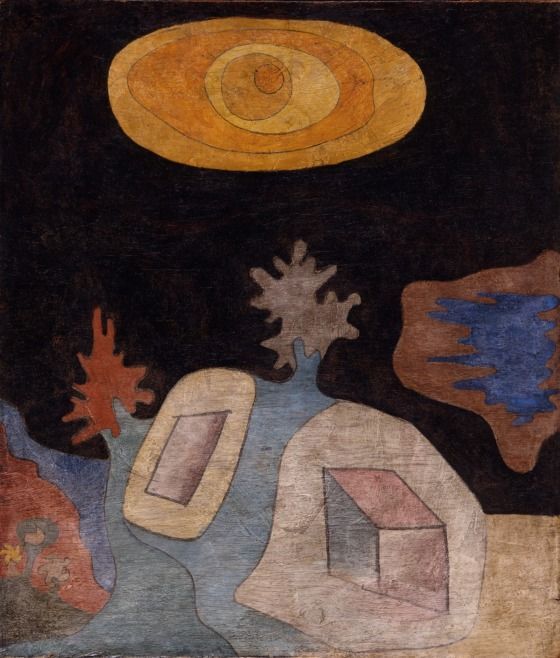
Klee’s “Untitled” reflects the artist’s aim to imagine and depict “other possible worlds”. Many of Klee’s works from this period focus on otherworldly or symbolic depictions, aimed at accessing a “secret” or “inner” nature rather than replicating the actual world around him.
Because it blends abstract, geometric forms with a whimsical, often childlike imagination, this work has been said to epitomize Klee’s transition into the Bauhaus era.
In early exhibitions, this painting was sometimes referred to as Freundliche vier (Friendly Four) — as though the four distinct shapes shown interacting here possessed consciousness.
IN THE LAND OF PRECIOUS STONES
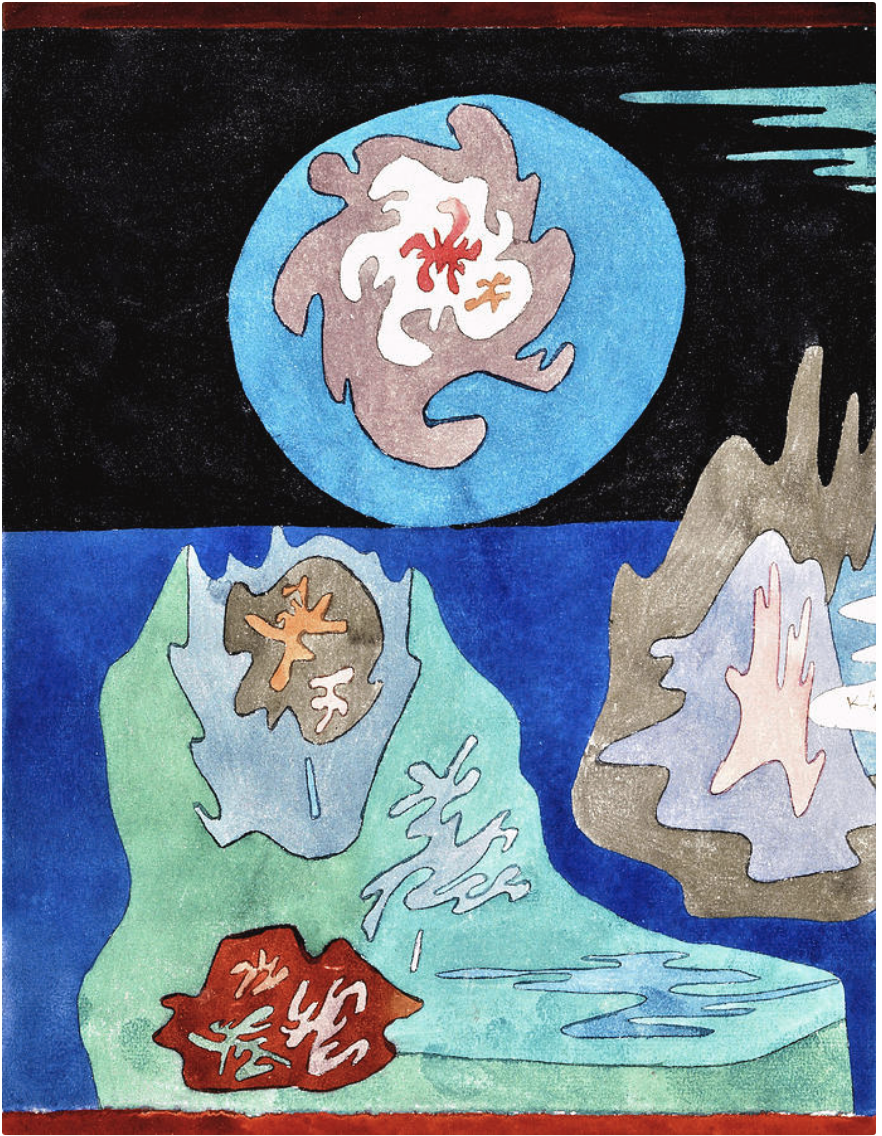
An abstract fantasy landscape utilizing a jewel-toned palette and geometric shapes to create a dreamlike, kaleidoscopic “other world.”
Again, the shapes here almost seem to be conscious subjects.
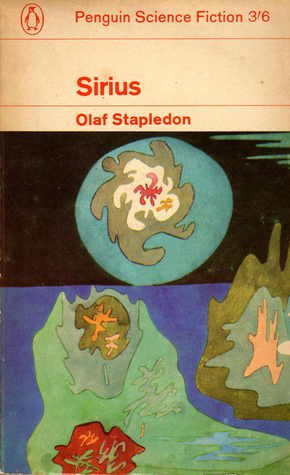
Fun fact: In 1963, Penguin left behind their distinct color-coded cover designs, and launched a series of sci-fi novels featuring abstract and surrealist works of art by the likes of Max Ernst, Yves Tanguy, and René Magritte. Klee’s In the Land of Precious Stones was used for a new edition of Olaf Stapledon’s 1944 sf novel Sirius.
Josh Glenn’s EMANATIONS series includes the following installments: CATASTROPHE: DECLINE & FALL | DYING EARTH | ECO-CATASTROPHE. COSMIC AWE: DEEP TIME | STARS WHEEL IN PURPLE | IS THERE LIFE ON MARS. DEHUMANIZATION: CYBORG MANIFESTO | MECHANIZATION. & many others.
MORE RADIUM AGE SCI FI ON HILOBROW: RADIUM AGE SERIES from THE MIT PRESS: In-depth info on each book in the series; a sneak peek at what’s coming in the months ahead; the secret identity of the series’ advisory panel; and more. | RADIUM AGE: TIMELINE: Notes on proto-sf publications and related events from 1900–1935. | RADIUM AGE POETRY: Proto-sf and science-related poetry from 1900–1935. | RADIUM AGE ART: Proto-sf and science-related fine art from 1900–1935. | RADIUM AGE 100: A list (now somewhat outdated) of Josh’s 100 favorite proto-sf novels from the genre’s emergent Radium Age | SISTERS OF THE RADIUM AGE: A resource compiled by Lisa Yaszek.