
STOP MOTION
By:
September 29, 2026
An installment in EMANATIONS, a series of posts featuring 10 of Josh Glenn’s favorite examples of Radium Age-era fine art that explore a particular proto-sf-adjacent theme. In this case, that theme is DISENCHANTMENT / UNSEEN FORCES. The sub-theme, meanwhile, is…
THE CITY RISES
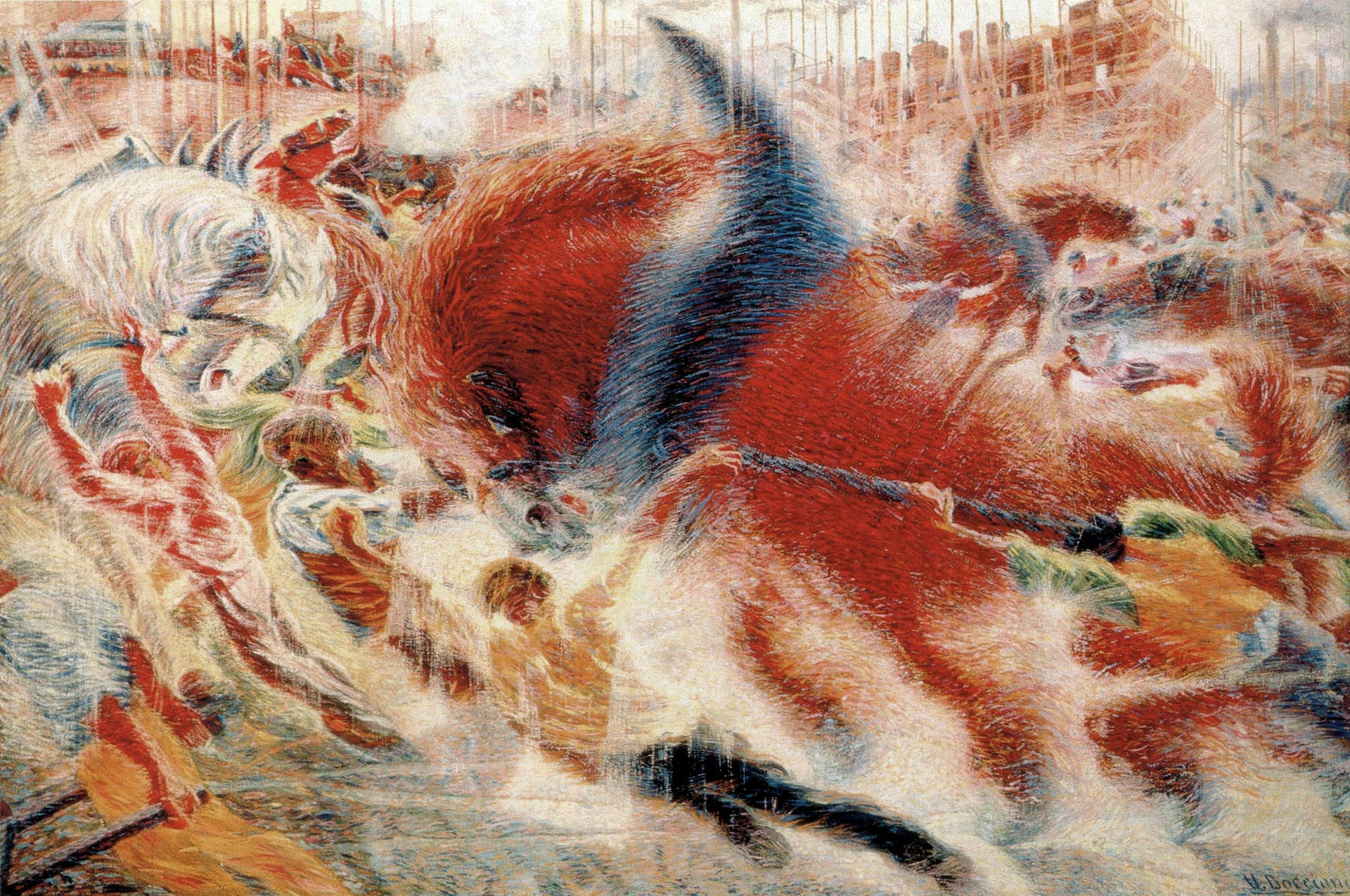
“[O]n or about December, 1910,” Virginia Woolf would claim in a 1924 essay, “human character changed.”
Let’s begin with Boccioni.
Started at some point after he and fellow newbie Italian Futurists Carlo Carrà, Luigi Russolo, Giacomo Balla, and Gino Severini published the “Technical Manifesto of Futurist Painting” (in April 1910), and completed at some point before May 1911, at which date it was exhibited at Milan’s Exhibition of Free Art, Boccioni’s La città che sale is considered the first Futurist painting. Though it may not signal a change in human nature, exactly (Woolf is talking about, e.g., people questioning their religious faith, the dissolution of hierarchies and other seemingly natural sociocultural norms and forms, and writers experimenting with avant-garde story-telling techniques to depict humankind’s shockingly complex interiority), “The City Rises” signals a change, c. late 1910, in human perspective.
Cubism, which Picasso and Braque began developing in 1906–08, had by that point begun to expand into a larger movement. Severini, who’d moved to Paris in ’06, urged his Italian comrades to pay attention to what was happening there. Boccioni, Carrà, and Russolo would make a flying visit to Paris in October 1911, where they’d encounter Cubism at the Salon d’Automne. So “The City Rises” is an example of pre-Cubist Futurism. Though they would become major influences on the Futurists, this painting is influenced not by the austere four-dimensional analytics of Picasso and Braque, but by the flickering vibrations of Divisionism. To suggest the dynamism of the modern city, Boccioni here blurs the lines between work horses and workmen starting their day; the impression is one of frantic activity.
By paying close attention to the speed, sound, and rhythm of racing cars, speeding trains, whirring propellers, and bustling crowds, the Futurists would remind us (as we read in their manifesto) that “All things move, all things run. A profile is never motionless before our eyes, but it constantly appears and disappears. On account of the persistency of an image on the retina, moving objects constantly multiply themselves; their form changes, like rapid vibrations, in their mad career. Thus a running horse has not four legs, but twenty, and their movements are triangular.” If Analytic Cubism (which avoided real motion to keep the focus purely intellectual and structural, showing an object from multiple viewpoints) demanded that we develop a far-out perspective on space, then pre-Cubist Futurism demanded that develop a far-out perspective on time.
Owned by MoMA.
THE FUNERAL OF THE ANARCHIST GALLI
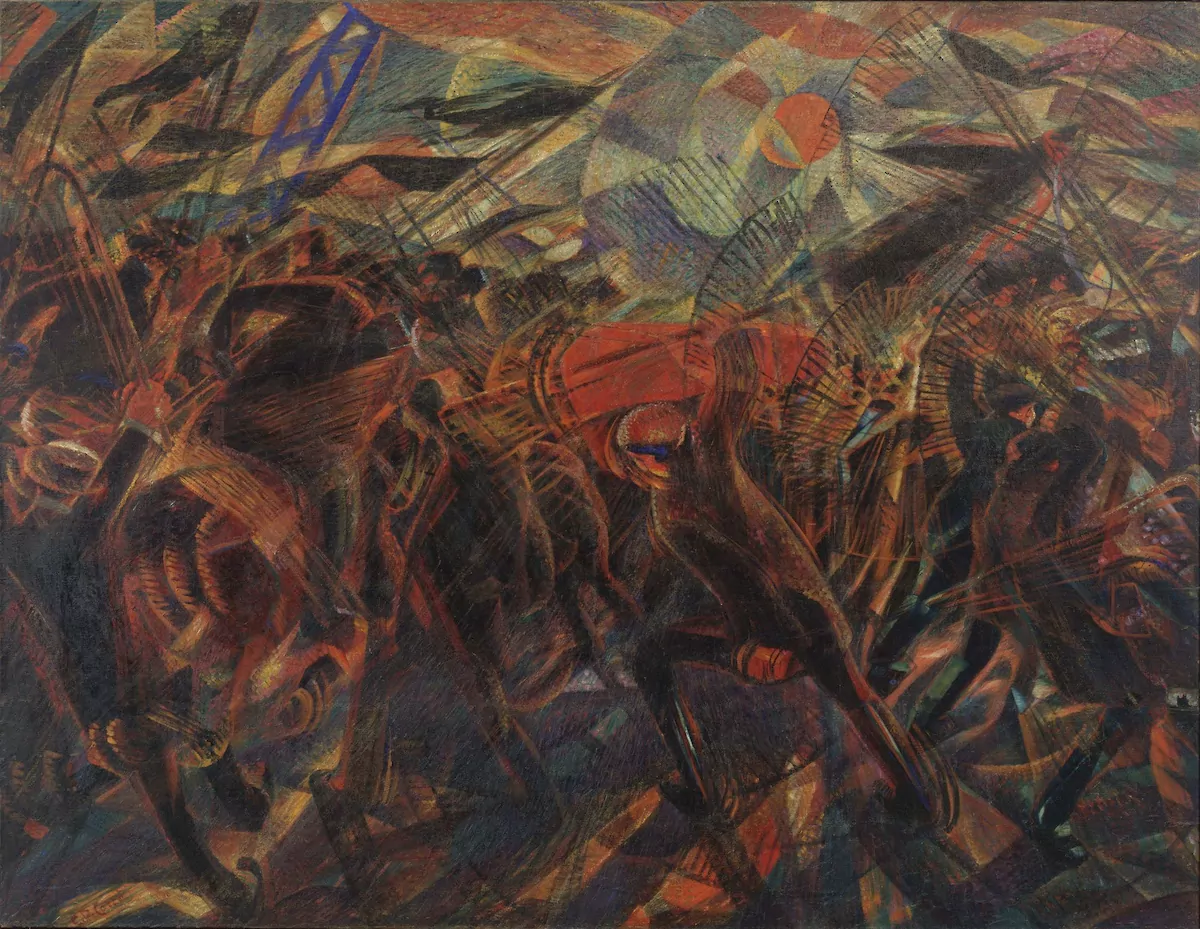
“We will sing of great crowds excited by work, by pleasure and by riot,” according to Marinetti’s 1909 “Futurist Manifesto.” If work was the subject of Boccioni’s painting, riot is the subject of Carrà’s.
In 1906, the Italian anarchist Angelo Galli was killed on the eve of a general strike. A major organiser of the strike, Galli was stabbed by security guards of an automotive and metallurgical factory in Milan. Fearing that Galli’s funeral would become a de facto political demonstration, the police refused to allow the procession of anarchists into the cemetery. Carrà, who was associated with the Milanese anarchists, witnessed the ensuing street battle. In his retrospective painting of that scene, Carrà uses structural techniques borrowed from Cubism: Here, fracturing and overlapping forms break down traditional perspective and collapse depth. Instead of a static, multi-angled object, however, the painting conveys physical dynamism, speed, and aggression. The red-draped bier wobbles dangerously amid swinging clubs, lances, and surging horses.
Space (Cubism) and time (Futurism) were now joined, forming a kind of vortex into which the viewer finds himself irresistibly drawn. “If we paint the phases of a riot,” we read in 1910’s “Technical Manifesto of Futurist Painting,” “the crowd bustling with uplifted fists and the noisy onslaught of the cavalry are translated upon the canvas in sheaves of lines corresponding to the conflicting forces, following the general law of violence of the picture. These force-lines must encircle and involve the spectator so that he will in a manner be forced to struggle himself with the persons in the picture.”
The painting was exhibited in 1912 when Felix Fénéon organized “The Italian Futurist Painters” exhibition at the Galerie Bernheim-Jeune.
Owned by MoMA.
AU VÉLODROME
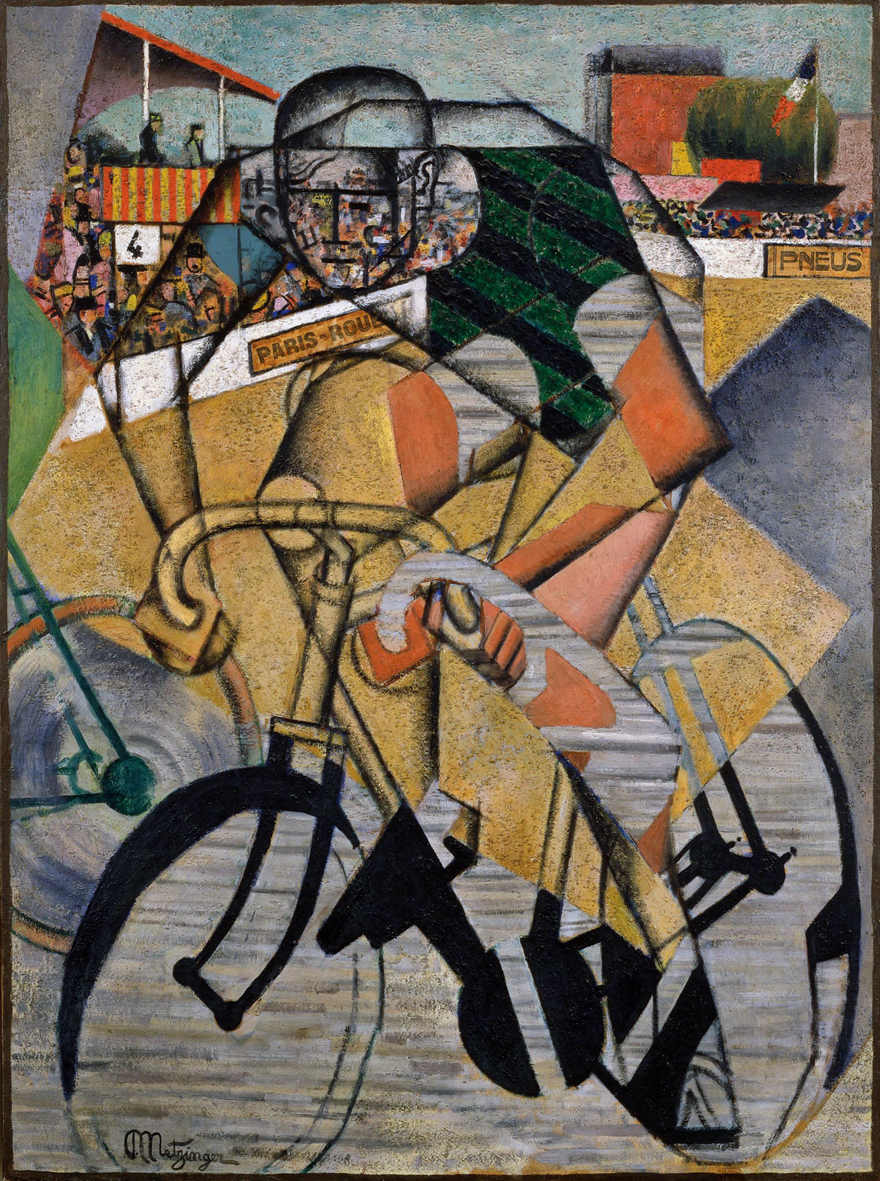
Metzinger’s painting, which depicts the final sprint of the 1912 Paris-Roubaix cycling race, was created while he was writing, with Albert Gleizes, Du “Cubisme” — the first theoretical work on Cubism.
Au Vélodrome (also known as At the Cycle-Race Track) merges some techniques of French Cubism (e.g., transparent overlapping planes, a granular surface texture, printed-paper collage elements) with some of Italian Futurism (the choice of a dynamic subject in motion, first and foremost; but also the blurred rear wheel suggesting high speed, and the fusing of forms across a static plane). Cubist and Futurist forms alike, one ought also to point out, are here superimposed over a specific, real-world sporting event. It’s a photo-finish. A series of frames captured — or that’s the impression we get — as Charles Crupelandt crosses the race’s finish line.
Metzinger first encountered Futurist works in February 1912 when Felix Fénéon organized “The Italian Futurist Painters” exhibition at the Galerie Bernheim-Jeune. This painting is often used as a primary example of his theory-driven effort to expand the “vocabulary” of Cubism beyond static objects.
Other modernist sporting-event paintings of note: Gleizes’ Football Players (1912–13;) Delauney’s L’Équipe de Cardiff (1913), Boccioni’s Dynamism of a Cyclist (1913), Goncharova’s The Cyclist (1913), Boccioni’s Dynamism of a Cyclist (1913), Depero’s Ciclista multiplicato (1922). The bicycle, one is given to understand, was celebrated during the late 19th and early 20th centuries as a symbol of human-machine synthesis because, unlike the steam engine or the automobile (about which people had mixed feeings), it multiplied human power without replacing it.
Owned by the Peggy Guggenheim Collection in Venice.
NUDE DESCENDING A STAIRCASE, NO. 2
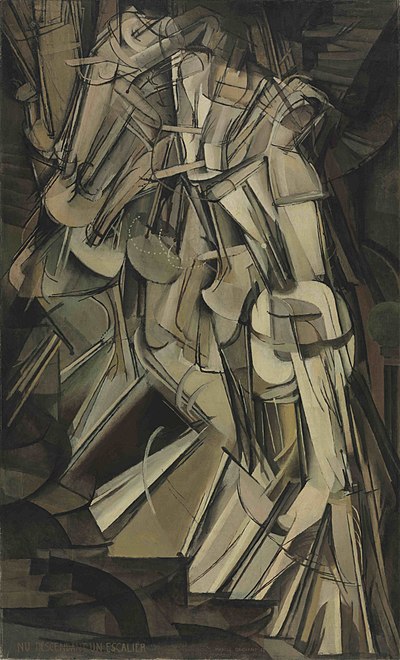
“In 1912… the idea of describing the movement of a nude coming downstairs, while still retaining static visual means to do this,” Duchamp would years later tell an interviewer asking about Nude Descending a Staircase, “particularly interested me.”
He continued, revealing the influences on the painting: “The fact that I had seen chronophotographs of fencers in action and horse galloping (what we today call stroboscopic photography) gave me the idea for the Nude. It doesn’t mean that I copied these photographs. The Futurists were also interested in somewhat the same idea, though I was never a Futurist. And of course the motion picture with its cinematic techniques was developing then too. The whole idea of movement, of speed, was in the air.
More or less independently of the Futurists, then, influenced by stroboscopic photography (cf. Muybridge’s 1887 Woman Walking Downstairs), the multiple frames of cinema, and the speeded-up zeitgeist, Duchamp too pulled space and time together into a spacetime vortex. Rather than freezing a single, isolated moment in a static grid of perspective, Nude Descending a Staircase reflects a Radium Age-era universe newly defined by constant flux, observer dependence, and the synthesis of time and space. Not that Einstein’s breakthroughs were well-known before 1919; but prior to and influencing Einstein there was both a cultural and scientific shift toward non-Euclidean geometry. In which “simultaneity” (a key term) is relative to the observer.
Here Duchamp layers successive “planes” of movement onto a single canvas. The discernible “body parts” of the figure are composed of nested, conical and cylindrical abstract elements, assembled together in such a way as to suggest rhythm and convey the movement of the figure merging into itself. The result helps persuade the viewer that time is not a series of disconnected ticks on a clock, but rather a continuous, fluid continuum. At the time he was writing a (never-completed) book titled A l’Infinitif (also known as The White Box), the surviving notes for which reference Poincaré’s writings on the fourth dimension, as well as Jouffret’s.
Duchamp enteed the painting in the Cubists’ 1912 Salon des Indépendants in Paris, but it was withdrawn after the Cubist committee members — including his own brothers — objected to it. They disliked his Futurist-style fragmentation of time and motion. When the painting made its debut at the New York Armory Show of 1913, it instantly became — for better or worse — iconic.
Owned by the Philadelphia Museum of Art. I was excited to see it at MoMA in 2026.
DYNAMIC HIEROGLYPH OF THE BAL TABARIN
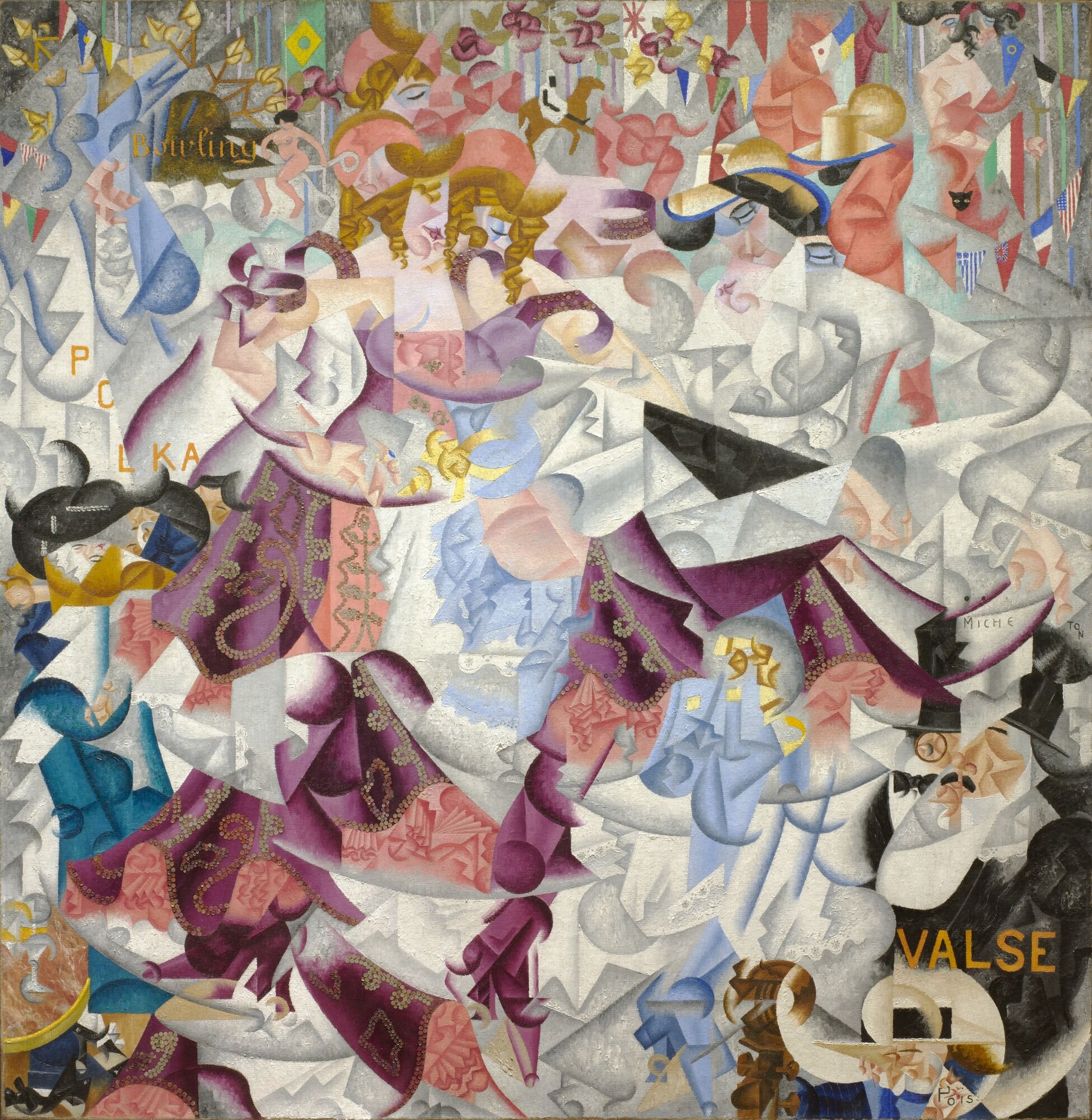
From MoMA’s website:
Severini was fascinated by the dancehall as a subject for the opportunity it offered for the depiction of multisensory experience. Here he pictures a woman with brown curls and a white, blue, and pink flounced dress as she dances to music in the Paris nightclub Bal Tabarin. Different elements of the work point to current events — the Arab riding a camel refers to the Turco-Italian War of 1911, and flags convey sentiments of nationalism.
In his depiction of Bal Tabarin the artist merges the Futurists’ interest in capturing the dynamism of motion with the integration of text and collage elements, such as sequins, influenced by his study of Cubism.
So yes, this is another fruitful Cubist/Futurist work — as beautiful as the chance meeting on a dissecting table, to quote Isidore Ducasse / Comte de Lautréamont, of a sewing machine and an umbrella.
Owned by MoMA.
THE KNIFE GRINDER or PRINCIPLE OF GLITTERING
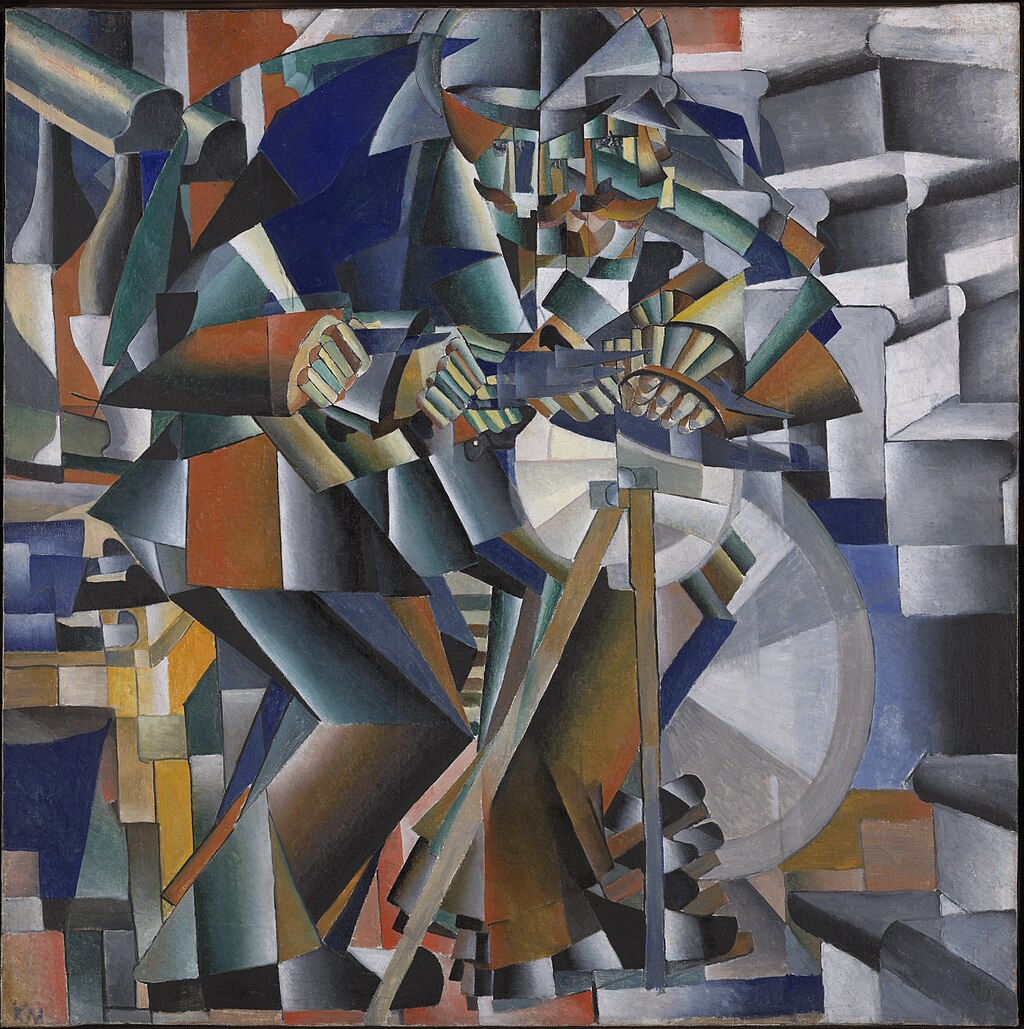
Here’s another fantastic example of Futurism-meets-Cubism. In fact, the main school of painting and sculpture practiced by those Russian Futurists who’d been meeting and collaborating since 1910 was named, in 1913, “Cubo-Futurism.” As early as 1909 Natalia Goncharova applied both Cubist and Futurist means of expression in her paintings. Another major painter to become a Cubo-Futurist, just before he’d found Suprematism, a radically non-objective form of painting, was Kazimir Malevich.
The Knife Grinder or Principle of Glittering is Cubist because here we see both the knife grinder and his sharpening wheel broken into flat, interlocking geometric shapes and transparent planes. There is no fixed viewpoint; we’re viewing different angles of the man’s body and the machine simultaneously. And it’s Futurist because (in addition to the industrial subject matter) we’re being shown the rapid, rhythmic movement of the machinist working his treadle; his hands, feet, and legs are multiplied kaleidoscope-style. The spinning grinding wheel, the sharpened metal blade(s) seem to… as the title suggests… glitter.
Owned by the Yale University Art Gallery.
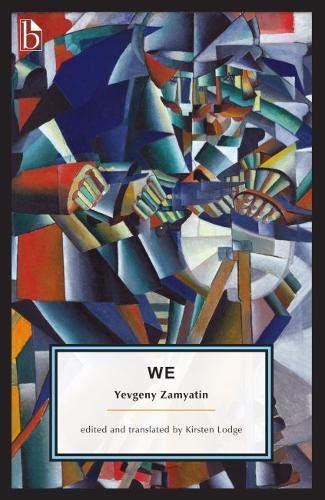
Fun fact: Malevich’s painting in 2020 was used to illustrate the cover of a new edition of Yevgeny Zamyatin’s proto-sf novel We.
UNIQUE FORMS OF CONTINUITY IN SPACE
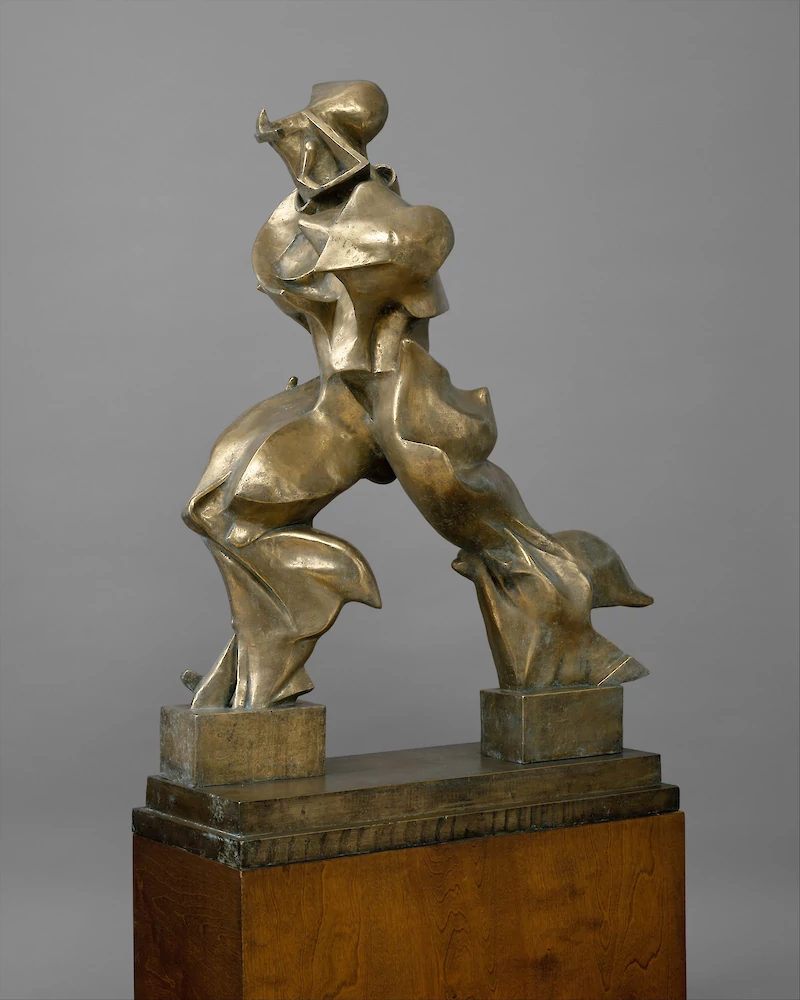
Back to Boccioni. Operating under the influence of Henri Bergson, who argued that intuition and lived experience reveal reality far better than rigid intellect. As the leading theorist of the Futurist visual artists, in 1913 he coined the pejorative phrase “analytical discontinuity” to describe how the methods of depicting movement employed by some avant-garde artists — Picasso, Duchamp, Kupka — broke reality down into frozen, separate, or sequential stages that ultimately stripped the subject of its Bergsonian life force. They lacked continuous flow, dynamic movement, a sense of the fluid relationship between any mobile body and its surrounding space.
Instead, according to Boccioni, what was needed was “synthetic continuity.” An objects’s dynamic motion and the space surrounding that object in motion must be depicted holistically, seamlessly. Hence his iconic sculpture shown above. Which instead of showing superimposed sequential stages of a body in motion shows a muscular, striding figure interpenetrating with the environment around it. The boundaries between the object and space dissolve; the medium is warped by that which passes through it, before flowing back together. The air sweeping around the body becomes part of the body. Unseen forces act upon us, at all times; we act on them too.
PS: Unique Forms of Continuity in Space was cast in plaster; it was never cast into bronze during the artist’s lifetime. Because multiple authorized bronze casts were made after Boccioni’s death (starting in 1931, 1949, and 1972), different worldwide institutions own and display individual casts. Of the two bronze casts made in 1931, one is displayed at MoMA.
Fun facts: Unique Forms of Continuity in Space (1913) rates a mention in Edward Shanks’s apocalyptic proto-sf novel The People of the Ruins (1919), which the MIT Press reissued. Also, in 1981 the sculpture inspired the design of the alien Melkur race in the Doctor Who serial The Keeper Of Traken.

SWIFTS: PATHS OF MOVEMENT + DYNAMIC SEQUENCES
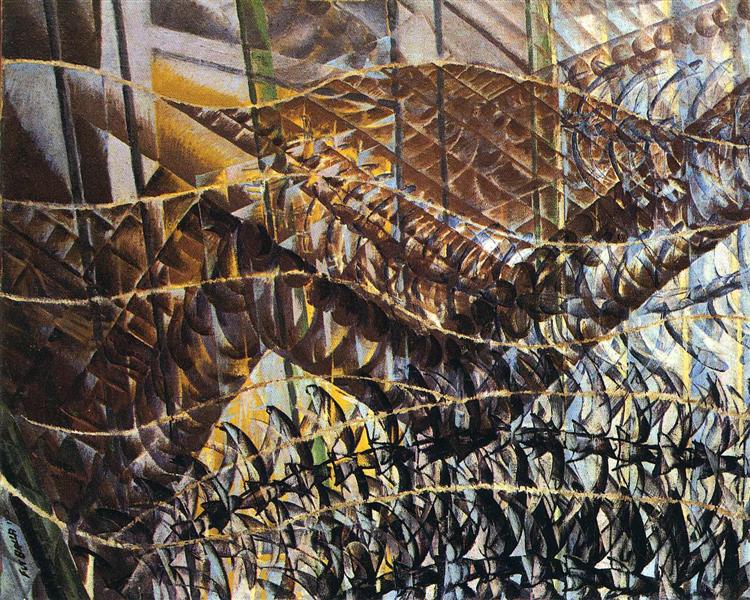
Here Balla attempts to depict the speed, rhythm, and overlapping trajectories of swifts flying past a window. Instead of painting a single bird in one fixed spot, the artist maps out the trajectory of the birds across time and space; this world is one made up not of particles so much as waves.
The composition moves, as your eye travels across the canvas, from recognizable birds near the foreground into abstract, geometric waves of motion and light. From MoMA’s website:
Transfixed by speed and dynamic motion, Balla learned how to portray movement in his paintings by looking to photography. During prior decades, Étienne-Jules Marey had developed a photographic technique that captured motion through multiple exposures. His photographs of birds in flight directly influenced Balla’s painting, with its curved arcs evoking the rhythmic flapping of wings.
Also, here’s a quote from the book MoMA Highlights: 350 Works from the Museum of Modern Art New York (second edition, 2004):
Swifts emulates Marey’s scientific visual analysis, which, in Balla’s time, subjected “dynamic sensation” to scrutiny, but adds to it a sense of exhilarated pleasure.
Owned by MoMA.
SPEEDING MOTORBOAT
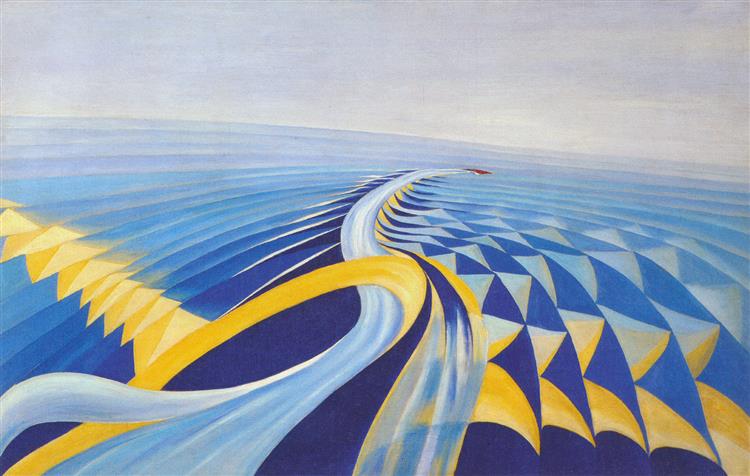
Speaking of a sense of exhilarated pleasure…
Cappa, for whom Balla was a mentor, and who in 1923 would marry Filippo Tommaso Marinetti, here prioritizes the experiential feeling of speed over the object of the painting itself. The vessel is positioned off in the distance, emphasizing how rapidly it has sliced through space; we’ve missed it.
As with Unique Forms of Continuity in Space, we’re being required to grok how a body moving through space interacts dynamically with that space. Patterns and flows are disrupted, yet it’t not chaos. The boat’s movement transforms the medium through which it races into a stylized, rhythmic pattern of expanding geometric swirls, concentric arcs, and sharp angles in blue and gold.
Owned by the Galleria d’Arte Moderna di Roma Capitale.
BIRD IN SPACE
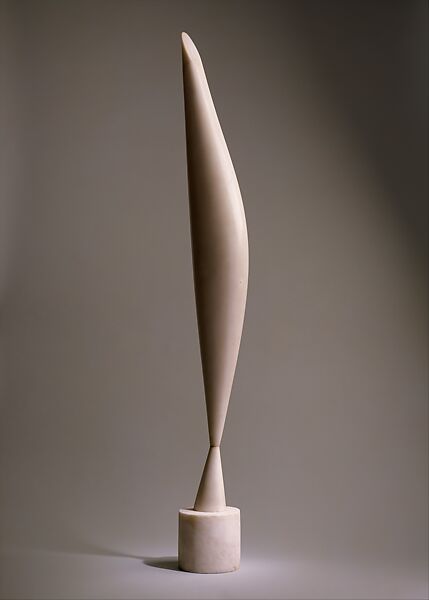
Brâncuși removed realistic details from his flying “bird” — feathers, wings, beak, etc. — to depict the pure, essential essence of flight and upward movement. One is reminded of the waves behind Cappa’s motorboat, or the air streaming around Boccioni’s “Melkur”: the invisible forces of flight itself are what we’re seeing. And although Boccioni’s sculpture seems so different — it is the opposite of streamlined — there’s a similar concept here. Brâncuși described the sculpture as a project meant to “fill the vault of the sky,” meaning that Bird in Space does not stop at its edges; our imagination connects it to the the surrounding space, which — no longer unnoticed by us — now feel limitless and dynamic. We’re flying too.
L’Oiseau dans l’espace was created in multiple iterations — at least 30 — from 1923 through the ’40s. These are owned by various major museums and collections around the world. New York’s Metropolitan Museum of Art owns the original marble. MoMA owns a 1928 bronze version. Etc.
Fun fact: Muriel Rukeyser’s 1939 poem “”Reading Time: 1 Minute 26 Seconds” encourages us to allow “Bird” to disrupt our perspective. Excerpt:
…The climax when the brain acknowledges the world,
all values extended into the blood awake.
Moment of proof. And as they say Brancusi did,
building his bird to extend through soaring air,
as Kafka planned stories that draw to eternity
through time extended. And the climax strikes…
Josh Glenn’s EMANATIONS series includes the following installments: CATASTROPHE: DECLINE & FALL | DYING EARTH | ECO-CATASTROPHE. COSMIC AWE: DEEP TIME | STARS WHEEL IN PURPLE | IS THERE LIFE ON MARS. DEHUMANIZATION: CYBORG MANIFESTO | MECHANIZATION. & many others.
MORE RADIUM AGE SCI FI ON HILOBROW: RADIUM AGE SERIES from THE MIT PRESS: In-depth info on each book in the series; a sneak peek at what’s coming in the months ahead; the secret identity of the series’ advisory panel; and more. | RADIUM AGE: TIMELINE: Notes on proto-sf publications and related events from 1900–1935. | RADIUM AGE POETRY: Proto-sf and science-related poetry from 1900–1935. | RADIUM AGE ART: Proto-sf and science-related fine art from 1900–1935. | RADIUM AGE 100: A list (now somewhat outdated) of Josh’s 100 favorite proto-sf novels from the genre’s emergent Radium Age | SISTERS OF THE RADIUM AGE: A resource compiled by Lisa Yaszek.