
ATOMIC SUBLIME
By:
August 8, 2026
An installment in EMANATIONS, a series of posts featuring 10 of Josh Glenn’s favorite examples of Radium Age-era fine art that explore a particular proto-sf-adjacent theme. In this case, that theme is DISENCHANTMENT / UNSEEN FORCES. The sub-theme, meanwhile, is…
The internal structure of the atom was discovered progressively throughout the Radium Age era (c. 1900–1935). Atoms were thought to be the smallest possible division of matter until 1899 when J. J. Thomson discovered the electron through his work on cathode rays. (In 1904, Thomson published a paper describing a new model of the atom.) The understanding of atomic structure was further shaped by Ernest Rutherford’s discovery of (what was later dubbed) the nucleus in 1911 and Bohr’s quantum model of the atom (1913); it was finalized by the discovery of the neutron in 1932.
PS: The current theoretical model of the atom involves a dense nucleus surrounded by a probabilistic “cloud” of electrons.
LOÏE FULLER’s DANCING
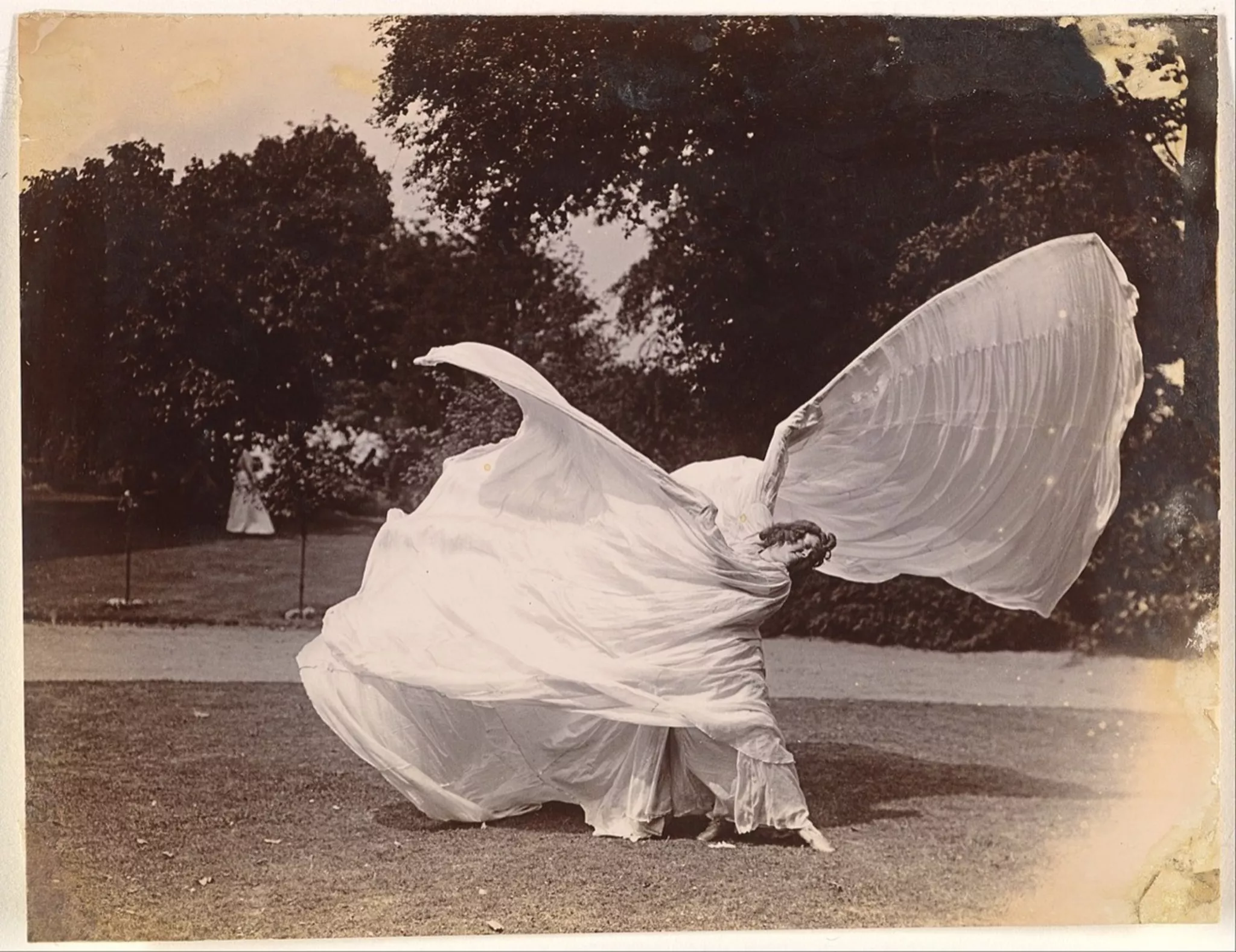
Dance’s potential to become a purely abstract art (vs. a vehicle for storytelling, as in ballet; or a pantomime of sex and seduction, as in music hall performances) seems to have been first realized, Pepe Karmel writes in Abstract Art: A Global History, in the performances of the American dancer Loïe Fuller. Who dispensed with the narratives of classical dance, and instead provided a choreographic equivalent to the asbtract forms of music. Her performances — her international career took off in 1892 when she invented the Serpentine Dance and headlined at the Folies-Bergère in Paris — were abstract visual spectacles about transformation, nature, and technology.
Often her costume involved yards of billowing white silk, which she’d manipulate using hidden wands sewn inside her sleeves. She created shapes that held form momentarily before morphing into something else. Rotating, colored spotlights — cuttibg-edge performance lighting, at the time — dyed the silken images various colors; all in all, it was a proto-psychedelic performance.
Fuller’s drive to invent new theatrical effects impelled her to consult with scientists — including Thomas Edison and Marie Curie. For example, she developed an “Ultraviolet Dance” that utilized phosphorescent salts and early black-light principles to make her costumes glow in the dark.
Karmel connects Fuller’s art form to the “pulsating curves” of art nouveau design — which corresponded to the anti-materialist contemporary belief in a mysterious force (what Bergson would later call an élan vital) animating all living creatures in a way that could not be explained by mechanistic biology. (Fuller was a major muse for the Art Nouveau movement.) However, Karmel goes on to note, Fuller’s idea of representing this vital impulse through waving lines was borrowed from the then-new science of electromagnetism — which analyzed light, electricity, and magnetism as waves in the “ether,” an invisible substance filling all of space. If the fundamental properties of the physical world took the form of waves, Fuller determined that her performances would make these waves visible.
After the turn of the century, Fuller transitioned into running her own touring company — “Loie Fuller and Her Muses” — and later directed and produced experimental films. Her last major stage appearance was in London in 1927.
Fun fact: Taylor Swift’s 2018 Reputation Tour featured a segment dedicated to Fuller. During Swift’s performance of “Dress” each night on the tour, several dancers recreated the Serpentine Dance.
PRIMORDIAL CHAOS, NO. 16
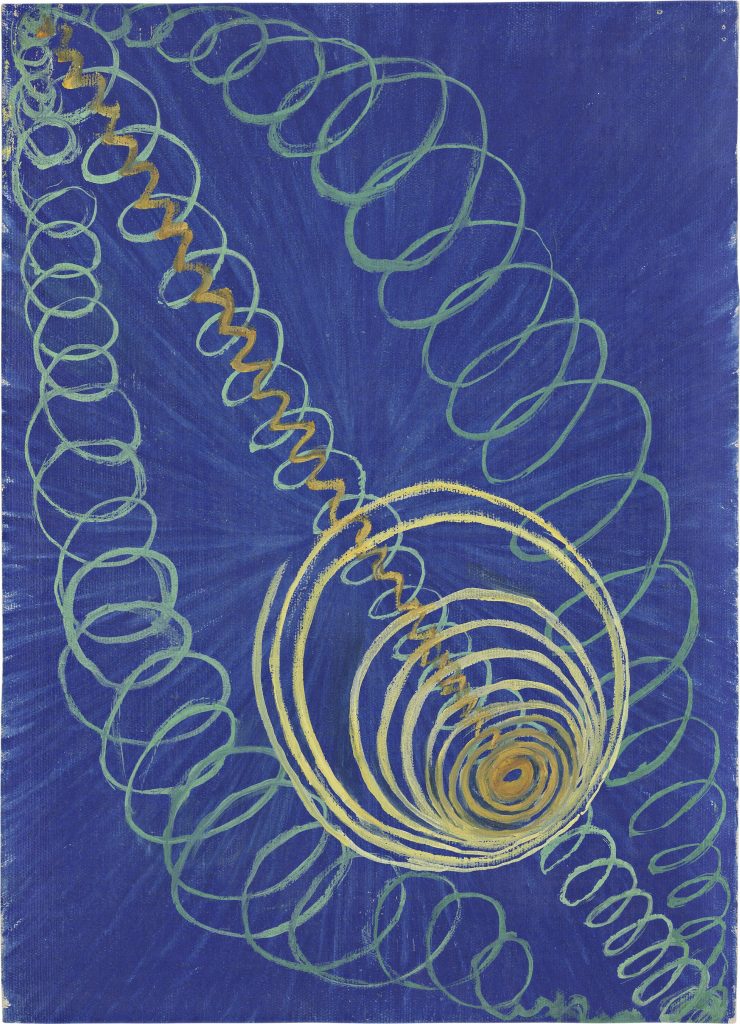
In 1896, Hilma af Klint and Anna Cassel formed a spiritualist group called De Fem (the Five); its three other members were Sigrid Hedman, Mathilda Nilsson and Cornelia Cederberg. The five women conducted séances, made automatic drawings together, and attempted to communicate with other worlds. Rituals led them to attempt to commune with spirits they called High Masters. A gifted medium, Cassel — who would also join the Theosophical Lodge of Stockholm in 1904 — soon came to dominate the group.
Af Klint was possessed by “dual interests in the scientific discoveries of her time and the mysteries of the spiritual world” (as a 2023 New York Times story puts it). Which led her to Rudolf Steiner’s Anthroposophical Society. Convinced that the High Masters wanted her to create paintings, using an inventive geometric visual language (grids, circles, spirals and petal-like forms — sometimes diagrammatic, sometimes biomorphic) uniquely capable of depicting invisible forces both of the inner and outer worlds, af Klint withdrew from the Five in order to begin this work.
“The pictures were painted directly through me,” af Klint would write, “without any preliminary drawings and with great force.” Having studied studying the densely written notebooks of af Klint and Cassel, Hedvig Martin, a history Ph.D. in Amsterdam, has recently concluded that Cassel (whom Martin believes was af Klint’s lover) painted half of the “Primordial Chaos” series, a procession of images meant to illustrate the birth of the world and the dualities of life. Scholars have also suggested that several paintings attributed to af Klint may have been painted by Cassel and other members of their collective.
Titled “Series I” or “The First 26 Small Ones” (the title would be changed later to “Primordial Chaos”), the group’s initial body of work endeavored to visualize the so-called Akashic records: a supernatural compendium, as elucidated by Theosophy’s cofounder and chief theoretician, Helena Blavatsky, of all universal events and thoughts occurring in the past, present, and future and concerning all life forms.
See Klint (et al.) paintings via Wikimedia.
AROUND A POINT
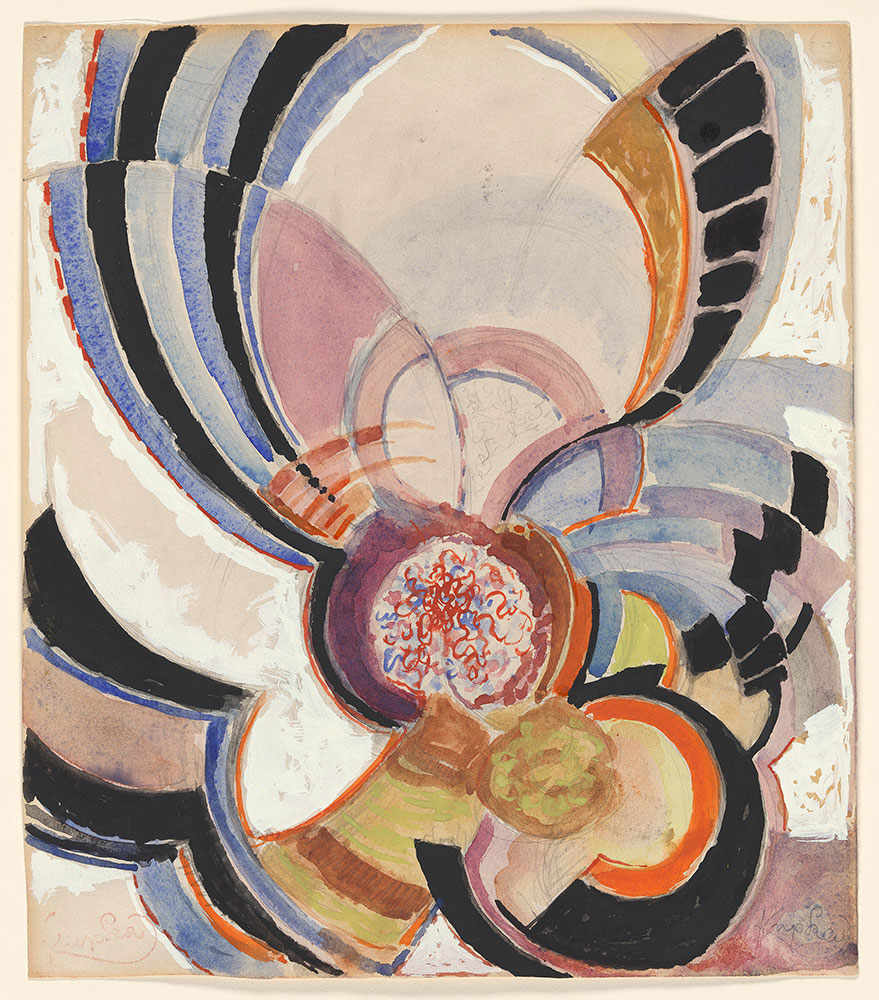
Around a Point is a major series of abstract works — Kupka started to produce studies for this work as early as 1911 — that explores cosmic rotation, universal gravitation, and the hidden rhythms of the universe.
The later large oils synthesize of the artist’s ideas, interests, and beliefs about creation, cosmic symbolism, the hidden “inner,” and scientific theories of motion, light, and color.
The “point” was a key concept for Kupka. In his book Creation in the Plastic Arts (w. 1907–13, p. 1923), a philosophical and theoretical framework for his departure from representational art into total abstraction, he writes:
The suns and the satellites, ovoid spheres, rings, nebulae and comets that populate infinite space, as astronomy describes it, all of this, to our eyes, simply represents a mass of bright points. On the other hand, other small points, observed with a microscope and that science tells us are part of an infinite multitude of molecules and atoms, even smaller points, become, to the naked eye, bodies, articulated organisms.
To Kupka, the ‘point’ represented a double notion of infinitely big and infinitely small. The central point, in his works from this series, is often represented as a small dot pierced by light, acting as the center of creation from which rings and celestial bodies radiate.
This particular painting was inspired by the artist’s observation of the rhythmic arcs made by a young girl playing with a ball in a garden. Kupka translated this everyday motion into swirling, abstract trajectories.
Kupka was also fascinated by the Disks of Newton (which demonstrated how moving colors blend into white light) and combined such physics concepts with Eastern philosophy, Theosophy, and the layered petals of the lotus flower.
THE SPHERES! THE CIRCLES! THE WHEELS!
Bruno Taut (1880–1938) was a German architect and urban planner best known for his passionate advocacy of vibrant, colorful design and utopian, socially conscious housing. Unlike his modernist contemporaries who favored stark, unadorned whites and grays, Taut believed color was a cheap but powerful tool to bring joy and personality to working-class housing.
Inspired by poet (and proto-sf author) Paul Scheerbart, Taut used glass as a symbol of purity, transparency, and a new collective morality. In 1914, for example, he and Scheerbart designed the Glass Pavilion in Cologne — a kaleidoscopic, prism-filled temple built entirely of glass to reflect his utopian, spiritual views on architecture. (The building was destroyed soon after the exhibition since it was an exhibition building only and not built for practical use.) Scheerbart introduced Taut to Gustav Fechner’s theory of universal animation, which saw all matter, organic and inorganic, as interwoven life forms linked in a cosmic chain that runs from the earth to the stars.
Taut also founded Die glaserne Kette (“The Crystal Chain”), a secret correspondence group via which visionary architects dreamed up optimistic, nature-integrated cities during World War I. To his brother Max — also an architect — in January 1918, Taut wrote: “How loathsome politics now is! But I shan’t run away, my Glanzwelt [sparkling/radiant world] lives within me.”
Alpine Architektur (1919) is a utopian, expressionist publication of Taut’s large-scale drawings and notes. It envisions transforming the European Alps with glittering glass-and-steel structures and crystalline temples to promote spiritual renewal, global harmony, and eternal peace over industrial destruction. (The project was purely visionary rather than practical, meant to inspire a transformed human consciousness rather than physical construction.) Part Four of Alpine Architektur, “Structures of the Earth’s Crust,” moves from the reconstruction of mountain ranges to the reworking of the entire Earth with glass architecture, before expanding to Part Five, “Star Structures,” in which stars and other cosmic entities are transformed to crystalline structures.
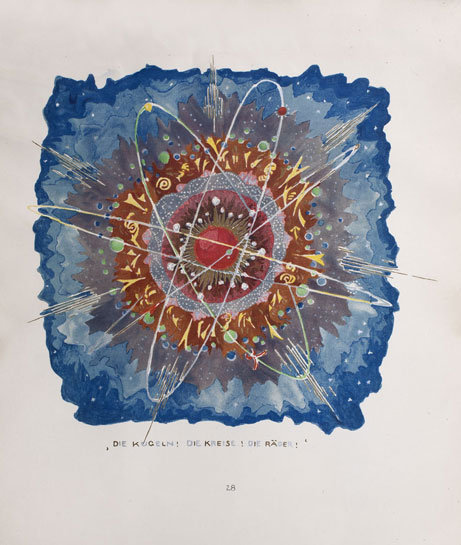
In the last pages of Taut’s book, we find fanciful images of outer space, inspired by Scheerbart’s 1910 essay “Das Perpetuum Mobile,” which rhapsodizes over “the omnipresent mechanics of the universe.” An illustration of an atom-like structure / solar system is accompanied by this caption: “THE SPHERES! THE CIRCLES! THE WHEELS!”
A pacifist, Taut would flee the Nazi regime in 1933.
RELEASED ENERGIES
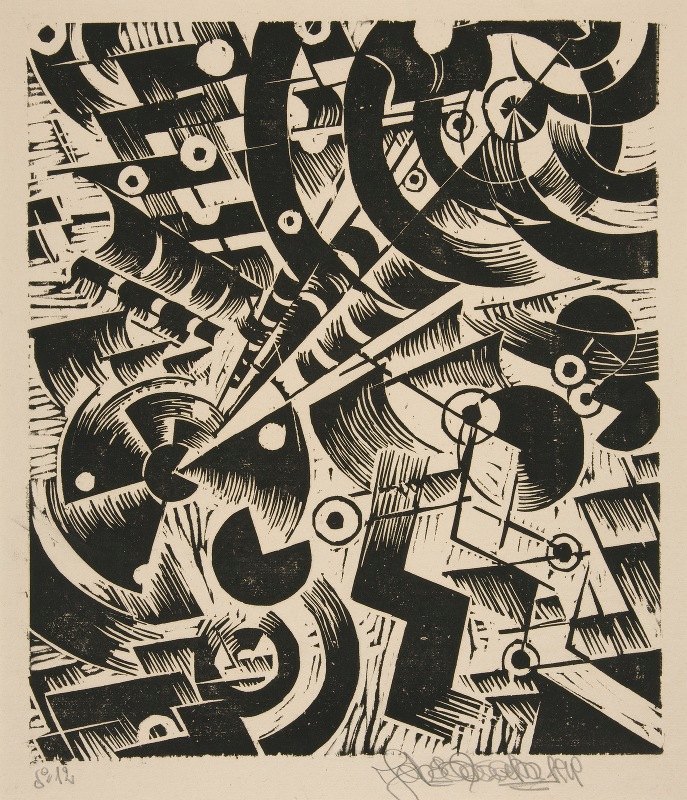
Molzahn’s early works emphasize distorted forms and intense colors to convey emotional and psychological states rather than objective representation. In works like this one from the 1910s, he employed jagged lines and vibrant, non-naturalistic hues to depict industrial machinery with a sense of frenetic energy . He described his technique as a means to “make visible the invisible energies” of the era.
This approach aligned with Expressionist principles of subjective expression, advocating for art that captured “the dynamic forces of modern life” through simplified, rhythmic forms.
The wedge-cut, open-circle geometric shapes symbolize the bursting, rotating, or opening mechanics of unleashed power — such as spinning cogs, rotors, or radiating energy waves — translating invisible physical forces into sharp, graphic, geometric abstraction. In 1917 Ernest Rutherford successfully changed nitrogen into oxygen by bombarding it with alpha particles, often described as a natural splitting or breaking of an atomic nucleus. To me, tese Pac-Man shapes look like representations of split-open, energy-releasing atoms.
NOTEBOOK, JULY 2–11, 1919
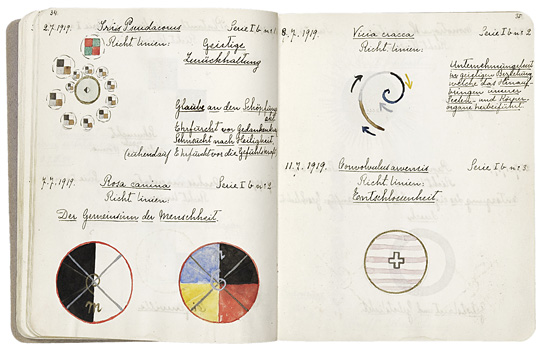
Klint used these pages to bridge the gap between the physical world (e.g., plants) and the spiritual realm (symbolic geometry). The pages follow a structured format: a date, the Latin name of a plant, and its corresponding “spiritual” diagram.
On this spread:
- Top Left (2.7.1919): Iris Pseudacorus (Yellow Flag Iris). The diagram features a central golden circle surrounded by smaller, rhythmic squares, labeled with Geistige Zurückhaltung (Spiritual Restraint).
- Bottom Left (7.7.1919): Rosa Canina (Dog Rose). Two circular diagrams represent the “common sense of humanity,” divided into black/white and primary color sectors.
- Top Right (8.7.1919): Vicia cracca (Tufted Vetch). A spiral diagram with arrows suggests movement and growth energy.
- Bottom Right (11.7.1919): Convolvulus arvensis (Field Bindweed). A simple cross within a circle, labeled with Entschlossenheit (Decisiveness).
THE ENERGIC II
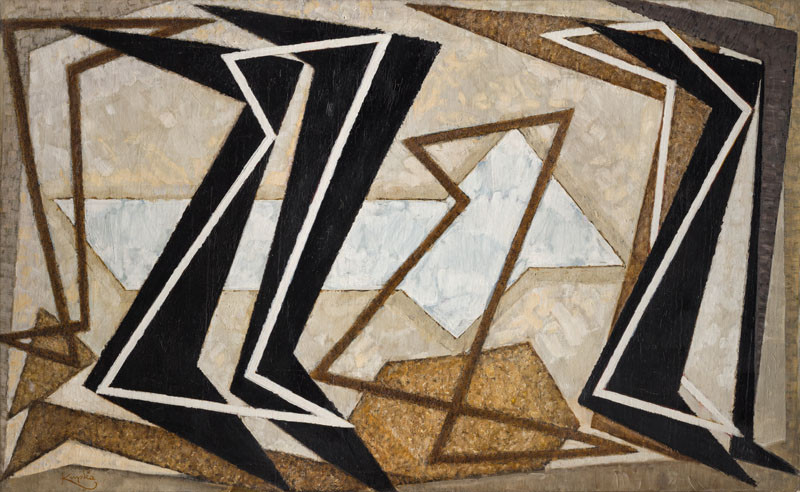
An example of Kupka’s exploration into how abstract lines and pure form might permit us to visualize invisible energy and cosmic forces.
Influenced by the 1909 Futurist Manifesto, Kupka was fascinated with depicting continuous motion and rendering the “invisible” energy of the modern Industrial Age. The abstract black and white lines (often accented with gold) are designed to evoke unseen mechanical and spiritual forces vibrating through space.
PS: In physics and psychology (such as Carl Jung’s analytical psychology), the term “energic” relates to energy or the underlying psychic or physical forces at play during transformation.
CENTRIFUGAL FORCES
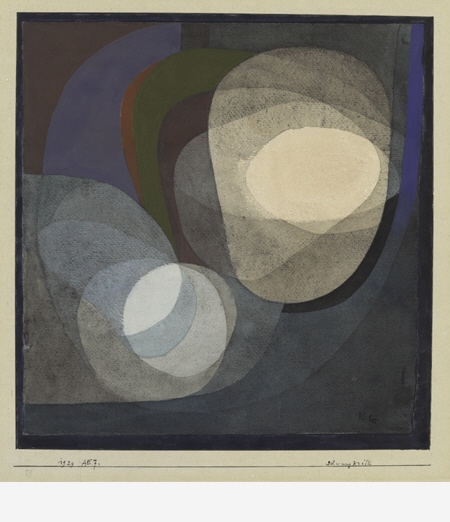
Klee viewed art creation through a scientific lens, comparing the generative forces of nature to the structural elements of visual art. At the Bauhaus, he taught that lines, shapes, and color values operated under universal physical rules, famously stating that art should move past merely recording appearances to understanding underlying physiological and structural processes.
Klee’s 1929 painting Centrifugal Forces (also known as Schwungkräfte) is an abstract exploration of the invisible physical and cosmic energies that govern movement and space, and which shape the universe.
How to translate dynamic physics into a poetic, visual language? Using a blend of abstract lines, geometric forms, and color, here Klee creates a sense of rotation and expansion. Because motion (or so he understood) is at the root of all growth, via abstract compositions like this one, he sought to visualize the processes of creation, change, and the universe in flux.
THE VORTEX
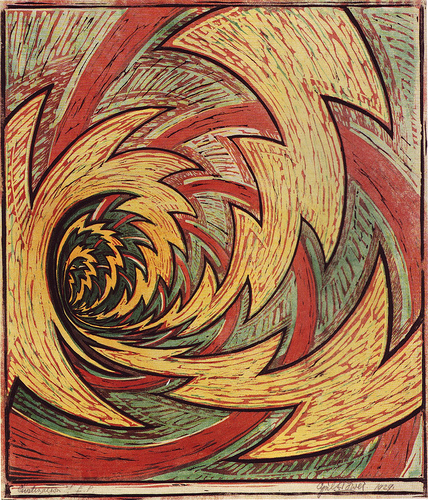
Power was a practicing architect before he left the field to study linocut at London’s Grosvenor School of Modern Art. Many of his prints focus on images of contemporary leisure activities and systems that both connoted modernity and allowed it to thrive. These “Vorticist” art works (typically characterized by a centrifugal force seeming to fling the picture’s constituent parts in all directions) have been described as suggesting, each in their own fashion, the “vortex of change drilling into the established order of things.” Here, however, Power embraces near total abstraction — depicting the vortex of change itself. It’s one of the few times he’d ever do so.
Hugh Kenner, writing about Vorticism, describes the notion of the vortex for these poets and artists as “a patterned integrity,” i.e., the making-visible of modernity’s determining forces.
RHYTHMS
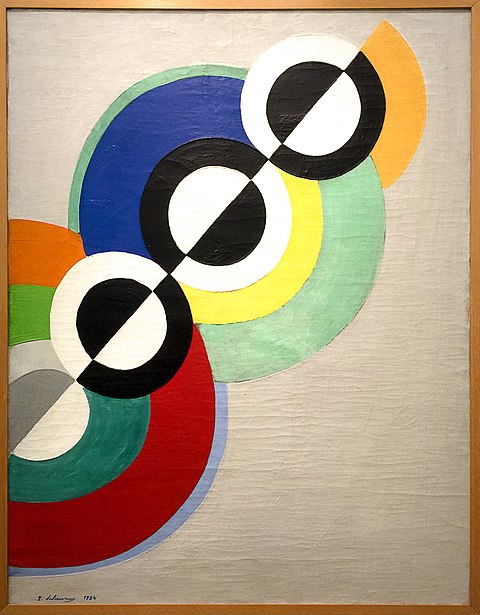
Inspired by everything from astral theories to the whirling of propellers and the halos cast by electric lamps, in his art Delaunay “sought to overcome the limits imposed by the format of the canvas,” according to one critic, “by integrating a gyratory dynamic into his compositions.” This late piece features strong, contrasting tones of black and white alongside bright colors; the result is a sweeping, wave-like or modular visual effect.
From Paris’s Musée d’Art Moderne website:
The dynamic possibilities of coloured discs entering into movement by the mere physical action of looking at them were exploited to give the composition rhythm. By a “synchromic” effect, one’s vision is activated by an interplay of curves and counter-curves, discs with concentric circles of various thicknesses which act against each other, and above all by contrasting complementary colours (red/green, blue/orange) and discordant colours (red/blue; pink/red, and so on). These canvases — the Museum also possesses the maquettes for them — were the culmination of Delaunay’s research before his untimely death in 1941.
As mentioned in an earlier post, Delaunay was deeply inspired by scientific color theory, specifically the “simultaneous contrast” ideas of Michel Eugène Chevreul. He transformed these scientific observations into a mystical framework where color became a “thing in itself” with its own expressive power. He and his wife, the equally talented Sonia Delaunay, believed that art could reveal a hidden universal harmony through the interaction of colors.
Josh Glenn’s EMANATIONS series includes the following installments: CATASTROPHE: DECLINE & FALL | DYING EARTH | ECO-CATASTROPHE. COSMIC AWE: DEEP TIME | STARS WHEEL IN PURPLE | IS THERE LIFE ON MARS. DEHUMANIZATION: CYBORG MANIFESTO | MECHANIZATION. & many others.
MORE RADIUM AGE SCI FI ON HILOBROW: RADIUM AGE SERIES from THE MIT PRESS: In-depth info on each book in the series; a sneak peek at what’s coming in the months ahead; the secret identity of the series’ advisory panel; and more. | RADIUM AGE: TIMELINE: Notes on proto-sf publications and related events from 1900–1935. | RADIUM AGE POETRY: Proto-sf and science-related poetry from 1900–1935. | RADIUM AGE ART: Proto-sf and science-related fine art from 1900–1935. | RADIUM AGE 100: A list (now somewhat outdated) of Josh’s 100 favorite proto-sf novels from the genre’s emergent Radium Age | SISTERS OF THE RADIUM AGE: A resource compiled by Lisa Yaszek.