
DEEP TIME
By:
May 31, 2026
An installment in EMANATIONS, a series of posts featuring 10 of Josh Glenn’s favorite examples of Radium Age-era fine art that explore a particular proto-sf-adjacent theme. In this case, that theme is COSMIC AWE. The sub-theme, meanwhile, is…
THE BEGINNING OF LIFE
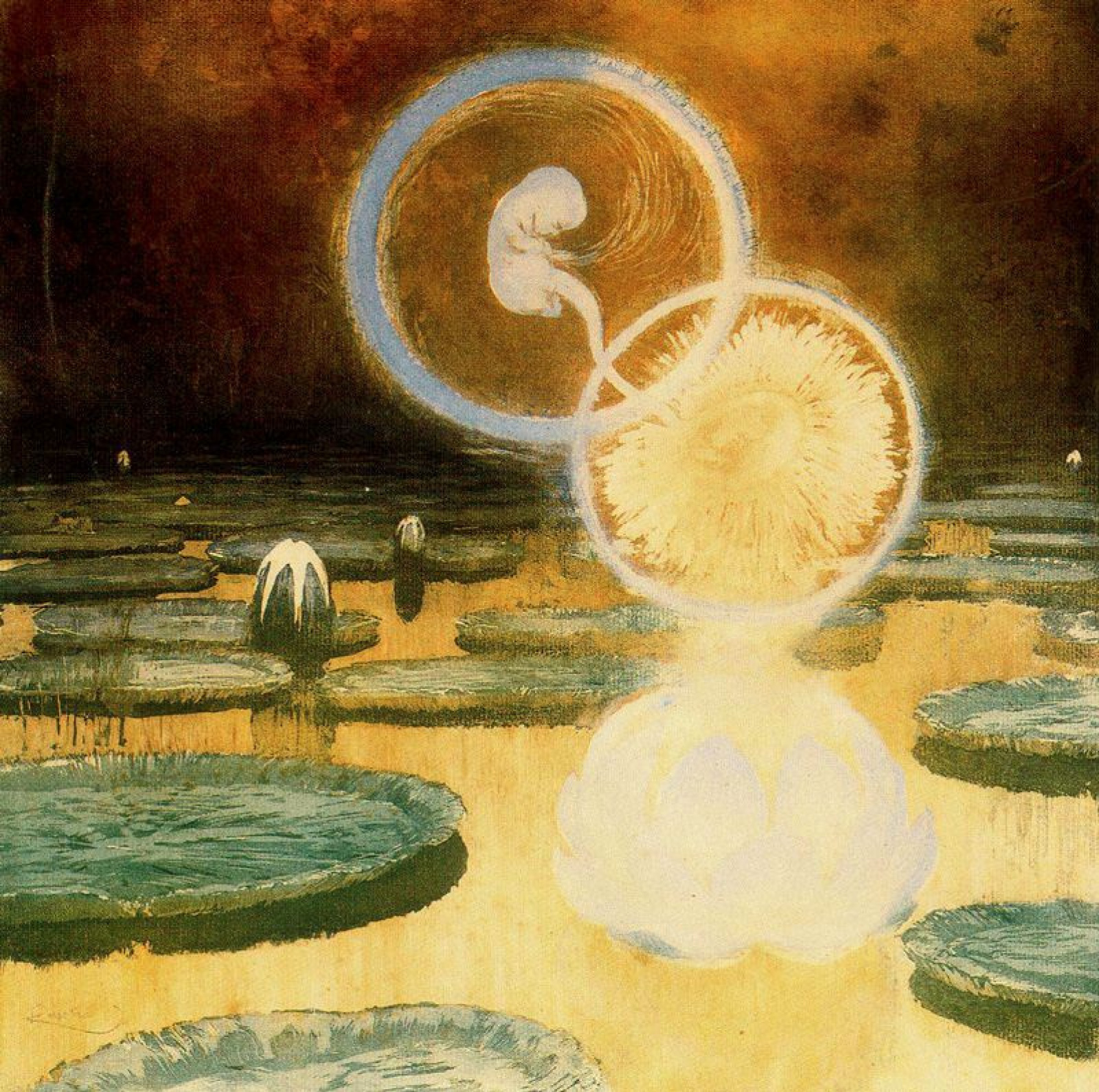
The Czech painter Kupka (1871–1957), a Symbolist (and later, a pioneering Orphist) who spent his active years in Paris, “remains one of the most under-researched artists,” according to Chelsea Ann Jones in The Role of Buddhism, Theosophy, and Science in František Kupka’s Search for the Immaterial Through 1909 (2012), “given his important status as one of the first painters of totally abstract works of art, beginning in 1912.”
Yes: During the late 19th century and into the Radium Age era, Theosophy, Eastern religions, esoterica, and science were instrumental in unlocking writers’ and artists’ imaginations… allowing them to conceive of an immaterial, invisible reality that (unlike the material world) could only be depicted symbolically.
Here in 1900 we find Kupka poised at a pre-abstraction moment, seeking ways to express through representational art that which that representational art can never express. Starting around 1905, Kupka’s work would become increasingly abstract, concentrating on color and motion; here, it’s somewhere between representational and abstract.
The art historian Pepe Karmel notes that the popularity of the embryo/fetus motif as a symbol of spiritual rebirth, during this era, reflects the influence of German biologist Ernst Haeckel’s famous 1870s diagram (below) of comparative embryological development.
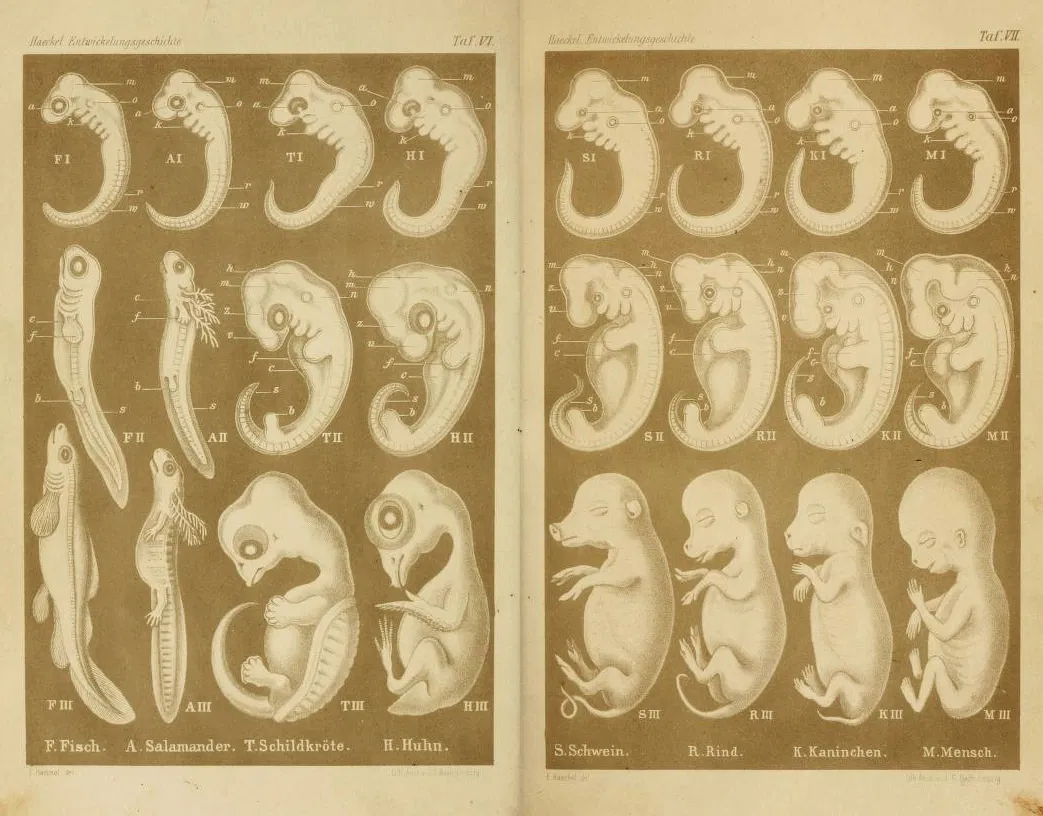
Haeckel argued that diverse species began as virtually identical embryos and recapitulated their evolutionary histories in utero before assuming their different mature forms. He seems to have fudged the evidence, making the embryos look more similar than they actually are… but it was a powerful visual argument for the oneness of all living creatures.
THE WAY OF SILENCE
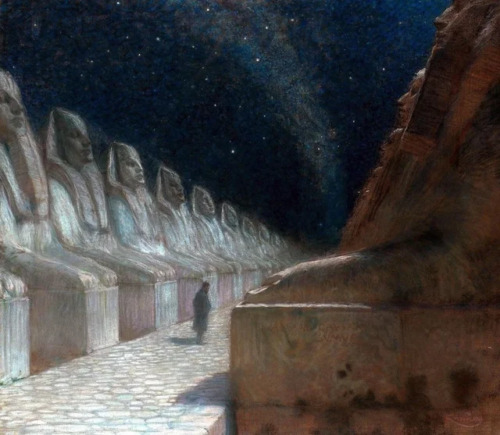
According to Audrey Wagtberg Hansen, in her essay “Cold Gods and Fatal Women: The Many Faces of the Sphinx in the 19th Century,” Kupka’s Way of Silence II (a different, but very similar painting) was “inspired by [Edgar Allan] Poe’s poem ‘Dream-land.’ Here we see a lone traveler on a seemingly endless road under a starry sky, flanked by two rows of stone sphinxes.”
Excerpt from Poe’s poem:
By a route obscure and lonely,
Haunted by ill angels only,
Where an Eidolon, named
NIGHT,
On a black throne reigns
upright,
I have reached these lands but
newly
From an ultimate dim Thule —
From a wild weird clime that lieth, sublime,
Out of SPACE — Out of TIME.
CREATION OF THE WORLD — II
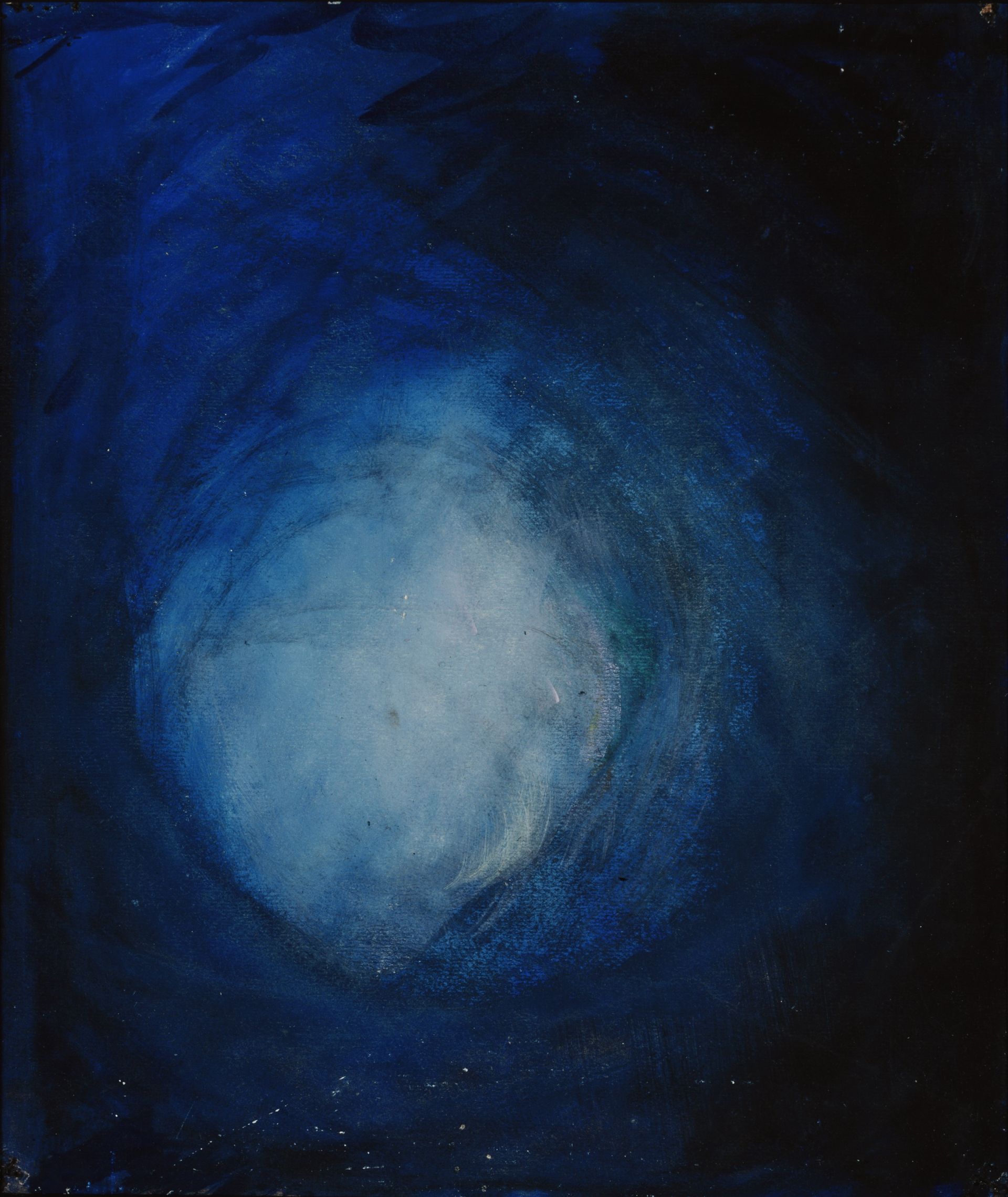
Čiurlionis’s Creation of the World — II is a symbolic, cosmic-themed tempera painting depicting the formation of planets and stars from chaotic, empty space.
As part of a 13-painting cycle, this work merges scientific concepts of stellar gas formation with spiritualism and imaginative, abstract imagery. The Theosophical idea of a primeval field of energy spreading through the first movement of the universe is apparent throughout this series; and in this painting in particular.
See 1905 installment for more info on this series of paintings.
STUDY FOR “COSMIC SPRING”
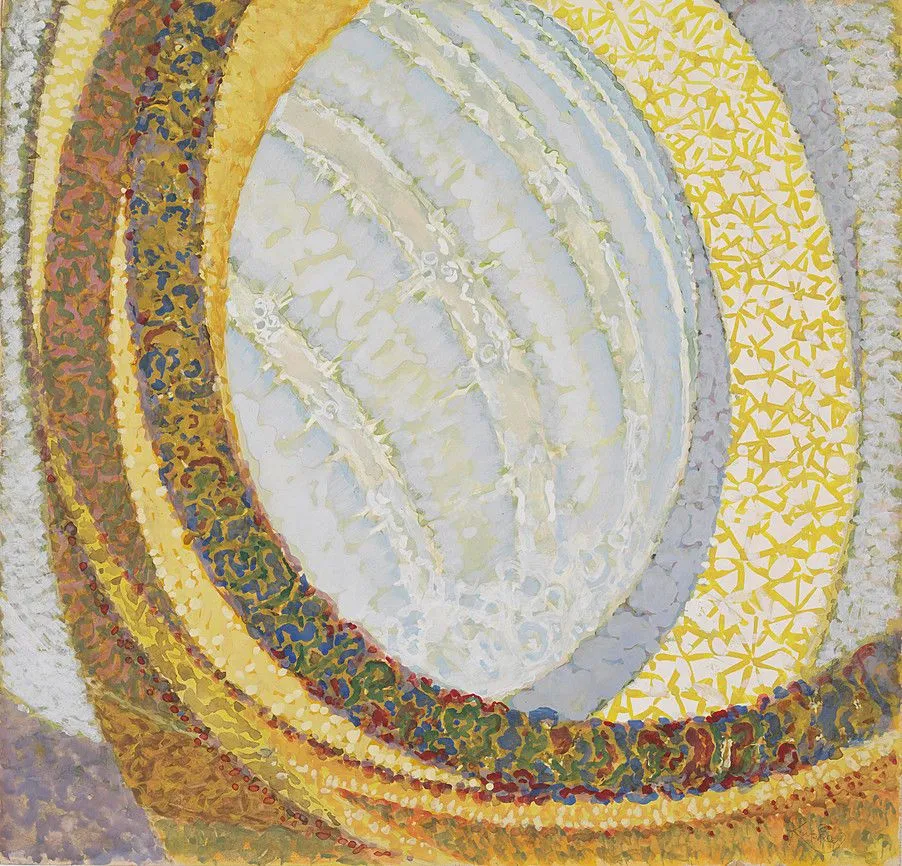
A pivotal work offering a glimpse of Kupka’s transition from (at least partially) figurative art and Symbolism, during this period, to pure abstraction and Orphism. The artist here explores the birth of life and cosmic energy, utilizing intersecting circular forms and vibrant colors to represent abstract, organic movement and the “thoughtforms” of creation — i.e., rather than literal reality.
This gouache study is characterized by circular, organic, and rhythmic patterns, signifying a “springtime” or germination in the cosmos.
BLUE II
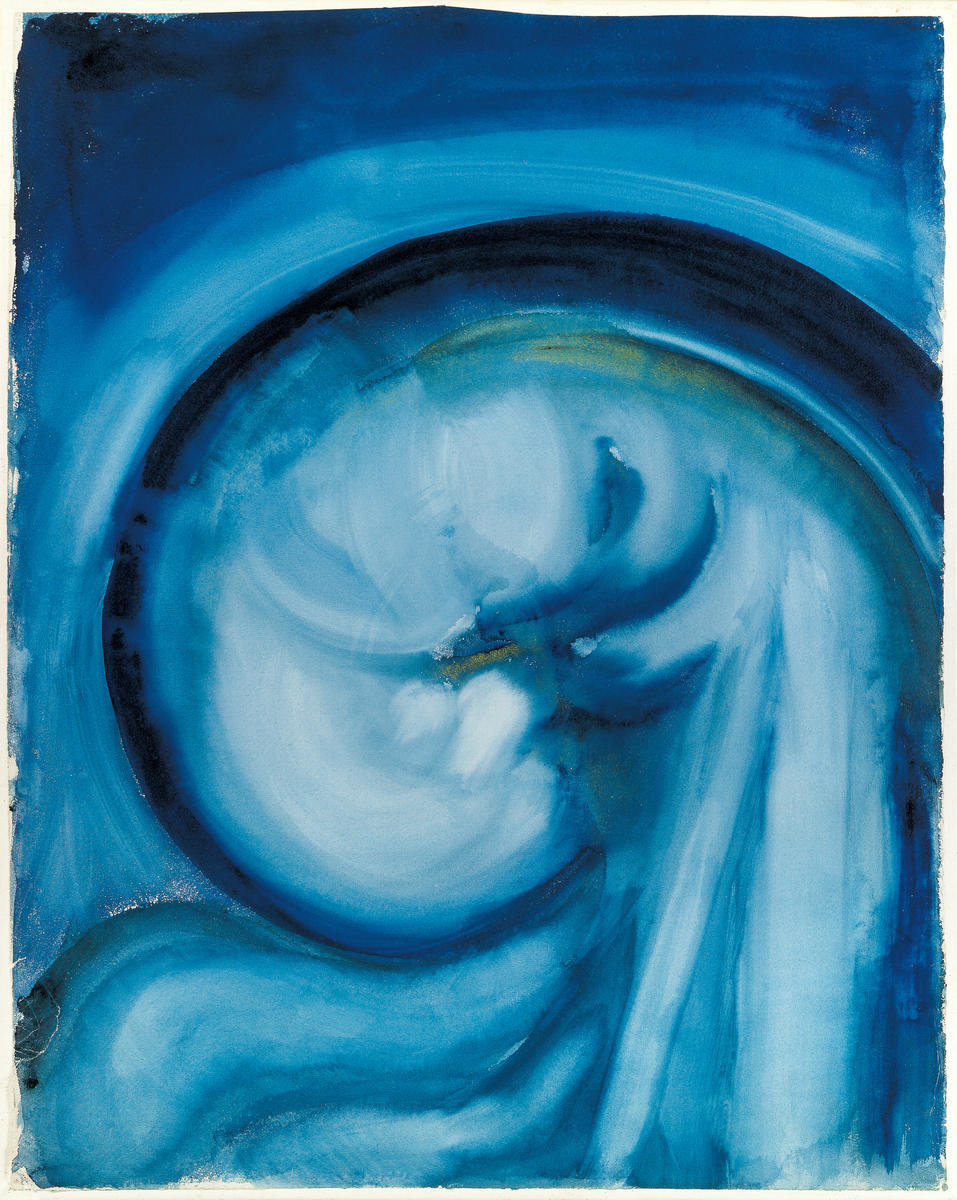
O’Keefe’s watercolor is an exercise in emotional expression through abstract (non-representational), fluid shapes. Part of a 1916 series, it explores abstracting forms from nature into simple, rhythmic lines.
The forms in the Blue series (including Blue II) are thought to be influenced by O’Keefe’s engagement with the work of Kandinsky and perhaps also with her own experience playing the violin — i.e., translating the emotional quality of sound into visual, abstract shapes.
O’Keefe uses a “fetal form as a symbol of cosmic creation,” writes Pepe Karmel in Abstract Art: A Global History, suggesting a thematic similarity to Kupka’s The Beginning of Life.
CREATION
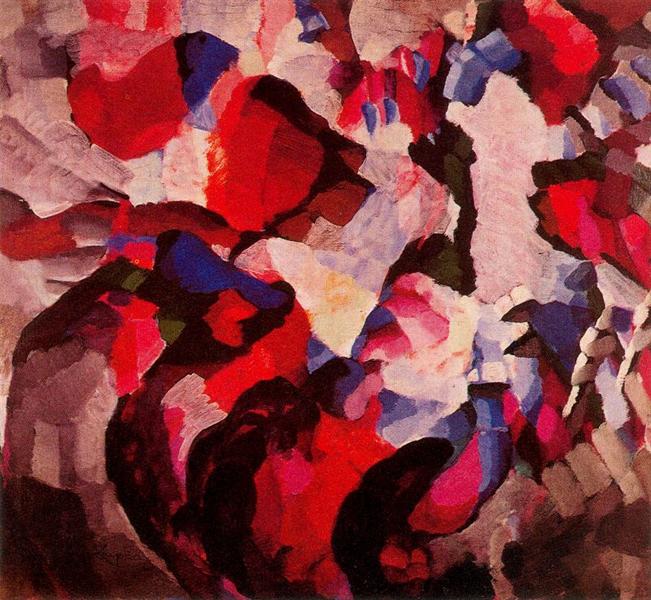
Kupka again! This Orphist painting explores the cosmic, spiritual, and biological origins of life, blending vibrant color with abstract forms to represent, in the artist’s words, a “visual odyssey” of genesis.
The work reflects Kupka’s interest in Theosophy, music, and Theosophic visions of “thought-forms.” It evokes emotional and spiritual “vibrations” via abstract, swirling shapes.
Creation, one reads, symbolizes the unfolding universe and the mystery of creation. Its radiating, swirling shapes evoke both galactic explosions and organic, cellular growth. Shapes emerge from darkness, converging around a center point… perhaps suggesting an “eye of the cyclone”-like spiritual center to the universe?
CREATING THE WORLD
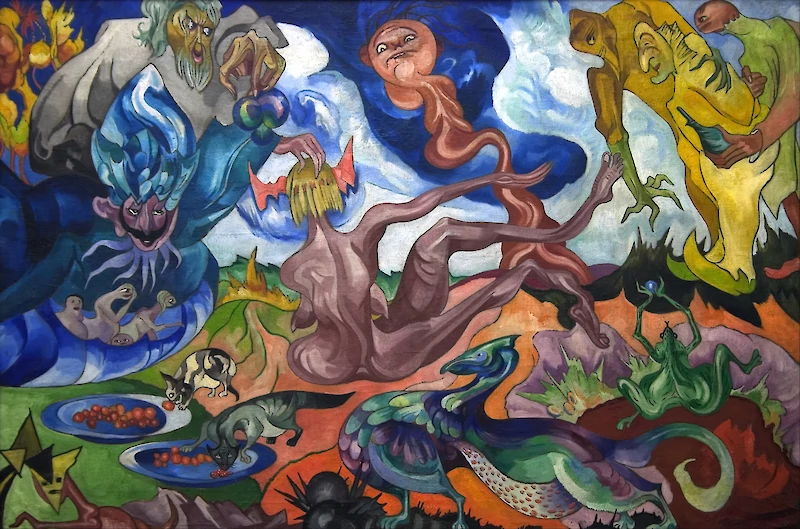
Witkiewicz (aka Witkacy, 1885–1939) was a visionary Polish painter, philosopher, theorist, playwright, photographer — and a proto-sf author too.
This painting is an example of Witkacy’s surreal and symbolic style, which often features dynamic, bizarre, non-objective forms. He frequently explores themes of existential anxiety and a “monstrous” or chaotic reality, often linked to the artist’s philosophical views on the degradation of European civilization.
Much of Witkacy’s writing, some eerily prophetic, deals darkly and humorously with the theme of a conservative world suddenly subjected to change: the clash of cultures, future totalitarianisms, apocalypse. Set in the twenty-first century, Witkacy’s 1930 novel Nienasycenie depicts a fractured, ersatz West, a consumer society subject to a growing appetite for novelty, being taken over by Chinese Communists and Eastern mysticism, whose purveyors provide Westerners with happy pills.
PS: Witkacy committed suicide after the Nazi invasion of his country when he learned that Soviet armies had also invaded from the east… the direction in which he was fleeing at the time.
THE CREATION OF THE WORLD
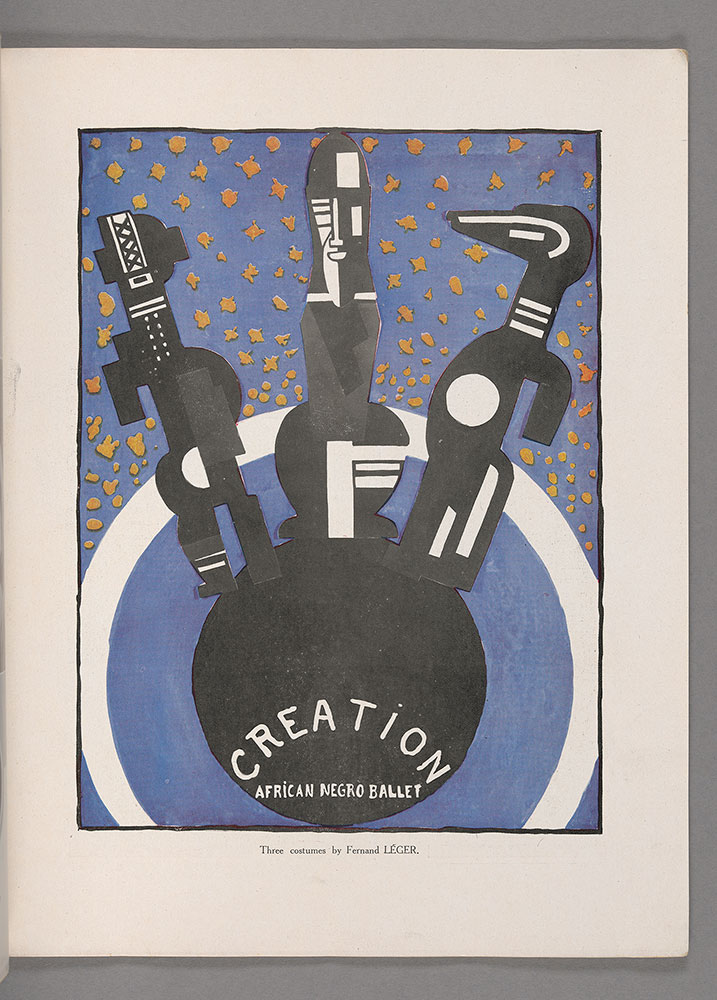
From MoMA’s website:
For the 1923 Ballets Suédois production (premiere Paris). Choreography by Jean Börlin. Music by Darius Milhaud. Scenario by Blaise Cendrars, based on an African legend
This work illustrates the way Léger (and other artists associated with Cubism, notably Picasso) made use of African sculpture for their own pictorial, compositional, and narrative ends. Along with the ballet’s jazz–inflected score and frenzied choreography, these designs shed light on the fascination with the “primitive” that was very much in vogue in Paris at that time.
Léger’s drawings depict Nzame, Medere, and N’kava, the ballet’s deities of creation — who emerge from chaos and oversee the transformation of flora and fauna from an undistinguished mass into an organized dance.
PS: The Swiss-born Blaise Cendrars also wrote Radium Age proto-sf, including Kodak (Documentaire) (1924, a kind of prose-poem collaged from the text of the 1912 pulp proto-sf novel Le Mystérieux Docteur Cornelius [“The Mysterious Dr Cornelius”] (1912) by Gustave Le Rouge.
BIRTH OF THE WORLD
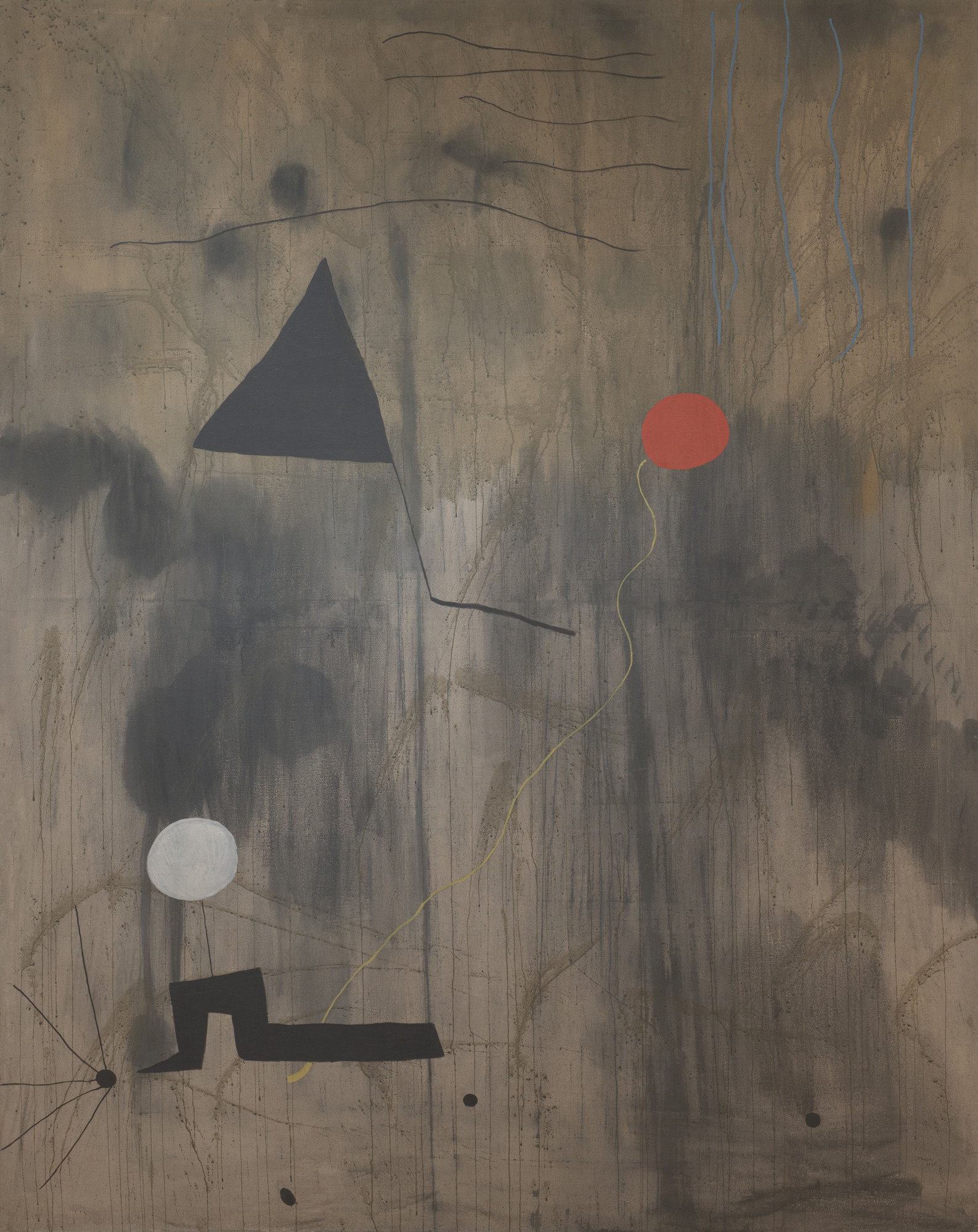
From MoMA’s website:
In this signature work, Miró covered the ground of the oversize canvas by applying paint in an astonishing variety of ways that recall poetic chance procedures. He then added a series of pictographic signs that seem less painted than drawn, transforming the broken syntax, constellated space, and dreamlike imagery of avant-garde poetry into a radiantly imaginative and highly inventive form of painting. He would later describe this work as ‘a sort of genesis,’ and his Surrealist poet friends titled it The Birth of the World.
According to the first Surrealist manifesto of 1924, “the real functioning of the mind” could be expressed by a “pure psychic automatism,” which is to say the absence of any control exercised by reason. Miro, under the influence of Surrealist ideas, here combined chance with plan. Perhaps God did too, when He created the world?
THE CREATION
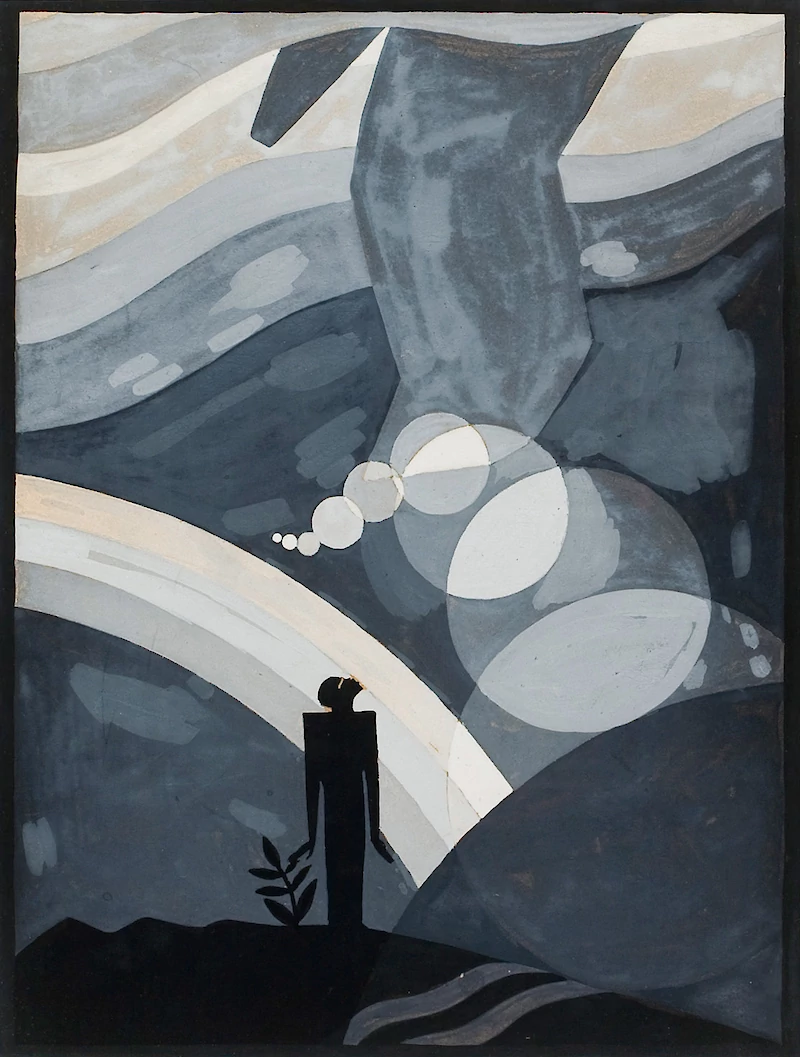
The Creation is a gouache illustration created for James Weldon Johnson’s Harlem Renaissance book of poems, God’s Trombones: Seven Negro Sermons in Verse (1927). It depicts the biblical creation story as a dynamic, primordial explosion of life; we see God’s hand reaching through a stylized, geometric landscape to bring light, humanity, and nature into existence.
This scene illustrates the opening lines of Johnson’s poem, portraying God stepping out into space to create a world, separating light from darkness, and placing the sun in the heavens. A glimpse of an amphibious creature may symbolize a transition from a watery void into a new world.
Excerpt from James Weldon Johnson’s “The Creation”:
And God stepped out on space,
And He looked around and said,
“I’m lonely —
I’ll make me a world.”And as far as the eye of God
could see
Darkness covered everything,
Blacker than a hundred
midnights
Down in a cypress swamp.Then God smiled,
And the light broke,
And the darkness rolled up on
one side,
And the light stood shining on
the other,
And God said, “That’s good!”Then God reached out and took
the light in His hands,
And God rolled the light around
in His hands
Until He made the sun;
And He set that sun a-blazing in
the heavens.
And the light that was left from
making the sun
God gathered it up in a shining
ball
And flung it against the
darkness,
Spangling the night with the
moon and stars.
Then down between
The darkness and the light
He hurled the world;
And God said, “That’s good.”
Josh Glenn’s EMANATIONS series includes the following installments: CATASTROPHE: DECLINE & FALL | DYING EARTH | ECO-CATASTROPHE. COSMIC AWE: DEEP TIME | STARS WHEEL IN PURPLE | IS THERE LIFE ON MARS. DEHUMANIZATION: CYBORG MANIFESTO | MECHANIZATION. & many others.
MORE RADIUM AGE SCI FI ON HILOBROW: RADIUM AGE SERIES from THE MIT PRESS: In-depth info on each book in the series; a sneak peek at what’s coming in the months ahead; the secret identity of the series’ advisory panel; and more. | RADIUM AGE: TIMELINE: Notes on proto-sf publications and related events from 1900–1935. | RADIUM AGE POETRY: Proto-sf and science-related poetry from 1900–1935. | RADIUM AGE ART: Proto-sf and science-related fine art from 1900–1935. | RADIUM AGE 100: A list (now somewhat outdated) of Josh’s 100 favorite proto-sf novels from the genre’s emergent Radium Age | SISTERS OF THE RADIUM AGE: A resource compiled by Lisa Yaszek.