
LAST AND FIRST MEN
By:
August 25, 2026
Under the direction of HILOBROW’s Josh Glenn, the MIT Press’s RADIUM AGE series is reissuing notable proto-sf stories from the underappreciated era between 1900–1935.
In these forgotten classics, sf readers will discover the origins of enduring tropes like robots (berserk or benevolent), tyrannical supermen, dystopias and apocalypses, sinister telepaths, and eco-catastrophes.
With new contributions by historians, science journalists, and sf authors, the Radium Age book series will recontextualize the breakthroughs and biases of these proto-sf pioneers, and chart the emergence of a burgeoning literary genre.
Today marks the publication of the following Radium Age series title…
(ABRIDGED EDITION)
OLAF STAPLEDON
Introduction by MATTHEW DE ABAITUA
(August 25, 2026)
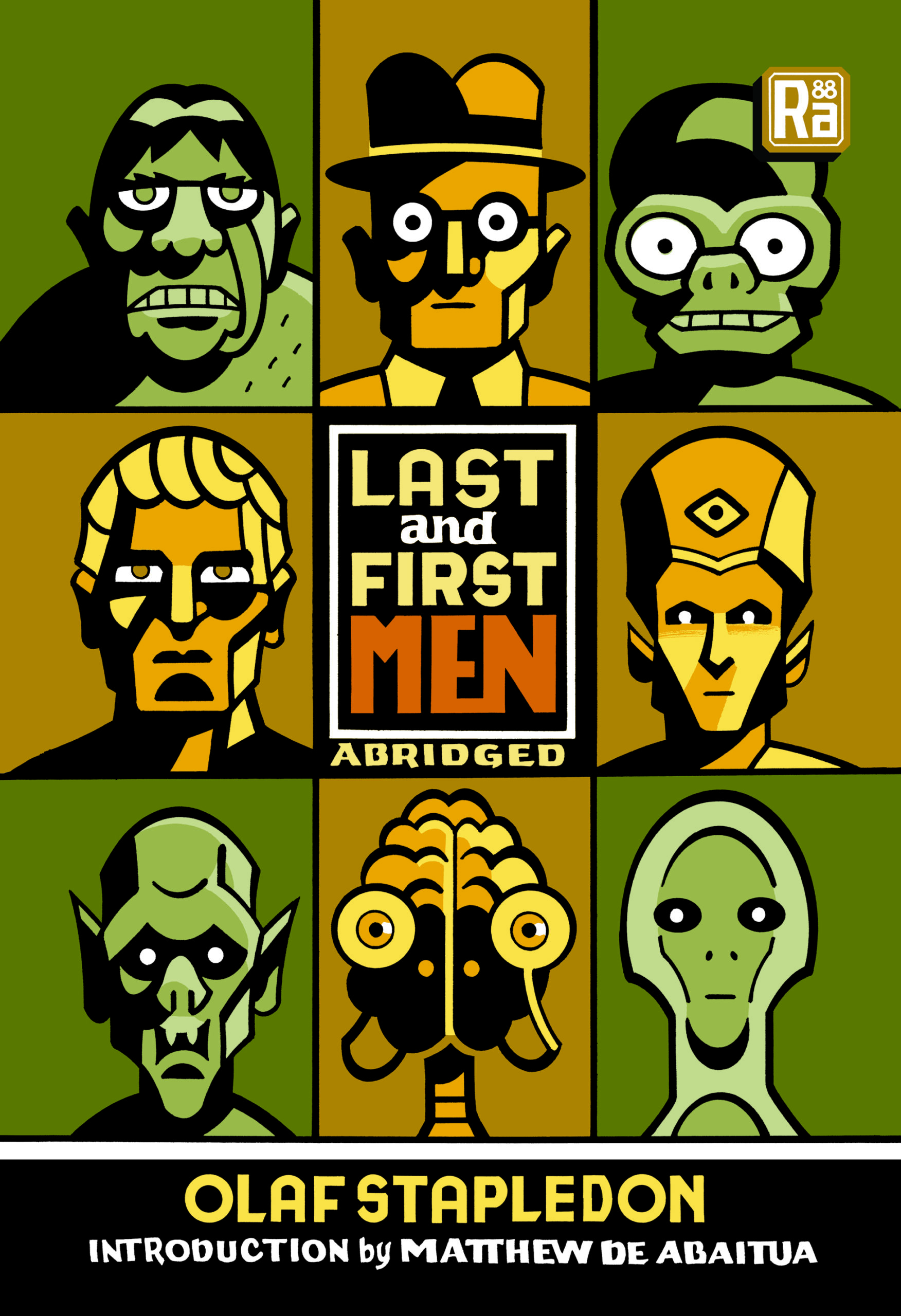
A dazzling work of science fiction to which Dune, the Foundation trilogy, and 2001: A Space Odyssey owe a major debt.
Narrated telepathically by one of the Last Men, Olaf Stapledon’s epic history of the future caused a literary sensation when it first appeared in 1930. Over the course of two billion years, it seems, ever more alien versions of humankind will rise and fall — developing every sort of utopian and dystopian civilization only to descend into savagery again and again, until eventually the Earth’s resources are depleted.
This abridged edition takes us from the fall of the First Men to the initial efforts of the Fifth Men, the “last Terrestrials,” to colonize other planets.
“No book before or since has had such an impact on my imagination; the Stapledonian vistas of millions and hundreds of millions of years, the rise and fall of civilizations and entire races of men, changed my whole outlook on the universe and has influenced much of my writing ever since.” — Arthur C. Clarke, New York Times (1983)
“No one ought to miss reading W. Olaf Stapledon’s Last and First Men.” — H.P. Lovecraft (letter, 1936)
“The blend of imagination and scientific plausibility is more than Wellsian!” — Julian Huxley (letter, 1930)
“A mad myth, soberly written.” — The Saturday Review (1931)
“The boldest imaginings of Mr. Wells pale before the dreams of Mr. Stapledon.” — Oxford Magazine (1930)
“Last and First Men is a seminal work of cosmological SF — a philosophical examination of the future evolution of humanity, inspirational to Arthur C. Clarke and so many of Stapledon’s successors. Great to see it included in The MIT Press’s Radium Age series.” — Charles Stross, Hugo and Locus award winning author
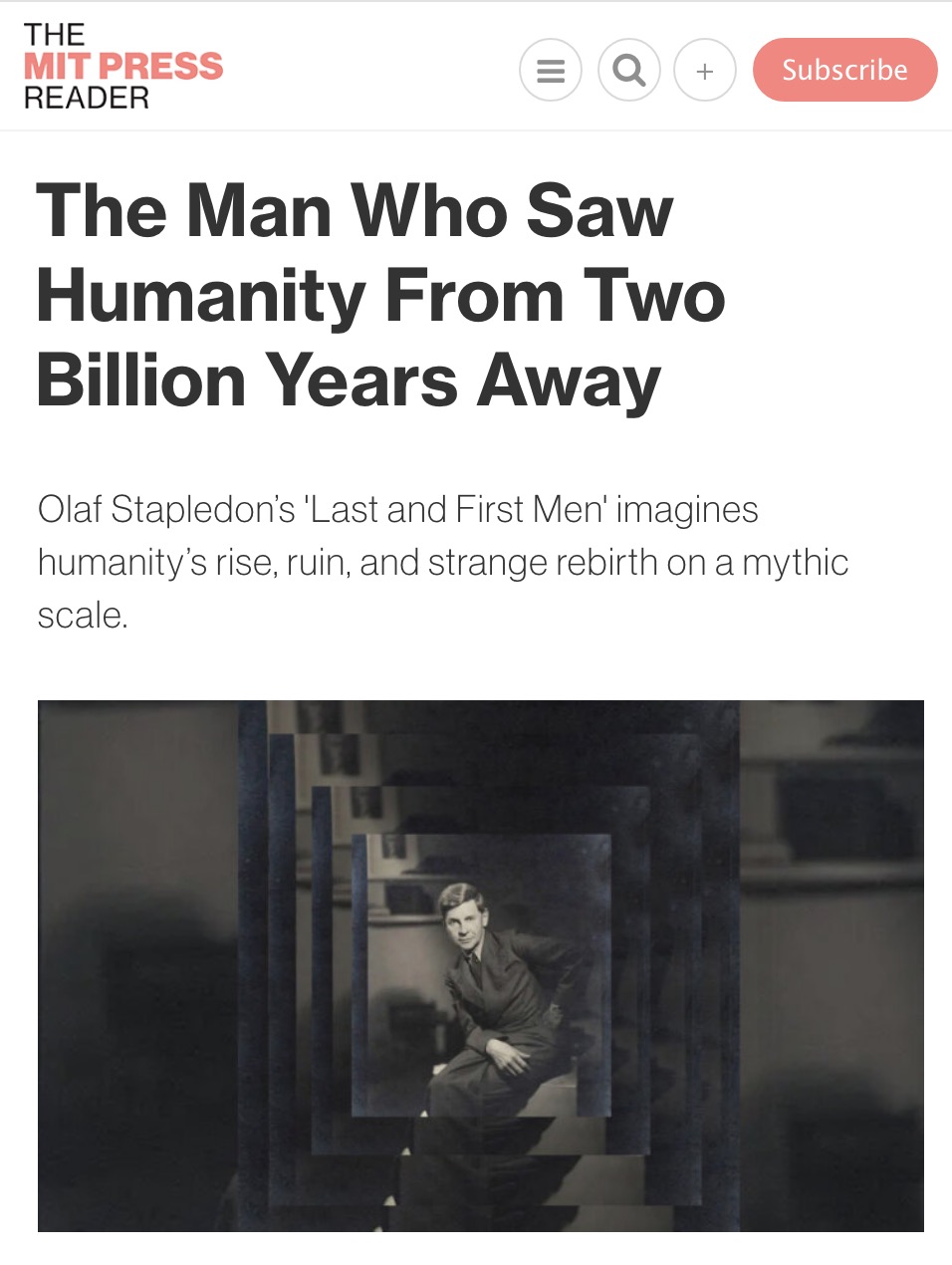
A version of Matthew De Abaitua’s introductory essay, titled “The Man Who Saw Humanity From Two Billion Years Away,” was published on 8/24/26 by the MIT Press Reader. Excerpt:
Last and First Men is not progressive. Civilizations rise and fall, the tide of progress advances and retreats, variants upon the theme of humanity strike up and diminish — what endures of humanity is not spirit in the Christian sense so much as, in the philosophy of the Fifth Men, “a work of tragic art.” The Fifth Men regarded the cosmos as an aesthetic unity in four dimensions. Art focuses aspects of the cosmos, making it apprehensible even if its complexity means that it can never be entirely known.
Press for MITP’s edition of Last and First Men includes the following…
“A story of the ongoing evolution of humanity that’s considered a classic of the genre. Radium Age’s new edition [of Olaf Stapledon’s Last and First Men] has a few enticing extras, including an introduction from IF THEN author Matthew De Abaitua and some truly excellent cover artwork from Seth depicting several stages in humanity’s development.” — Reactor’s Can’t Miss Indie Press Speculative Fiction for July and August 2026
“The story is epic in every sense of the word: it spans billions of years, following the evolution of humanity from Earth far, far into the future, with plenty of highs and lows as they progress. The MIT Press and Joshua Glenn have added this abridged version of the book to their ongoing Radium Age series. It comes with an introduction by British author Matthew De Abaitua.” — Transfer Orbit
“The rise, fall, and rebirth of humanity.” — LitHub
MATTHEW DE ABAITUA‘s sf novel The Red Men (2007) was shortlisted for the Arthur C. Clarke Award. His sf novels IF THEN (2015) and The Destructives (2016) complete the loose trilogy. His book Self & I: A Memoir of Literary Ambition (2018) was shortlisted for the New Angle Prize for Literature. He is a Senior Lecturer in Creative Writing at the University of Essex.
OLAF STAPLEDON (1866–1950) was a British philosopher and author whose science-fiction novels, including Last and First Men (1930), Last Men in London (1932), Odd John (1935), Star Maker (1937), and Sirius (1944), helped popularize such tropes as grand cosmic scales, homo superior, the “supermind,” terraforming, and genetic engineering. Arthur C. Clarke, H.P. Lovecraft, Isaac Asimov, Stanislaw Lem, and others have acknowledged Stapledon’s significant influence on science fiction’s Golden Age.
Originally published 1930. Cover illustrated and designed by Seth. See this book at The MIT Press.
RADIUM AGE PROTO-SF FROM THE MIT PRESS: VOICES FROM THE RADIUM AGE, ed. Joshua Glenn | J.D. Beresford’s A WORLD OF WOMEN | E.V. Odle’s THE CLOCKWORK MAN | H.G Wells’s THE WORLD SET FREE | Pauline Hopkins’s OF ONE BLOOD | J.J. Connington’s NORDENHOLT’S MILLION | Rose Macaulay’s WHAT NOT | Cicely Hamilton’s THEODORE SAVAGE | Arthur Conan Doyle’s THE LOST WORLD & THE POISON BELT | G.K. Chesterton’s THE NAPOLEON OF NOTTING HILL | MORE VOICES FROM THE RADIUM AGE, ed. Joshua Glenn | William Hope Hodgson’s THE NIGHT LAND | Hemendrakumar Roy’s THE INHUMANS | Charlotte Haldane’s MAN’S WORLD | Francis Stevens’s THE HEADS OF CERBERUS & OTHER STORIES | Edward Shanks’s THE PEOPLE OF THE RUINS | J.D. Beresford’s THE HAMPDENSHIRE WONDER | John Taine’s THE GREATEST ADVENTURE | Marietta Shaginyan’s YANKEES IN PETROGRAD | BEFORE SUPERMAN: SUPERHUMANS OF THE RADIUM AGE, ed. Joshua Glenn | E. and H. Heron’s FLAXMAN LOW: OCCULT DETECTIVE | Irene Clyde’s BEATRICE THE SIXTEENTH | Olaf Stapledon’s LAST AND FIRST MEN | MOTHERSHIP RISING: AFROFUTURISM IN THE RADIUM AGE, ed. Lisa Yaszek | & more to come.
RADIUM AGE PROTO-SF: “Radium Age” is Josh Glenn’s name for the nascent sf genre’s c. 1900–1935 era, a period which saw the discovery of radioactivity, i.e., the revelation that matter itself is constantly in movement — a fitting metaphor for the first decades of the 20th century, during which old scientific, religious, political, and social certainties were shattered. More info here.