
OMAC YOUR ENTHUSIASM (20)
By:
June 12, 2026
One in a series of enthusiastic posts, contributed by 25 HILOBROW friends and regulars, analyzing and celebrating our favorite… Seventies (1974–83) sci-fi novels and comics! Series edited by Josh Glenn.
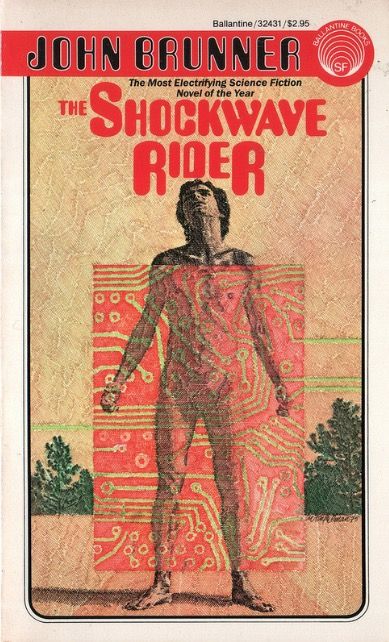
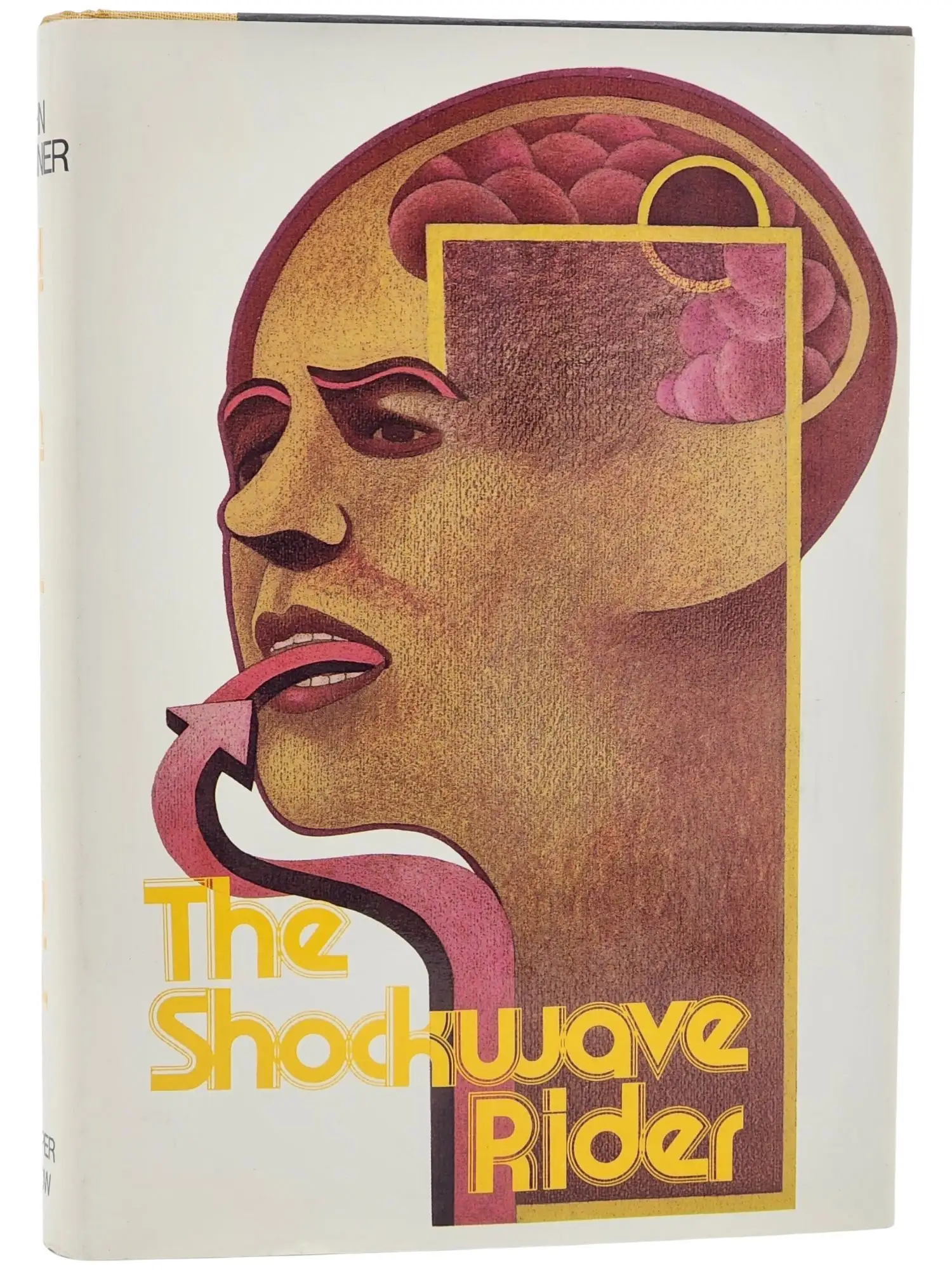
THE SHOCKWAVE RIDER | JOHN BRUNNER | 1975
The Seventies were a boom time for futurists. Alvin Toffler ushered in the decade with his information-overload inquiry Future Shock. No author of this era was more precognitive than British science-fiction writer and nuclear disarmament activist John Brunner. In what would become known as his Club of Rome quartet, named after the group responsible for 1972’s The Limits of Growth, another predictive text about mankind’s future, Brunner investigated threats to our continued survival in sometimes oracular dystopias. He delved deep into overpopulation (Stand on Zanzibar), race and violence (The Jagged Orbit), and environmental devastation (The Sheep Look Up). For the quartet’s final book, Brunner was galvanized by reading Future Shock. The Shockwave Rider envisioned a computer-tyrannized society and a man who frees himself from its grasp.
Around the 2020s, America has acceded to a “plug-in life-style.” As “the tendril-ears of federal computers wove through his society like mycelia,” Nickie Haflinger has spent six years swimming against the data stream. Behold the man on Murray Tinkelman’s classic cover: Beneath author and title in Amelia — that signature Seventies Future font from Future Shock to Rollerball — an Adamic figure trammeled by a printed circuit board shroud. (I have all the Ballantine Brunners with Tinkelman’s covers.) Haflinger has fled the government think tank where he was brought as a 12-year-old orphan. Unshackled from the microchip-forged manacles of his identity code, he can call up new identities. This persona-shifting phone(booth) phreak has been a “[u]topia designer, lifestyle counselor, Delphi gambler, computer-sabotage consultant, systems rationalizer, and God knows what else besides.”
The Shockwave Rider was cyberpunk avant la lettre. The novel introduced the word “worm” to denote a rogue self-perpetuating program inimical to a computer system. In one of his exchanges under interrogation by the think tank, Haflinger imagines a man not undone by a surfeit of information but who traverses “the ultrasonic-blender confusion of twenty-first century society, as a dolphin rides the bow wave of ship, out ahead but always making in the right direction,” adding, “And having a hell of a good time with it.” Haflinger is the forerunner of Neuromancer’s hacker Case, the Anonymous technoanarchist, Mr. Robot’s fsociety.
Amidst dystopia, Brunner gives us a glimmer of a utopia in the Northern California paid-avoidance (read: off-grid) town of Precipice, constructed in a shuttered college town in the aftermath of the Great Bay Quake. It is a refuge for Haflinger and a pastiche of various visionary-created loci amoeni (“bits of Ghirardelli and Portmeirion and Valencia and Taliesin”). (Curiously, Claes College bears the Dutch name for Nick!)
Brunner ought to have more readers. He should be recognized as much for his style as his prognostications. Regardless of whether he belongs to science fiction’s New Wave, he shared their fervor for innovative storytelling. Shockwave Rider’s intertitles break in on the pages like elliptical television chyrons. He notably took inspiration from John Dos Passos and Marshall McLuhan but his linguistic and sociological explorations owe a debt as well to the contemporary author Brunner most admired, Anthony Burgess. Given its genesis a half-century ago as a sort of Toffler fanfic, The Shockwave Rider astonishes with how much it says about networked societies, prediction markets, digital nomadism, and preserving our humanity in our age of AI and accelerationism.
OMAC YOUR ENTHUSIASM: INTRODUCTION by Josh Glenn | Mark Kingwell on RIDDLEY WALKER | Carlo Rotella on THE FACE | Sara Ryan on DREAMSNAKE | Matthew Battles on THE WORD FOR WORLD IS FOREST | Ramona Lyons on HIGH-RISE | Adam McGovern on SHADRACH IN THE FURNACE | Deb Chachra on THE HITCHHIKER’S GUIDE TO THE GALAXY | Tom Nealon on DHALGREN | Michael Grasso on FLOW MY TEARS, THE POLICEMAN SAID | Stephanie Burt on BRIGHTNESS FALLS FROM THE AIR | Nikhil Singh on SABRE | Gordon Dahlquist on VALIS | Miranda Mellis on THE DISPOSSESSED | Marc Weidenbaum on SOFTWARE | Peggy Nelson on THE TRANSMIGRATION OF TIMOTHY ARCHER | Josh Glenn on ENGINE SUMMER | Mimi Lipson on A SCANNER DARKLY | Douglas Wolk on THRILLER | David Hirmes on ARZACH | Anthony Miller on THE SHOCKWAVE RIDER | Annie Nocenti on JIMBO | Seth on MR. MACHINE | Alex Brook Lynn on JUDGE DREDD | Joe Alterio on THE INCAL | Jason Grote on JOSIE AND THE ELEVATOR.
JACK KIRBY PANELS | CAPTAIN KIRK SCENES | OLD-SCHOOL HIP HOP | TYPEFACES | NEW WAVE | SQUADS | PUNK | NEO-NOIR MOVIES | COMICS | SCI-FI MOVIES | SIDEKICKS | CARTOONS | TV DEATHS | COUNTRY | PROTO-PUNK | METAL | & more enthusiasms!