
MATHEMATICAL SUBLIME
By:
November 25, 2026
An installment in EMANATIONS, a series of posts featuring 10 of Josh Glenn’s favorite examples of Radium Age-era fine art that explore a particular proto-sf-adjacent theme. In this case, that theme is FAR-OUT MATHEMATICS / FOURTH DIMENSION. The sub-theme, meanwhile, is…
According to Kant, numerical relations and infinite mathematical progressions trigger a feeling of awe — because they push our imagination to its absolute limit, while at the same time reason can successfully calculate a conception of these phenomena. Confronted with a reality that can be calculated, yet not imagined, we experience that blend of awe and terror known as the sublime.
Triggers of this physical and intellectual experience may include: infinite regress and fractals (shapes like the Mandelbrot Set featuring infinite complexity); higher dimensions (visualizing a 4D tesseract or an n-dimensional hypersphere is physically impossible for our three-dimensional brains); non-Euclidean space (hyperbolic geometry and the curved spacetime of general relativity present spaces that defy daily human intuition); “sacred geometry” and cosmic scale (think of how you feel inside a Gothic cathedral, for example).
TWO NUDES, IN AN EXOTIC LANDSCAPE

Growing up, Metzinger pursued an independent interest in mathematics alongside music and painting. In 1906, he became friends with Maurice Princet, who’d later be dubbed “le mathématicien du cubisme.” When Metzinger was introduced, in ’08, to Apollinaire’s circle, which included Braque and Picasso, Princet began to give members of the group informal lectures about mathematical order, Riemann’s theorems, and non-Euclidean geometry. At some point between 1904–07, Princet would introduce Picasso to Esprit Jouffret’s Elementary Treatise on the Geometry of Four Dimensions, a book popularizing Poincaré’s theories on how 4D hypercubes could be projected onto a 2D surface. The multi-perspective, flattened geometry of Cubist painting was, or so one hears, directly inspired by this book.
In ’05, though, when the painting here was made, Metzinger had not yet written Note sur la Peinture, the first essay to analyze the idea of moving around an object in a painting (in order to see it from different viewpoints). Nor had he and Albert Gleizes written Du “Cubisme”, which would be the first major theoretical text on the subject. So the painting here isn’t Cubist but rather Divisionist — and also Fauvist.
Divisionism started in France around 1884 when Georges Seurat and other painters inspired by by 19th-century scientific writings on optics and color developed the style — initially called chromoluminarism — by separating colors into individual dots or patches that blend in the viewer’s eye rather than on a palette. The technique aimed to achieve maximum optical brightness and color vibration. Divisionism laid the technical groundwork for 20th-century movements like Futurism and Cubism.
In contrast to the loose, atmospheric spontaneity of Impressionism, Baigneuses, Deux nus dans un jardin exotique employs a rigid, calculated, mechanical stroke — one that suppresses personal expressiveness in favor of a structured visual grid. In any structuralist system, individual parts do not possess isolated or independent meaning; instead, they form a whole through interconnected relationships, differences, and underlying rules or systems. In a statement made circa ’07, Metzinger would allude to the structuralist aspects of his mosaic-like paintings like the one shown here:
“I make a kind of chromatic versification and for syllables I use strokes which, variable in quantity, cannot differ in dimension without modifying the rhythm of a pictorial phraseology destined to translate the diverse emotions aroused by nature.”
In 1911, Metzinger would be one of the Cubist and abstract artists who’d form the Section d’Or — a group named by Jacques Villon (Gaston Duchamp) after the mathematical ratio known as the nombre d’or (or the “golden ratio”). Their 1911 showing at the Salon des Indépendants would create a scandal bringing “Cubism” to the attention of the general public for the first time.
THE ORIGINS

Sérusier was a pioneer of quasi-abstract art, a disciple of Gauguin’s who’d go on to to co-found the late 19th-century Parisian arts group Les Nabis. They believed that a work of art was not a depiction of nature, but a synthesis of metaphors and symbols created by the artist; they’d go their own ways in 1900. Drawn to esotericism, in 1897 Sérusier had an epiphany about art based on mathematics, number, and geometry — a system of mathematical harmonies that might reveal nothing less than the geometric structure of the universe.
Sérusier’s series of paintings made c. 1909–10 convey certain implications of what has been called the “geometric-occult nexus.” Plato’s Timaeus, which establishes two-dimensional triangles as the ultimate building blocks of the material universe, and which associates the tetrahedron (pyramid) with fire, was an influence on occultists of the era. (Fun fact: Werner Heisenberg’s reading of Timaeus in his youth shaped his philosophical view that the fundamental building blocks of matter are abstract “forms” or “ideas” and mathematical symmetries rather than the tiny, solid physical objects —subatomic particles — that temporarily manifest through them.)
Contemplation of these universal forms was supposed to induce in viewers of Sérusier’s paintings a sense of “equilibrium.”
MAN IN A CAFÉ
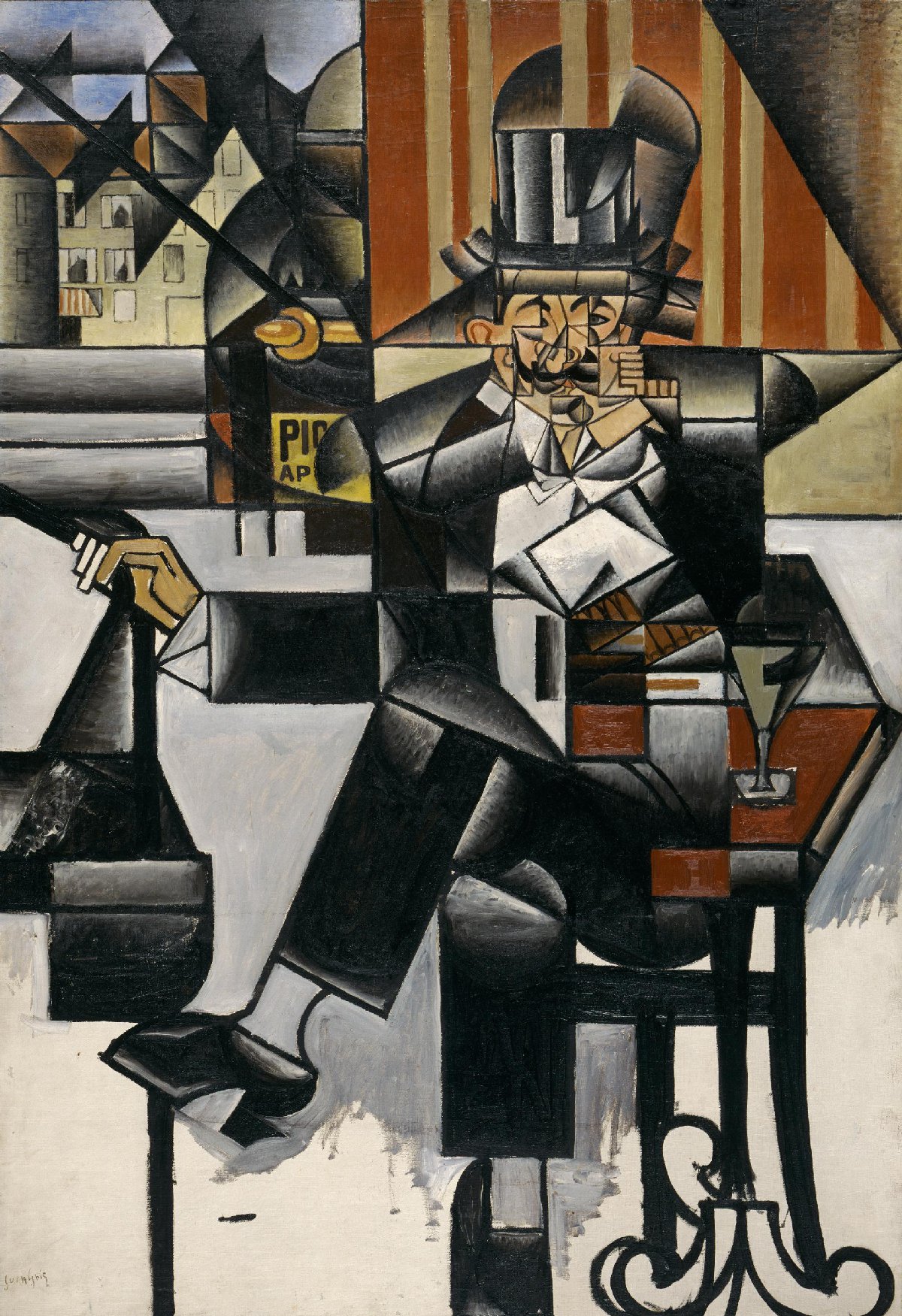
Gris was not a founding member of the Section d’Or group, but — along with Alexander Archipenko, Francis Picabia, and others — he began frequenting their weekly meetings after the controversial 1911 Salon exhibitions. He’d be a central participant in the group’s defining moment: the Salon de la Section d’Or exhibition in 1912.
From the Philadelphia Museum of Art website:
“Juan Gris was the only artist included in the 1912 Salon de la Section d’Or who actually used the ideal mathematical proportions of the Golden Section to construct his compositions, as seen in the complex system of grids and geometrical forms that make up this image of a café-terrace dandy. This modern man of taste, complete with top hat and black suit, rests one hand on a chair, while cradling a glass of absinthe in the other. The inclusion of the letters “PIC” and “AP” to the left of the man’s shoulder can be understood as a reference to Picasso, the cocreator of Cubism, and Guillaume Apollinaire, the movement’s fervent critical champion.”
Unlike Picasso, Braque, and other Cubists who fragmented forms through intuitive improvisation, here Gris applied the Golden Ratio (approximately 1:1.618), using it as a strict structural framework to organize the canvas’s dimensions, grid systems, and internal geometric planes. Key anchor points of the composition — such as the top hat at the apex, the placement of the shoulders, the cafe table, and the glass of absinthe — were predetermined.
THE KING AND QUEEN SURROUNDED BY SWIFT NUDES

In a 1962 interview Duchamp — a founding member of the Section d’Or — said of The King and Queen Surrounded by Swift Nudes that the barely visible “nudes,” here, depict “a different kind of speed, of movement — a kind of flowing around and between the central figures.” In a later interview, he’d distinguish between the “strong nude” (the painting’s titular king) and the “swift nudes” (the trails that crisscross the painting).
How to understand this stuff? Linda Dalrymple Henderson points to an imaginative, anthropomorphic discussion of electrons that appeared in an October 1908 issue of Mercure de France. The author describes the atom’s strong positive charge as the “king” of a court; and the swift negative electrons in their whirling orbit as the king’s dancing courtiers. Surely this was the inspiration for Duchamp — who at that time had become very interested in the problem of how to conceptualize and depict invisible scientific forces.
PS: The chess motif and the dynamic between a strong leader and their courtiers in this composition can be found in Duchamp’s masterwork, The Bride Stripped Bare by Her Bachelors, Even (The Large Glass) (1915–23).
ROUEN CATHEDRAL

Dumont, who hailed from Rouen originally, was involved with the Section d’Or group — and played a key role in organizing their inaugural 1912 exhibition, at which Cathédrale de Rouen was first exhibited. But unlike some of the its other members, while he enthusiastically embraced the intellectual fervor of the group, he did not apply strict mathematical rules or formulas to his paintings.
This massive (nearly 6 feet tall) painting, the Rouen Cathedral — which boasts features from Early Gothic to late Flamboyant and Renaissance architecture, and which had been famously painted by the Impressionist Monet in the ’90s — is Cubist, to be sure. The cathedral (along with the surrounding cityscape) is “scientifically” split and flattened, here, into multiple perspectives and geometric planes, sharp facets and structured forms. But Dumont’s style is loose, expressive, intuitive.
Cathédrale de Rouen has been described as a transitional bridge between Late Fauvism, Expressionism, and early Cubism. Which makes it particularly interesting — also lovely. I’d like to see it in person… but it’s housed far away, at the Milwaukee Art Museum.
THE CONQUEST OF THE AIR
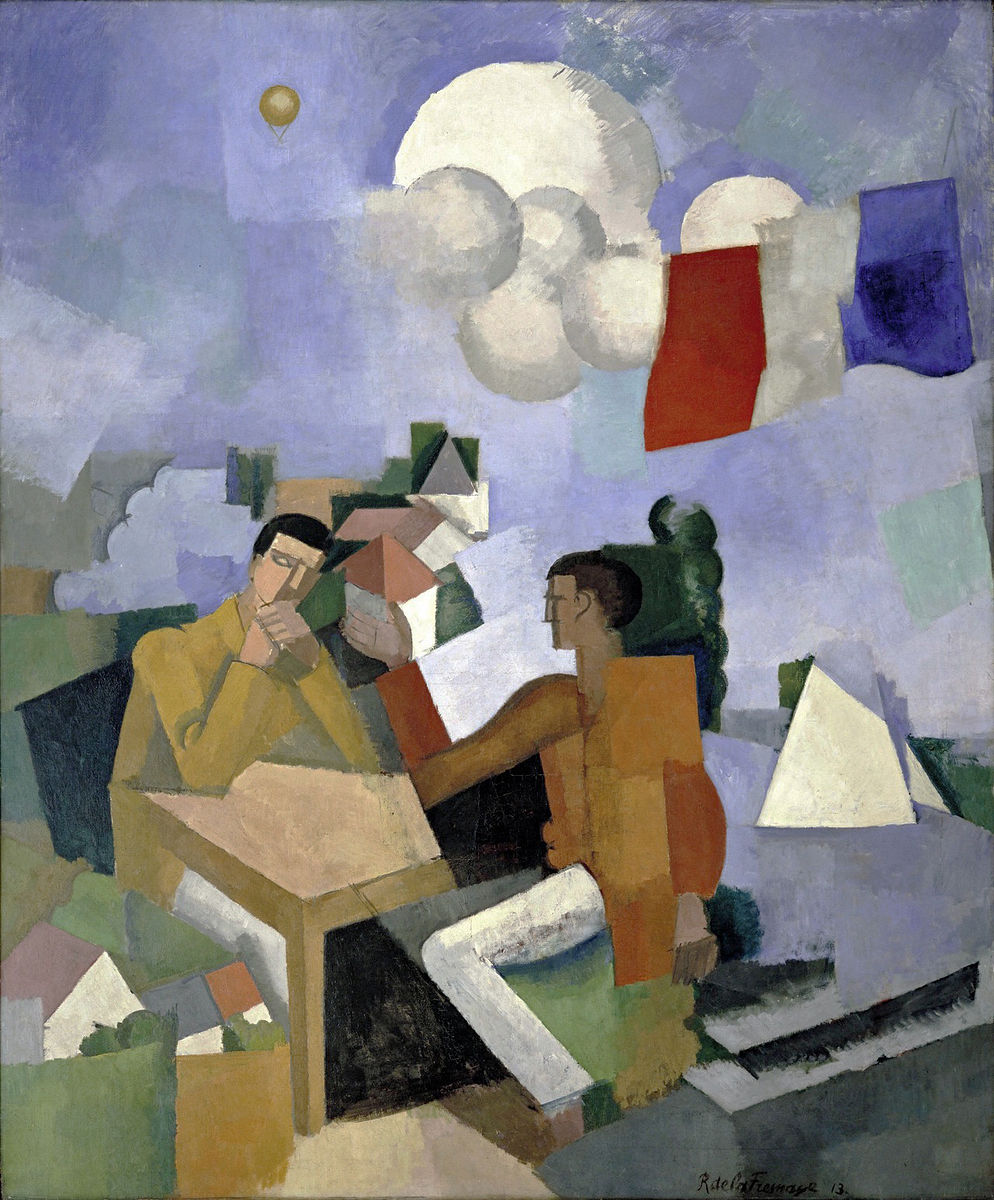
La Fresnaye formally joined the Section d’Or group in 1912. Here, he depicts two figures — himself and his brother Henri, an aviation engineer — engaged in what we understand to be mental calculation, scientific planning, speculative thought. One of the technological breakthroughs that can result from quiet, contemplative human thought is depicted high in the sky above: a hot-air balloon. This device is an homage to French aeronautical innovation, recalling the Montgolfier brothers’ pioneering manned balloon flight in 1783.
The painting structures clouds, figures, and objects into distinct, faceted, and geometric volumes (spheres, cylinders, and sharp angles) that suggest a rational, mathematical order of space. Which is Cubist. But the open-air clarity, the vibrant, prismatic bright colors (influenced by Robert Delaunay) tip us off that this is a Section d’Or painting. The painting’s title and the French flag suggest a patriotic belief that France can lead the way in aeronautic engineering and innovation once again.
PS: La Fresnaye enlisted in the French army with intense patriotic fervor, but was discharged after he was gassed. After the war he abandoned Cubist experimentation, and the bright, joyous, soaring optimism of paintings like this one was replaced by more introspective, melancholy work.
FORM-SPIRIT TRANSFORMATION
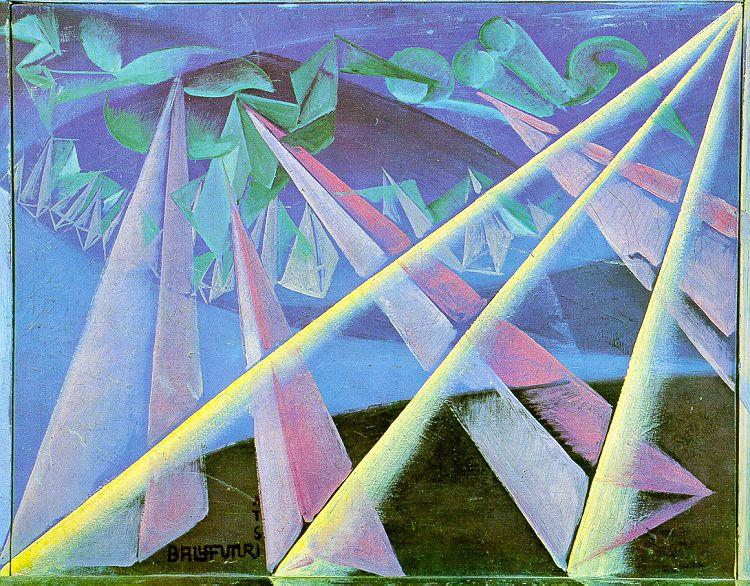
Starting in 1916 (or earlier), Balla regularly attended the meetings of an Independent Theosophical League splinter group in Rome. His shift toward complete abstraction and dynamic lines of force was influenced by the Theosophical text Thought-Forms, which depicts human emotions and spiritual states projected (via specific colors and shapes) into the invisible world. Here, Balla offers a representation of the fourth dimension — understood, by esotericists at the time, as a higher plane of reality where matter and spirit intertwine.
How to visualize how the physical world (form) and the invisible astral world (spirit) occupy the same space simultaneously — via dynamic interpenetration? By fragmenting the canvas into sharp, semi-transparent pyramids, Balla conjures up a dimension of pure geometric light and energy. Intersecting, dynamic, luminous “lines of force” create a complex structuralist network or web. The upward-pointing triangular and pyramidal vertices seem to act as energetic vectors, symbolizing the movement of human souls ascending from the earthly realm and transforming into cosmic energy.
Forms, in the fourth dimension, aren’t static; they’re constantly flowing from one state into another as energy and consciousness transcend material boundaries. As an antidote to this ceaseless (Futurist) dynamism, which might seem chaotic, the painting’s calm color scheme emphasizes the harmony of human beings with the universe.
PS: After WWI, Albert Gleizes would revive the Section d’Or with the goal of creating a unified European avant-garde movement. The second (1920) and third (1925) major Section d’Or exhibitions therefore included Italian Futurist works — alongside other modern movements like Bauhaus, De Stijl, and Constructivism.
BROKEN AND RESTORED MULTIPLICATION
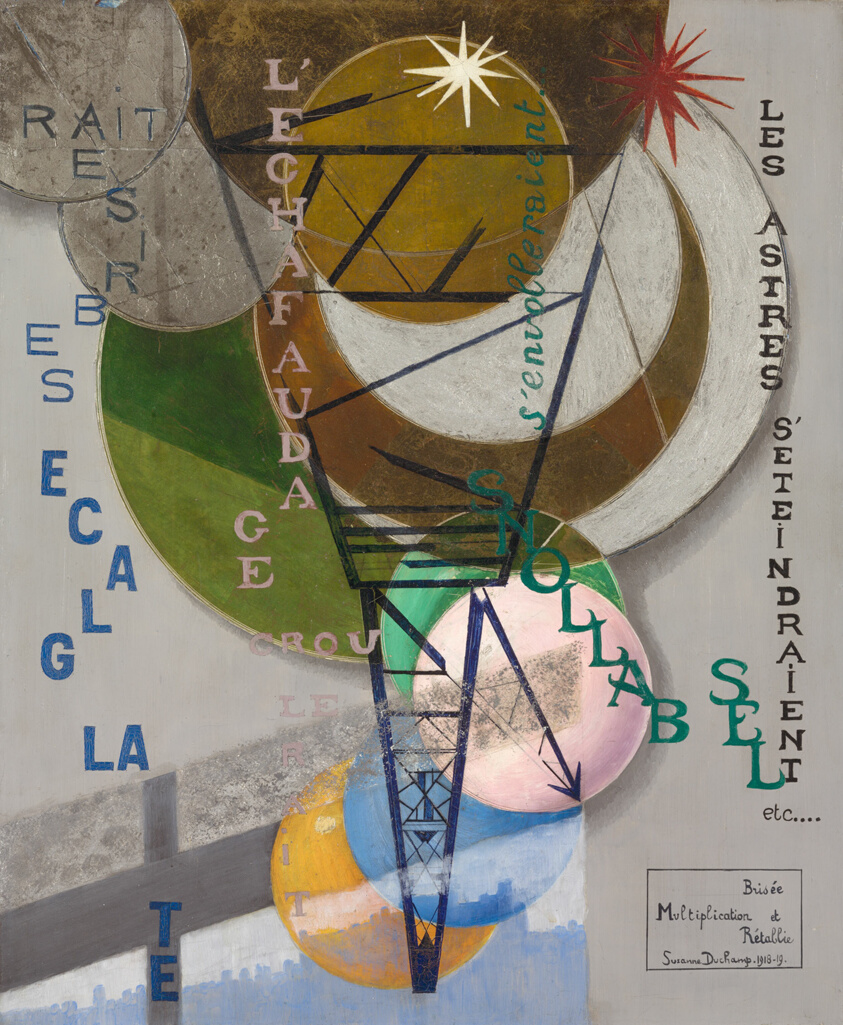
Suzanne Duchamp, the younger sister of Jacques Villon, Raymond Duchamp-Villon, and Marcel Duchamp, exhibited her early Cubist-influenced work in 1912’s Salon de la Section d’Or. Around 1916 she joined the Dadaist movement. Regarding Broken and Restored Multiplication, the Art Institute of Chicago’s website tells us:
Like many Dada works, those by Suzanne Duchamp weave painting, collage, and language together in complex ways. Broken and Restored Multiplication is filled with visual and verbal metaphors of disorder and breakage: at the center, a schematic Eiffel Tower is turned upside down; just below it, a modern cityscape is reflected in its mirror image. The phrases that run up and down along the surface of the picture further the idea of order upended: “The mirror would shatter, the scaffolding would totter, the balloons would fly away, the stars would dim, etc.”
The Eiffel Tower, which appears in earlier avant-garde paintings as an icon of the technological sublime, is here turned on its head. We’re confronted with the underbelly of the rational, calculated progress of the modern scientific age; what Adorno and Horkheimer would later call the dialectic of Enlightenment. The scientific certainty of optics, too, is here distorted into an unstable, multi-layered visual experience. As in Section d’Or works, we find here the influence of mathematics and science — diagrammatic geometry, playful optics, mechanistic allegories — but after WWI it’s all gone topsy-turvy.
PS: When Suzanne and Jean Crotti married in 1919, Marcel Duchamp sent instructions for an artwork (later titled Ready-made malheureux), that involved hanging a geometry textbook — representing logical certainty, absolute truths, and unchanging laws — by strings from the balcony of their Paris apartment, and leaving it exposed to the wind and rain.
CHESS BOARD

Villon (Gaston Duchamp), who’d suggested the group name Section d’Or after reading a translation of Leonardo da Vinci’s Trattato della Pittura by Joséphin Péladan, which emphasized the mystical and mathematical importance of the “golden ratio,” served in World War I — including time as a military camouflage artist. In 1920, he returned to his studio. The mathematical proportions, rhythmic grids, and crystalline geometry are still in evidence — but Villon’s work going forward will be more tight, disciplined, refined.
It’s worth noting that for Villon and his siblings, the game of chess functioned as an abstract, mathematical language. Marcel Duchamp had painted Villon and Raymond in his 1911 work Portrait of Chess Players. By 1920, Marcel was beginning to pivot away from traditional art to commit his life to chess.
Regarding Chess Board, the Philadelphia Museum of Art’s website tells us:
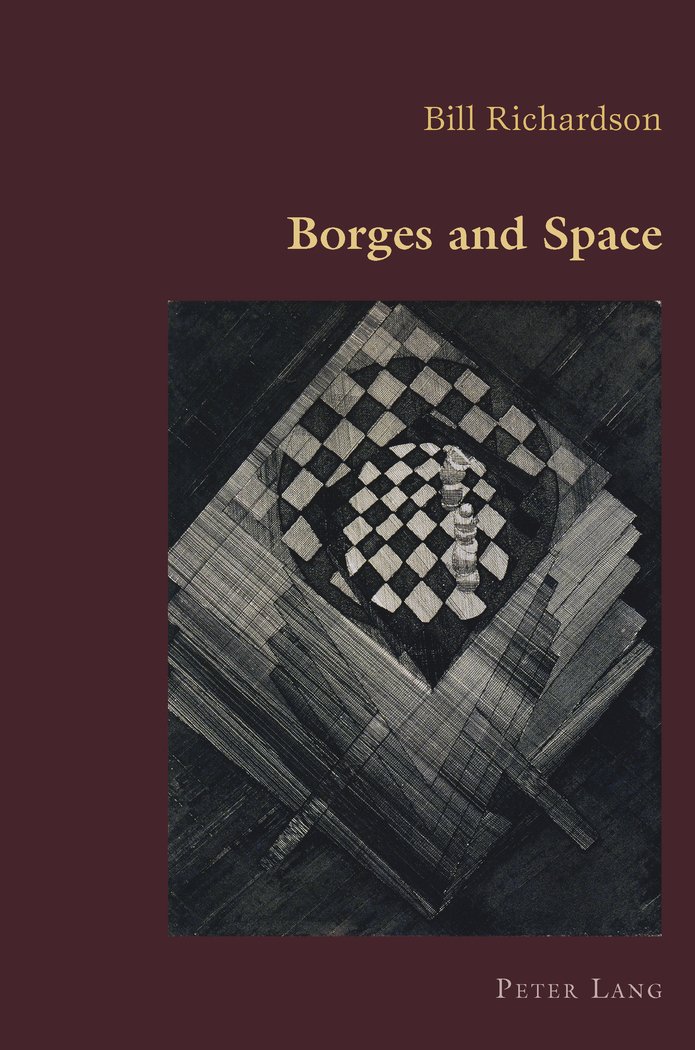
In his first etching after World War I, Villon’s technique showed an extraordinary refinement that had not been present in his earlier Cubist prints. In this work, he subjected the table and chessboard to what he called “constructive decomposition,” by dividing them into stacked planes infused with light and shadow. Working in fine, dense strokes, he created layered zones of varied tones by maintaining absolute control over the spacing of parallel lines and crosshatchings. The result is an image of a chessboard that progressively emerges through infinite tonal variations, as though it had floated to the top of a dark pool.
Villon’s “constructive decomposition” is a mathematical technique. Instead of intuitively shattering the chessboard, here he precisely divides it into intersecting grids and overlapping planes, which are seen coalescing into a tighter, more cohesive “final” chessboard. Even the shading here isn’t fluid; Villon instead uses strict, parallel crosshatching. The mathematically precise spacing of lines in the composition creates infinitely varying tonal gradients. Villon uses the grid motif to revise the entire visual field. The chessboard and its surrounding space merge into a unified network of interrelated geometric units; the chessboard and pieces arise out of the density of light and shadow almost like an emergent phenomenon. The rigid, hard-edged chessboard thus feels mysteriously luminous and fluid.
PS: Villon’s etching was used to illustrate the cover of a 2012 scholarly work exploring the critical and philosophical dimensions of space and place in the writings of Jorge Luis Borges. See below:
NUMBERS IN LOVE
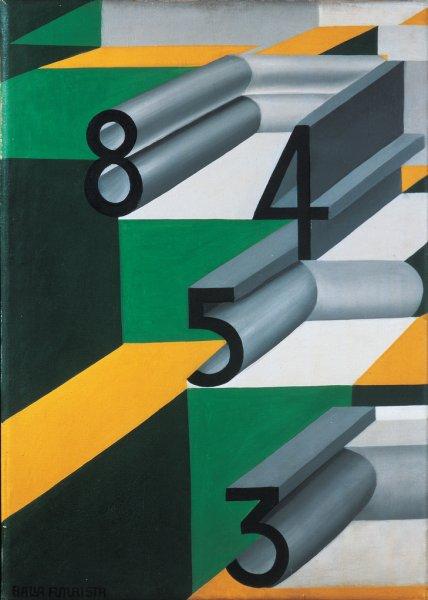
Inspired by rapid industrialization, motor cars, and electric lighting, around 1912–14 Balla wanted to depict the invisible forces — such as velocity, sound waves, and light vibrations — rather than just the physical object itself. Abandoning traditional figurative painting, he shifted to a conceptual and geometric style.
Numbers in Love was shown at the 1926 Venice Biennale inside the Soviet pavilion. It has been cited as a nonconformist piece because it represents a deliberate turn toward a playful, inward-looking, esotericism-inspired abstraction painted during a time when the rising Italian Fascist regime demanded rigid, monumental, and hyper-nationalistic art. I don’t know. Balla was enthusiastic about Mussolini’s fascist takeover until I think the mid-1930s.
Fascinated with the underlying mathematical order, harmony, and symmetries found in nature, here Balla renders numbers as solid, three-dimensional, extruded forms casting architectural shadows. The painting’s title may be ironic, or perhaps Balla is suggesting that certain structural relations between numbers — as in the Fibonacci sequence (see the “3,” “5,” and “8” here) — are particularly harmonious.
What’s with the “4,” though? It breaks the mathematical progression of the Fibonacci sequence (1, 1, 2, 3, 5, 8…). It’s been suggested by some that the “4” acts here as a deliberate anomaly to a strict mathematical order. Maybe love, for Balla, has something to do with disruption?
Josh Glenn’s EMANATIONS series includes the following installments: CATASTROPHE: DECLINE & FALL | DYING EARTH | ECO-CATASTROPHE. COSMIC AWE: DEEP TIME | STARS WHEEL IN PURPLE | IS THERE LIFE ON MARS. DEHUMANIZATION: CYBORG MANIFESTO | MECHANIZATION. & many others.
MORE RADIUM AGE SCI FI ON HILOBROW: RADIUM AGE SERIES from THE MIT PRESS: In-depth info on each book in the series; a sneak peek at what’s coming in the months ahead; the secret identity of the series’ advisory panel; and more. | RADIUM AGE: TIMELINE: Notes on proto-sf publications and related events from 1900–1935. | RADIUM AGE POETRY: Proto-sf and science-related poetry from 1900–1935. | RADIUM AGE ART: Proto-sf and science-related fine art from 1900–1935. | RADIUM AGE 100: A list (now somewhat outdated) of Josh’s 100 favorite proto-sf novels from the genre’s emergent Radium Age | SISTERS OF THE RADIUM AGE: A resource compiled by Lisa Yaszek.