
MECHANIZATION
By:
July 3, 2026
An installment in EMANATIONS, a series of posts featuring 10 of Josh Glenn’s favorite examples of Radium Age-era fine art that explore a particular proto-sf-adjacent theme. In this case, that theme is DEHUMANIZATION. The sub-theme, meanwhile, is…
THE BRIDE

Duchamp’s breakthrough painting was completed in August 1912. “This is not the realistic interpretation of a bride but my concept of a bride expressed by the juxtaposition of mechanical elements and visceral forms,” he would later explain. This anti-romanticized Bride is reduced to semi-mechanical organs of digestion and reproduction (see the gear-toothed womb at lower left).
Speaking of viscera, the art historian Linda Dalrymple Henderson connects the dots between this and Duchamp’s earlier X-ray related works. “Duchamp’s Bride is painted in clearly defined, static forms that differ sharply from the fluid, transparent, and often dynamic forms of his X-ray related works of Fall 1911 and Spring 1912.” She goes on to surmise the following: “This new preoccupation with the internal organs of the body surely relates to advances in x-ray technology….”
Duchamp would also say that he “first glimpsed the fourth dimension” via this painting. Henderson reminds us of the semi-occult notion, popular at the time, that “a four-dimensional being could easily observe the interior of solid, three-dimensional forms, just as x rays had enabled modern man to do.”
1915
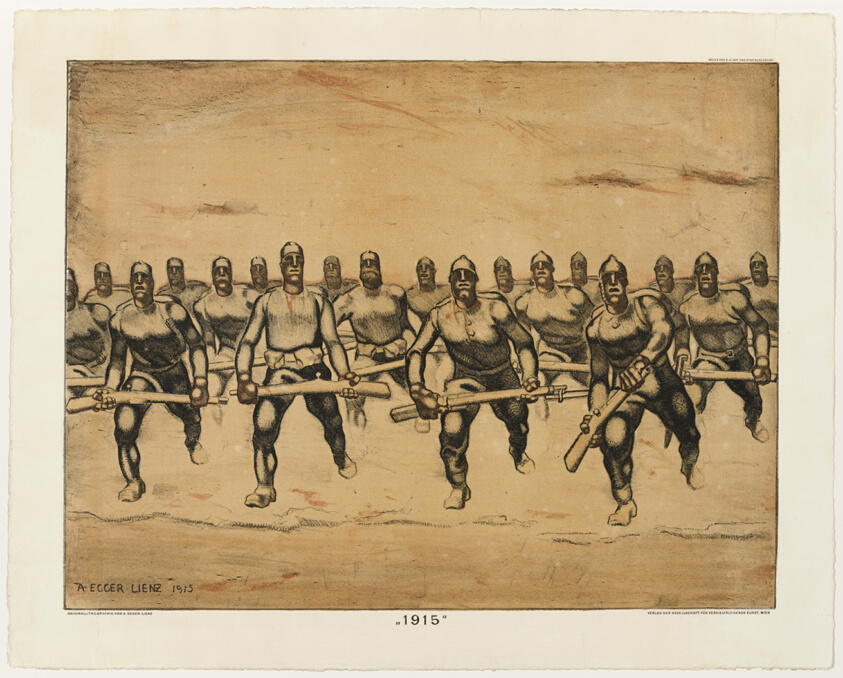
Drafted into the military in 1915, the Austrian artist Egger-Lienz witnessed the carnage of the front lines first-hand. “1915” (also known as “The Nameless”) is a monumental and chilling allegory. From the Art Institute of Chicago’s website:
In this four-color lithograph, sculpted and depersonalized machinelike bodies charge forward with unfettered vigor. The blunt, angular rendering of their hands make their flesh appear solid and inviolable, while their collective formation mimics the force and symmetry of an engine. The effacement of these soldiers’ features renders their faces impenetrable and their assault terrifying. Here, even while not depicting the actual mechanisms of modern warfare, Albin Egger-Lienz poignantly evoked the brutal dehumanization of the first industrialized war in history.
SOLDIERS PLAYING CARDS
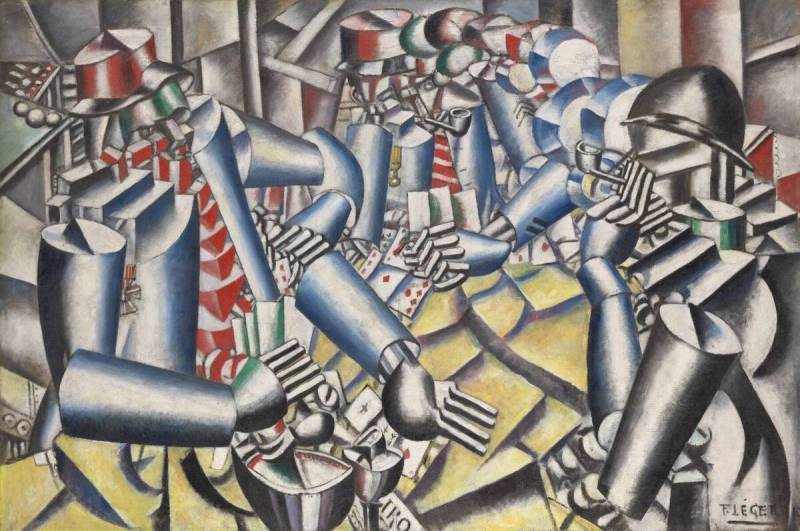
Léger co-founded the Section d’Or in 1911; his paintings, from then until 1914, would become increasingly abstract. But then the artist spent two years fighting on the front in Argonne; while in the trenches, he produced many sketches of artillery pieces, airplanes, and fellow soldiers. In September 1916, he’d nearly die during a mustard gas attack at Verdun. During a period of convalescence he painted The Card Players.
As he would explain, about the robot-like paintings he’d produce from this point on:
I was stunned by the sight of the breech of a 75 millimeter in the sunlight. It was the magic of light on the white metal. That’s all it took for me to forget the abstract art of 1912–1913. The crudeness, variety, humor, and downright perfection of certain men around me, their precise sense of utilitarian reality and its application in the midst of the life-and-death drama we were in … made me want to paint in slang with all its color and mobility.
During Léger’s so-called “mechanical period,” the figures and objects that he’d paint would characterized by sleekly rendered tubular and machine-like forms. Mockingly dubbed “Tubism,” his new aesthetic aimed to capture the dynamism of modern, industrial life. He believed that machines, speed, and city environments required a new visual language, leading him to blend human figures with geometric, machine-like cylinders and pistons.
THE PREDICTOR
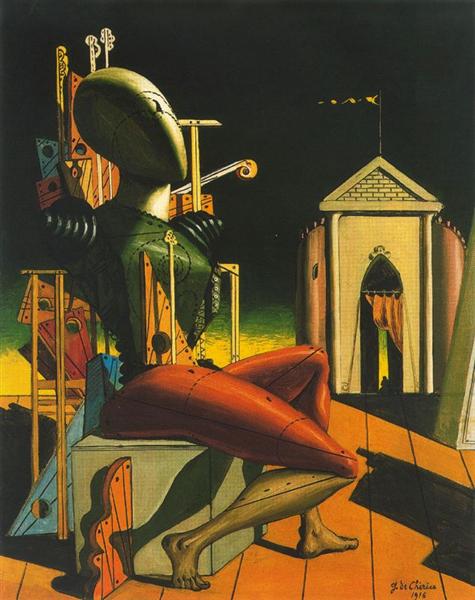
De Chirico, who viewed his “metaphysical” paintings — i.e., paintings that aimed to depict a visionary world beyond physical reality — as stages for hidden, non-human narratives, here confronts us with an eyeless, armless mannequin. Instead of human flesh, its body features geometric patterns that echo cartography and architectural blueprints. An inhuman or superhuman figure, one might say — which (thanks to its cold inhuman logic) can perceive the imperceptible forces that shape and guide human perception… and which can therefore predict human behavior.
RED AND BLACK SAVAGES
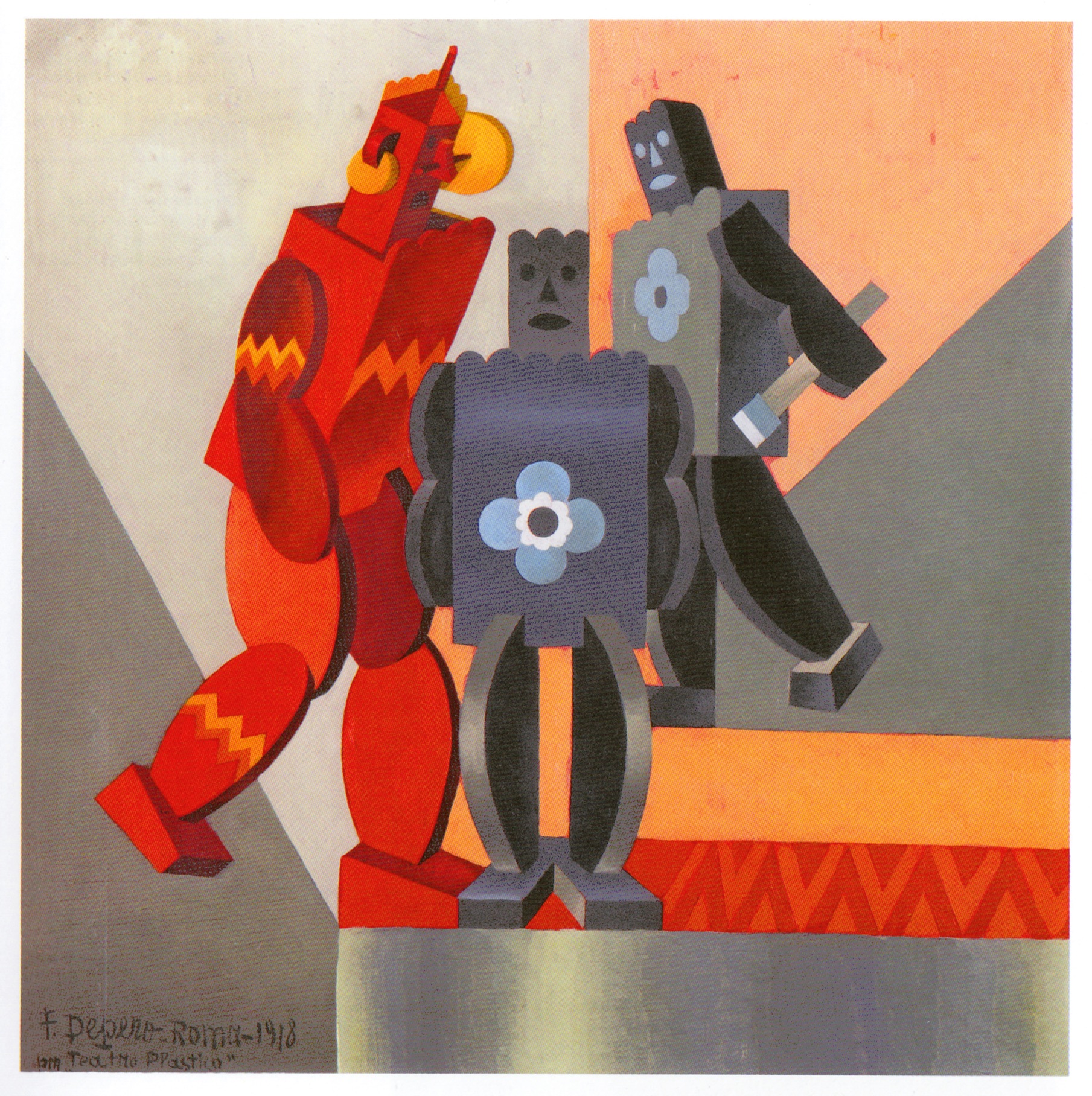
Depero’s Plastic Ballets were avant-garde theatrical performances that replaced human dancers with wooden puppets. They depicted whimsical, fast-paced dreamworlds defined by rigid movements, comic transformations, and geometric stage designs — all set to modernist music by the likes of Alfredo Casella, Béla Bartók, and Francesco Malipiero.
Machine aesthetics were a popular field of theatrical exploration in many countries, ranging from capitalist America to Bolshevik Russia. See: the experiments at the Bauhaus stage workshop, Vsevolod Meyerhold’s biomechanics, and Nikolai Foregger’s machine dances, for example.
By using jointed marionettes rather than human dancers, Depero was able to explore rigid, superhuman, and purely mechanical movements. Depero’s automatons moved in violent, rigid, and explosive ways designed to shock and awe audiences. These productions paved the way for the artist’s later proto-sf mechanical works (like the Anihccam 3000), for which human actors would wear rigid costumes to depict anthropomorphic machines.
Why did Depero refer to his robot characters, which included figures like the “Great Savage” (Il Grande Selvaggio), as “savages”? To the Futurists, who were heavily influenced by Nietzsche, being “savage” meant breaking free from the rules of polite society; a “savage” was someone (or something) not ruined by modern civilization. Cf. Nietzsche’s argument that modern society makes people weak and guilty by punishing natural urges. Unlike Nietzsche, who viewed machines as tools of dehumanization and conformity, however, for the Futurists mechanical objects bursting with power threatened to disrupt the strict, unnatural rules of modern culture — which made them “savage” in Nietzsche’s positive sense too.
In other words, Depero doesn’t valorize robots because they promise to remove all discomfort and struggle from life; instead, he valorizes them because they promise to run amuck — because they lack human morality and sentimentality, because they threaten to destroy us.
Note that Karel Čapek’s play Rossum’s Universal Robots (R.U.R.), which introduced the word “robot” to the world, and which depicted a factory that mass-produces artificial, human-like laborers… who eventually develop consciousness, revolt, and wipe out the human race, wouldn’t appear until 1920.
THE SKAT PLAYERS
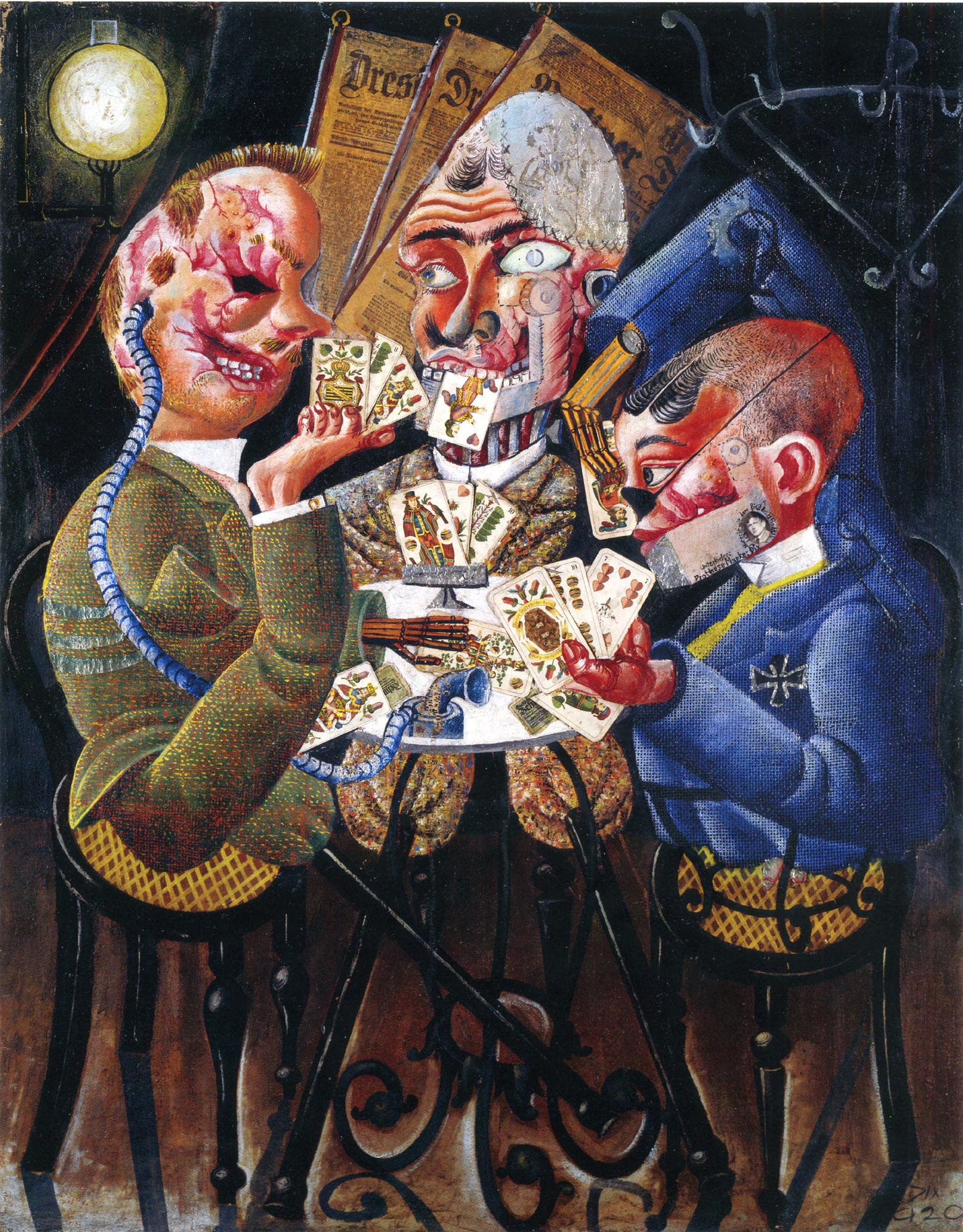
Otto Dix volunteered for the German army in 1914. Trained as an artilleryman and machine-gunner, he would serve on both the Western and Eastern Fronts. After which he used his art to force his audience to confront the gruesome, everyday reality of soldiers maimed in battle.
From MoMA’s website, regarding this painting:
We’re looking at a group of three German military officers, the shattered hulks of their bodies speaking to the devastation wreaked on Germany and on the heroic figure of the invulnerable war hero by WWI. As you look through Dix’s painting you see this contrast between the mechanical and the organic, between flesh and prosthetics, between the viscous application of oil paint and the materials of montage or collage. Along the lower edge of the composition, this play between organic and inorganic is particularly poignant in the similarities between the officer’s prosthetic legs and the wooden legs of the chairs. There is a sympathy involved in his portrayal of these dysfunctional figures, who are reduced to mere shadows of their former self.
Skat — a game that relies on strategy, risk, and gambling — may be here intended to symbolize how the world’s governments viewed the war as a game.
THE BEAUTIFUL GIRL
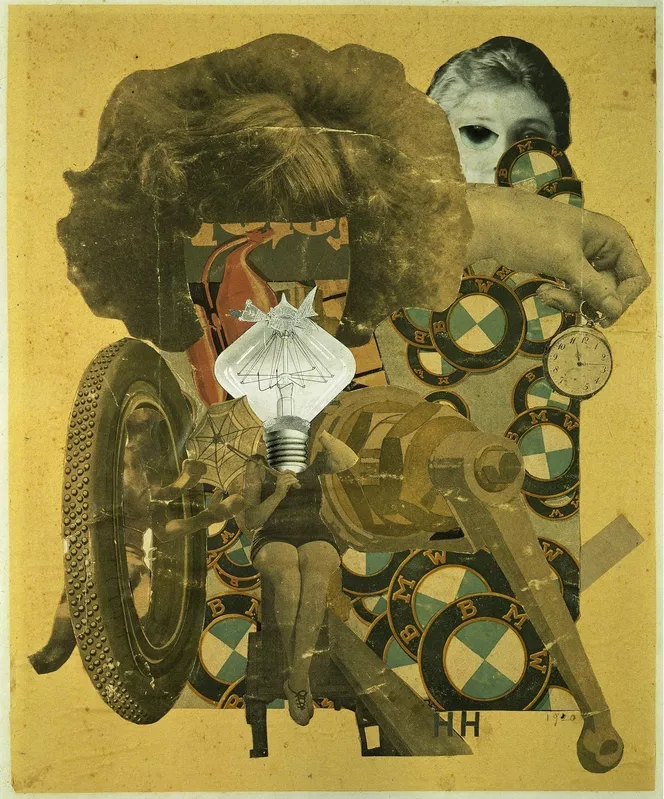
Höch’s unsettling photomontage — an assemblage of found images from magazines and advertisements — is a feminist, anti-capitalist reaction to the birth of industrial advertising and ideals of beauty it furthered.
The central female figure is depicted headless, wearing a swimsuit and holding a parasol, but her head is replaced by a lightbulb (suggesting, some critics note, that one can switch her on and off at will — an early fembot?) topped with a perfectly coiffed, bobbed hairstyle.
She is surrounded by car parts and BMW logos. A disembodied hand dangles a pocket watch. Corporations and new technologies, apparently, have overtaken this female subject’s individuality.
DAUM MARRIES HER PEDANTIC AUTOMATON…
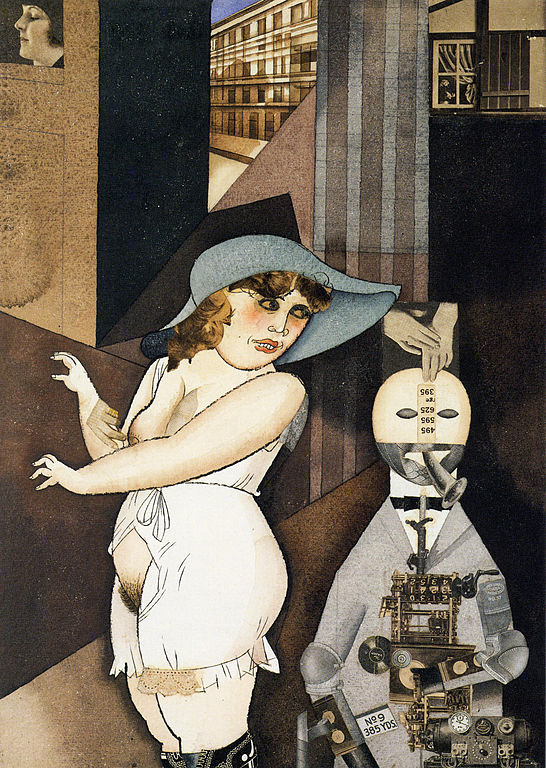
Grosz’s famous mixed-media art work depicts a surreal, satirical wedding scene featuring a scantily clad bride (representing his real-life new wife, whose nickname “Maud” is anagrammed) standing next to a robotic or mechanical groom (formed of cut-up magazine images, and named after himself). Human beings were becoming automated, Dadaists like Grosz felt; and “pedantic” — fixated in dry, intellectual problems, rather than living life. He saw society treating people like replaceable machine parts and mindless tools.
The setting is a Chirico-esque irrealistic cityscape.
PS: Heartfield was a close friend and fellow artist (sometimes a collaborator), who was highly amused by the prospect of Grosz turning into a “tamed” husband.
CONSTRUCTION ON WHITE (ROBOT)
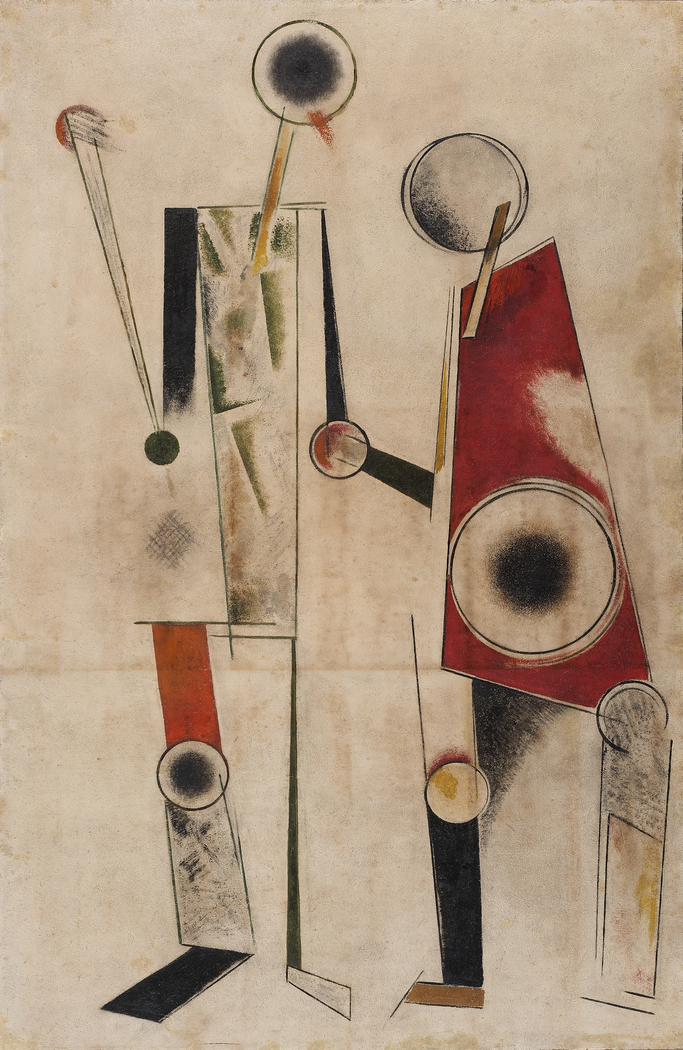
In the wake of the 1917 Russian Revolution, artists like Rodchenko viewed machines not as cold, oppressive tools, but as agents of liberation. Through science and mechanical engineering, according to the precepts Russian Cosmism — a philosophical movement advocating for “active evolution,” or the evolutionary transformation of humanity into immortal, godlike beings — humankind could take control of its destiny.
Rodchenko’s painting uses stark geometric abstraction — geometric forms placed against an immaculate white background — to depict the era’s fascination with machines as symbols of human liberation and the creation of a “new man” for the modern age. The “robot” is an idealized representation of this new, technologically enhanced human, capable of overcoming biological limitations and conquering the cosmos.
INTELLECTUAL EXPRESSION CROSSING THE REALITY LINE
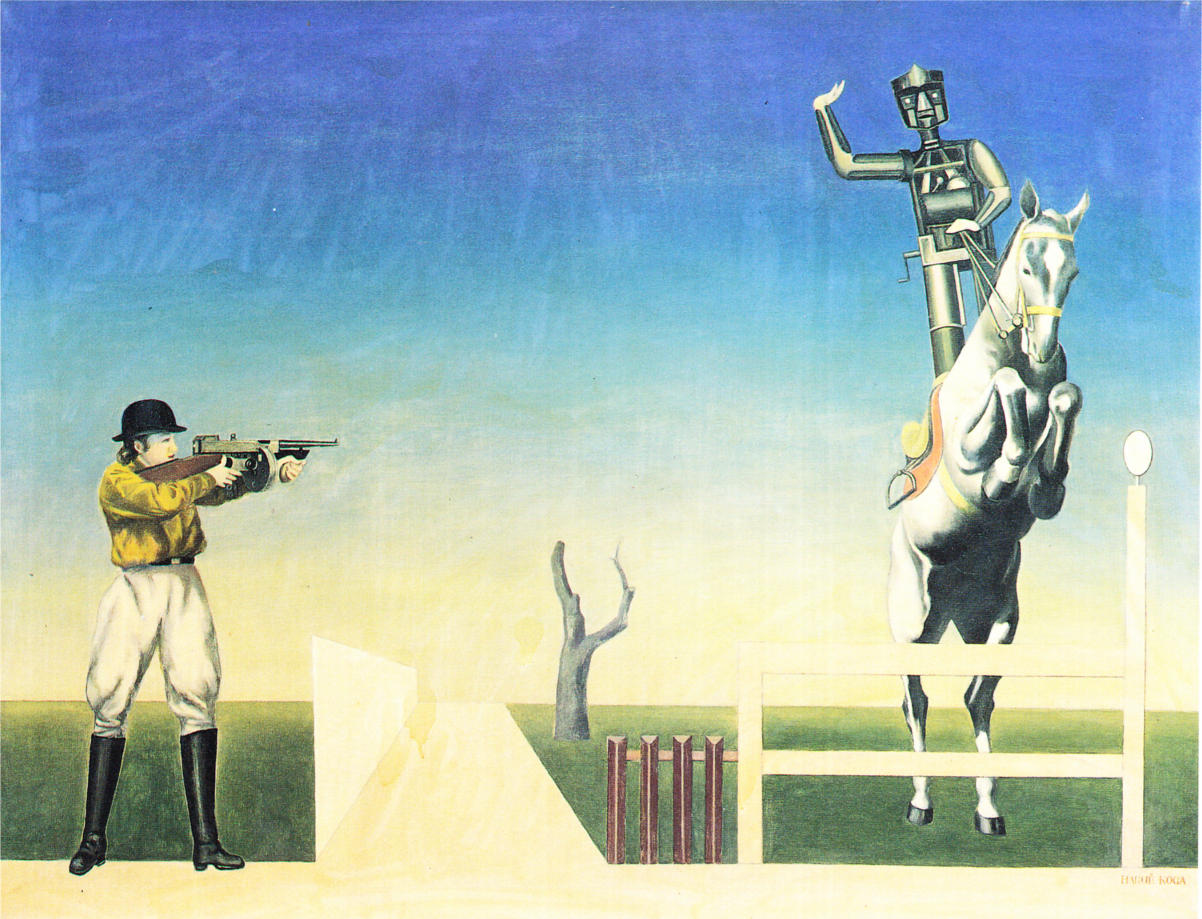
Harue Koga (1895–1933) was a Japanese avant-garde painter active from the 1910s to the early 1930s. He is considered to be one of the first and one of the most representative Japanese surrealist painters.
Koga appropriated images from magazines, newspapers, and film stills, then combined them into a single art work — painting them with meticulous photorealism. “Intellectual Expression Crossing the Reality Line,” which includes a lifelike depiction of the famous British robot Eric, which had been exhibited in London in 1928, seems to explore the tension between the artist’s own optimism for technological progress and the chaotic, rapidly shifting social landscape of the era.
Fun fact: Koga is often referred to as the David Bowie of early 20th-century Japanese avant-garde art. I must learn more about him.
Josh Glenn’s EMANATIONS series includes the following installments: CATASTROPHE: DECLINE & FALL | DYING EARTH | ECO-CATASTROPHE. COSMIC AWE: DEEP TIME | STARS WHEEL IN PURPLE | IS THERE LIFE ON MARS. DEHUMANIZATION: CYBORG MANIFESTO | MECHANIZATION. & many others.
MORE RADIUM AGE SCI FI ON HILOBROW: RADIUM AGE SERIES from THE MIT PRESS: In-depth info on each book in the series; a sneak peek at what’s coming in the months ahead; the secret identity of the series’ advisory panel; and more. | RADIUM AGE: TIMELINE: Notes on proto-sf publications and related events from 1900–1935. | RADIUM AGE POETRY: Proto-sf and science-related poetry from 1900–1935. | RADIUM AGE ART: Proto-sf and science-related fine art from 1900–1935. | RADIUM AGE 100: A list (now somewhat outdated) of Josh’s 100 favorite proto-sf novels from the genre’s emergent Radium Age | SISTERS OF THE RADIUM AGE: A resource compiled by Lisa Yaszek.