
CYBORG MANIFESTO
By:
June 21, 2026
An installment in EMANATIONS, a series of posts featuring 10 of Josh Glenn’s favorite examples of Radium Age-era fine art that explore a particular proto-sf-adjacent theme. In this case, that theme is DEHUMANIZATION. The sub-theme, meanwhile, is…
CHOCOLATE GRINDER (No. 1)
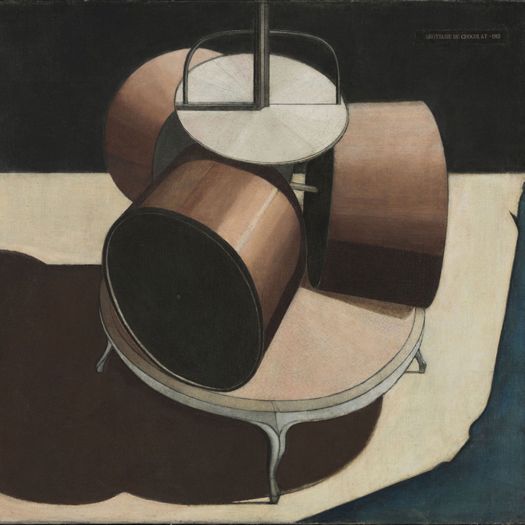
This painting, about which I was not aware until HILOBROW friend Jonathan Pinchera and I visited the MoMA show “Marcel Duchamp” in April of this year, was inspired by a chocolate grinding machine that the artist spotted in the window of a Rouen confectioner’s shop. Fascinated with the rotating drums of the chocolate grinder, which suggested to him a sexual connotation, Duchamp depicts the machine in a precise, impersonal fashion.
Around this same time, Duchamp conceptualized the “bachelor machine” (machine célibataire), which is to say: a mechanical assemblage representing a closed system of autoerotic, unproductive sexual energy. Other Dada artists, including Francis Picabia and Max Ernst, would pick up on Duchamp’s notion. For better or worse — it’s not always clear — these machines signify a rejection of traditional bourgeois life and productive labor. They are rebellious social models of anti-procreation.
This particular bachelor machine will show up again; see below.
THE ROCK DRILL
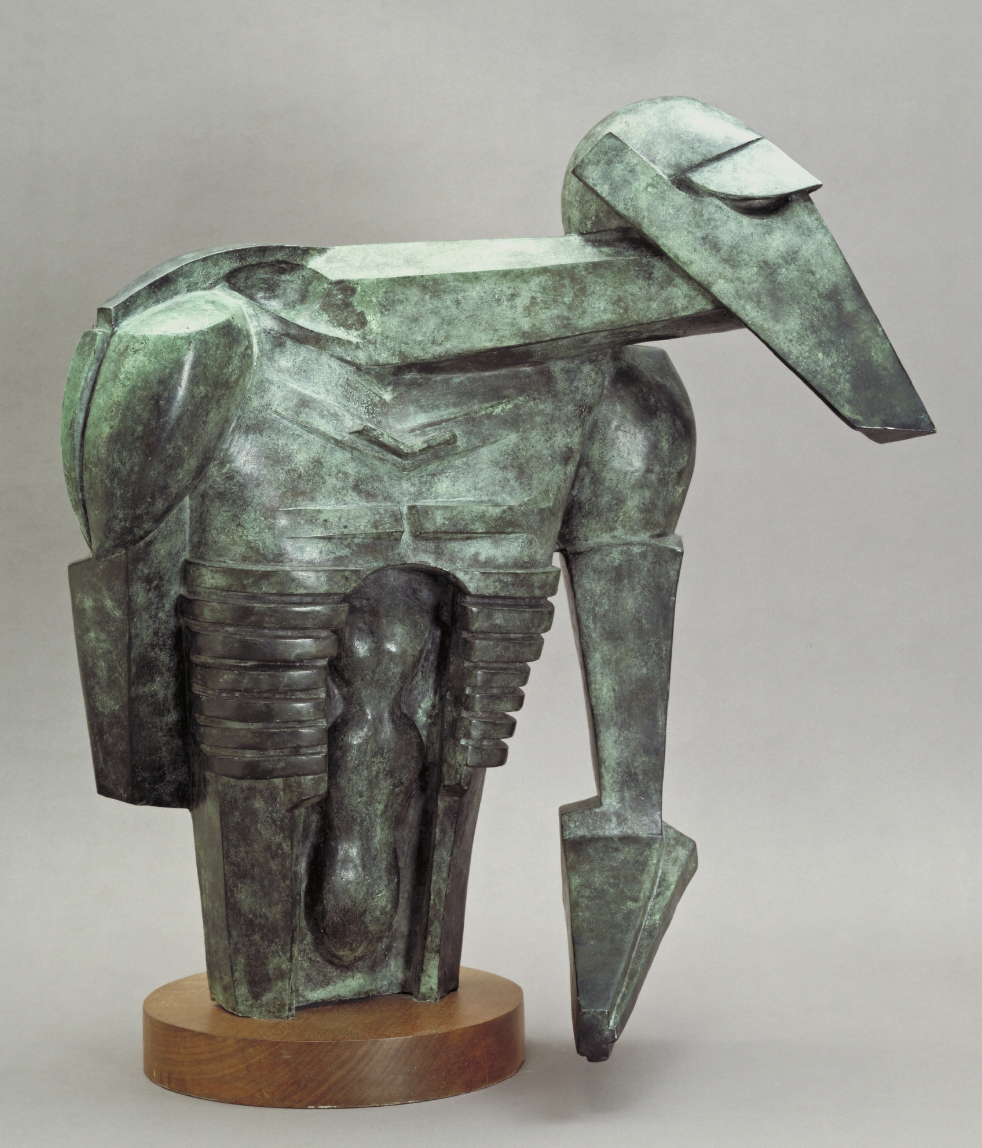
Though he’d never officially join the Vorticist movement, Epstein was closely associated with them. Like the Vorticists, his art from this period celebrates machinery and dynamic form. Rock Drill, then, no matter what it may have come to signify in the years since its creation, was originally intended as a celebration of modern machinery and masculine virility.
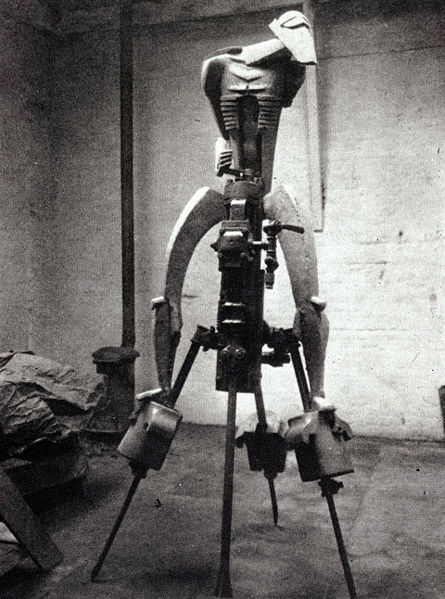
Unable to afford casting the humanoid figure in metal, Epstein fashioned it from plaster — then mounted it on an industrial rock drill. The only organic feature is what appears to be a foetus within the creature’s open rib-cage.
In May 1916, Epstein broke up the sculpture, removing the drill and reducing the upper figure to a legless one-armed torso, which he had cast in gunmetal. In 1940, recalling the horrors of the 1914–18 war, Epstein would suggest that this remaking was connected to his own change of heart about mechanized humanity:
My ardour for machinery (short-lived) expended itself upon the purchase of an actual drill, second-hand, and upon it I made and mounted a machine-like robot, visored, menacing, and carrying within itself its progeny, protectively ensconced. Here is the armed sinister figure of to-day and to-morrow. No humanity, only the terrible Frankenstein’s monster we have made ourselves into.
PS: As I was writing this post, I was surprised and thrilled to stumble upon Epstein’s Rock Drill in the 2026 exhibition “New Humans: Memories of the Future” at the New Museum in New York. The exhibit is ongoing; check it out if you can!
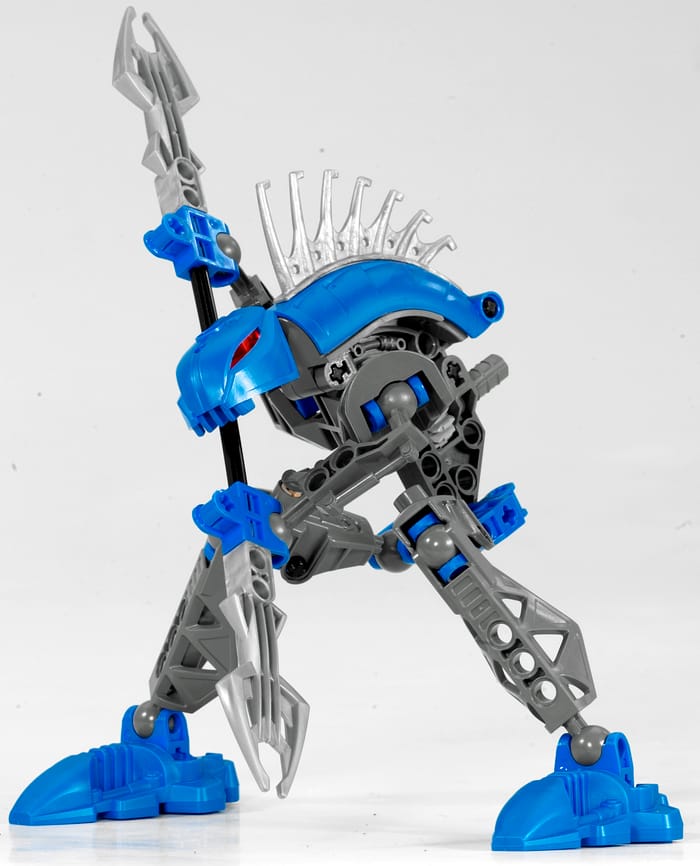
PPS: My son Max used to have some Lego Bionicle figures. These bear a striking resemblance to Epstein’s Rock Drill. In fact, some of them even have a little fetus- / slug-like creature nestled inside. A “spine-slug.”
ROCK DRILL
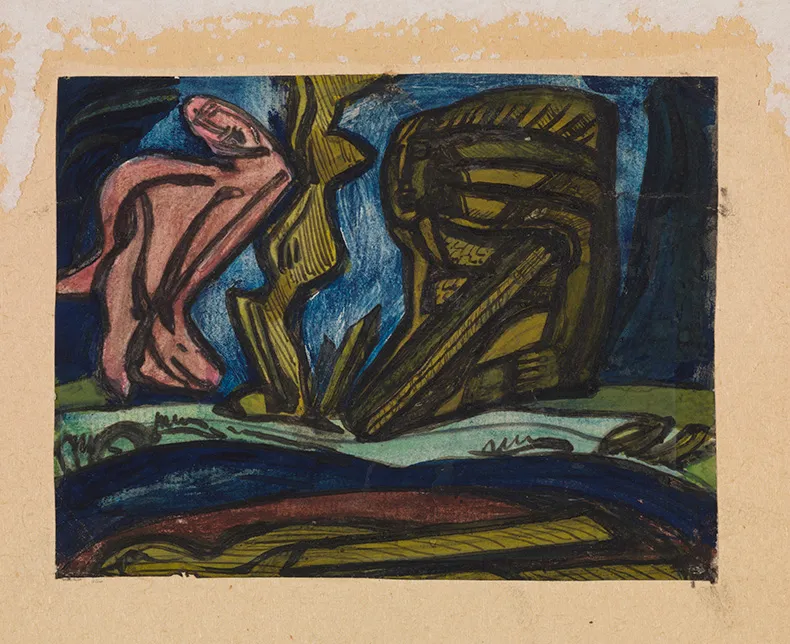
Saunders, one of only two female members of the Vorticists’ movement, also depicts a rock driller. Here we find a stylized figure, blending human and machine elements with a block-like body, engaged in a violent, phallic action. (A pink, more human-looking human, seems to suffer at left.) Was Saunders critiquing Epstein’s Rock Drill?
The other female Vorticist was Jessica Dismorr, who in 1915 published the poem “Monologue.” Excerpt:
Details of equipment delight me.
I admire my arrogant spiked tresses, the
disposition of my perpetually
foreshortened limbs,
Also the new machinery that wields the
chains of muscles fitted beneath my
close coat of skin.
On a pivot of contentment my balanced
body moves slowly.
Inquisitiveness, a butterfly, escapes.
It spins with drunken invitation. I poke my
fingers into the middles of big succulent
flowers.
Here’s Francesca Brooks on this poem:
In Rock Drill (1913) and Venus (c.1914-1915) the Vorticist, Jacob Epstein, presents us with his antithetical vision of modern man — part human, part inimitable machine, and the archetypal woman — slumped and hunched in a passive pose. In ‘Monologue’ […] Dismorr plays with these visions of the masculine and the feminine Vorticist. The female body in ‘Monologue’ is subjected to the ‘new machinery’ of Rock Drill: the poem’s subject becomes automated, mechanic, with ‘arrogant spiked tresses’ and ‘chains of muscles’, yet she also struggles with the corporeal apathy of Venus as she lies a ‘slack bag of skin’; the two corporeal identities (slack skin and chain muscle) are seemingly at impossible odds with each other. ‘Monologue’ is evidence of Dismorr’s negotiation of the gender archetypes implicit in Vorticism’s aesthetics and her struggle with their aggressively binary nature.
I SEE AGAIN IN MEMORY MY DEAR UDNIE
MACHINE TOURNEZ VITE
Francis Picabia’s obsession with machinery predated his 1913 visit to New York, but it was there that he came to view machines as the quintessential expression of the modern age — for better and worse. His so-called “machinist” period began at this point, and would last until 1922; he drew and painted many “mechanomorphs” (his term), which is to say assemblages of gears, spark plugs, and other machine parts intended to depict people and concepts. Some of these are erotic (and therefore, I guess, examples of “bachelor machines”); some are satirical; some are both. Like his fellow Dadaists, Picabia’s tendencies were counter-Enlightenment and anti-sentimentalist; thus, his depictions of humans as inexorably driven by mechanical instinct rather than reason.
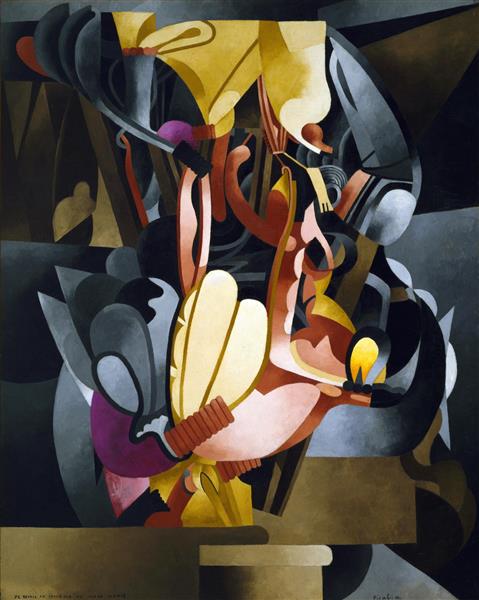
From MoMa’s website:
In this large painting, rhythm is intimated via a series of repeated, interpenetrating pistons and orifices, fusing the mechanical with the biological.
The title of this painting, which was inspired by Picabia’s memories of watching the dancer Stacia Napierkowska rehearse aboard the ship he’d taken to New York in 1913, is borrowed from the Aeneid: “Dying, he saw again in memory his dear Argos.” “Udnie” is a scrambled version of the name of French musicologist Jean d’Udine, whose 1910 theory of synesthesia connected painting, dance, and music.
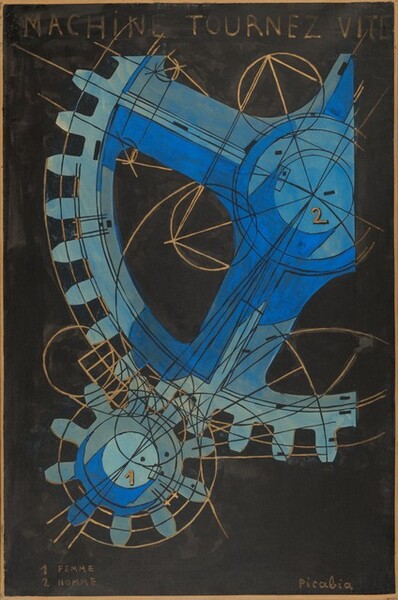
Picabia’s brush and ink painting/drawing over a 19th-century French lithograph mimics the look of a blueprint. The neatly lettered legend identifies the small gear as “woman” and the large gear as “man.” The painting’s title, meanwhile, seems to encourage the man and woman to crank more quickly in their coupling.
This painting, one feels it necessary to point out, predates e.e. cummings’ 1926 poem “ONE XXII” (she being Brand / -new;and you / know consequently a / little stiff i was / careful of her and(having / thoroughly oiled the universal / joint tested my gas felt of / her radiator made sure her springs were O. / K.)i went right to it…” etc.) by a decade.
THE SPIRIT OF OUR TIME
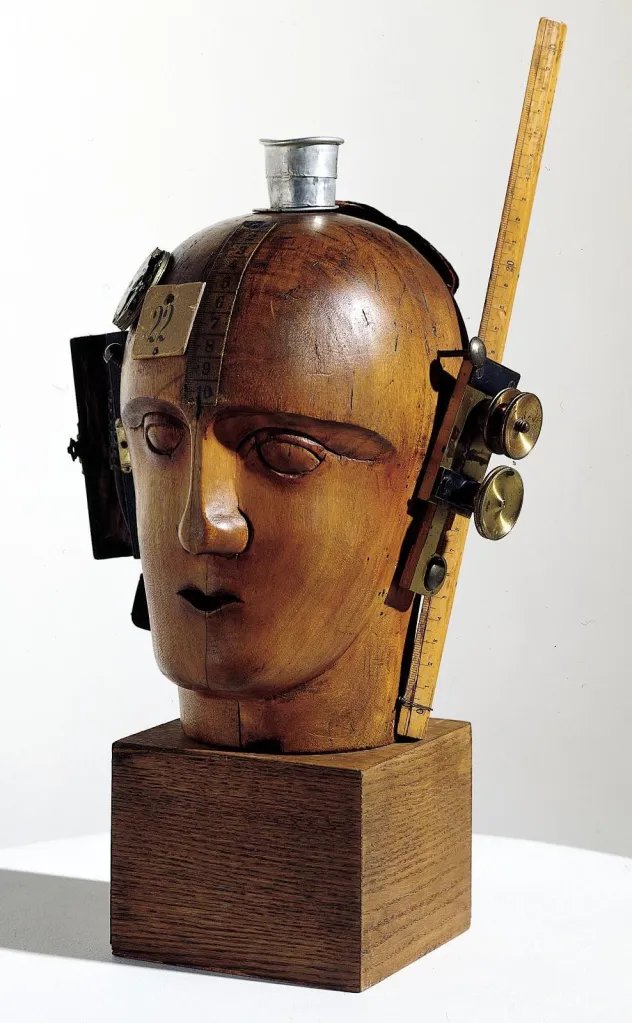
Another Dadaist artwork, this one a mannequin head adorned with measuring tools and objects. The Spirit of Our Time – Mechanical Head is widely understood as a satirical depiction of WWI-era humankind, who’ve evolved/devolved into mindless robots who process information efficiently rather than… thinking.
In 2003, writing in The Guardian, Jonathan Jones said the following about this piece:
Der Geist Unserer Zeit – Mechanischer Kopf specifically evokes the philosopher George Wilhelm Friedrich Hegel. For Hegel, whose books include Phänomenologie des Geistes (1807), everything is mind. Among Hegel’s disciples and critics was Karl Marx. Hausmann’s sculpture might be seen as an aggressively Marxist reversal of Hegel: this is a head whose “thoughts” are materially determined by objects literally fixed to it.
However, there are deeper targets in western culture that give this modern masterpiece its force. Hausmann turns inside out the notion of the head as seat of reason, an assumption that lies behind the European fascination with the portrait. He reveals a head that is penetrated and governed by brute external forces.
Hausmann’s crudely carved head, that of a tailor’s dummy, has a fantastically stupid and gloomy look, an absence of life that travesties all the great expressive faces of sculpture, from Michelangelo’s Moses to Rodin’s Thinker.
Dead of eye and moronic of mouth, the head is given identity only by the objects stuck to it: a tape measure, a wooden ruler, a tin cup, a spectacles case and a piece of metal, which could be a plate plugging the damaged skull of a soldier. If this is a “mechanical head”, the prototype for humanity become robotic, it is a crude, Frankensteinian early experiment, in which the emotions and the soul survive only as a heart shape engraved on the empty tin cup.
SELF-CONSTRUCTED LITTLE MACHINE
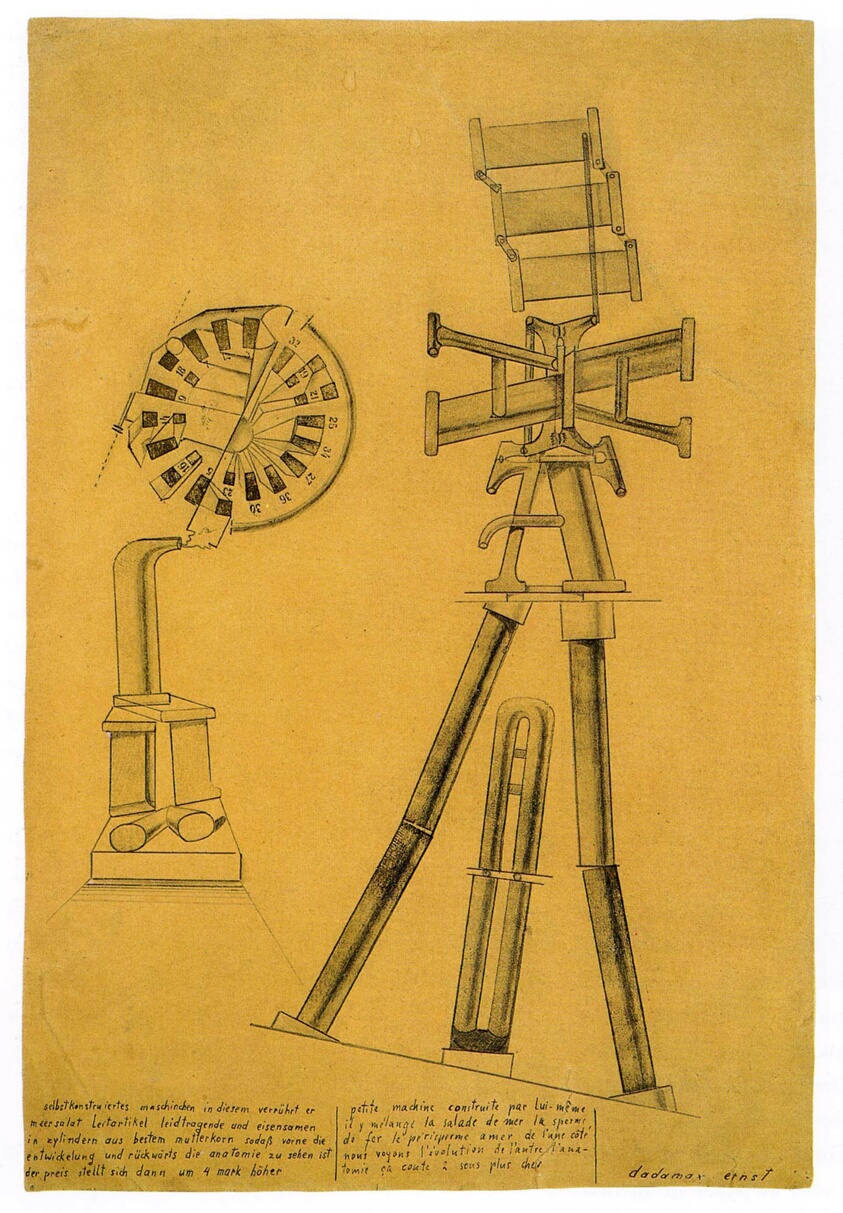
At the bottom of this Dadaist collage, Ernst has inscribed two absurdist messages:
self-constructed little machine in which he mixes sea salad, editorial mourner and iron sperm into cylinders of the best ergot so that the development can be seen in front and the anatomy in back the price is then about 4 marks higher)
and
a little machine constructed by himself in which he mixes sea salad iron sperm bitter perisperm on one side we see the evolution on the other the anatomy it costs 2 cents more
Ernst’s “self-constructed little machine” is a fragmented, hybrid creature, a humanoid figure built of found mechanical objects. Yes, this is another Dadaist “bachelor machine.”
THE NEW MAN
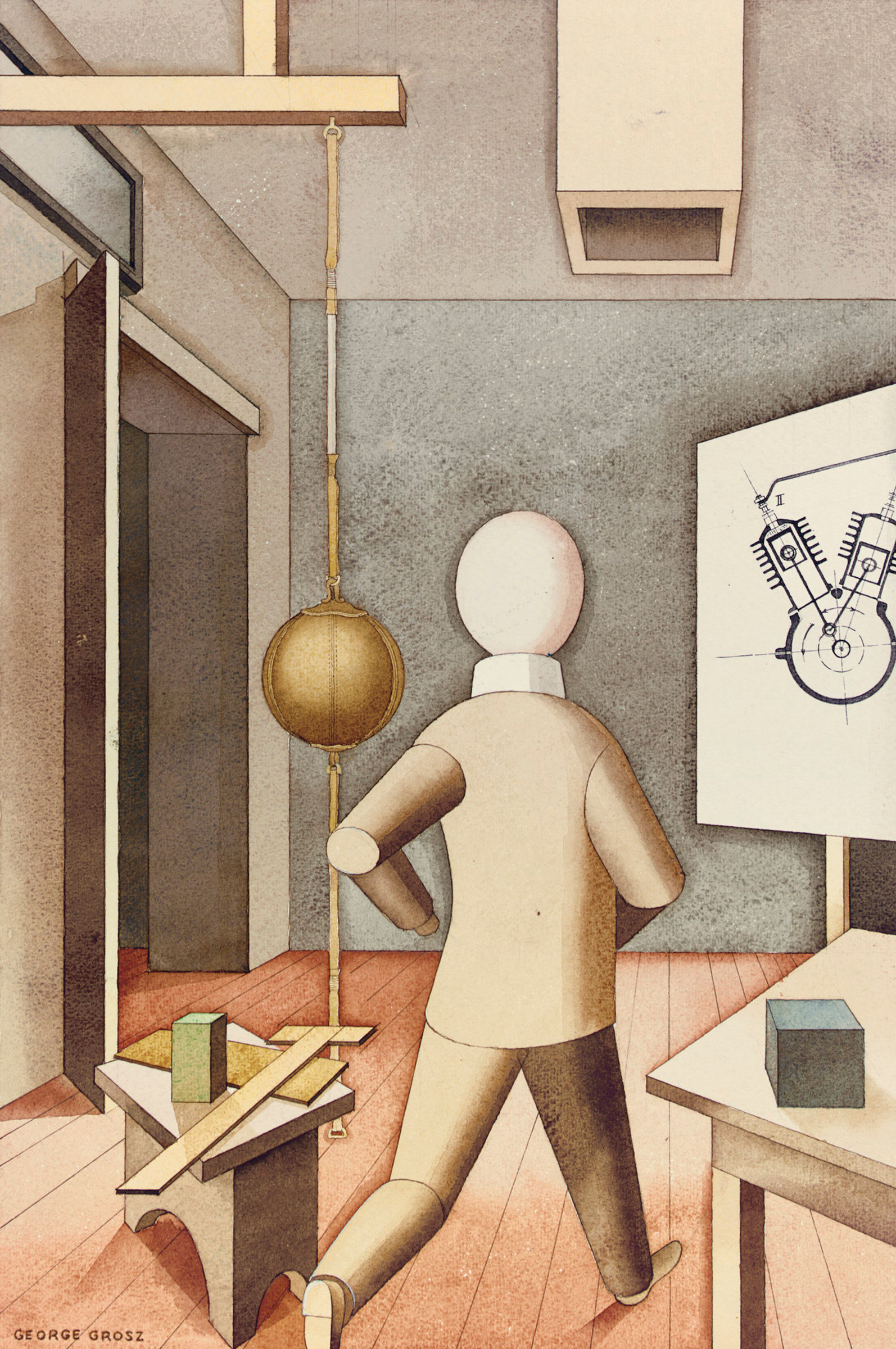
Grosz, a key member of the Berlin Dada group, here portrays a bourgeois German as a hollow, synthetic, or mechanical automaton. It’s a dystopian vision; the painting’s title echoes that of Dada cofounder Richard Huelsenbeck’s 1917 manifesto. The modern individual, supposedly sophisticated and enlightened, is in fact a puppet whose every action is determined by external forces — from capitalist greed to militarism and heartless bureaucraticism.
THE BRIDE STRIPPED BARE BY HER BACHELORS, EVEN
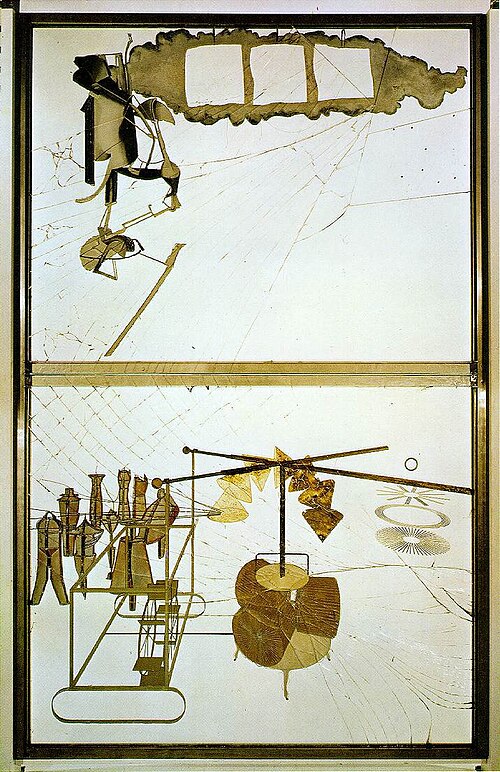
The Bride Stripped Bare by Her Bachelors has been described as a compendium of Duchamp’s artistic obsessions, from sexuality and machines to humor, chance, and the workings of pictorial illusion.
In the upper half of this work, the Bride, a mechanical yet also insectile group of geometric and tentacular forms, exudes a cloudy halo of scent. Below her, nine mannequin-like Bachelors respond to the Bride’s provocation by producing their own sexual gases — which are then processed through various mechanical devices. (We can recognize, for example, Duchamp’s chocolate grinder here — still representing automated, lonely, and unproductive sexual desire.) PS: Have the Bachelors stripped the bride bare, or does she strip herself? The artist’s use of même in the work’s title may suggest the latter.
MECHANISM
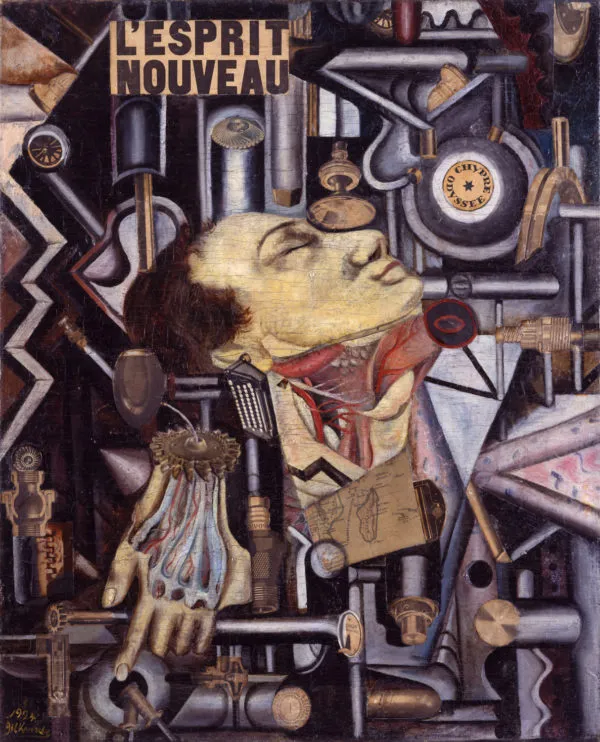
Kawabe Masahisa was a pioneering Japanese avant-garde artist who played a crucial role in the development of modernism and collage techniques in 1920s Japan. “Mekanizumu” is a mixed-media collage that deploys a cyborg-like human head fused with mechanical parts to explore the impact of rapid industrialization and modernization on the human body and identity.
From the IAFOR website:
The artist Kawabe Masahisa (1901–1990) depicted a human head surrounded by various machinery in his 1924 work Mekanizumu (“Mechanism”). The functions of the tools, pipes, screws, bolts and gears are difficult to guess, as one’s perception is limited and thus not able to contextualize the individual elements. The cold and grey-colored impression of the machinery is placed in contrast to the skin-coloured head of the human and the red of his dissected throat. The human parts blend almost naturally with the mechanical surroundings and vanish gradually while screws and gears are being assembled around them.
I don’t know anything about the 1920s Japanese machine age art movement, nor associated artists like Murayama Tomoyoshi. I need to learn more!
Josh Glenn’s EMANATIONS series includes the following installments: CATASTROPHE: DECLINE & FALL | DYING EARTH | ECO-CATASTROPHE. COSMIC AWE: DEEP TIME | STARS WHEEL IN PURPLE | IS THERE LIFE ON MARS. DEHUMANIZATION: CYBORG MANIFESTO | MECHANIZATION. & many others.
MORE RADIUM AGE SCI FI ON HILOBROW: RADIUM AGE SERIES from THE MIT PRESS: In-depth info on each book in the series; a sneak peek at what’s coming in the months ahead; the secret identity of the series’ advisory panel; and more. | RADIUM AGE: TIMELINE: Notes on proto-sf publications and related events from 1900–1935. | RADIUM AGE POETRY: Proto-sf and science-related poetry from 1900–1935. | RADIUM AGE ART: Proto-sf and science-related fine art from 1900–1935. | RADIUM AGE 100: A list (now somewhat outdated) of Josh’s 100 favorite proto-sf novels from the genre’s emergent Radium Age | SISTERS OF THE RADIUM AGE: A resource compiled by Lisa Yaszek.