
STARS WHEEL IN PURPLE
By:
June 7, 2026
An installment in EMANATIONS, a series of posts featuring 10 of Josh Glenn’s favorite examples of Radium Age-era fine art that explore a particular proto-sf-adjacent theme. In this case, that theme is COSMIC AWE. The sub-theme, meanwhile, is…
My moniker for this sub-theme is borrowed from a 1931 poem by H.D. that reads, in part: “Stars wheel in purple, yours is not so rare / as Hesperus, nor yet so great a star / as bright Aldeboran or Sirius.”
SUN, MOON, SIMULTANEOUS 1
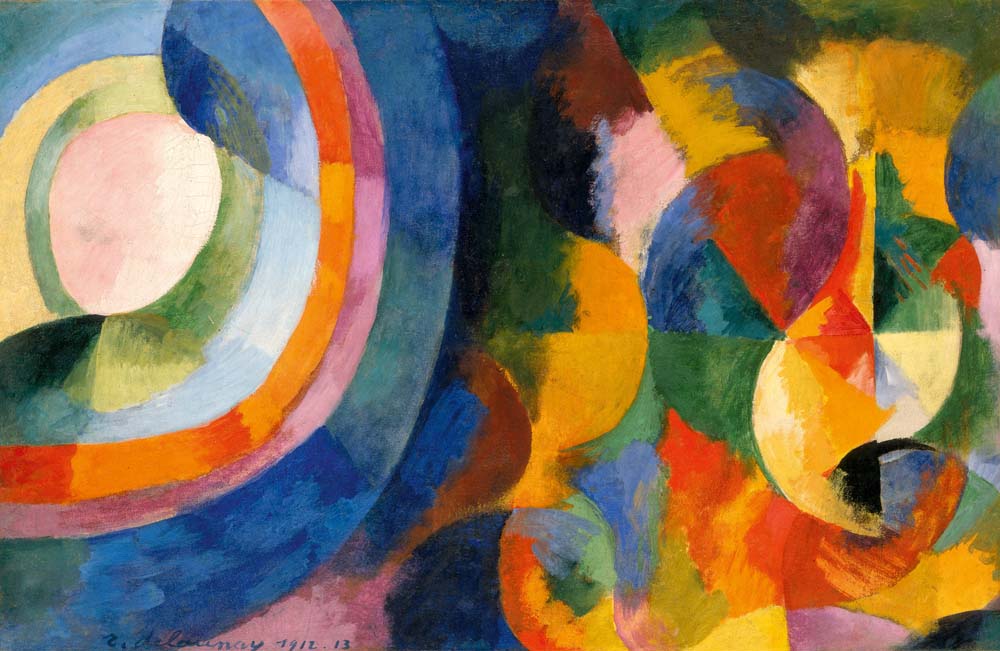
Robert Delaunay’s spiritual beliefs were rooted in a mystical interpretation of color and light. Though he shared the abstract interests of artists like Kandinsky — who was deeply influenced by Theosophy — Delaunay’s approach was more grounded in scientific color theory, specifically the “simultaneous contrast” ideas of Michel Eugène Chevreul. He transformed these scientific observations into a mystical framework where color became a “thing in itself” with its own expressive power. He believed that art could reveal a hidden universal harmony through the interaction of colors — a concept that he and his wife, the equally talented Sonia Delaunay, called Simultaneity.
In 1913 Delaunay adopted the sun and moon as abstract symbols of enlightenment, first opposed and then merging into a single, multi-colored disk. In art works such as the one shown here, which suggests the rhythmic movement of the cosmos, he deployed the primary colors together with their complements. Pepe Karmel suggests that Delaunay’s goal seems to have been “spiritual seduction, leading the viewer through color towards divine light.” The circular frame and swirling forms represent the universe, with the “sun” and “moon” suggested by opposing intensities of light.
PLANET MERCURY PASSING IN FRONT OF THE SUN
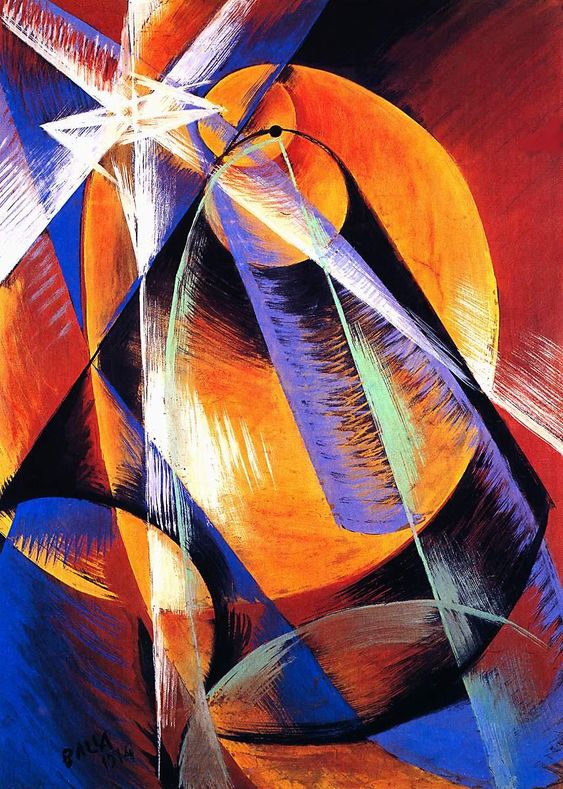
Balla’s hobby as an amateur astronomer influenced at least some of his fellow Futurist artists to shift their focus from urban “machinism” to the vaster forces of nature — and what Balla called the “deepest essence of the universe.”
This painting depicts the transit of Mercury — when that planet passes directly between the Sun and Earth, appearing as a tiny black dot crossing the solar disk — that took place in 1914. Balla’s goal was to represent the view through a telescope (magnified and filtered) and simultaneously the view with the naked eye. The sun is represented here (at least) three times: as a large orange sphere, and as two overlapping smaller spheres. Mercury appears as a black dot traveling on a curved path across the smallest of the sun-forms.
PS: Alongside Fortunato Depero, in 1915 Balla would co-sign the “Futurist Reconstruction of the Universe” manifesto. Excerpt:
We will give skeleton and flesh to the invisible, the impalpable, the imponderable and the imperceptible. We will find abstract equivalents for all the forms and elements of the universe, and then we will combine them according to the caprice of our inspiration, to shape plastic complexes which we will set in motion.
PS: Lest it seem as though I am advocating for Balla’s worldview in its entirety, I should note that there are several truly abhorrent aspects — including but not confined to aggressive elitism, militant nationalism, a giddy eagerness for global warfare, and a demand to dissolve boundaries between art and extreme politics — of the otherwise compelling manifesto quoted here.
ASTRAL RHYTHMS
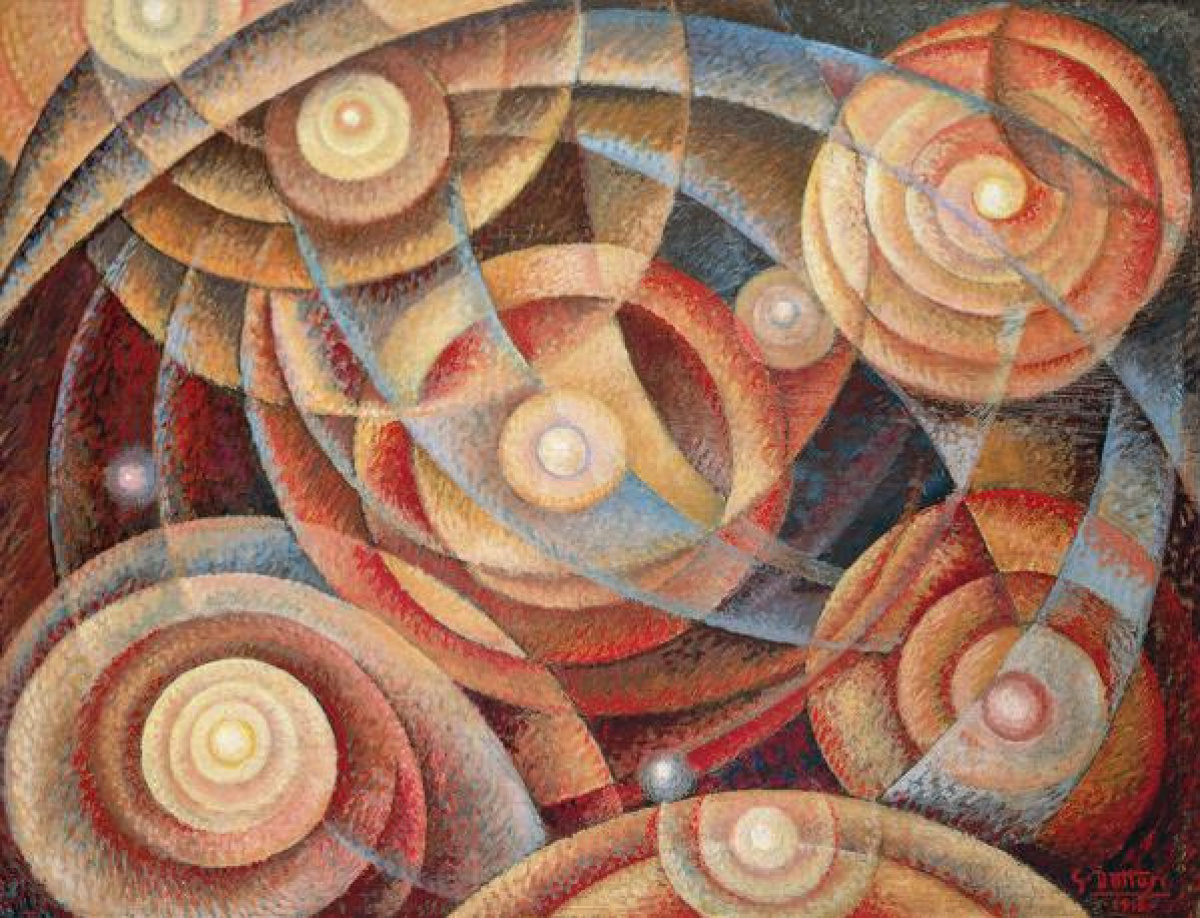
Using a vibrant palette and swirling, rhythmic forms, the Futurist Dottori attempts to convey the rhythmic movement of celestial bodies and the energy of the cosmos. This abstract painting illustrates the Futurists’ obsession with speed, energy, and the “vortex” of modern life… while projecting those concepts onto a kind of astral plane.
This could also be categorized as DIAGRAMMATIC SUBLIME.
ROAR OF SPACE
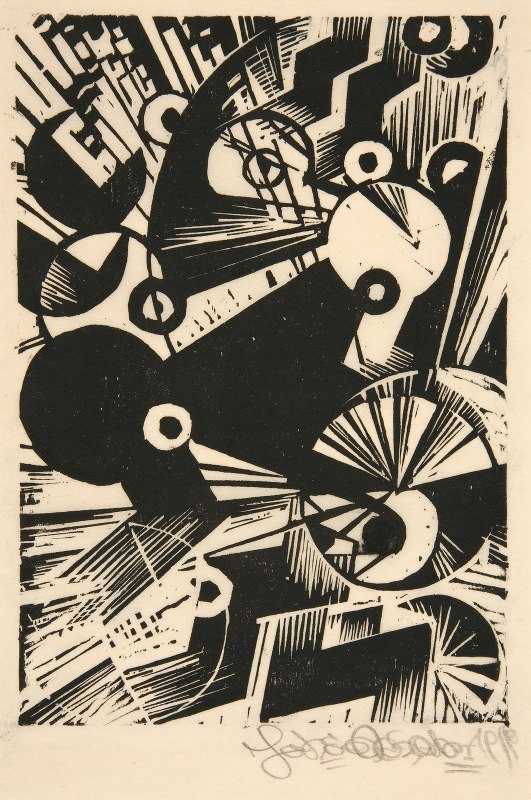
Molzahn, a German artist associated with Expressionism, Cubism, Futurism, and later, Constructivism, has been called a “forgotten architect of abstraction.” In 1919, Molzahn published a “Manifesto of Absolute Expressionism,” which argues that art should act as a symbol for a grander cosmic force. In this woodcut print, using geometric, abstract forms he portrays the universe as a dynamic, vibrating entity — a massive, precise dynamo of sorts — rather than a static void.
THE NEW PLANET
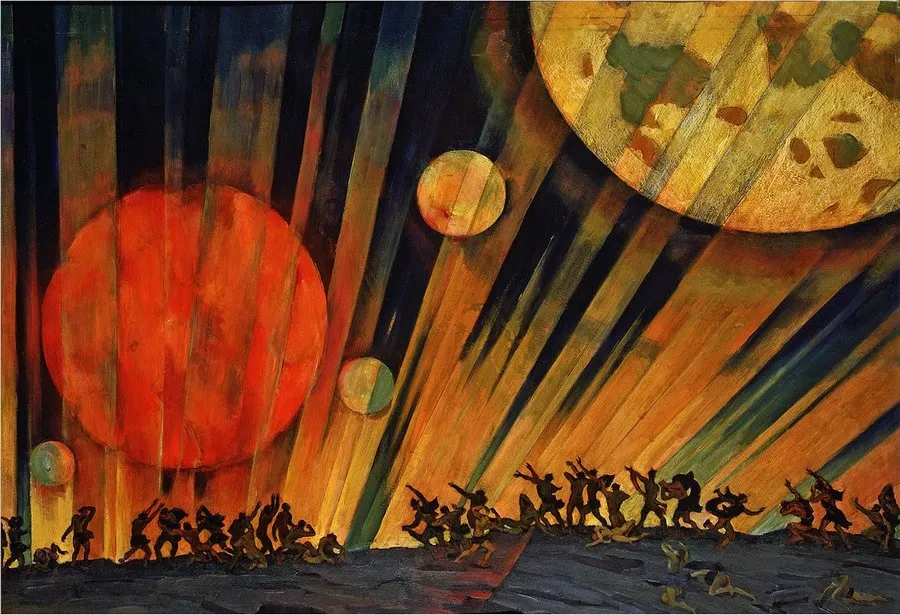
In this allegorical painting, the artist, a Russian painter associated with the avant-garde movement Mir Iskusstva, depicts a massive, glowing red planet rising into the sky, accompanied by celebratory beams of light. The artist was also a theatre designer (Sergei Diaghilev was editor of Mir Iskusstva’s eponymous magazine); and the painting — which is surely intended to put us in mind of the xenon searchlights outside a theater on a play or movie’s opening night — began as a sketch for a stage curtain at the Bolshoi. The 1917 October Revolution is compared to a cosmic event; the tiny people witnessing the birth of the new Soviet society react with awe and delight.
One can also find a dark side to this painting, though. Some of the figures are not celebrating but falling, dead, or fleeing in terror. Whether you welcome or abhor the revolution, you’re forced to acknowledge that its triumph comes at an immense human cost.
TWO WORLDS
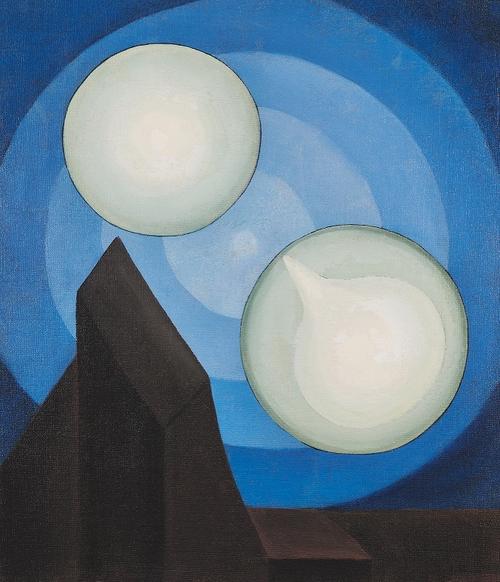
Like many of her contemporaries in the Transcendental Painting Group, an artist collective established in Taos (NM), some years after this painting was created, whose shared goal was to depict “imaginative realms that are idealistic and spiritual,” the Canadian artist Henrietta Shore was inspired by Theosophy and Kandinsky.
Two Worlds aims to evoke in viewers a sense of “cosmic awe” — i.e., that profound sense of wonder, transcendence, and self-diminishment/dissolution one experiences when confronted by the immense vastness of the universe. As the title suggests, Shore was also concerned with depicting the rhythmic harmony that exists (or so she and others believe) between realms or “spheres” of existence, such as the inner and outer world, say, or the Light and the Dark. Compare, in this respect, with Delauney’s “Soleil, lune, simultané 1” (1913) above.
ORBITAL TRAJECTORY OF A PLANET HURTLING TOWARD THE SUN
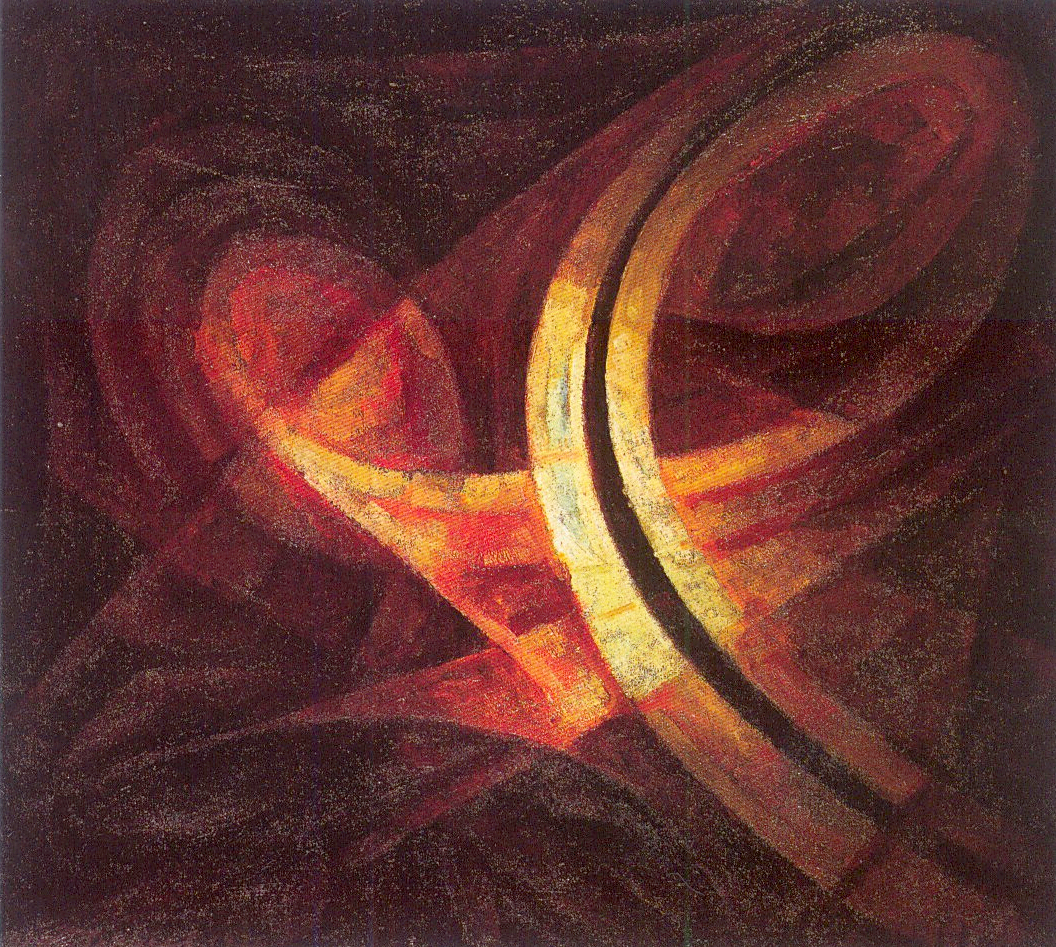
Ivan Kudriashev was a painter, graphic artist, theatrical designer, and interior designer; he was a student of Kazimir Malevich, who in 1915 developed Suprematism, a radical abstract art movement that reduced art to fundamental geometric shapes in search of the “supremacy of pure feeling” over objective reality. Ivan’s father, Alexei, meanwhile, was a carpenter who worked as a model-maker for the pioneering aerospace engineer Konstantin Tsiolkovsky (aka the “father of cosmonautics”). From 1918 on, under the influence of Tsiolkovsky’s innovative theories on space exploration and rocket physics, Ivan turned to the problems of cosmic abstract painting — as filtered through Suprematism. His so-called Space series, one reads, represents a mode of “interplanetary-dynamic abstraction.” Which is to say that unlike pure Suprematism, which was non-representational, Kudriashev’s Space series explored the physical mechanics of the universe.
“Orbital Trajectory of a Planet Hurtling Toward the Sun” uses bold, tilted geometric structures to convey the energy of a planet’s movement through space. And it deploys a “cross-section of colors” to represent celestial phenomena that were, at the time, still theoretical. An effort to give visionary form to the imperceptible.
DEEPENED IMPULSE
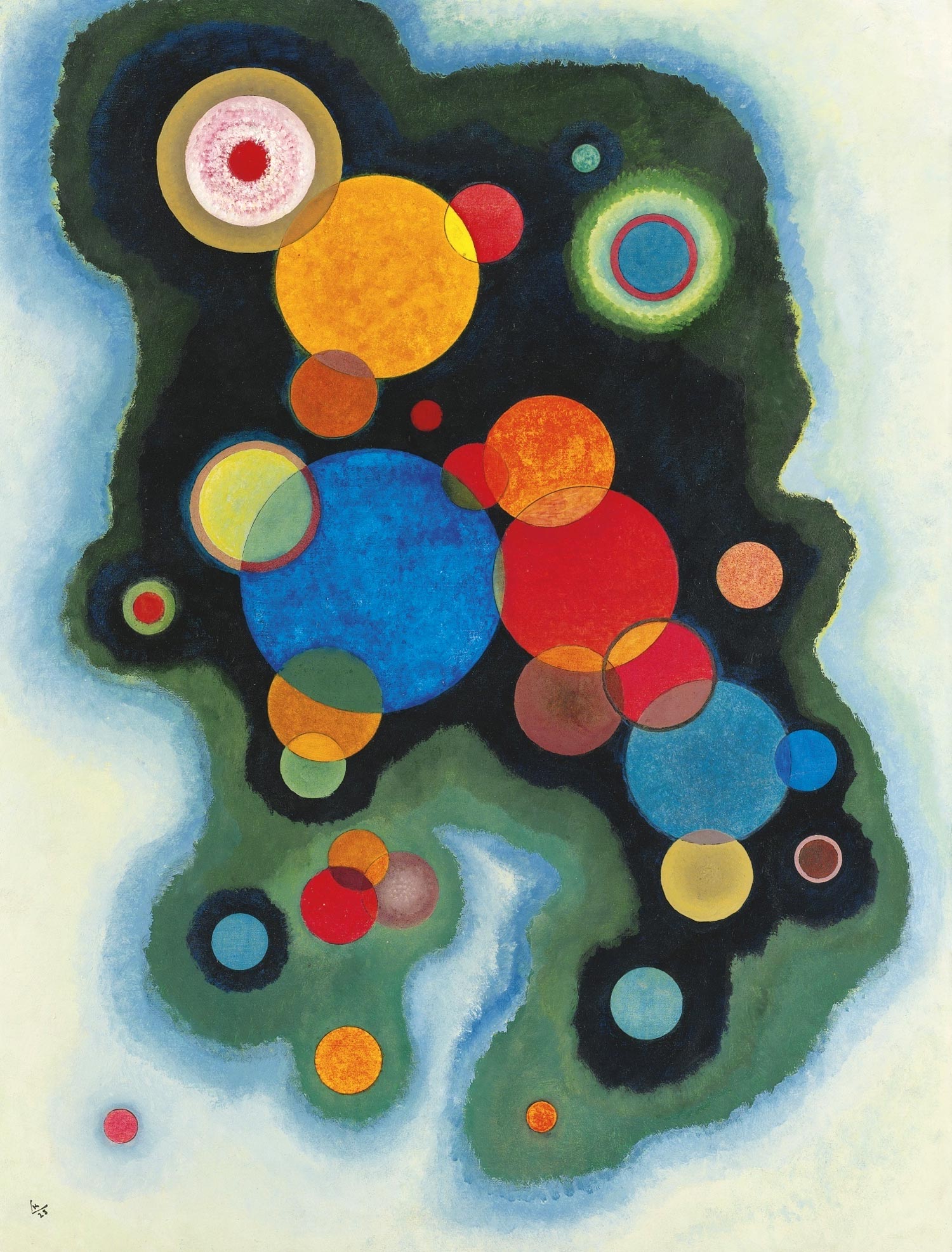
Kandinsky’s work became more intellectually sophisticated and analytical during his tenure at the Bauhaus (1922–1933), during which time he shifted from lyrical abstraction to geometric abstraction. He remained deeply interested in Theosophy and Eastern Mysticism, and in mathematics. He thus viewed the fourth dimension not merely as a mathematical or spatial concept, but as a crucial, mystical, and spiritual realm that art could access. Even as the world became increasingly materialistic, the fourth dimension represented a “hidden, universal reality” beneath the surface, to which abstract art — specifically via geometric forms like the circle — could provide a gateway. My favorite Kandinsky paintings are resonant meditations on the spiritual / mathematical power of the circle form.
Deepened Impulse, which features spherical shapes floating against a dark, expansive background, is often interpreted as a representation of the cosmos. The nebulae-like washes of color around the shapes evoke energy, motion, and the “music of the spheres.” Here Kandinsky attempts to replace merely 3D, “materialistic” representation with a 4D, “spiritual” experience.
STAR GAZER
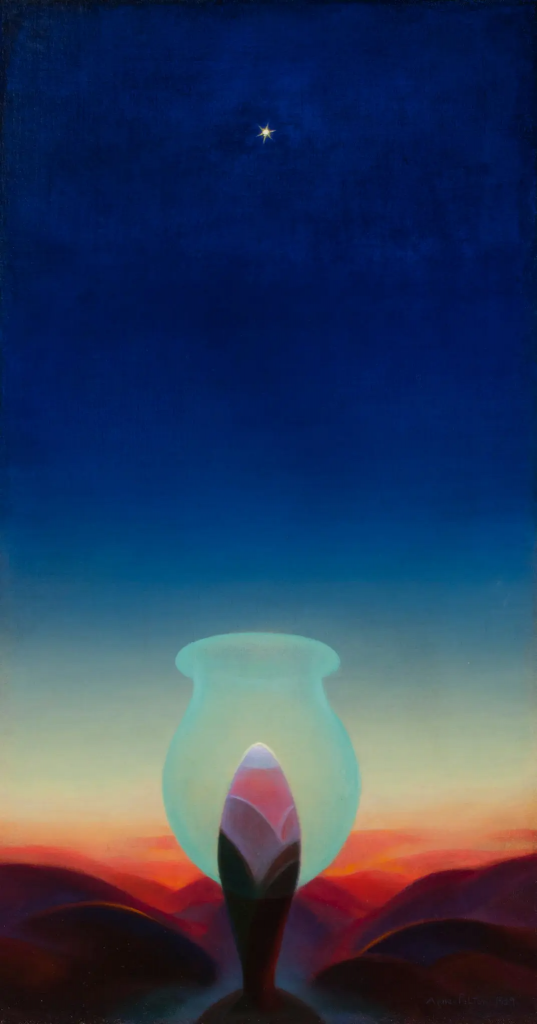
As a founding member of the Transcendental Painting Group (mentioned above), Pelton aimed to use color and form to carry art “beyond the appearance of the physical world.” Created shortly after Pelton first began visiting the California desert, Star Gazer reflects the artist’s deep interest in Theosophy and the “cosmic communion” between the spiritual and celestial realms. At the center of the painting, a multicolored bud or lotus-like flower sits before an azure vessel — representing a human pilgrim ready to receive heavenly inspiration.
A single, luminous star sits at the apex of the composition, guiding the pilgrim toward a higher plane of consciousness.
THE PLANET
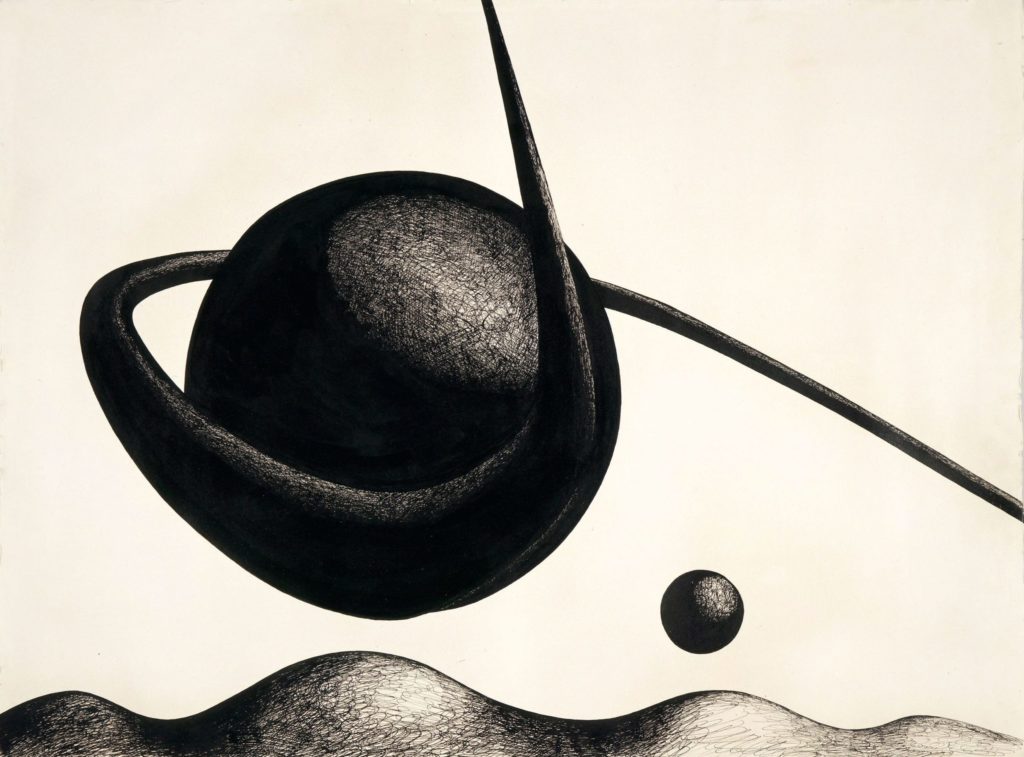
Calder’s fascination with astronomy stemmed from a desire to represent the cosmos as a dynamic, interconnected system. This desire, one hears, was influenced by a 1922 experience in which — while traveling on a ship off Guatemala, he woke on deck to see a fiery red sunrise on one side and the moon as a silver coin on the other. He’d often cite such “detached bodies floating in space” as the ideal source for his subsequent art forms. He used kinetic mobiles and “universes” to capture the delicate, balanced, and energetic nature of space, thus translating Einsteinian physics into art.
In the early ’30s, Calder’s work underwent a profound transformation, shifting from figurative wire sculptures and the Cirque Calder toward pure abstraction and kinetic art. In 1934, he’d begin creating his first outdoor works, experimenting with larger, more durable, and industrially produced sheet metal. This ink drawing — which reminds me of a subsequent artist, Edward Gorey — was produced just before that turning point in his career.
Josh Glenn’s EMANATIONS series includes the following installments: CATASTROPHE: DECLINE & FALL | DYING EARTH | ECO-CATASTROPHE. COSMIC AWE: DEEP TIME | STARS WHEEL IN PURPLE | IS THERE LIFE ON MARS. DEHUMANIZATION: CYBORG MANIFESTO | MECHANIZATION. & many others.
MORE RADIUM AGE SCI FI ON HILOBROW: RADIUM AGE SERIES from THE MIT PRESS: In-depth info on each book in the series; a sneak peek at what’s coming in the months ahead; the secret identity of the series’ advisory panel; and more. | RADIUM AGE: TIMELINE: Notes on proto-sf publications and related events from 1900–1935. | RADIUM AGE POETRY: Proto-sf and science-related poetry from 1900–1935. | RADIUM AGE ART: Proto-sf and science-related fine art from 1900–1935. | RADIUM AGE 100: A list (now somewhat outdated) of Josh’s 100 favorite proto-sf novels from the genre’s emergent Radium Age | SISTERS OF THE RADIUM AGE: A resource compiled by Lisa Yaszek.