
SCIENCE FANTASY
By:
September 20, 2026
An installment in EMANATIONS, a series of posts featuring 10 of Josh Glenn’s favorite examples of Radium Age-era fine art that explore a particular proto-sf-adjacent theme. In this case, that theme is DISENCHANTMENT / UNSEEN FORCES. The sub-theme, meanwhile, is…
Science fantasy is a mixed fiction genre that may combine elements of both science fiction (like spaceships, robots, and futuristic settings) and fantasy (like magic, mythical creatures, and supernatural forces).
During the so-called Golden Age of Science Fiction, science fantasy stories were to some extent marginalized, in the pages of science fiction magazines, in favor of (supposedly) scientifically plausible material. That said, works of fantasy in which magic is revealed to have a natural scientific basis were not particularly rare during the so-called Golden Age. L Sprague de Camp and Fletcher Pratt (cf. The Mathematics of Magic, 1940) , Jack Vance, C L Moore, Henry Kuttner, Leigh Brackett, Poul Anderson — they would all write Golden Age science fantasy that I think holds up pretty well.
During the Radium Age, there wasn’t any hard-and-fast distinction between “science fiction” (a term that wasn’t popularized until 1929) and “science fantasy.” There is a fantasy element in much proto-sf writing from this era. Most of the big names — William Hope Hodgson, H.P. Lovecraft, Clark Ashton Smith, Robert E. Howard, Edgar Rice Burroughs — tried their hand at science fantasy. A. Merritt’s The Face in the Abyss (1929/31) was an extraordinarily popular work of science fantasy. In fact, the term “science fantasy” wasn’t coined until 1935 — i.e., at the very end of the Radium Age — by Forrest J. Ackerman. Marion Zimmer Bradley would help popularize it in the ’40s.
THE BLACK SUN
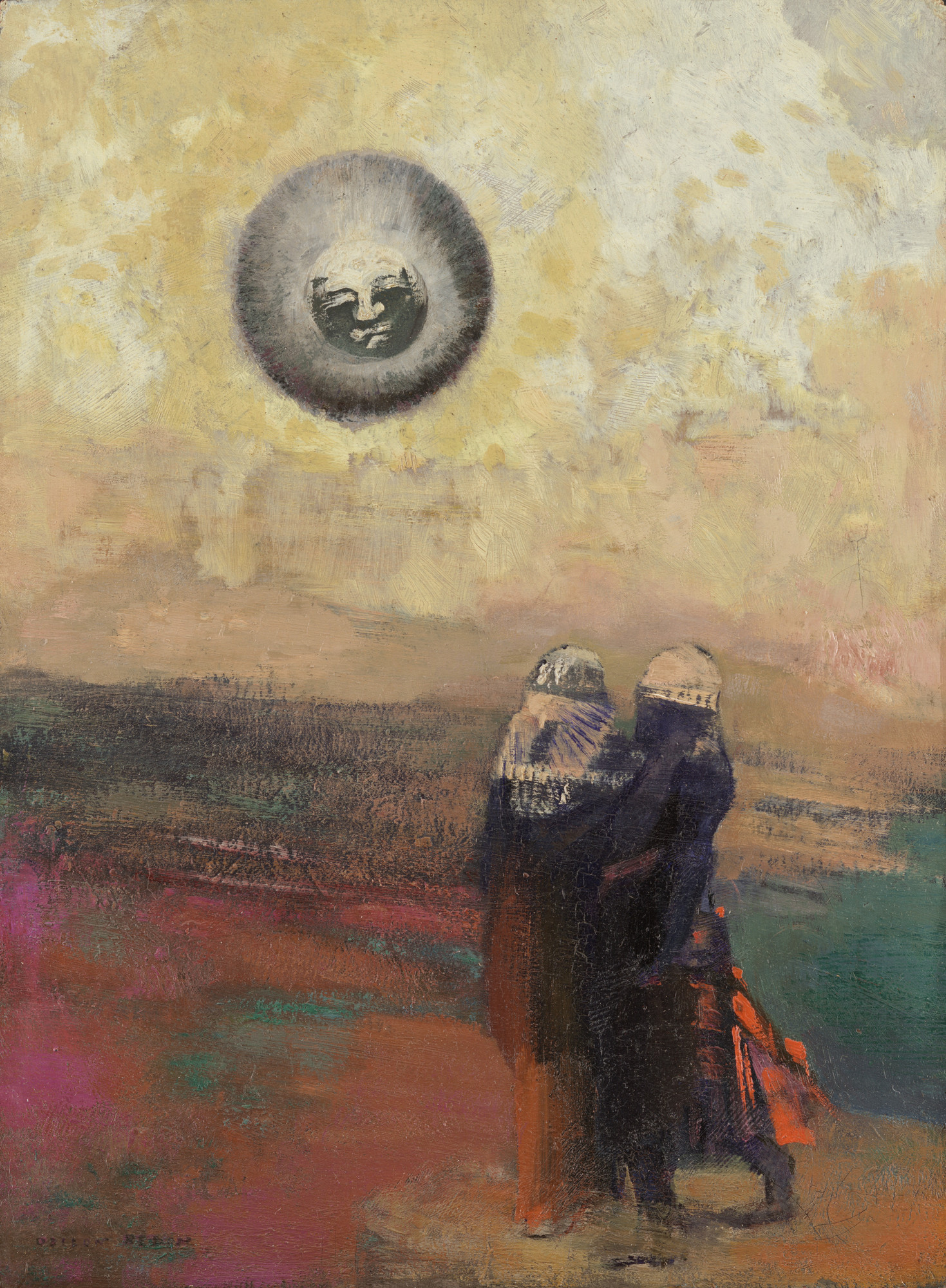
Via his drawings and paintings, Redon engaged with everything from new technologies for studying microbes to developments in astronomy and the popularization of evolution. Scientific breakthroughs of the late 19th and early 20th century demanded that we embrace continuous change and uncertainty. Redon’s art is concerned, or so we read in Kristian Moen’s 2013 treatise Film and Fairy Tales: The Birth of Modern Fantasy, with “making the unreal real and the invisible visible.” As Redon himself put it, the goal was “placing the logic of the visible, insofar as is possible, at the service of the invisible.” A fine way to describe science fantasy.
Like some of the Radium Age proto-sf authors named above, Redon seeks to create a startling contrast between realistic — even scientific — ratiocination and depictions, on the one hand, and far-out fantastical notions on the other. His work isn’t pure imagination, Redon would insist, but rather: imagination depicted via the “attentive reproduction of the objects of external nature in her tiniest, most particular and most accidental aspects.”
Remy de Gourmont’s described Redon’s work as a brilliant exercise in “imaginative logic”; one hears that Redon was pleased with this turn of phrase — another perfectly fine way to describe science fantasy.
During the second half of the 19th century, the establishment of the law of conservation of energy led scientists like Lord Kelvin to propose that the Sun operates as a cooling fireball with a limited lifespan of tens of millions of years. Redon’s The Black Sun, we read in Moen’s book, emerges from this sort of scientific context — i.e., in which “stars could no longer be thought of as glittering ornaments pinned on the ark walls of the firmament, but had to be reconceived as changing, moving, dying, or originating in the ongoing panoramic drama of the cosmos.”
PS: The couple in the bleak landscape, gazing up at the dying sun, might almost be wearing helmets / breathing apparatuses. One is reminded of George C. Wallis’ 1901 proto-sf story “The Last Days of Earth,” a story set in 13,000,086 CE — almost everyone on the dying planet having expired except for a man and his wife.
AN ASPIRATION TO ENFOLD ALL
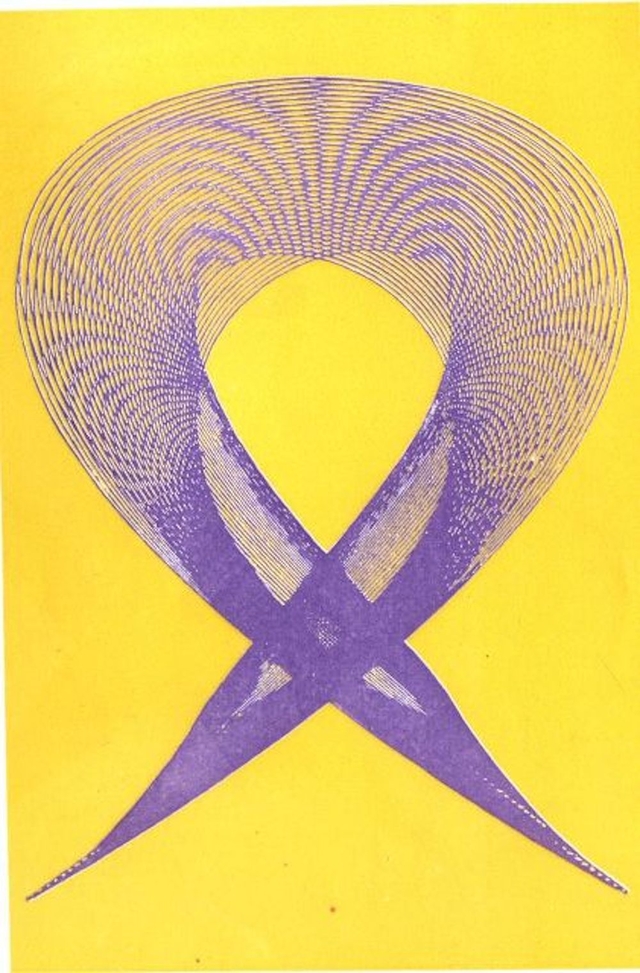
From Besant and Leadbeater’s 1901 book Thought-Forms. In which the authors explore the spiritual / supersensible “vibrations” of ideas, emotions, and sounds via visual forms. In their introduction to the book, the authors exult that Curie’s discovery of radium and Röntgen’s X-ray photos have “revolutionized the concept of matter and are leading science into the astral world.” Occult notions of “astral sight” or “four-dimensional vision” — which surpass the merely material, illusory world of the senses and give access to permanent transcendental realities — were now, occultists and psychical researchers claimed, scientifically proven.
Theosophists believe there to be several “planes of existence” (the astral plane is one of them), each characterized by particular rates of vibrational energy. Though imperceptible to the untrained eye or ear, the vibrations of one’s thoughts and feelings manifest as various shapes, colors, and sounds that can be “read” — surfaced and dimensionalized — by the initiated.
Thought-Forms, which encourages visual artists to “move far beyond the limiting Kantian categories of time, space and causality, and to act as a conduits conveying spiritual insight to the viewer, circulated widely among artists in the first decades of the twentieth century. Blavatasky’s “greatest influence may have been on [non-representational / abstract modernist] art,” Gauri Viswanathan writes, “rather than the history of ideas.”
THE BLACK IDOL
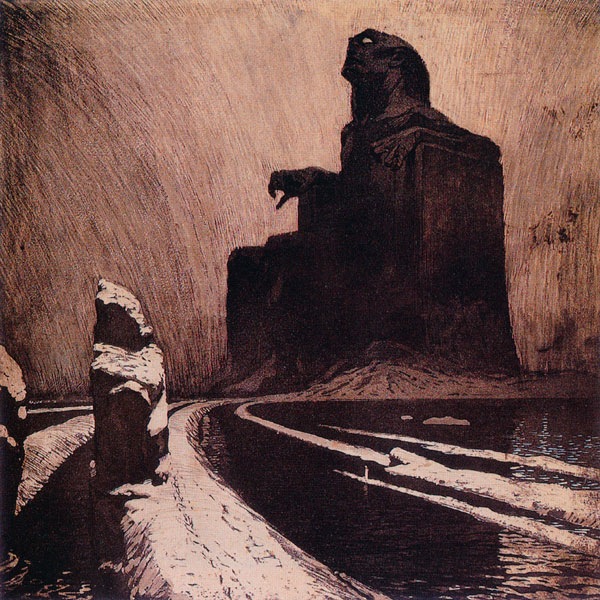
“By a route obscure and lonely, / Haunted by ill angels only,” we read in Edgar Allan Poe’s 1844 poem “Dream-Land,” one of his most famous:
Where an Eidolon, named NIGHT,
On a black throne reigns upright,
I have reached these lands but newly
From an ultimate dim Thule —
From a wild weird clime that lieth, sublime,
Out of SPACE — Out of TIME.
Resistance is part of Kupka’s four-part Symbolist cycle The Way of Silence — which was inspired by Poe’s “Dream-Land,” as well as by theosophical concepts of invisible astral forces, cosmic hierarchies, and the eternal spiritual struggle of human consciousness. (Theosophy is Science Fantasy.) This particular art work suggests a spiritual journey through a desolate landscape; the colossal sphinx-headed statue is an eidolon. That is to say, it’s an idealized form… in this case, it seems to represent humankind’s defiant struggle against the vast, crushing forces of eternity.
PYRAMIDS (ALLEGRO)
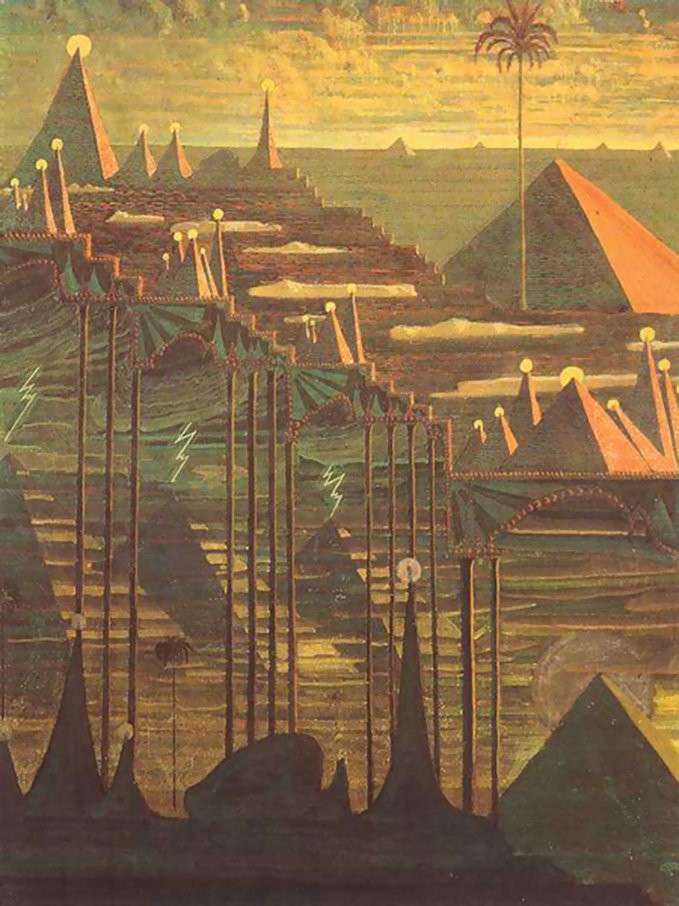
Čiurlionis’ three-part series (the lively “Allegro,” the more tranquil “Andante,” and th emore playful “Scherzo”) titled Sonata of the Pyramids is — like much fantasy and science fantasy from this era — Orientalist. It invites us to marvel at the obscure and supposedly mystical ancient culture and knowledge of — in this case — Egypt.
Like his fellow Theosophists, Čiurlionis believed in reincarnation and the pre-existence of human souls. (To his muse and future wife, Sofija, he wrote that “our beginning is somewhere in the infinity before all ages”… and that “a very long time ago, and definitely not once, we have already changed our form.”) In occult circles, Egypts pyramids were places where one can experience the intervention of higher cosmic powers, which — among other things — prepares one for eventual reincarnation.
Isn’t this simply Fantasy, you ask? Take a closer look… at the fantastic, modernistic buildings that coexist, in Čiurlionis’s version of Egypt, with the pyramids. Some of which apparently attract and conduct electricity from lightning bolts…
EVOLUTION
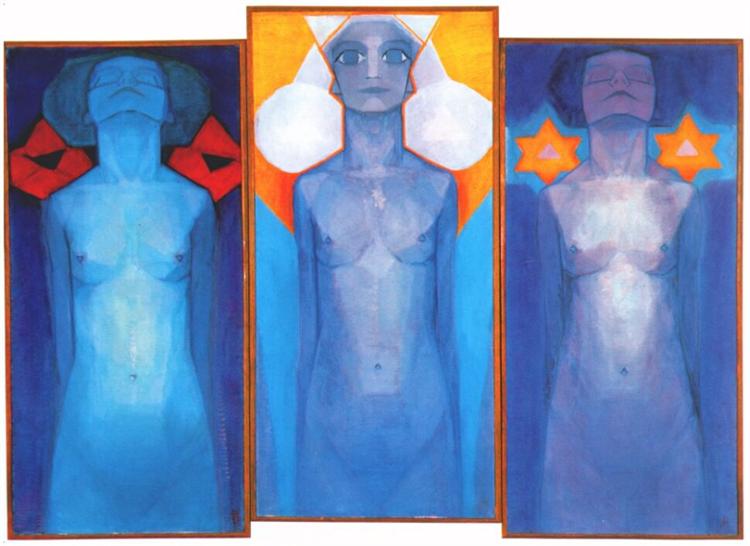
Evolution was still actively debated and undergoing scientific re-evaluation in the 1910s, setting the stage for the major anti-evolution crusades of the 1920s. But Mondrian’s painting is about spiritual evolution. He’d joined the Theosophical Society in 1909; influenced by Blavatsky and Steiner, he thought / hoped humanity was evolving toward a higher spiritual awareness… and believed that art could reveal the hidden, harmonious structure connecting all life.
In 1911 Mondrian viewed a modernist art exhibition in Amsterdam that included the works of Cézanne, Picasso, and Braque. He would relocate to Paris before the end of the year. Evolution is Mondrian’s final painting to feature a recognizable human form before he transitioned away from Symbolism and entirely into abstraction. ( As he later stated, to approach the spiritual in art, one must make as little use of reality as possible.)
According to Robert Welsh’s essay “Mondrian and Theosophy” (in The Spiritual Image in Modern Art), the blue and yellow colors used here are astral “shells or radiations” of the figures. It’s also been suggested that Evolution depicts a single person undergoing spiritual initiation — first on the left (matter), then the right (soul), and finally to center figure (spirit).
THE SPELL IS BROKEN
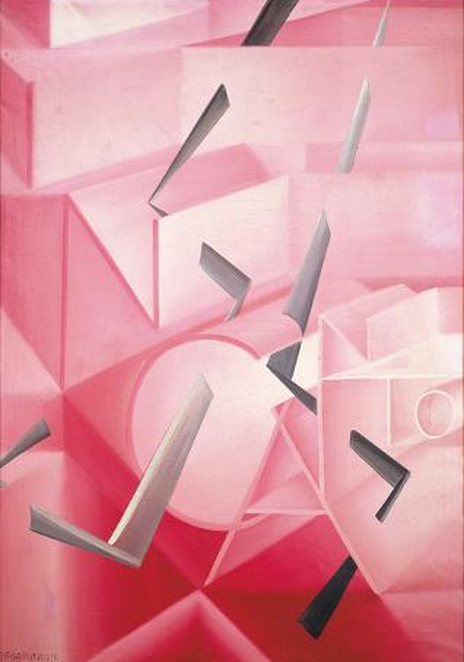
Geometric forms — which spell (from top left to bottom right) incanto [spell / enchantment] — rendered in shades of pink and red suggest, perhaps, the interior of a modern person’s brain. Which is under the spell, or so Balla and the Italian Futurists believed (with Nietzsche), of tradition, nostalgia, and a paralyzing fixation on the historical past. Marinetti’s manifestos described Italy’s obsession with its own classical art, ruins, and museums as a hypnotic poison.
This static, enchanted state of mind is interrupted by… something. Whatever the slightly curved yet sharply angular grey shapes are supposed to represent. The violent, beautiful velocity of the machine age itself, one assumes. Or one of the age’s instantiations: industrial speed, technological integration, or even warfare, which the proto-fascist Marinetti infamously hailed as the world’s “only hygiene.”
TRIUMPH OF THE EGG
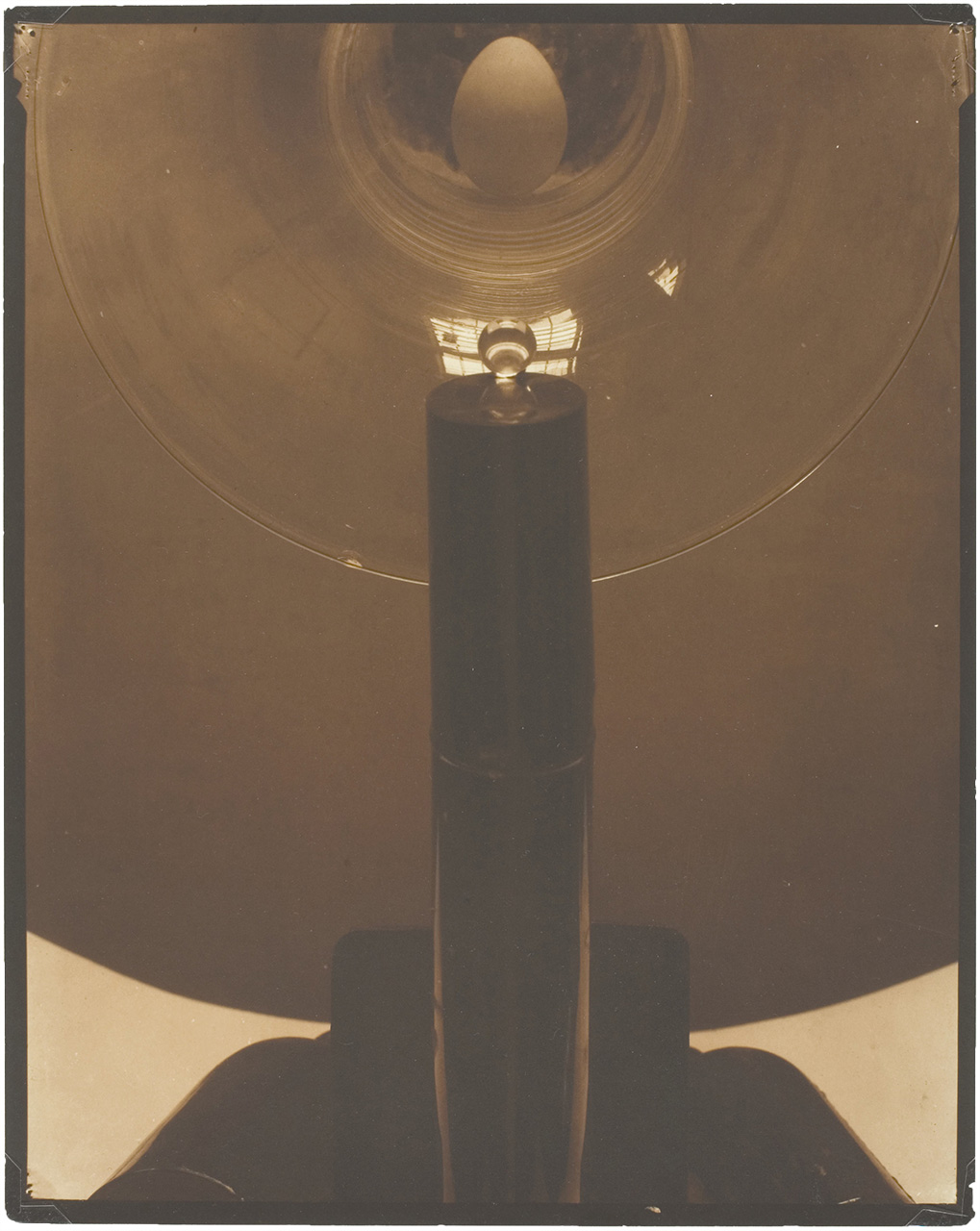
After WWI, during which he’d served as an aerial reconnaissance photographer, which (he’d claim) taught him the value of “unwavering objectivity,” Steichen abandoned his earlier, romanticized “Pictorialist” style and started anew. He was also deeply interested in mathematics and science, including Einstein’s breakthroughs.
Triumph of the Egg uses one of the most symbolic and mythical of objects — an egg, which we cannot help but perceive as a representation of life, rebirth, fertility, and new beginnings — as an example of the mathematical harmony and structural essence found in nature. It’s a physical symbol for abstract universal laws.
From the Art Institute of Chicago’s website:
These images of objects from his home and garden, which Steichen later referred to as “finger exercises,” were in fact formal studies of shape, volume, scale, and tone that laid the foundation for the techniques that he would employ as a commercial photographer. They were his attempt at obtaining, in poet Carl Sandburg’s words, “the maximum amount of realism.” This image comes from a series in which he constructed visual interpretations of Albert Einstein’s theories regarding the space-time continuum, using common objects as symbols.
It’s a work of art about Einstein’s Special Theory of Relativity… and yet the floating egg, the black cylindrical structure, the halo-like opening of a gardener’s bell jar… one is reminded of Redon’s The Black Sun, Kupka’s Resistance, Mondrian’s Evolution.
RAYOGRAPH WITH HAND, LENS, AND EGG
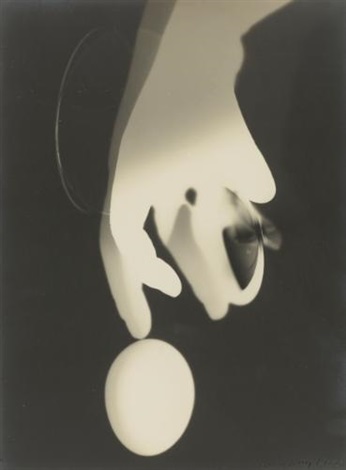
Another egg!
Although the cameraless photographic process (photogram) was decades old by then, Man Ray popularized it — and renamed it the “rayograph” — starting in 1921. Neither entirely abstract nor entirely representational, by recording the direct shadows, outlines, and translucent qualities of everyday objects, rayographs like this one revealed a new way of seeing that delighted the Dadaists. The process is spontaneous, unpredictable; unexposed areas glow white, fully exposed areas turn black; ghostly silhouettes emerge. Tristan Tzara suggested that Man Ray had captured the moments “when objects dream.”
The egg — again, a symbol of reproduction, fertility, and the cycle of life — is here transformed into a glowing abstract form.
PESSIMISM AND OPTIMISM
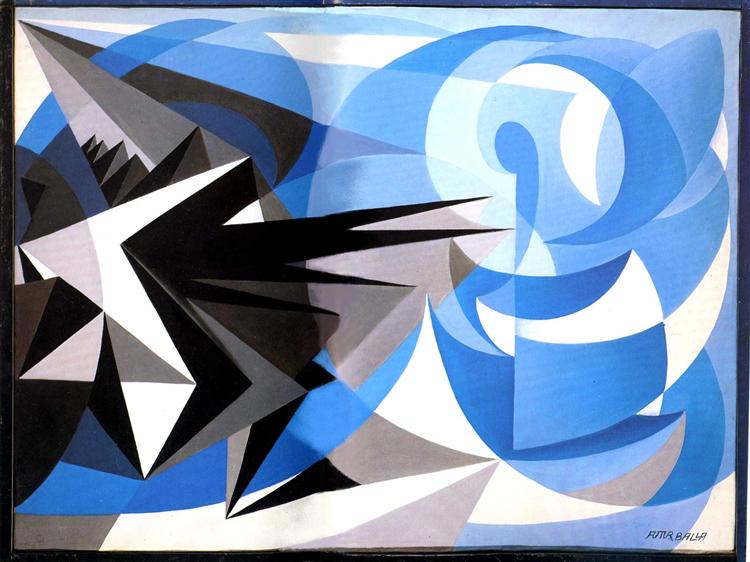
Balla considered Pessimism and Optimism to be his masterwork… because the painting achieves, or so he claimed, a visual and structural balance between two opposing, fundamental forces of human existence during a chaotic historical era.
After Umberto Boccioni, who’d helped shape the revolutionary aesthetic of the Futurism movement, was killed in 1916 (during a cavalry training exercise), Balla established himself as the leading artist of the Futurist movement. He was actively involved in Theosophical and spiritualist circles in Rome during the 1910s and 1920s. After WWI he developed a view of life that revealed to him the invisible, imponderable dynamics governing the universe.
There are two fundamental, opposing psychological and universal energies of the world, he came to believe. Pessimism he represents, in this painting, via dark, gloomy, sharp, irregular black vectors; optimism he represents via curved, luminous blue and white waveforms… forever in motion to ward off pessimism’s attack.
Balla depicts these two states as interpenetrating, complementary forces of existence. The dynamic tension between them is crucial.
ACHIEVED WHOLENESS
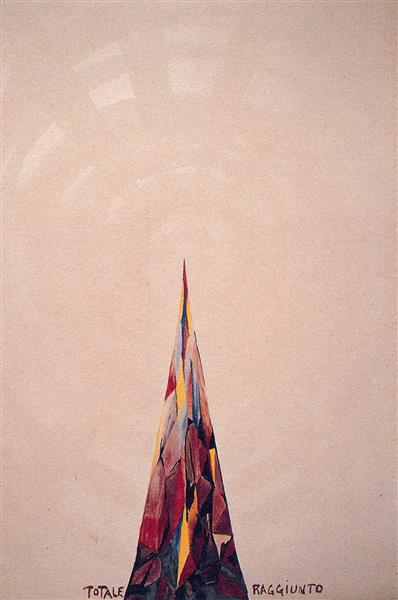
In her 1924 abstract Futurist novel Le forze umane: romanzo astratto con sintesi grafiche, Cappa had published 19 graphic syntheses (ink illustrations and woodcuts), most notably “Feminine Forces: Spiral of Sweetness + Serpent of Charm” and “Masculine Forces: Weapons and Feathers,” mapping out emotional chemistry between genders. Achieved Wholeness is an evolution of that effort: It depicts the moment where the conflicting internal forces of the ego — such as rebellion, raw desire, and sorrow — finally resolve into a state of absolute, unified cosmic harmony.
Josh Glenn’s EMANATIONS series includes the following installments: CATASTROPHE: DECLINE & FALL | DYING EARTH | ECO-CATASTROPHE. COSMIC AWE: DEEP TIME | STARS WHEEL IN PURPLE | IS THERE LIFE ON MARS. DEHUMANIZATION: CYBORG MANIFESTO | MECHANIZATION. & many others.
MORE RADIUM AGE SCI FI ON HILOBROW: RADIUM AGE SERIES from THE MIT PRESS: In-depth info on each book in the series; a sneak peek at what’s coming in the months ahead; the secret identity of the series’ advisory panel; and more. | RADIUM AGE: TIMELINE: Notes on proto-sf publications and related events from 1900–1935. | RADIUM AGE POETRY: Proto-sf and science-related poetry from 1900–1935. | RADIUM AGE ART: Proto-sf and science-related fine art from 1900–1935. | RADIUM AGE 100: A list (now somewhat outdated) of Josh’s 100 favorite proto-sf novels from the genre’s emergent Radium Age | SISTERS OF THE RADIUM AGE: A resource compiled by Lisa Yaszek.