
TRANSHUMANCE (8)
By:
March 4, 2026
We are thrilled to serialize Transhumance, a post-apocalyptic novella by HILOBROW friend and contributor Charlie Mitchell.
TRANSHUMANCE: 1 | 2 | 3 | 4 | 5 | 6 | 7 | 8 | 9 | 10.
Little Dog freezes and neither says a word. He feels like one of those wide-eyed rabbits cornered against a fence. The spoon slowly sinks back down into the bowl; enough is said without words now. Why does he feel like that rabbit? This pemmican is everyone’s. Sun beams outline Khyber’s form, dust and fine hairs and umber edges of his beard — his left hand is clenched into a fist on the table. His head is turned towards the youth but his face glowers in shadow. That ax rests to his right on the table. It’s just a hunt, with Baba’s friend — yes he’s not Kindred, yes he knows more than he says out loud. The hunt might render more pemmican and more than that. The spoon has remained in the bowl. He has never seen this wordless contempt, never felt it pollute a space in such miasma. The giant’s silence perturbs in a way Little Dog has never felt before.
He bolts out of the hall. He’s panting and seething before he tosses Dalton his share of pemmican, and ties on the snowshoes. Khyber’s silhouette in the dining hall — the whiplash pivot of love to guilt and fear — will forever inform the youth’s social tact and trust. He’ll gnaw on that confrontation on the hunt, and then on many nights lying awake in a bedroll when sleep won’t come until he cycles.
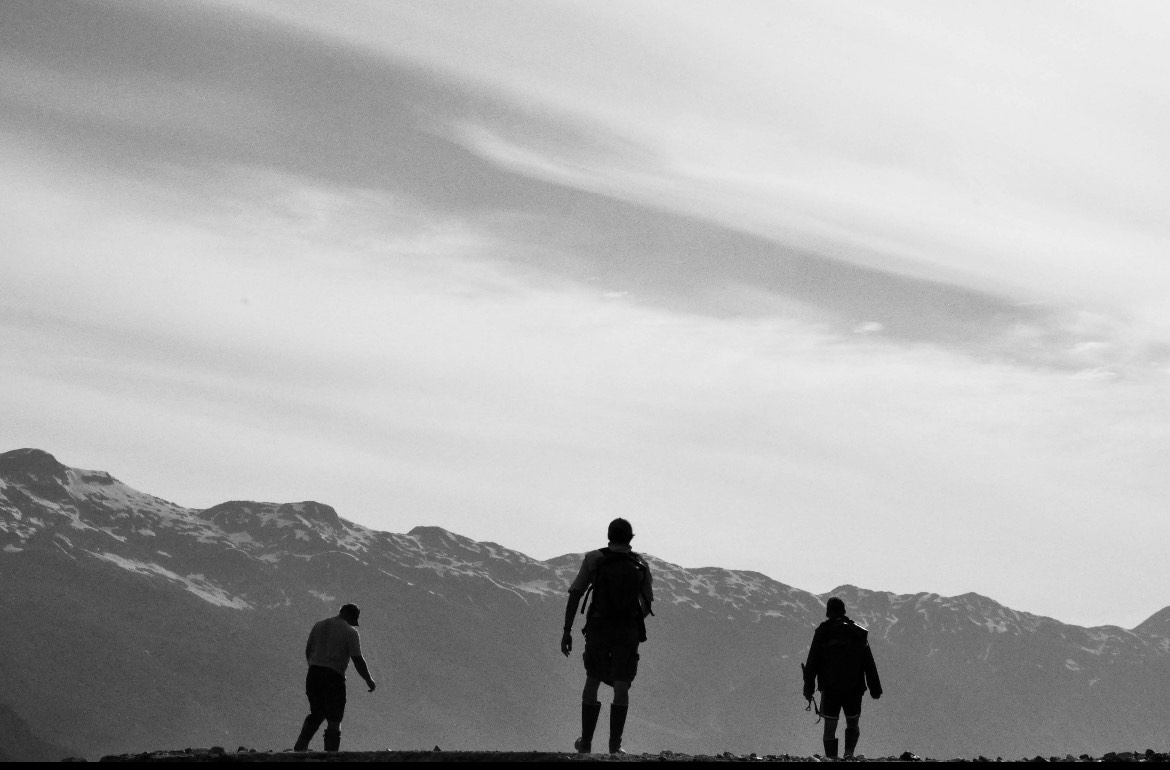
They strike south out of the valley with the palomino in tow. Buttes give way to snowed-over riparian gorges and white sage swathed out like an old man’s stubble. Here and there a barren lodgepole spared from wildfire. Every direction is framed by low slung mountains in some distance, the curved spines of great dormant behemoths. A raven croaks. Robins, chickadees and starlings flit about the melt-freeze. Caught fast again in winter there’s still berries and reasons to sing.
He peppers Dalton with questions.
“Dalton, what’s the fastest car ever to go?”
“What did a sinth-sizer sound like?”
“Did plastic grow or did you dig for it like metal?”
“Shh — yer gonna scare any game off.”
“Sorry,” he drops his voice. “And is it true you could live in a car?”
It goes on like this. He is not ignoring the youth. The old man has turned towards his inner world and peruses the rolodex of rubble and regret — would the boy even grasp ‘rolodex’, let alone the concept of address? Unravelings of a dead and tattered social contract.
What use is there in telling this kid who’s summed up from this fresh new world? It’ll never come again. How much longer can you stretch out ammo and synthetic fabric? How many canned goods still survive, or the hoardings of corn-based food immune to rot? How can you articulate the Internet — sigils writhing behind glass and how it balkanized entire empires, like a spiderweb of fracturing glass despite its best potential, to an adolescent who’s amazed by an old Cold War film reel? Why shoulder the trauma of what you had to do while it crumbled, and how could you paint it as a good and comfortable life when you knew the butcher’s bill.
Global travel and transatlantic flights, that at one point an airplane was more than a granary, even the notion of nation or statehood. Little point. Give them a new mythology, burn the old sacred texts (or let them stay charred and dead) and stitch up something new. Say for example that airplane chewed by rust and bearded by lichen hunkered down on a weed-riven tarmac. A great eagle who bore people in its belly over mountains and river valleys, deserts and lakes, into cloud kingdoms and across seas, with such a splitting roar. Kids always ask why they’re roosting for good now; ‘engine’ connotes more like ‘soul’ or ‘purpose’ in more than one community nowadays. Funny how it all’s reckoned and panned out.
Prostrate and weep — I’m sorry, I’m so sorry that the weight of it all caught up and crashed down and now you’re fucked in the rubble, that you don’t even know the full depth of just how deeply we failed you — but only Dalton and Baba remember what the rubble once was. Great way to unneededly alarm a kid.
They plow a trail on top ridgelines, where there are clear lines of sight and surefoot passage. Dalton leads the horse ridden by a tuckered Little Dog. The sled track conceals their number. Do you want to know the horrors, LD?
And who are you, he asks himself. Where do you fit in this mess?
Everyone else is gone.
“Dalton?”
The bones of the world didn’t care. Shook civilization off like a flea. He’s surprised that winter still comes and settles honestly; relief for that relic of a man and just plain tribulation for the youth. Not a shred of irony lost. Though it isn’t a mess to this boy — his world is crisp and bright and warm with chinook gushing through pine needles and juniper. His Baba had given him that. On the other hand — Baba had read the portents, wordlessly withdrew from civilization, from his friends, to carve out his own kingdom. Judas Iscariot — or Moses. Again, Dalton had seen worse communes. Much worse.
“Sure you could, but it was a low thing. Plenty better places to live in. But there were homes you could hitch onto the back of some cars, called trailers and campers. That was a mighty fine way to live. Your Kindred have a couple, at least skeletons done patched up. Toss me some pemmican — thanks.”
There’s that auspicious sound of water babbling. He leads the horse, kid, and sled down the ridgeline and into a creekbed marked by four bare willow trees. The kid stays quiet only while he chews on what the once-stranger had said.
Written in 2023, this story was serialized, then published in its entirety, here at HILOBROW in 2026.
MORE ORIGINAL FICTION & POETRY AT HILOBROW: James Parker’s COCKY THE FOX | Karinne Keithley Syers’ LINDA, LINDA, LINDA | Matthew Battles’ THE SOVEREIGNTIES OF INVENTION stories | James Parker’s KALEVALA bastardizations | Annalee Newitz’s “THE GREAT OXYGEN RACE” | Charlie Mitchell’s “SENTINELS” | Josh Glenn’s “VALIDATION SESSION” | & more.