
MEDIA DIET
By:
June 22, 2026
A weekly series exploring the media “input” of a group of people — HILOBROW’s friends and contributors — whose “output” we admire.
Tom has been a valued HILOBROW contributor since 2009. His first post was on the topic of RZA. His most recent contributions to this publication include: DHALGREN | THE BARON IN THE TREES | SKELETOR. He is also the author of several food-history HILOBROW series, including CONDIMENT ABECEDARIUM.
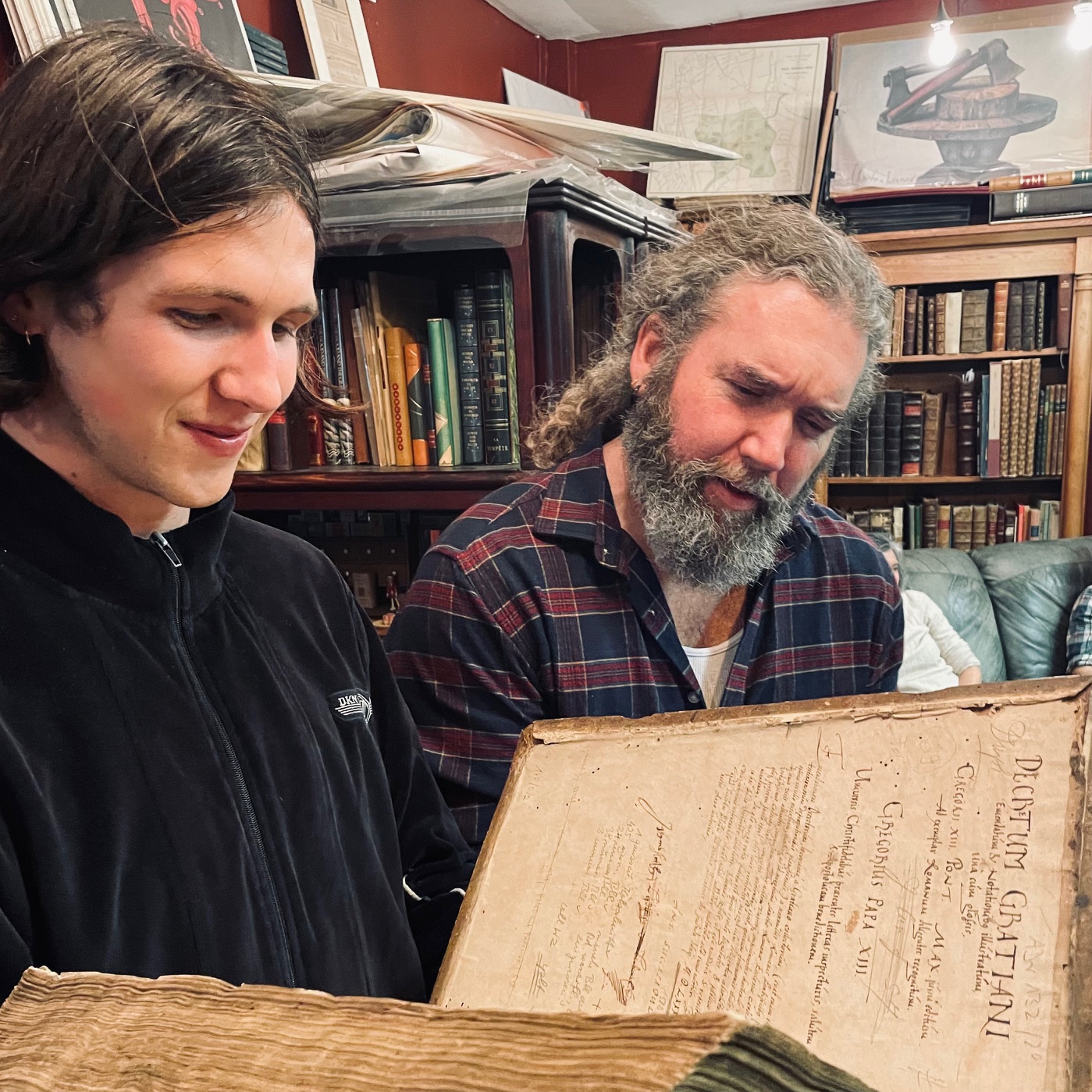
Boston…
HILOBROW: What forms of media do you “take in” the most regularly/frequently, during a typical day or week?
TOM NEALON: I listen to music while I work, so it’s hard to beat that on quantity — though I’m rarely listening actively since I’m packing books or cataloging or staring off into space thinking about how I should be doing one of the first two things. When I write I need to have music on or else the words start to boom in my head and I eventually go crazy, but that has to be either something very familiar or anodyne — but lively. Funk works well, or Sun Ra, hip-hop instrumentals.
Lately so much of my media day is defined by what I used to do but don’t anymore — go on twitter or read the news. I find that in lieu of reading stories, I will just read headlines and try to imagine the story — I will even shout out to my wife, reflexively, like the crazy person I was during TRUMP1, constantly surprised by some new stupidity, some fresh horror, “Can you believe [something from a headline]” and then have to admit that I didn’t read the story when she half-heartedly asks for specifics. Sometimes I will let bluesky wash over me and details about the world will seep randomly into my psyche, or not. I will make an honest effort to read independent journalism: Marisa Kabas, Sarah Kenzidor or political writing in Defector. Or I will try to read foreign papers: Le Monde or The Irish Times like smart people I knew decades ago used to do. But it never sticks and I go back to the fretful bathing and imagining. Writing it out like this, it might be a sub-optimal system for staying informed.
I still read fiction everyday, sometimes voraciously, some days just a little. And I binge watch a mix of prestige and — what’s the opposite of prestige? unimpressive? esteemless? — television to take my mind off my insomnia. It remains a great time to be a television-watching insomniac, so that’s not too bad.
HILOBROW: What music — genres, particular artists and songs — do you listen to during a typical day?
TOM NEALON: I’ve always been a sort of serial monoculturist, and, despite forays into algorithmic daily playlists, I still basically am, so I will listen to only Czarface for a whole week, or switch to Waxahatchee, Silver Jews, Lucinda Williams for another week. Or spend three days listening to only Parliament, Death Grips and Robyn. (I got rid of Spotify recently, but the Wrapped thing at the end of the year would usually assure me that, in the aggregate, I listened to a normal amount of each one.) I still, despite almost everyone assuring me that I should stop, mostly listen to whole albums. It’s hard to articulate why or maybe I can’t and it’s just that middle-aged inertia and resistance to change popping up in a weird place, but I keep doing it. These things shift about, but the reigning perfect song is “Nightcrawler” by Czarface (a band designed in a lab to appeal to me — nerd beats, comic books, and the Wu-Tang Clan? Whole albums collaborating with MF Doom and Kool Keith? Come on). I think I listen to hip-hop to be inspired by beats, wordplay, serendipitous juxtapositions; to alt whatever, indie rock, to be comforted and unsurprised; funk, edm pop, punk to maintain my mind-body stuff? Maybe. I’ve lost touch, a bit, with why anyone does anything, to be honest.
HILOBROW: What work of literature (old or new) would you recommend to someone trying to make sense of today’s world?
TOM NEALON: I think about this a lot — like with most cataclysmic times, this age we are living in is both very specific and completely connected to these grinding wheels of civilization that recapitulate conjunctions of human frailties, vanities, hatreds, and capacious desires over and over. I deal mostly with early books for work, the 15th to the 18th century, so I tend to fixate on the elements that recur. So, while I think saying Parable of the Sower (or maybe Talents), Dhalgren, Lathe of Heaven, or Minority Report, would all make sense, I can’t help feeling like it’s the early satires that still capture this mess the best. Especially Gulliver’s Travels and Gargantua & Pantagruel. The rules of the novel weren’t set yet, nor were the rules of the Enlightenment, so the characters blunder about getting into trouble, eating sausages, and exposing the ridiculousness of humanity. They were written at either end of the early modern period where Western culture had become molten and contextless, so you could just write crazy shit and readers would be like… “OK.” They had to have an entire fall of the Roman Empire and a Dark Ages to decontextualize their culture, we just had to invent the Internet and social media.
If I had to pick just the one, maybe it would be Gulliver because, since it was written during the Enlightenment, it deals with very recognizable problems of how to navigate the collision of science and religion, the narcissism of small differences, colonialism, and on and on. But Gargantua is such a crazy contextless muddle, like a Bosch or a Brueghel painting but 1,000 pages long, that it speaks directly to this world we made where right and wrong, real and unreal, are somehow in flux again, like they were in the Early Modern period when Europe emerged from the fecund weirdness of the Middle Ages and started wondering about the kings and the churches and why they had so much stuff. They were trying to remake something imagined, rebuild antiquity as they pictured it. The current project isn’t dissimilar: the neo-classical revival, 17th-century economic theory, the degradation of rights and the value of human life. In the 16th century they wanted to bring back the best ideas of Ancient Greece and Rome, while we want to reinstate the worst from the 16th, so I think there is a lot to think about in literature from that period.
MEDIA DIET series: MATTHEW BATTLES | ADRIENNE CREW | HOLLY INTERLANDI | CAROLYN KELLOGG | MARK KINGWELL | FLOURISH KLINK | ADAM McGOVERN | CHARLIE MITCHELL | TOM NEALON | ANNIE NOCENTI | GARY PANTER | LYNN PERIL | JONATHAN PINCHERA | NICHOLAS ROMBES | CARLO ROTELLA | LUCY SANTE | SETH | MIKE WATT | JUDITH ZISSMAN | & many others! Visit the SERIES INDEX.