
BEATRICE THE SIXTEENTH
By:
March 31, 2026
Under the direction of HILOBROW’s Josh Glenn, the MIT Press’s RADIUM AGE series is reissuing notable proto-sf stories from the underappreciated era between 1900–1935.
In these forgotten classics, sf readers will discover the origins of enduring tropes like robots (berserk or benevolent), tyrannical supermen, dystopias and apocalypses, sinister telepaths, and eco-catastrophes.
With new contributions by historians, science journalists, and sf authors, the Radium Age book series will recontextualize the breakthroughs and biases of these proto-sf pioneers, and chart the emergence of a burgeoning literary genre.
Today marks the publication of the following Radium Age series title…
IRENE CLYDE
Introduction by LUCY SANTE
(March 31, 2026)
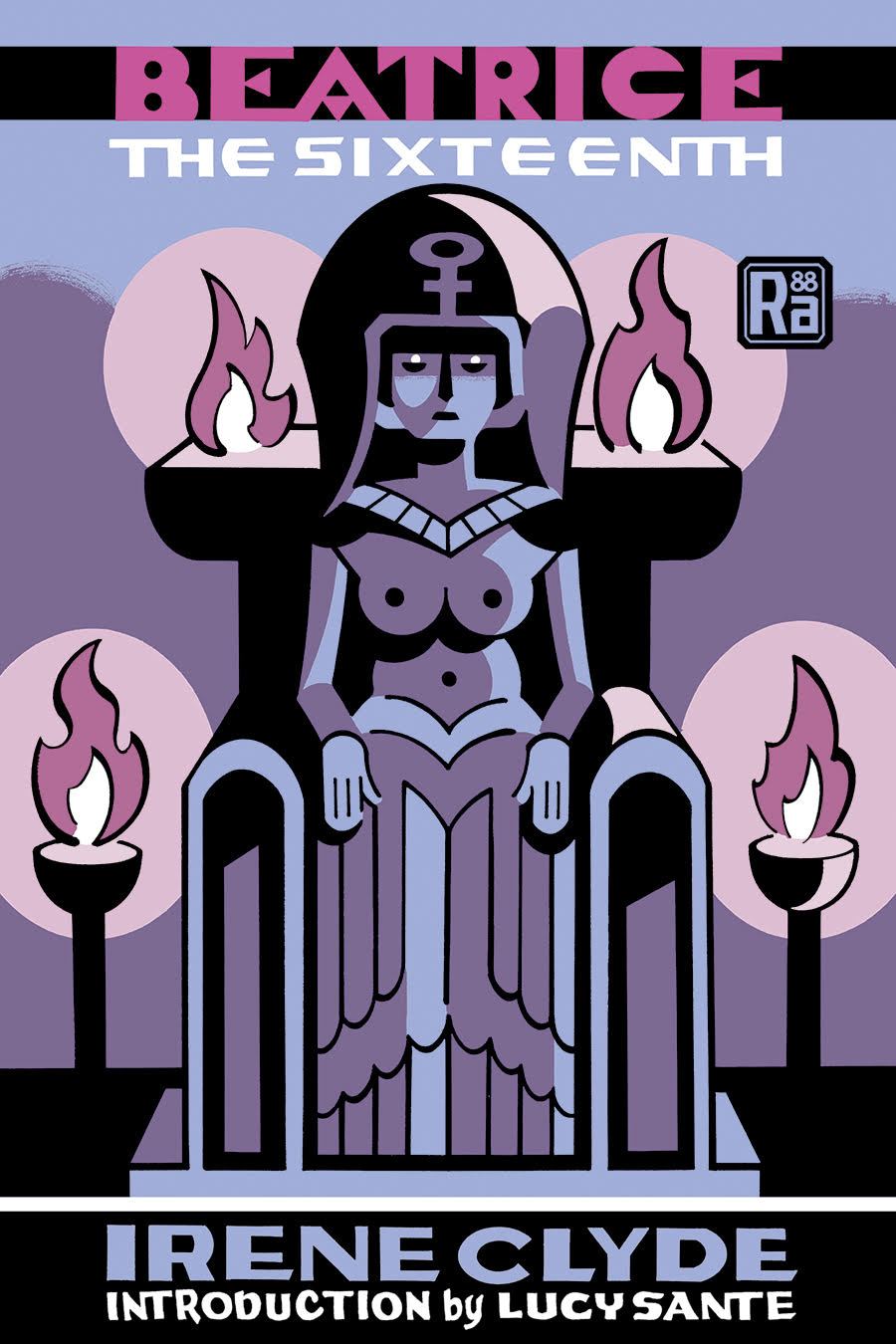
Introduced by Lucy Sante, author of the acclaimed memoir of transition I Heard Her Call My Name, this pioneering 1909 feminist utopia is productively discombobulating. When Mary Hatherley, an intrepid British explorer, is kicked in the head by the camel she was riding through the Arabian desert, she finds herself transported to what seems to be an alternate version of Earth. Arriving in Armeria, she discovers a society in which the very concept of gender is unknown. Like Mary, the reader will become disoriented, enjoyably so: By initially avoiding the use of gendered pronouns, the story’s author (herself a gender-fluid activist) challenges our assumptions about gendered social paradigms.
“This little book has something peculiarly its own in its treatment. It is really a study of the Soul precipitated into another country without losing the consciousness of its immediate past life. Everything is strange — scenery, people, customs and ideals. Though the authoress has not stated clearly what her purpose is, we cannot help thinking that she means it to represent the Soul’s experience upon an occult plane of consciousness.” — The Herald of the Cross (1910)
“A gynarchic state, Armeria, where women marry each other and buy the babies on whom the future of Armeria depends… Readable and suggestive.” — The Occult Review (1909)
“A real wonderland, where only the fair sex live and reign…” — The Theosophist (Jan. – Mar. 1910)
“Recently rediscovered early 20th-century transfeminine author Irene Clyde’s Beatrice the Sixteenth is an interdimensional Amazonian romance and imperialist ethnographic fantasy rolled into one. Readers of this new edition are in for an unexpected and thought-provoking journey.” — Susan Stryker, author of Transgender History: A Resource for Today’s Struggle — And Tomorrow’s.
Press for MITP’s edition of Beatrice the Sixteenth includes the following…
“Over a century ago, writer Irene Clyde was pushing back against perceptions of gender in the U.K. Now, Clyde’s novel Beatrice the Sixteenth, set in a utopian alternate world with no concept of gender, is getting a stylish new edition, complete with an introduction by the great Lucy Sante.” — Reactor
“The introduction by Lucy Sante places the book in context of its Edwardian author, who would now be considered a transwoman, and her advocacy for the ‘abolition of gender binaries’ and ‘celebration of female-female intimacy.’ The book explores a society that upholds women-dominated communities as utopian, eschewing binaries, and having no men.” — Foreword
LUCY SANTE’s books include Low Life, Kill All Your Darlings, The Other Paris, Maybe the People Would Be the Times, and I Heard Her Call My Name. She was recently appointed an officer of the Order of the Crown by the Belgian government.
IRENE CLYDE (b. Thomas Baty, 1869–1954) was an English lawyer, writer, and activist who spent much of her life in Japan. She co-founded the Aëthnic Union, a society dedicated to challenging binary gender distinctions; and for 25 years she helped edit, write, and publish Urania, a privately circulated journal which covered such topics as same-sex relationships, androgyny, and sex changes, and which sharply criticized heterosexual marriage. Beatrice the Sixteenth (1909) is her only novel.
Originally published 1909. Cover illustrated and designed by Seth. See this book at The MIT Press.
RADIUM AGE PROTO-SF FROM THE MIT PRESS: VOICES FROM THE RADIUM AGE, ed. Joshua Glenn | J.D. Beresford’s A WORLD OF WOMEN | E.V. Odle’s THE CLOCKWORK MAN | H.G Wells’s THE WORLD SET FREE | Pauline Hopkins’s OF ONE BLOOD | J.J. Connington’s NORDENHOLT’S MILLION | Rose Macaulay’s WHAT NOT | Cicely Hamilton’s THEODORE SAVAGE | Arthur Conan Doyle’s THE LOST WORLD & THE POISON BELT | G.K. Chesterton’s THE NAPOLEON OF NOTTING HILL | MORE VOICES FROM THE RADIUM AGE, ed. Joshua Glenn | William Hope Hodgson’s THE NIGHT LAND | Hemendrakumar Roy’s THE INHUMANS | Charlotte Haldane’s MAN’S WORLD | Francis Stevens’s THE HEADS OF CERBERUS & OTHER STORIES | Edward Shanks’s THE PEOPLE OF THE RUINS | J.D. Beresford’s THE HAMPDENSHIRE WONDER | John Taine’s THE GREATEST ADVENTURE | Marietta Shaginyan’s YANKEES IN PETROGRAD | BEFORE SUPERMAN: SUPERHUMANS OF THE RADIUM AGE, ed. Joshua Glenn | E. and H. Heron’s FLAXMAN LOW: OCCULT DETECTIVE | Irene Clyde’s BEATRICE THE SIXTEENTH | Olaf Stapledon’s LAST AND FIRST MEN | MOTHERSHIP RISING: AFROFUTURISM IN THE RADIUM AGE, ed. Lisa Yaszek | & more to come.
RADIUM AGE PROTO-SF: “Radium Age” is Josh Glenn’s name for the nascent sf genre’s c. 1900–1935 era, a period which saw the discovery of radioactivity, i.e., the revelation that matter itself is constantly in movement — a fitting metaphor for the first decades of the 20th century, during which old scientific, religious, political, and social certainties were shattered. More info here.