
THE METAL GIANTS (8)
By:
July 18, 2026
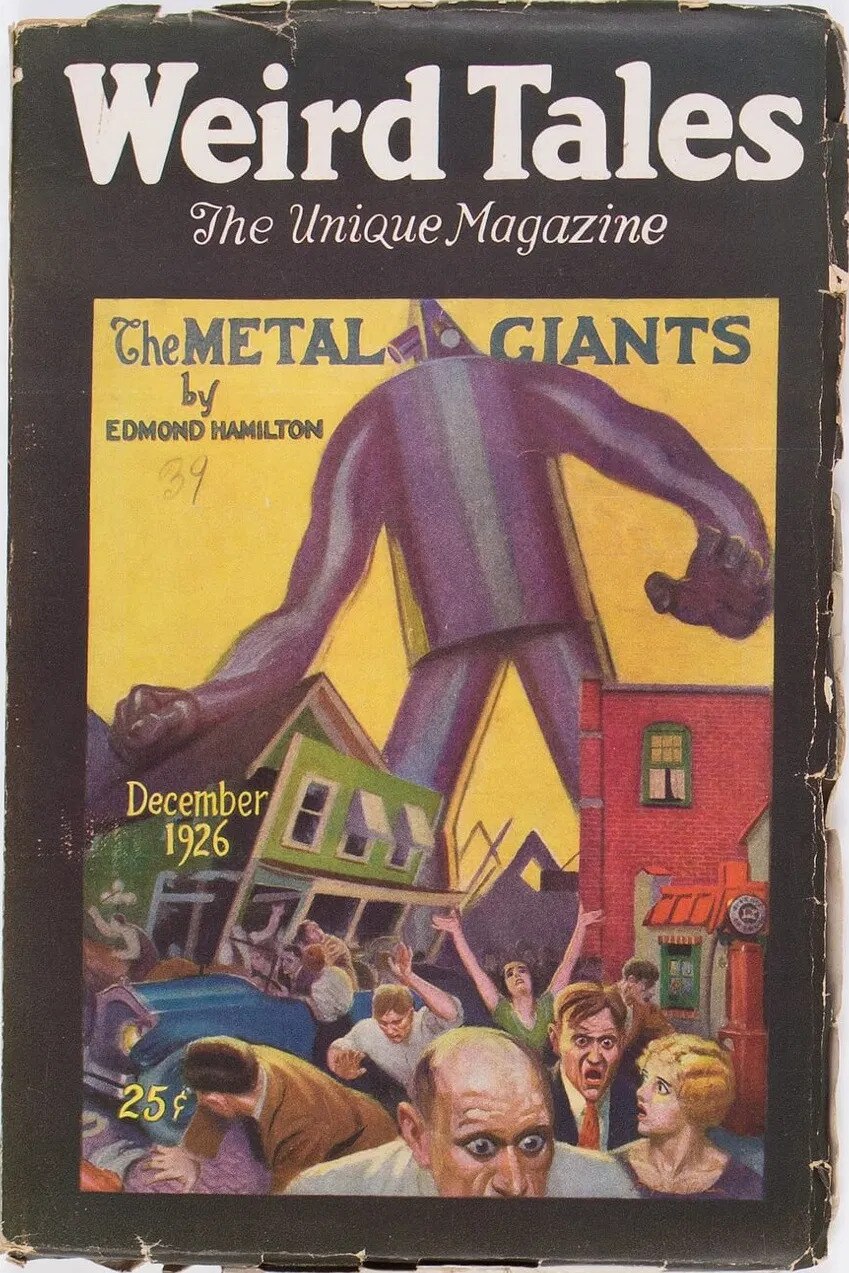
Edmond Hamilton’s The Metal Giants, which features an atom-powered metal brain that constructs a rampaging army of 300-foot-tall robots, first appeared in the December 1926 issue of Weird Tales. HiLoBooks is pleased to serialize the story for HILOBROW’s readers.
ALL INSTALLMENTS: 1 | 2 | 3 | 4 | 5 | 6 | 7 | 8 | 9.
A sound of crashing trees greeted Lanier as he went on, and then, very much louder, the whistling scream he had already heard, near by, clamorous. Aflame with excitement he pushed on, forced through a cruel growth of briars and down a wooded hillside, emerging with a sudden shock into a grassy basin, more than a half-mile across, level and treeless. And in its center was a great circle that flashed brilliantly in the sunlight, shining, magnificent. A circular, gleaming platform, and on it, hanging a few inches above its surface, a dark, egg-shaped object, with two thin, tapering arms. The metal brain!
An electric shock seemed to pass through Lanier at sight of it. The super-intelligence that was destroying the civilization of man, casting him from his lordship of the world! A metal king on its throne of metal! For the first time Lanier realized the soulless nature of the thing, cold, precise, unhuman, unswerving in purpose, terrible.
Standing near the platform was one of the towering metal giants, and it was from this one that there emanated the screaming signal he had heard. And over at the basin’s farther side, where the hills beyond sank down to it in a long, wooded slope, stood another of the great fighting-machines, also motionless.
Lanier sensed a quality of waiting, of expectancy, in the attitude of the brain and its minions. Over beyond that wooded slope, the crashing of trees began again and he wondered if the other metal giants were returning from their raid to the north. Louder, ever louder, became that snapping and roar of falling timber, and now a shape began to loom up at the top of that long slope, a gigantic shape that was moving rapidly toward the basin.
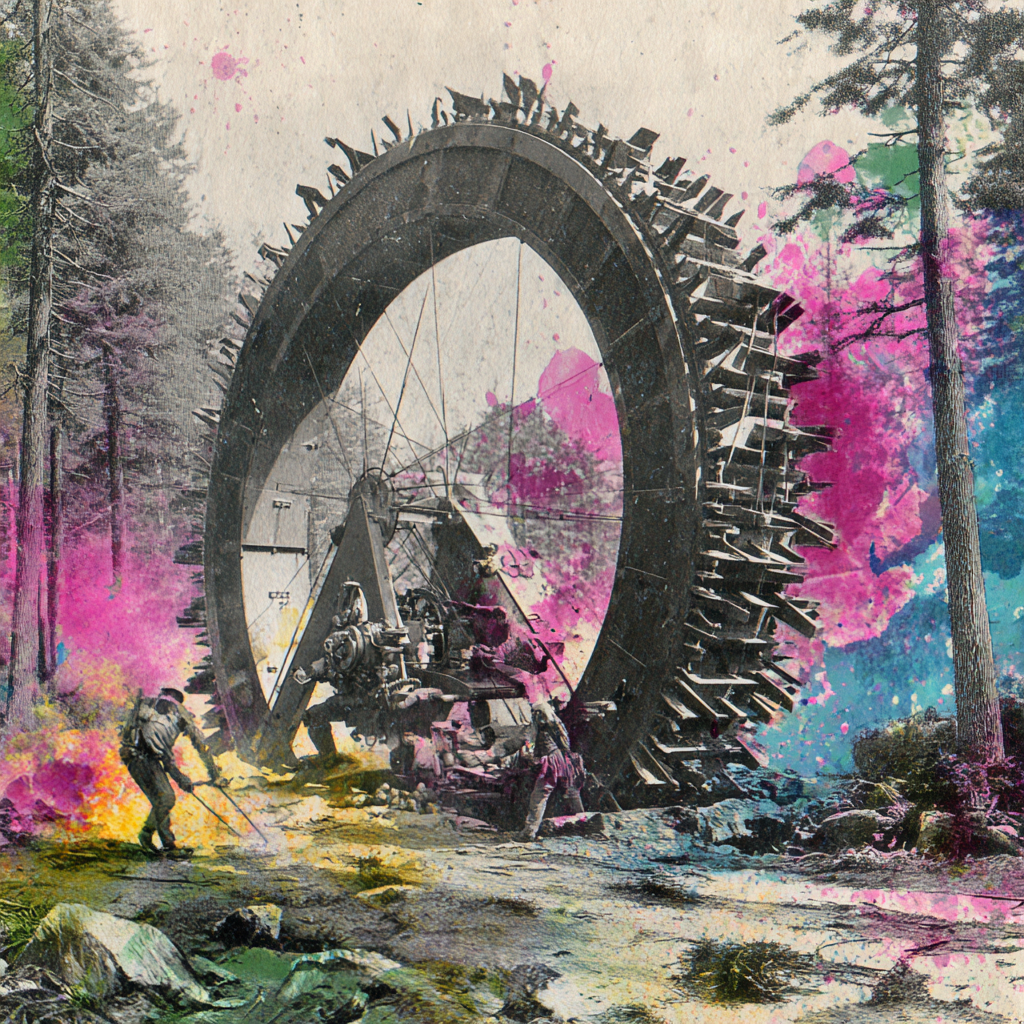
On it came, until its whole bulk was in view, poised on the ridge, and Lanier jerked with astonishment, for the thing was a mighty wheel, a wheel that must have been at least fifty feet taller than even the immense fighting-machines, whose huge, shining spokes and broad, point-studded rim were of smooth metal, and at the hub of which swung a square, boxlike structure of the same material.
Again the whistling signal of the nearer fighting-machine ripped the silence, and now it was answered from far away, toward the east. Lanier looked and saw, in surprise, four others of the metal giants, very far away, hurrying across the hills toward the basin, with mighty, whirling steps. The four that had been left at Stockton, coming at the summons of the metal brain, for what? Aid, battle — that mighty wheel, a foe of the metal brain — then, who ——?
“Detmold!” Lanier’s cry was like a trumpet call, a scream of comprehension and gladness and faith. “Detmold!” He had constructed the wheel to crush the metal brain and its minions, had built it up, using the tentacle-machines as his own tools, controlling then in the way he had thought, fighting the metal brain with the instruments of its own making.
And now the great wheel was slowly rolling down the slope toward the outermost metal giant. There was no sound to indicate the source of the wheel’s motive power, but Lanier little doubted that Detmold had seized and utilized the same secret of atomic power that had been used by the brain for its own creatures. Slowly, almost clumsily, the wheel lumbered down to the basin, until it was but a few hundred feet above the outer fighting-machine. Suddenly the inaction of the latter ended and one long arm flashed out, holding a globe from which the deadly gas spurted toward the hub of the wheel.
With unexpected, lightning rapidity, the larger machine swerved to one side, then, pivoting instantly, rolled with terrific speed and power toward the erect giant, striking it with a deafening crash. The fighting-machine went down, and as the huge wheel rolled over it there was a cracking of metal, and the thing lay broken and harmless.
Over in the east the four approaching fighting-machines were striding toward the basin with utmost speed, screaming their signals, that were answered by the metal giant left functioning in the basin, that stood beside the brain and its platform. And it was toward this remaining enemy that the wheel advanced, slowly, cautiously, edging forward like a snake that can strike with lightning speed. It followed a course that circled with the edge of the basin, and as it passed near Lanier, he saw the tiny figure of a man at the box-structure at the hub, saw Detmold, intent on the control of the giant mechanism; and then the wheel had rolled past him and was moving slowly toward the metal platform and the fighting giant beside it.
On it went, until it was very near the monster machine there, then paused, twisting, hovering, turning. Flash! — and it had struck at the watchful giant, struck and missed, since the thing had turned in time to avoid the impact. Instantly the wheel turned and struck again, and Lanier cried out to see it crash squarely into the fighting-machine. But the latter was not overturned. It braced itself to stand and wound its mighty arms around the spokes of the wheel in a great effort to hold it back from the platform and the brain. The hurrying metal giants in the east were very near now, striding almost into the basin, racing madly toward this combat of titans. And on the metal circle rested the brain, its lens-eyes turned toward the battle, directing the efforts of its creatures as they battled and hurried in its behalf.
The long arms were still twisting through the spokes of the wheel, that was still striving to reach the near-by platform. Suddenly one of those arms released its hold on a spoke and swept up to the hub, caught the tiny figure of the man there and hurled him toward the edge of the basin, where Lanier saw him strike a tree there. And at the sight, Lanier screamed, ran forward with fists clenched, shouting insane, childish threats, an ant beside the two battling giants. But now, without the controlling hand of its builder, the wheel was whirling, toppling, falling, crashing down onto the circular platform, smashing fighting-machine and metal brain beneath its mighty bulk, crushing both into a twisted heap of metal.
Crash! — and Lanier stood quite still. Over at the eastern edge of the basin the four metal giants had suddenly slumped down and lay motionless, sunken into heaps of cold, lifeless metal, as also must have done all those other metal giants that were spreading terror at Wheeling, as all the creatures of the metal brain must have done when released from its commands by its shattering. Truly, Detmold had struck at the center, had smashed completely the dreadful menace that was his own creature. In awe and wonder, in swiftly flooding thankfulness and gratitude, Lanier looked about. All around was silence.
RADIUM AGE PROTO-SF: “Radium Age” is Josh Glenn’s name for the nascent sf genre’s c. 1900–1935 era, a period which saw the discovery of radioactivity, i.e., the revelation that matter itself is constantly in movement — a fitting metaphor for the first decades of the 20th century, during which old scientific, religious, political, and social certainties were shattered. More info here.
SERIALIZED BY HILOBOOKS: James Parker’s Cocky the Fox | Annalee Newitz’s “The Great Oxygen Race” | Matthew Battles’s “Imago” | & many more original and reissued novels and stories.