
THE METAL GIANTS (5)
By:
June 27, 2026
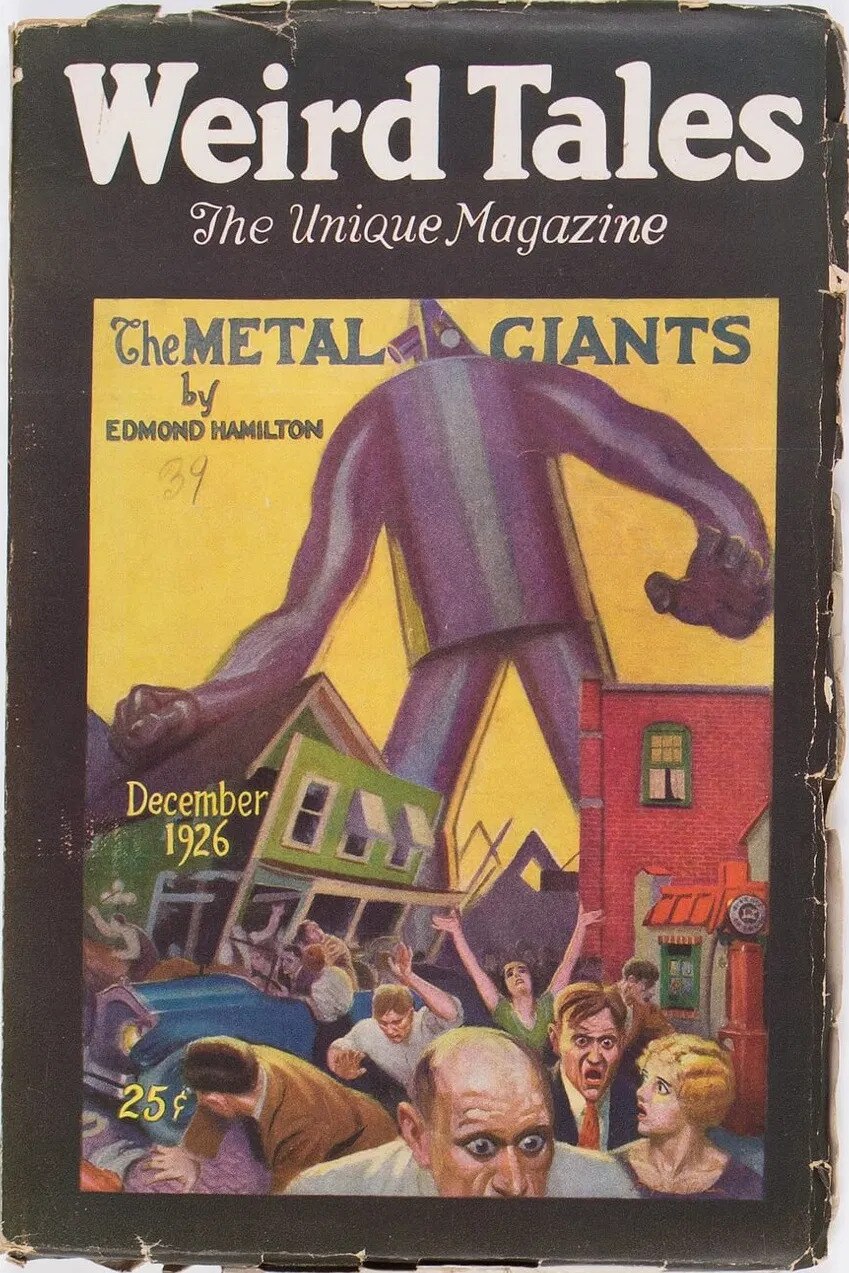
Edmond Hamilton’s The Metal Giants, which features an atom-powered metal brain that constructs a rampaging army of 300-foot-tall robots, first appeared in the December 1926 issue of Weird Tales. HiLoBooks is pleased to serialize the story for HILOBROW’s readers.
ALL INSTALLMENTS: 1 | 2 | 3 | 4 | 5 | 6 | 7 | 8 | 9.
And fear swept through the land.
In New York the first fragmentary reports of the annihilation of Stockton had been greeted with a good-natured laugh, but as more and more details came in, extras began to pour into the streets, and crowds gathered around the clamorous bulletins. In troubled silence they read the account of the few survivors, the story of that red hour of Stockton’s death. There came, too, later, short dispatches relating the further advance of the metal giants, who were evidently proceeding leisurely northward, killing, destroying, uprooting all in their path.
Clicking out over the network of wires, flashing across the night in radio waves went the short, ominous sentences, sentences in which an epoch of comparative safety and peace was dissolving, crumbling, falling. There were reports of action at Washington, of hurried meetings and swift discussions, and finally, late in the morning, a proclamation of the federal government was flashed to every section of the country.
It was evident, declared this statement, that the country was being attacked from within by men possessing new types of fighting machines, with vast and unknown powers. These men, who were probably either anarchists or agents of some foreign power, were using as a weapon a new and very deadly poison gas, a gas that sank harmlessly through skin and flesh but which dissolved all kinds of bone like sugar in water, causing instant dissolution of the skeleton and skull of every human body it touched, resulting in instant collapse and death. Therefore, it was advisable for everyone living within a three hundred mile radius of Stockton to take refuge in flight. Troops and artillery were already on the way to meet and battle the new foe, and scientists were being consulted as to the best method of combating it. It was hoped that the people would give full co-operation to the government by following its orders carefully, refraining from spreading alarmist rumors, and trying to carry on all essential business as usual.
Thus the proclamation, and its businesslike sound caused people to breathe easier for a time. There had been so many emergencies before that had been met and conquered. War and riot, flood and fire. And after all, these new war-machines could not be so very formidable, even though they had devastated a city. That story of their size, hundreds of feet and such, must be exaggerated. As for the deadly gas, well, there had been deadly gases before. Anarchists, foreign invaders, whoever they were, the soldiers would stop them. A few high-explosive shells would fix them.
Thus did the average citizen reassure his household when anyone in it expressed anxiety or fear. After that first panicky moment, the usual serenity of the country was again ascendant, and there was but little open worry concerning the enemy. An ignorant observer would scarcely have suspected the existence of the things, except for the newspapers.
It was definitely known that the metal giants, leaving four of their number at Stockton, were now advancing north toward Wheeling and Pittsburgh, eighteen in number. Airplanes and scouts reported their destruction of all towns and villages in their path, whose inhabitants had fled at the first alarm. The War Department had decided to concentrate its force a few miles south of Wheeling, and ten thousand soldiers, part of them hastily assembled militia, had been flung across the enemy’s path at that spot, backed by a heavy force of artillery. There were vague rumors of ambushes prepared for the foe, pits and high-explosive mines and the like.
On the evening of the third day after Stockton’s destruction, the fighting-machines were reported to be less than twenty miles south of the troops, and were already being shelled by a few heavy guns that were mounted on railway platforms. In every city, all waited tensely for news of the first clash. The hours dragged past, the crowds moved restlessly about, and still came no news.
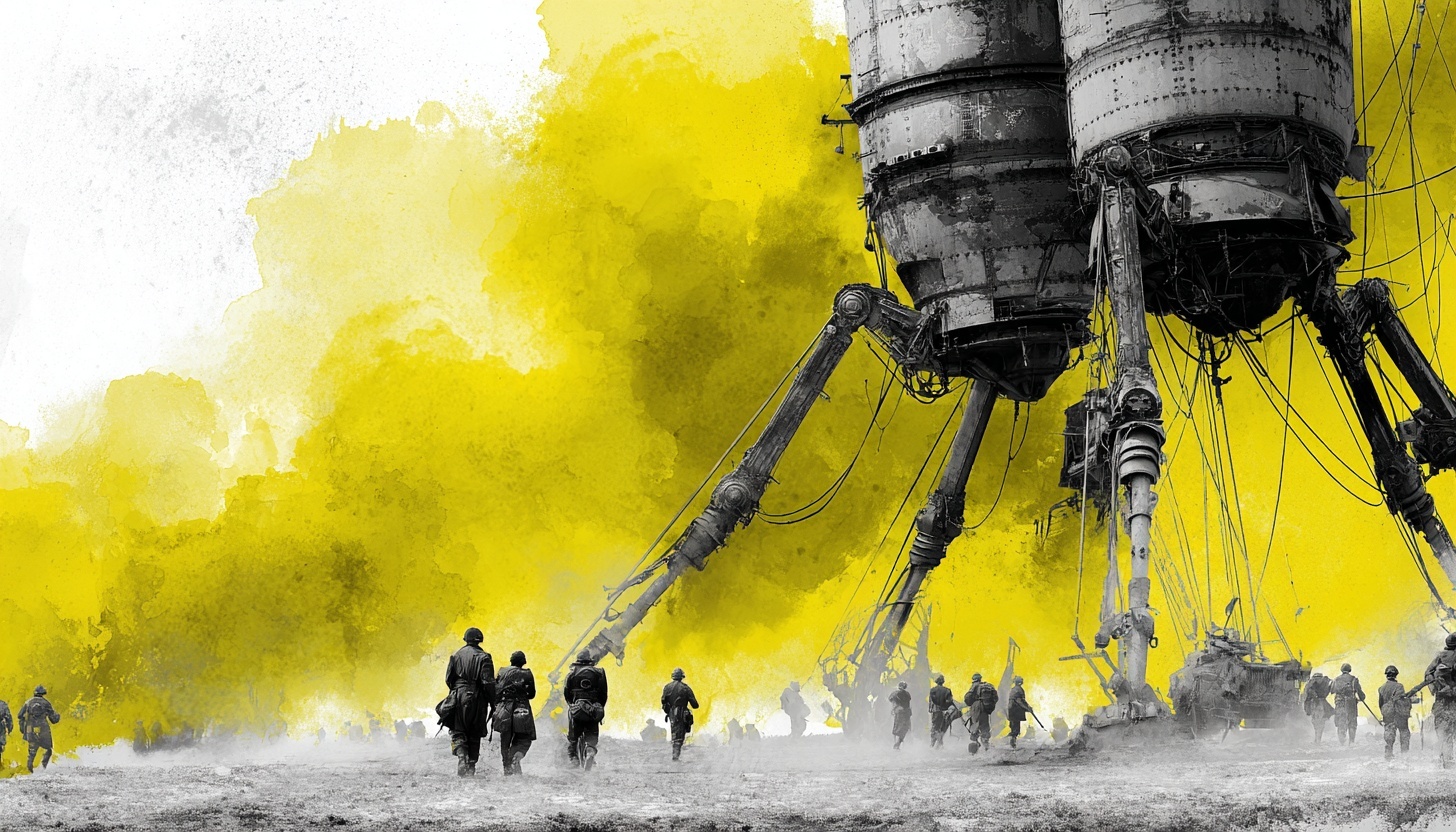
It was well after 2 o’clock in the morning that word finally came, that short, fateful dispatch that loosed terror on the world. It emanated from the fast-crumbling federal government, which had been transferred from Washington to Philadelphia:
PHILADELPHIA, July 24. — Word has been received by the War Department here that the troops defending Wheeling have been severely defeated by the enemy’s fighting-machines, which, using some unknown device, projected a blanket of their deadly gas over the country for several miles ahead of them, nine-tenths of the troops having been killed without seeing the enemy. The remnant of the force has retreated toward Pittsburgh, and it is thought that the fighting-machines have already entered Wheeling. One is believed to have been destroyed by shell-fire early in the engagement, but aside from this they have proved to be quite invulnerable.
No word has yet been received concerning the smaller force of troops detailed to attack the four machines at Stockton, but it is doubtful, if such an attack has already been made, whether it was successful. No one has yet seen the men controlling and operating the fighting-machines, as they seem to stay closely hidden within the latter, but they have shown by their actions that they are quite merciless, so warning is conveyed to the people of the country that when any section of the country is invaded by the enemy in these machines, the only safety at present lies in flight.
Offers of military aid have been tendered this government by several European powers, but until some new and effective weapon can be devised, it will be impossible to meet this unknown foe in battle with any chances of success.
RADIUM AGE PROTO-SF: “Radium Age” is Josh Glenn’s name for the nascent sf genre’s c. 1900–1935 era, a period which saw the discovery of radioactivity, i.e., the revelation that matter itself is constantly in movement — a fitting metaphor for the first decades of the 20th century, during which old scientific, religious, political, and social certainties were shattered. More info here.
SERIALIZED BY HILOBOOKS: James Parker’s Cocky the Fox | Annalee Newitz’s “The Great Oxygen Race” | Matthew Battles’s “Imago” | & many more original and reissued novels and stories.