
THE METAL GIANTS (7)
By:
July 14, 2026

Edmond Hamilton’s The Metal Giants, which features an atom-powered metal brain that constructs a rampaging army of 300-foot-tall robots, first appeared in the December 1926 issue of Weird Tales. HiLoBooks is pleased to serialize the story for HILOBROW’s readers.
ALL INSTALLMENTS: 1 | 2 | 3 | 4 | 5 | 6 | 7 | 8 | 9.
From that point onward, Lanier found the diary almost undecipherable, spotted and torn, with a broken scrawl here and there. There were entries that seemed to indicate that following his discovery of the metal brain’s activities, he had not left the house for several days, brooding over what he had seen. There were wild speculations on his part — he constantly accused himself of having loosed a terror on the world, foresaw a metal horde that would sweep over the earth, destroying, conquering, perhaps swinging out to other planets in its irresistible march, a cosmic metal plague. And all his work?
There was a gap of two days in the entries, and the following notes showed that he had spent those two days crouching near the fortress of the metal brain, observing the activity there. He wrote of the tentacle-machines and claimed that they were merely machines, without any trace of brain or intelligence, simply complex, automatic, and self-powered mechanism that were controlled by the metal brain, perhaps by some intricate form of radio-control. But he wrote also of a thing he had not seen on his first glimpse of the clearing, and that was the existence of the cylinders, as he called them throughout. They were just that, gleaming cylinders of metal, some fifty feet in diameter and half again as much in height, provided with two flexible arms on the same principle as the arms of the metal brain and the tentacles of the working-machines, but much larger and longer. And he believed these cylinders to contain some artificial brain like the one he had built, though not so intelligent, he thought. To think of it! The metal brain was constructing intelligent, similar servants, in addition to the mindless tentacled slave-machines.
There is a note of bitterness in that entry, where he wrote that while the cylinders undoubtedly had been furnished some portion of intelligence by their master, the metal brain, that master had been careful, evidently, not to repeat his own mistake and make them powerful enough to revolt against it. He believed these cylinders to be dependent almost entirely on the metal brain’s commands, thought they had been furnished also with a triple, all-seeing eye, set in a small case on their upper surfaces.
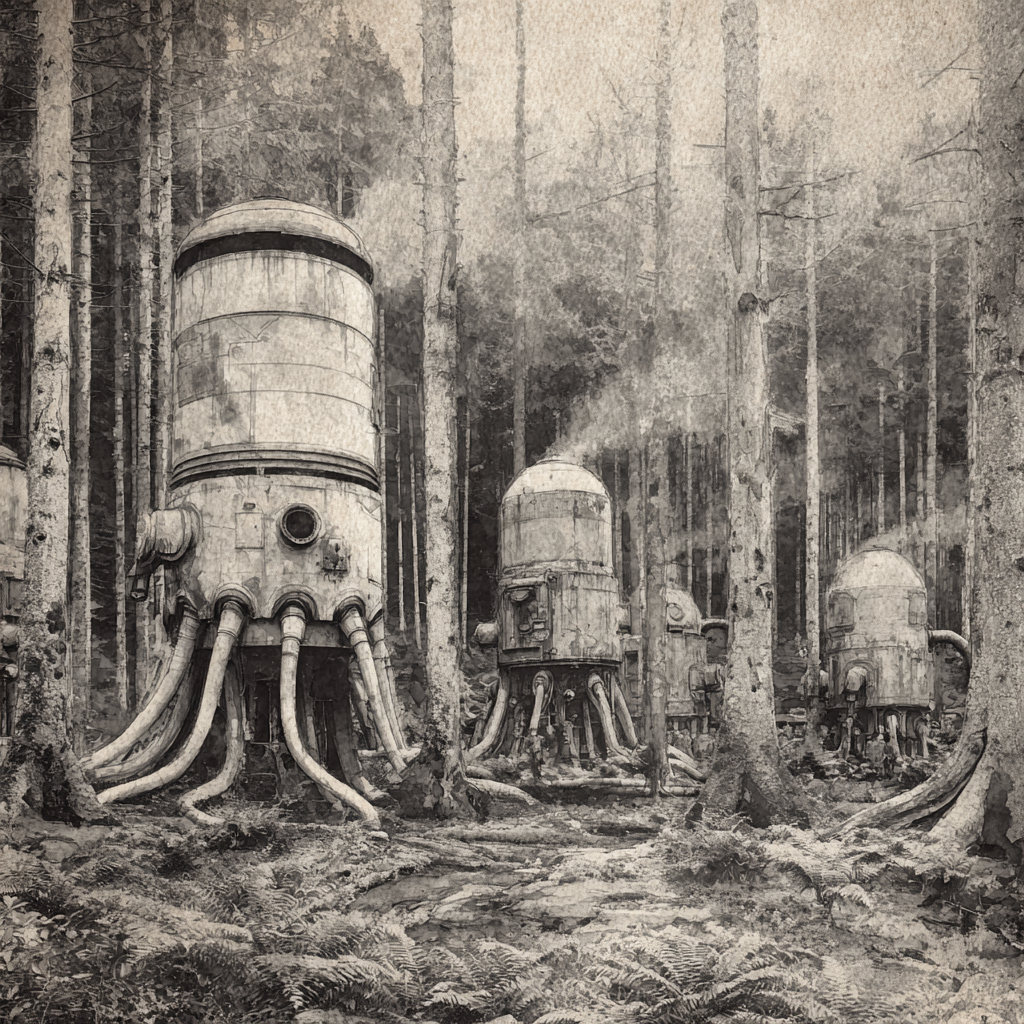
And now it was that Detmold first glimpsed the purpose and plans of the brain. For the tentacle-machines had finished their work, and strewn about the clearing lay a number of gigantic columns of metal, smooth and round, whose purpose he could not understand until he saw one of the cylinders, aided by the working machines and directed by the metal brain, connect the ends of two of those huge columns to its lower surface and then scramble up to a towering height, erect, powerful! Aided by this giant, the other cylinders were soon in position also, and the clearing was filled by a score or more of towering metal giants, who strode about in humanlike steps, under the commands of the comparatively tiny brain beneath.
There was no speculation on his part as to why the metal brain had picked this form for its huge servants, why it had cast on a shape so nearly human. Was it unconscious imitation, mimicry?
For several days Detmold returned to the clearing and saw the metal giants walking about, testing, drilling. Once he narrowly escaped being stepped on by a great limb and thereafter was more careful.. He could not understand the power of locomotion of the things, but set it down to some application of atomic force, discovered by the brain. Almost two weeks after his first discovery of the metal brain’s fort, he returned to find it deserted, the tentacle-machines and the metal-pourer lying in a heap at one side. But after a period of beating through the hills on the tracks of the giant fighting machines, he found the brain’s new camp, a grassy basin in the hills, only a few miles from Stockton, where it sat like a spider in a gigantic web, guarded by the metal giants.
It was then that Detmold saw the immediate purpose of the brain, saw that Stockton was marked for annihilation. The writing at that point was tortured, agonized. What could he do? He never considered bringing a force of men from Stockton to deal with the thing, for best of all men he knew the utter futility of such a course. Nor would the story he told have even been listened to in Stockton. Yet the thing must be crushed, and soon.
It would be best, perhaps, to give the last two entries in the diary in full. The first reads:
“I came back through the former camp of the brain today and spent some time examining the tentacle-machines there. As I thought, they are intricate mechanisms, capable of receiving an outside command and translating it into action, but that is all. I examined, too, the machine that produces molten metal and discovered the principle of the thing. It sucks up ordinary earth and separates the metallic atoms in that earth from the non-metallic, and pours out a constant stream of metal in this way. It is mostly aluminum, but inexplicably hardened and reinforced, probably by addition of outside elements. The principle of the thing is fairly simple and I am beginning to understand the power used to move the metal giants. I think that it could be applied differently, more effectively.”
And a little farther, the very last entry, tremendous in its implications; an entry, Lanier noted, that was dated two weeks before:
“I have just thought, if I were able to control those tentacle-machines, what might be done. And why not? The commands of the metal brain were undoubtedly transmitted to them by some form of radio waves, as is the case also with the cylinder things. And if I could control them in the same manner, would I be able — strike at the center ——”
The entry stopped there, abruptly, and though Lanier thumbed the pages he found no more writing in the little book. His brain was whirling, but in it was a wild hope, half doubting, half believing. Could such a thing ——?
Very carefully he reread certain passages in the diary, striving to calculate the position of the places mentioned. An hour later he was already a few miles from the house, heading toward the spot where he believed was the new camp of the metal brain. Evening was drifting down on the world like a cloud of gray powder, and soon came the thick, obscuring darkness.
That night he slept within a little group of pines, on a heap of gathered boughs, waking only at dawn. He stretched and yawned, then snapped to alertness as a sound came whispering faintly through the forest, a distant, wailing scream.
It came from the direction in which he was heading, and aroused at once, he plunged ahead at top speed. After he had gone the little glade was very silent, except for that distant cry. The chattering birds and squirrels had ceased their tiny clamor, vaguely frightened by the unfamiliar sound. All the creatures of the wild were silent, fearful, listening…
RADIUM AGE PROTO-SF: “Radium Age” is Josh Glenn’s name for the nascent sf genre’s c. 1900–1935 era, a period which saw the discovery of radioactivity, i.e., the revelation that matter itself is constantly in movement — a fitting metaphor for the first decades of the 20th century, during which old scientific, religious, political, and social certainties were shattered. More info here.
SERIALIZED BY HILOBOOKS: James Parker’s Cocky the Fox | Annalee Newitz’s “The Great Oxygen Race” | Matthew Battles’s “Imago” | & many more original and reissued novels and stories.