
GOLIAH (2)
By:
July 17, 2026
Goliah is a 1908 proto-sf novella by Jack London. It depicts a world transformed by a mysterious figure who ushers in a global, socialist utopia — forcing industrialists and politicians to comply. It originally appeared in The Red Magazine (December 1908). HiLoBooks is pleased to serialize the story for HILOBROW’s readers.
ALL INSTALLMENTS: 1 | 2 | 3 | 4 | 5.
Goliah remained silent till March 24. On the morning of that day, the newspapers published his second letter, copies of which had been received by the ten chief politicians of the United States — ten leading men in the political world who were conventionally known as “statesmen.” The letter, with the same superscription as before, was as follows:
“Dear Sir:
“I have spoken in no uncertain tone. I must be obeyed. You may consider this an invitation or a summons; but if you still wish to tread this earth and laugh, you will be aboard the yacht Energon, in San Francisco harbour, not later than the evening of April 5. It is my wish and my will that you confer with me here on Palgrave Island in the matter of reconstructing society upon some rational basis.
“Do not misunderstand me, when I tell you that I am one with a theory. I want to see that theory work, and therefore I call upon your cooperation. In this theory of mine, lives are but pawns; I deal with quantities of lives. I am after laughter, and those that stand in the way of laughter must perish. The game is big. There are fifteen hundred million human lives to-day on the planet. What is your single life against them? It is as naught, in my theory. And remember that mine is the power. Remember that I am a scientist, and that one life, or one million of lives, mean nothing to me as arrayed against the countless billions of billions of the lives of the generations to come. It is for their laughter that I seek to reconstruct society now; and against them your own meagre little life is a paltry thing indeed.
“Whoso has power can command his fellows. By virtue of that military device known as the phalanx, Alexander conquered his bit of the world. By virtue of that chemical device, gunpowder, Cortes with his several hundred cut-throats conquered the empire of the Montezumas. Now I am in possession of a device that is all my own. In the course of a century not more than half a dozen fundamental discoveries or inventions are made. I have made such an invention. The possession of it gives me the mastery of the world. I shall use this invention, not for commercial exploitation, but for the good of humanity. For that purpose I want help — willing agents, obedient hands; and I am strong enough to compel the service. I am taking the shortest way, though I am in no hurry. I shall not clutter my speed with haste.
“The incentive of material gain developed man from the savage to the semi-barbarian he is to-day. This incentive has been a useful device for the development of the human; but it has now fulfilled its function and is ready to be cast aside into the scrap-heap of rudimentary vestiges such as gills in the throat and belief in the divine right of kings. Of course you do not think so; but I do not see that that will prevent you from aiding me to fling the anachronism into the scrap-heap. For I tell you now that the time has come when mere food and shelter and similar sordid things shall be automatic, as free and easy and involuntary of access as the air. I shall make them automatic, what of my discovery and the power that discovery gives me. And with food and shelter automatic, the incentive of material gain passes away from the world for ever. With food and shelter automatic, the higher incentives will universally obtain — the spiritual, æsthetic, and intellectual incentives that will tend to develop and make beautiful and noble body, mind, and spirit. Then all the world will be dominated by happiness and laughter. It will be the reign of universal laughter.
“Yours for that day,
“Goliah.”
Still the world would not believe. The ten politicians were at Washington, so that they did not have the opportunity of being convinced that Bassett had had, and not one of them took the trouble to journey out to San Francisco to make the opportunity. As for Goliah, he was hailed by the newspapers as another Tom Lawson with a panacea; and there were specialists in mental disease who, by analysis of Goliah’s letters, proved conclusively that he was a lunatic.
The yacht Energon arrived in the harbour of San Francisco on the afternoon of April 5, and Bassett came ashore. But the Energon did not sail next day, for not one of the ten summoned politicians had elected to make the journey to Palgrave Island. The newsboys, however, called “Extra” that day in all the cities. The ten politicians were dead. The yacht, lying peacefully at anchor in the harbour, became the centre of excited interest. She was surrounded by a flotilla of launches and rowboats, and many tugs and steamboats ran excursions to her. While the rabble was firmly kept off, the proper authorities and even reporters were permitted to board her. The mayor of San Francisco and the chief of police reported that nothing suspicious was to be seen upon her, and the port authorities announced that her papers were correct and in order in every detail. Many photographs and columns of descriptive matter were run in the newspapers.
The crew was reported to be composed principally of Scandinavians — fair-haired, blue-eyed Swedes, Norwegians afflicted with the temperamental melancholy of their race, stolid Russian Finns, and a slight sprinkling of Americans and English. It was noted that there was nothing mercurial and flyaway about them. They seemed weighty men, oppressed by a sad and stolid bovine-sort of integrity. A sober seriousness and enormous certitude characterized all of them. They appeared men without nerves and without fear, as though upheld by some overwhelming power or carried in the hollow of some superhuman hand. The captain, a sad-eyed, strong-featured American, was cartooned in the papers as “Gloomy Gus” (the pessimistic hero of the comic supplement).
Some sea-captain recognized the Energon as the yacht Scud, once owned by Merrivale of the New York Yacht Club. With this clue it was soon ascertained that the Scud had disappeared several years before. The agent who sold her reported the purchaser to be merely another agent, a man he had seen neither before nor since. The yacht had been reconstructed at Duffey’s Shipyard in New Jersey. The change in her name and registry occurred at that time and had been legally executed. Then the Energon had disappeared in the shroud of mystery.
In the meantime, Bassett was going crazy — at least his friends and business associates said so. He kept away from his vast business enterprises and said that he must hold his hands until the other masters of the world could join with him in the reconstruction of society — proof indubitable that Goliah’s bee had entered his bonnet. To reporters he had little to say. He was not at liberty, he said, to relate what he had seen on Palgrave Island; but he could assure them that the matter was serious, the most serious thing that had ever happened. His final word was that, the world was on the verge of a turnover, for good or ill he did not know, but, one way or the other, he was absolutely convinced that the turnover was coming. As for business, business could go hang. He had seen things, he had, and that was all there was to it.
There was a great telegraphing, during this period, between the local Federal officials and the state and war departments at Washington. A secret attempt was made late one afternoon to board the Energon and place the captain under arrest — the Attorney-General having given the opinion that the captain could be held for the murder of the ten “statesmen.” The government launch was seen to leave Meigg’s Wharf and steer for the Energon, and that was the last ever seen of the launch and the men on board of it. The government tried to keep the affair hushed up, but the cat was slipped out of the bag by the families of the missing men, and the papers were filled with monstrous versions of the affair.
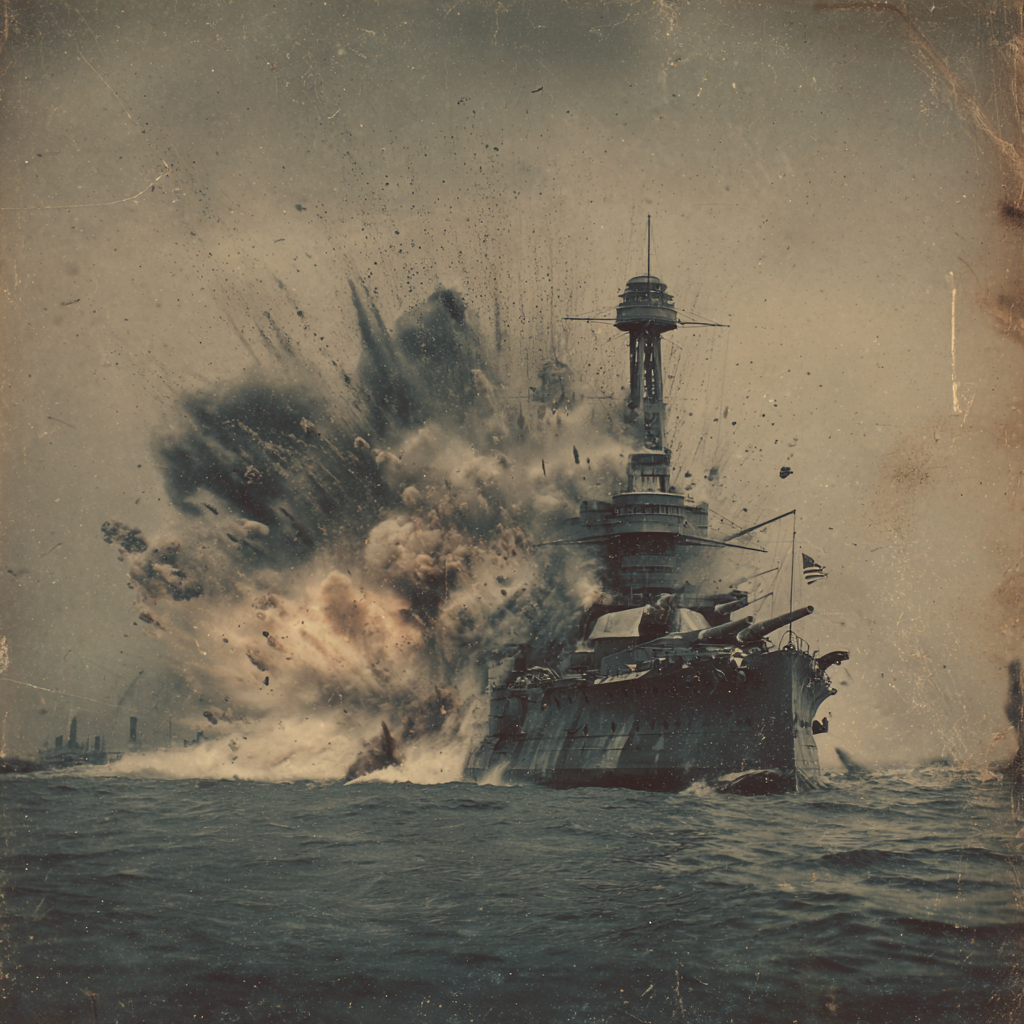
The government now proceeded to extreme measures. The battleship Alaska was ordered to capture the strange yacht, or, failing that, to sink her. These were secret instructions; but thousands of eyes, from the water front and from the shipping in the harbour, witnessed what happened that afternoon. The battleship got under way and steamed slowly toward the Energon. At half a mile distant the battleship blew up — simply blew up, that was all, her shattered frame sinking to the bottom of the bay, a riff-raff of wreckage and a few survivors strewing the surface. Among the survivors was a young lieutenant who had had charge of the wireless on board the Alaska. The reporters got hold of him first, and he talked. No sooner had the Alaska got under way, he said, than a message was received from the Energon. It was in the international code, and it was a warning to the Alaska to come no nearer than half a mile. He had sent the message, through the speaking tube, immediately to the captain. He did not know anything more, except that the Energon twice repeated the message and that five minutes afterward the explosion occurred. The captain of the Alaska had perished with his ship, and nothing more was to be learned.
The Energon, however, promptly hoisted anchor and cleared out to sea. A great clamour was raised by the papers; the government was charged with cowardice and vacillation in its dealings with a mere pleasure yacht and a lunatic who called himself “Goliah,” and immediate and decisive action was demanded. Also, a great cry went up about the loss of life, especially the wanton killing of the ten “statesmen.” Goliah promptly replied. In fact, so prompt was his reply that the experts in wireless telegraphy announced that, since it was impossible to send wireless messages so great a distance, Goliah was in their very midst and not on Palgrave Island. Goliah’s letter was delivered to the Associated Press by a messenger boy who had been engaged on the street. The letter was as follows:
“What are a few paltry lives? In your insane wars you destroy millions of lives and think nothing of it. In your fratricidal commercial struggle you kill countless babes, women, and men, and you triumphantly call the shambles ‘individualism.’ I call it anarchy. I am going to put a stop to your wholesale destruction of human beings. I want laughter, not slaughter. Those of you who stand in the way of laughter will get slaughter.
“Your government is trying to delude you into believing that the destruction of the Alaska was an accident. Know here and now that it was by my orders that the Alaska was destroyed. In a few short months, all battleships on all seas will be destroyed or flung to the scrap-heap, and all nations shall disarm; fortresses shall be dismantled, armies disbanded, and warfare shall cease from the earth. Mine is the power. I am the will of God. The whole world shall be in vassalage to me, but it shall be a vassalage of peace.
“I am
“Goliah.”
PS: Tom Lawson was a Boston businessman whose Amalgamated Copper Mining Company (which became the Anaconda Copper Mining Company) nearly dominated the copper market. Lawson broke with the financial backers of Amalgamated and became an advocate for financial reform. His 1906 book Frenzied Finance, the Crime of Amalgamated was sensationally successful. — ed.
RADIUM AGE PROTO-SF: “Radium Age” is Josh Glenn’s name for the nascent sf genre’s c. 1900–1935 era, a period which saw the discovery of radioactivity, i.e., the revelation that matter itself is constantly in movement — a fitting metaphor for the first decades of the 20th century, during which old scientific, religious, political, and social certainties were shattered. More info here.
SERIALIZED BY HILOBOOKS: James Parker’s Cocky the Fox | Annalee Newitz’s “The Great Oxygen Race” | Matthew Battles’s “Imago” | & many more original and reissued novels and stories.