
THE METAL GIANTS (4)
By:
June 18, 2026
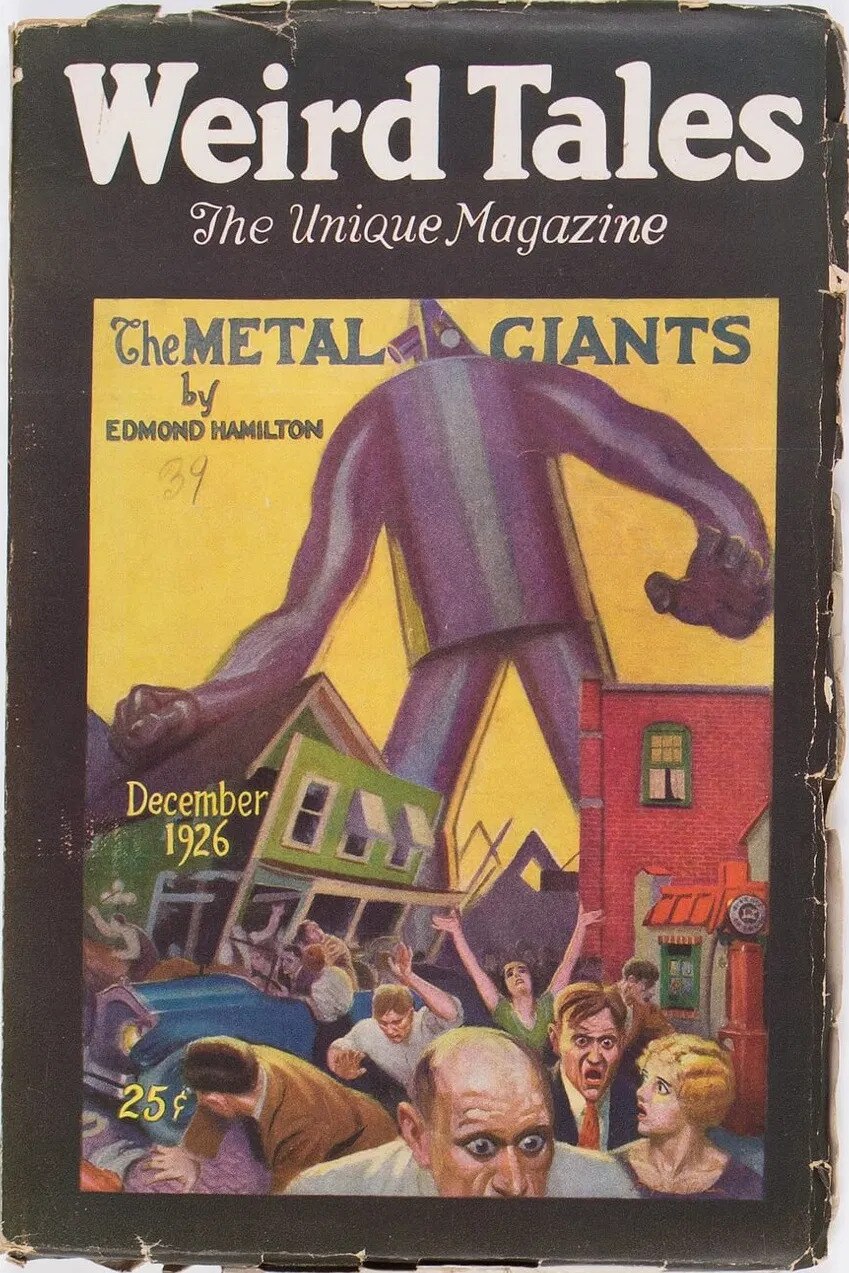
Edmond Hamilton’s The Metal Giants, which features an atom-powered metal brain that constructs a rampaging army of 300-foot-tall robots, first appeared in the December 1926 issue of Weird Tales. HiLoBooks is pleased to serialize the story for HILOBROW’s readers.
ALL INSTALLMENTS: 1 | 2 | 3 | 4 | 5 | 6 | 7 | 8 | 9.
The sun had slipped down very near the horizon when a sudden jangling of bells ran through Stockton, hurried, confused. The factory whistles blew frantically for a few minutes, then suddenly, unaccountably stopped. A cry, a shout was running over the city, swift as spreading flame, and everywhere houses belched forth their inmates and people looked anxiously about for the cause of disturbance. And then they looked up to the hills and saw their doom.
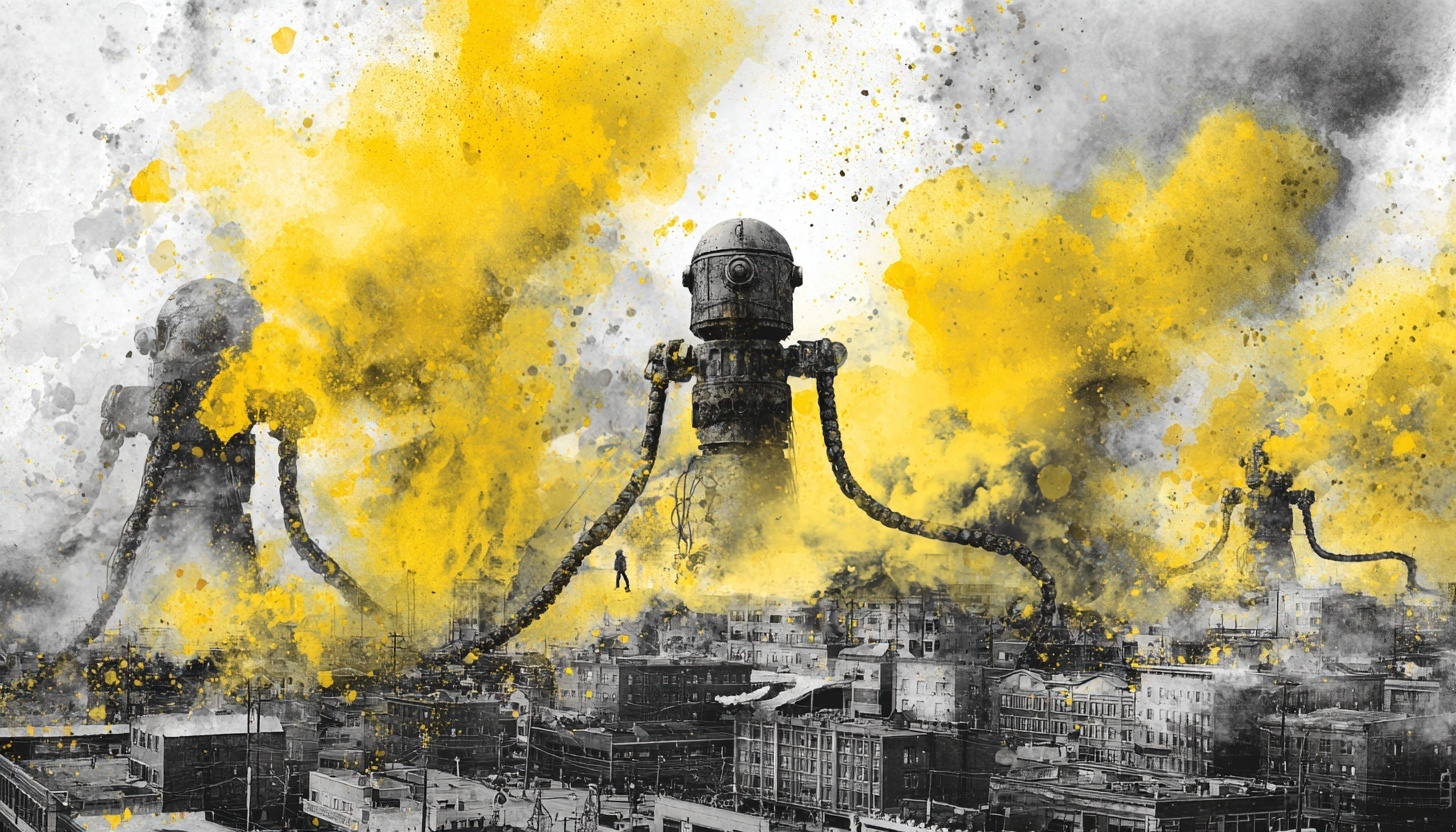
For on the heights around Stockton, in a great circle, stood a score or more of gigantic shapes, silent, motionless. They seemed quite identical in appearance, towering metal giants cast in a roughly human form, each with two immense limbs, smooth columns of metal ten feet across, looming up all of a hundred yards in height. And set on those two huge supports, the body, an upright cylinder of the same gleaming metal, fifty feet in diameter, quite smooth and unbroken of surface, and bearing on its smooth top something that flashed brilliantly in the sunlight, a small, triangular case in each side of which glittered a lens of glass. And from each cylinder projected two additional limbs, arms, shining and flexible, hanging almost to the ground, tapering, twisting.
The bells had stopped ringing, and in thick, stupefied silence the people in the streets gazed up at the metal giants, who surveyed them in equal immobility and silence. Then from one of their number sounded a weird call, a harsh, wailing sound that rose to a high-pitched scream. And at that signal all of the things began to stride swiftly down to the city, the mighty limbs whirling out and crashing down in steps of unbelievable length, buckling and straightening and whirling out in another step. Rapidly, inexorably, they closed in on Stockton, a diminishing, tightening circle.
That stunned moment of sheer astonishment fled, and a vast, hoarse bellow sounded, the mad shout of thousands of panic-stricken people. Down the streets raced careering autos, ripping through crowds of hapless pedestrians, driving into the mass of tangled wrecks that blocked every corner in a few minutes. Screaming, pushing, striking, the mobs flowed along the streets, striving always to win away from the city’s central section and escape into the surrounding country. And all the while, with thundering, earth-shaking strides, the metal shapes marched on toward the city.
On and on they came, until they had reached the outer suburbs, looming up above the buildings like giants in a toy village. The long, flexible arms were whipping out now, with tremendous power. Smash! — and a small brick building toppled. Smash! — a giant limb crashed down through a bungalow. Smash! smash! smash! — on and on, slowly, deliberately, reducing the city to ruins.
They made but small effort to kill the screaming little figures that ran about beneath them, but they let few of these escape outside their circle, herding them always toward the center of the city, as they closed in on it.
Nearly an hour had passed before that ring of giants had contracted to a mile diameter. Inside of it the streets were solidly packed with people, and the buildings were full to bursting, the supposedly safer cellars being pools of suffocating, trampling humanity.
Around was ranged the circle of the metal shapes, and for a moment they seemed to be contemplating the tiny, frenzied throngs beneath them. Again sounded the wailing signal, and each of the things seemed to be fumbling behind itself with a flexible arm, an arm that reappeared grasping a small, black sphere. In unison, they thrust forward these globes, from each of which a cloud of yellow gas instantly spurted, falling on the crowds beneath, flowing over and through them, a saffron flood that rolled on through the buildings and down into the packed cellars.
Wherever it touched, the people sank into death, slumping down like bags of sawdust, suddenly limp and inert. And the faces of the dead were dreadful to see, shrunken, collapsed, like shriveled masks of skin.
Swiftly the gas flowed away and sank into the ground, and the heaps of bodies were revealed, silent and unmoving, a strange contrast to the shouting and running of the moment before. Then smash! smash! — and the huge limbs were jerking out and crashing buildings down, kicking them over, pushing them aside, covering the mounds of dead with a tangled mass of broken bricks and twisted steel.
The metal giants strode away, here and there crushing a building, uprooting a track, moving toward the eastern end of the valley, whose inhabitants had seen and were fleeing in terror. And one man had seen who did not flee, a man whose face was stamped with horror. It was Lanier, and from his distant hill-top he looked down on a mass of broken ruins where on hour before had been a bustling city.
As he watched, darkness flowed down on the city, veiling its shattered remnants. He heard distant shouts snapping out, up the valley, where the metal shapes had gone. He could hear, too, a humming drone, as an airplane came and went and circled over the broken city, hovering for a time, then winging away toward the north. For some minutes he continued to peer into the deepening darkness, then rose stiffly from his crouched position and stumbled back into the forest, moving as a man in a daze. His brain held but one thought, his lips uttered but one word: “Detmold!”
RADIUM AGE PROTO-SF: “Radium Age” is Josh Glenn’s name for the nascent sf genre’s c. 1900–1935 era, a period which saw the discovery of radioactivity, i.e., the revelation that matter itself is constantly in movement — a fitting metaphor for the first decades of the 20th century, during which old scientific, religious, political, and social certainties were shattered. More info here.
SERIALIZED BY HILOBOOKS: James Parker’s Cocky the Fox | Annalee Newitz’s “The Great Oxygen Race” | Matthew Battles’s “Imago” | & many more original and reissued novels and stories.