
THE METAL GIANTS (2)
By:
June 6, 2026
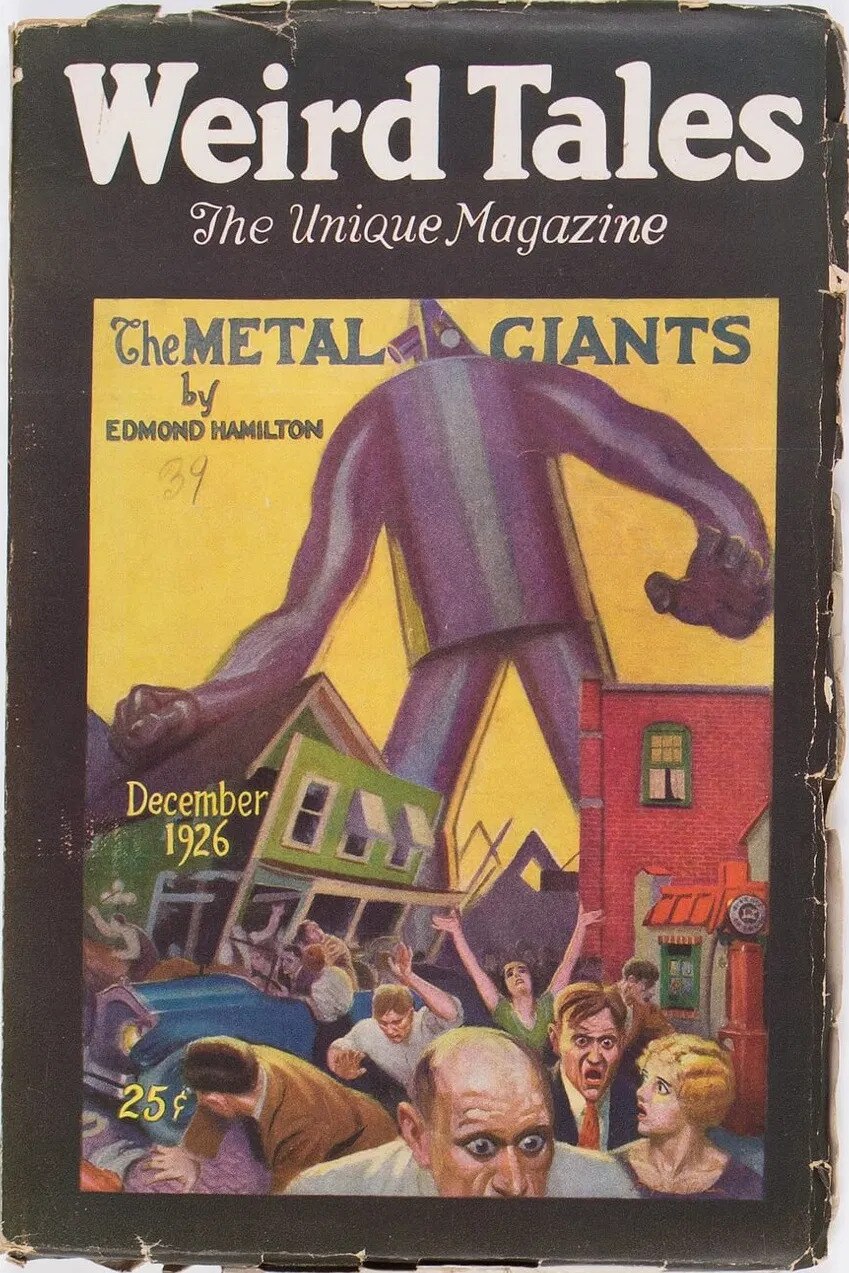
Edmond Hamilton’s The Metal Giants, which features an atom-powered metal brain that constructs a rampaging army of 300-foot-tall robots, first appeared in the December 1926 issue of Weird Tales. HiLoBooks is pleased to serialize the story for HILOBROW’s readers.
ALL INSTALLMENTS: 1 | 2 | 3 | 4 | 5 | 6 | 7 | 8 | 9.
It was fully four years after Detmold’s disappearance that the strange phenomena at Stockton began to attract attention. Stockton was a small steel town in northern West Virginia, set in a long valley between dark, thickly wooded hills, and from those hills came news of mysterious occurrences.
The first thing to reach the newspapers was a small article printed early in July, telling of some very curious ground-markings that had been discovered several miles west of Stockton. These marks were circles some ten feet across in which trees, bushes and ground had evidently been stamped down by some tremendous force, forming circular pits in the ground some three feet in depth. A number of these strange pits had been found by farmers, and no one seemed able to advance a plausible suggestion as to their cause.
The article was published throughout the country, but as no further news on the matter was immediately forthcoming, it was forgotten in a week, as stranger incidents have been forgotten.
Ten days passed before the second Stockton dispatch was printed, an article that caused a good many smiles. This dispatch told of a farmer named Morgan who lived in the hills north of the city, a wild, lonely district, and who had suddenly appeared in Stockton with his family and few possessions packed into a ramshackle Ford, intent on departing from the vicinity as soon as possible. When questioned as to the cause of his sudden migration, he told a very strange story.
Two nights before, he said, he had been awakened shortly after midnight by a crashing, snapping sound outside. His small house was set on the steep side of a narrow, winding valley, and the noise seemed to come from the forests at its foot. His curiosity aroused, he had stepped out on his little porch and had dimly seen, in the moonlight, a gigantic shape that was moving along the valley.
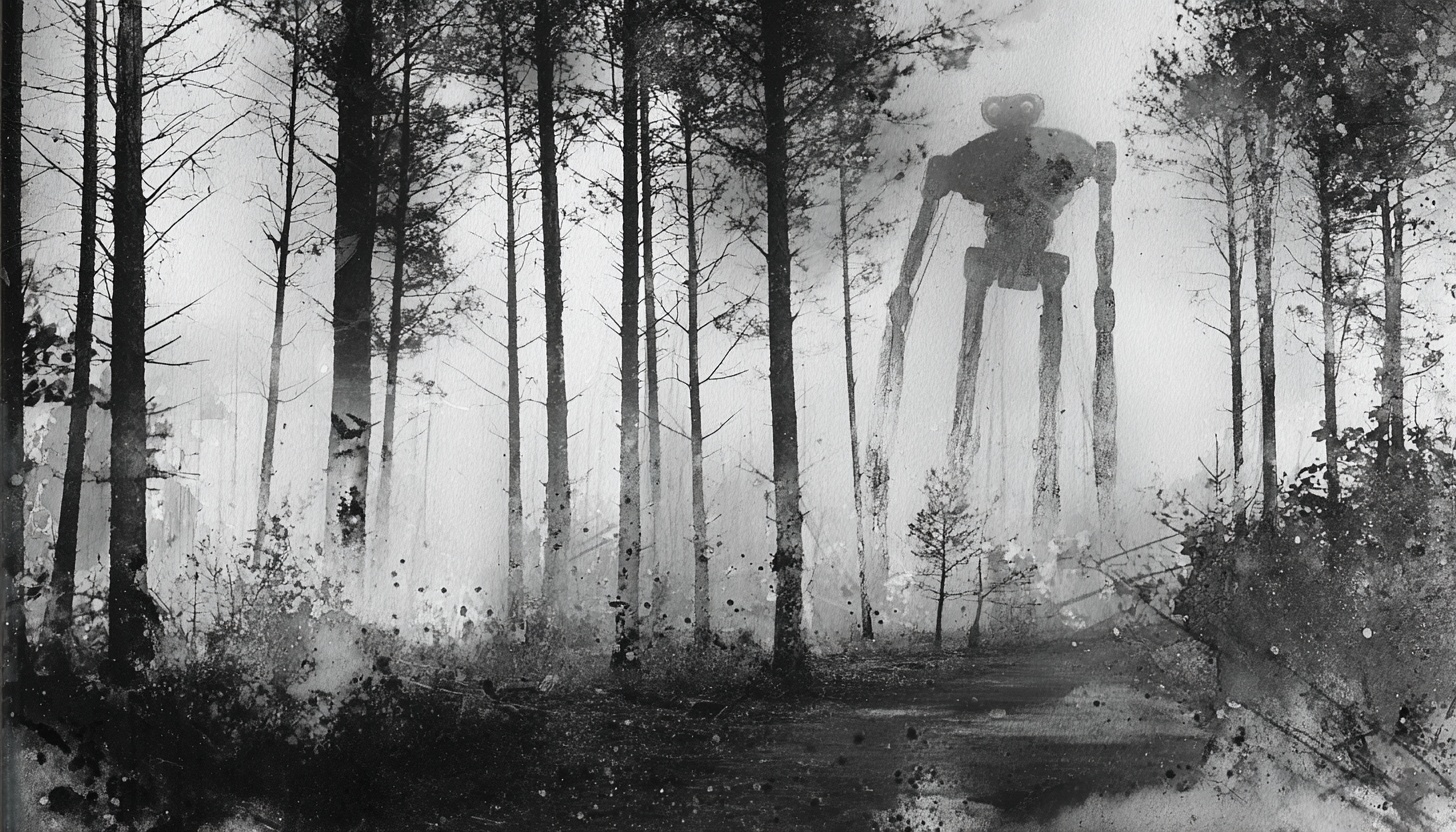
He described it, very vaguely, as being a monstrous parody of a human figure, with two huge legs or supports, all of three hundred feet in height, and for body, a large, cylindrical mass. It gleamed in the moonlight, he said, as if it were made of metal. It was striding down the valley in a stiff, immense imitation of the human step, and he could see that its towering limbs or supports, which buckled and straightened midway, like a human knee, were crushing the forest beneath them like a forest of twigs. Only one hurried, misty glimpse of the thing he got, and it disappeared around a turn in the valley, but when he explored the next morning he found its tracks, shallow, circular pits, identical in appearance with the strange markings that had already been found.
There was a good deal of amusement in Stockton over this tale, though Morgan sullenly asserted its truth. When it was reprinted throughout the country, the Story was generally accompanied by some humorous comment regarding the powers of West Virginia moonshine, and the progressiveness of the day, when tipplers now saw weird machines instead of the traditional serpents.
But the next day, after Morgan and his family had clattered out of Stockton in the rickety little car, it occurred to an inquisitive newspaper reporter to drive out to the valley and gather some information — not that he put any faith in Morgan’s story, but in order to get the views of the man’s former neighbors, the farmers of that section.
Early that evening the reporter returned, and the news he brought set Stockton buzzing with conjecture and argument. For he had not only found the markings Morgan had described, he had definitely ascertained that before the night in question no such marks had been seen in the little valley. And the few families who made their homes in that district were not laughing over the matter, but seemed considerably perturbed. All of them testified as to Morgan’s sobriety and truthfulness, and one household added a corroborating occurrence of a few days before, when an eight-year old son had returned from a ramble in the hills with a twisted, childish story of having seen “a big tin man” a long way off.
Such was the information the reporter brought back, and it caused excited discussion through all the town. Was such a thing possible? Could Morgan’s story have been true? But if so, if such a thing had actually been seen, what was it? Machine, vehicle, what? No, it could not be true, there must be some mistake, some exaggeration. And yet —
The wires out of Stockton were humming that night, and in Boston and Duluth and Fort Worth, the next morning, people were to read and wonder. It was a new sensation, and they waited with interest for further news. Whatever happened, the reporters would get it and serve it up in their daily paper, with photographs made on the spot and a diagram to make it all clear.
Until late that night the city’s principal streets were quite crowded, and there was constant discussion and speculation. For the first time, Stockton was finding itself a center of national interest, and it was very proud of its sudden fame.
Once, an hour before midnight, a great light was seen above the northern hills, a brilliant shaft of purple light that swept across the sky like a gigantic, flaming finger, then faded into the darkness. The crowds in the streets saw and marveled. For some time they watched, but it was not seen again, and the blackness of the night seemed to close around the city like a giant hand.
From the steel mills, great tongues of red flame shot up, soaring, beautiful, conveying a warm quality of reassurance against the vast, brooding darkness. The mighty furnaces and towers, standing out black and austere against the glare of molten steel, held within them a calm, silent encouragement, as if proclaiming the greatness and power of their builder, man. But the flame-shot sky behind them, like blood…
RADIUM AGE PROTO-SF: “Radium Age” is Josh Glenn’s name for the nascent sf genre’s c. 1900–1935 era, a period which saw the discovery of radioactivity, i.e., the revelation that matter itself is constantly in movement — a fitting metaphor for the first decades of the 20th century, during which old scientific, religious, political, and social certainties were shattered. More info here.
SERIALIZED BY HILOBOOKS: James Parker’s Cocky the Fox | Annalee Newitz’s “The Great Oxygen Race” | Matthew Battles’s “Imago” | & many more original and reissued novels and stories.