
THE METAL GIANTS (1)
By:
May 29, 2026
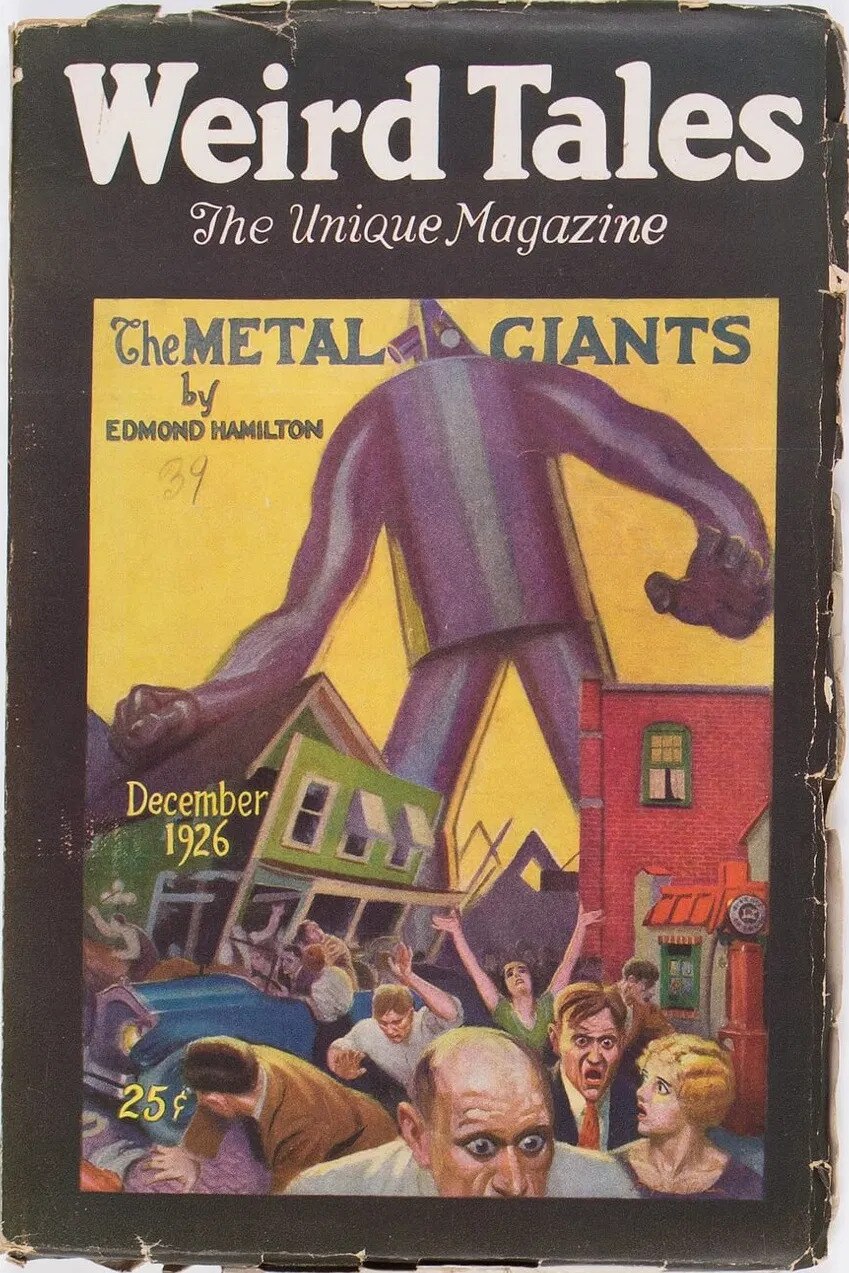
Edmond Hamilton’s The Metal Giants, which features an atom-powered metal brain that constructs a rampaging army of 300-foot-tall robots, first appeared in the December 1926 issue of Weird Tales. HiLoBooks is pleased to serialize the story for HILOBROW’s readers.
ALL INSTALLMENTS: 1 | 2 | 3 | 4 | 5 | 6 | 7 | 8 | 9.
As to the beginning of the matter, there is information in plenty. Dusty files of yellowing newspapers yield columns about it, for it was a mild sensation at the time. And concerning the appalling climax of the business, when the machine-monsters burst upon an incredulous world, there are but few who need to be informed. But what of the four years between, when that monstrous menace to humanity lay hidden in the West Virginia hills, germinating, growing, reaching? Will anything more of that time ever be known than a few scrawled pages in a little diary? Shall we ever comprehend much of the story but the petty furor of its beginning and its flaming, tragic end? Well, to that beginning.
One starts with Detmold. a professor of electro-chemistry, a rather unusual professor, who was constantly advancing radical, astounding theories in almost every branch of science. A few of his theories he proved, but most of them were unprovable, wild, untrammeled speculations. Today his suggestions are genuinely interesting and stimulating, but at the time it seemed that his experiments, his statements, were becoming more and more fantastic, calling forth an ever-increasing flood of shocked protests from outraged scientists. And this was not at all to the liking of Juston University, where he taught. Juston is the third oldest college in the country, and has an ancient, scholarly tradition that it takes very seriously.
So when complaints began to come in from some of the more prosperous alumni, possible donors of buildings and the like, the middle-aged gentlemen who directed the university’s policy met around a mahogany table and decided that Detmold must be removed from the institution at the first opportunity, as quietly as possible. And the next morning, as if to confirm the wisdom of their decision, Detmold announced the partial success of his latest experiment, which was the making of an artificial brain.
It was a supreme chance for the sensation-mongering Sunday supplements, for the gibing columnists, and they seized it at once. Detmold’s brain, as it was called, was derided in the theaters, cartooned in the newspapers, and jeered at by his fellow scientists. And yet, reading over the man’s ideas now, it is hard for us to detect any flagrant absurdity.
No doubt it was a startling proposition, to construct an artificial brain that would possess consciousness, memory, reasoning power. That mass of fiber inside our skulls by virtue of which we comprehend the world about us is a seemingly unsolvable mystery. Yet even such an idea as Detmold’s, advanced by a man of his admitted intellect and achievements, should have been given a fair hearing, at least.
In fact, experimenters had already tried to reproduce the make-up of the brain. Several scientists, following up the work of Loeb and Kendler in their efforts to manufacture living protoplasm from chemicals, had tried to produce a mass of living cells, with which to form a living organ, a heart or a brain. All such efforts had been failures, and it was admitted that success seemed impossible.
But Detmold had attacked the problem from an entirely different standpoint. It was his theory that the sensations of the nervous system are flashed to the brain as electric currents, or vibrations, and that it was the action of these vibratory currents on the brain-stuff that caused consciousness and thought. Thus, instead of trying to make simple, living cells and from them work up the complicated structure of the brain, he had constructed an organ, a brain, of metal, entirely inorganic and lifeless, yet whose atomic structure he claimed was analogous to the atomic structure of a living brain. He had then applied countless different electrical vibrations to this metallic brain-stuff, and finally announced that under vibrations of certain frequency the organ had shown faint signs of consciousness.
To the public of that time, such an assertion must have seemed quite insane. The usual comment on the subject was that if this were a sample of Detmold’s ideas, he had best keep the first brain he manufactured for his own use. And Detmold’s own attitude did not help his case, for he was an impatient, high-tempered type, prone to regard as fools and asses all those people who expressed any doubt concerning his work.
Three eminent scientists accepted his invitation to witness a demonstration of his experiment, and their comments later were caustic. It would seem that when the three illustrious gentlemen called at his laboratory at the appointed hour, Detmold had bruskly informed them that he was working out a sudden new idea concerning the experiment, and that they would have to call a few days later, by which time he hoped to have achieved complete success.
Naturally, that was the end of him at the university. It was plain to everyone that the man was a cheap faker who had warded off investigation and exposure at the last moment, and a cry went up that he should be removed from the institution he was disgracing. At the year’s biggest football game the next afternoon, when Juston played Bannister College, ten enterprizing students rushed onto the field between halves and unrolled a large cloth banner, with the painted words, “Fire Detmold!” A wave of applause and laughter rippled across the stadium at sight of it.
And after the game, the football team, become heroes of the hour by their victor over Bannister, marched together to the home of the university’s president and presented him with a petition demanding the summary dismissal of the professor whose charlatanry was smirching the name of Juston. The president smilingly accepted the document.
So the next morning, after an hour of nervous fidgeting and snapping of fingers, the president summoned Detmold and smoothly informed him that his resignation would be accepted.
There was a stormy scene in that office when Detmold learned that he was to be shunted out of the university. He was a tall, powerful man with a keen, relentless face, and in his rage he came near to laying violent hands on the president, and said a number of scathing things regarding that individual’s stupidity and cowardice, winding up with a red-hot denunciation of the world at large. When he burst out of the office, he thrust rudely through the little knot of curious listeners at the door, and hurried over to his laboratory, to begin packing the experiment that had caused his dismissal.
It was there that he was found an hour later by Gilbert Lanier, the one instructor at Juston who understood and sympathized with the man. Also Lanier, a diffident young English teacher, was probably Detmold’s only friend, for Detmold seemed to have no close relatives at all, and his testy, high-strung nature repelled most people. Sitting on a desk, moodily contemplating the little room that had been his private laboratory for years, he told Lanier of his dismissal, raging the while at the president and his disapproval of “impossible theories”.
“Impossible theories!” he mocked.
“My God, and I used to think that a great scientific discovery was welcomed with open arms! And these fools think I am crazy, to work on such a thing at all! Look at this, Lanier, — you haven’t seen it since I made the improvements,” and he turned to a table on which rested the artificial brain.
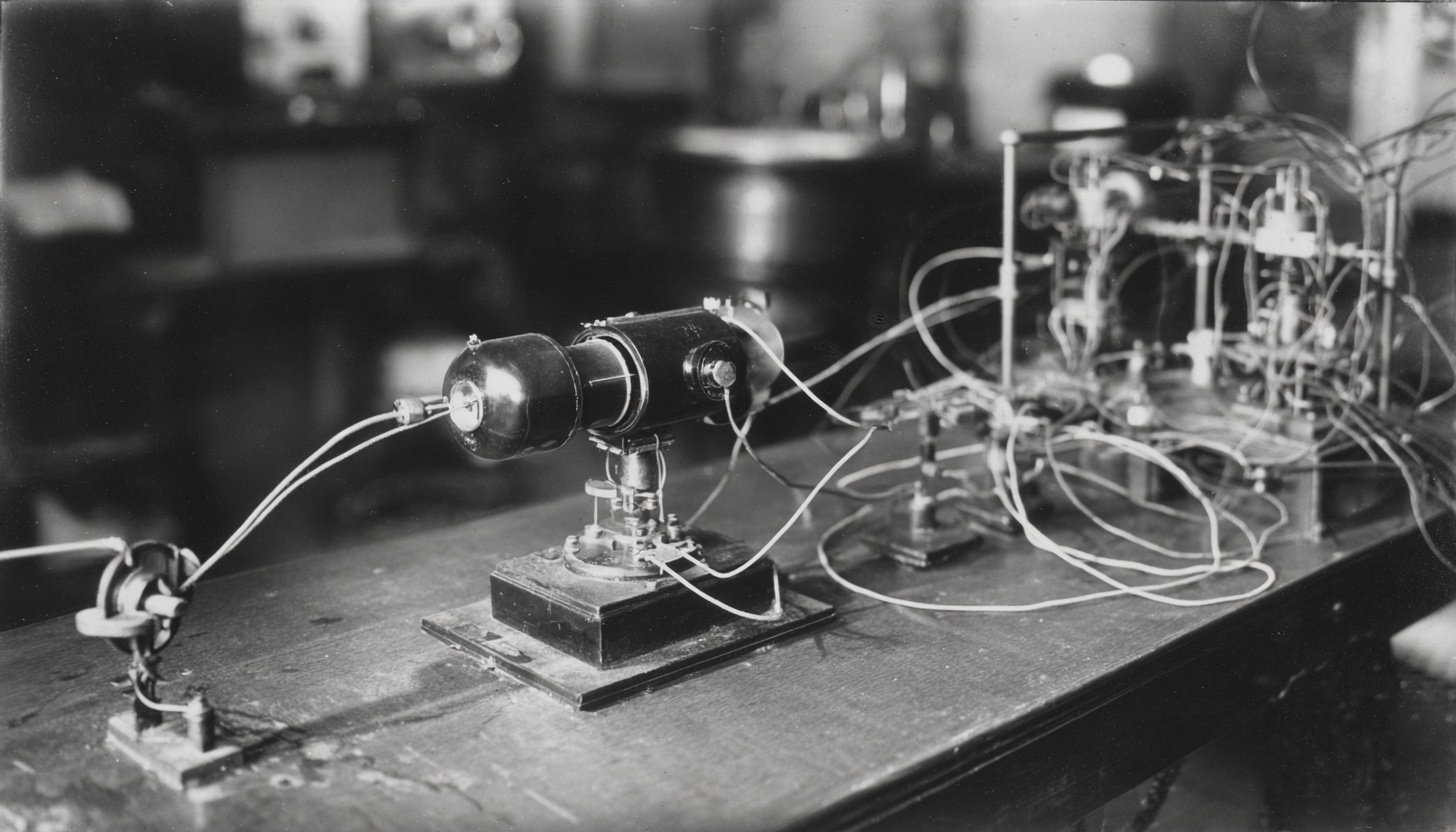
It was very simple in appearance, resembling an egg of black metal, some ten inches in length. Inset in its upper surface was a small lens of glass, and leading into each end of the thing were three wires, which were connected to a complicated tangle of electrical apparatus on the other side of the room.
As Lanier watched, Detmold made swift adjustments and snapped on several switches, and the low humming of a motor-generator filled the room. Turning eagerly, his smoldering resentment forgotten for the moment, he said, “The same basic principle. The T-wave, the vibratory current, is produced over there and led into the brain-case to act on the atomic organism inside. Right now that thing is conscious,” and he gazed at it with mingled fondness and pride.
Lanier could not restrain an incredulous shrug of his shoulders, and Detmold took it up at once. “I repeat, conscious,” he asserted. “It is consciousness of a crude, dim sort, but still consciousness, awareness, knowledge. And I can prove it now. Since you last saw it I’ve provided it with the sense of sight. See that inset lens? Well, it’s like no lens you ever saw, for it’s really an artificial eye, that I made myself. There is an artificial retina beneath and it is connected direct to the brain-stuff, and carries its sensations to it, as electric currents.”
“An artificial retina?” asked Lanier. “Isn’t that going a bit too far? An inorganic material sensitive to light?”
“Did you never hear of a substance called selenium?” asked Detmold with fine sarcasm, and as Lanier started, he added, “Ah, you begin to see! You remember that the electrical resistance of selenium varies enormously in light and in darkness, and you begin to perceive how the light striking that artificial retina could be translated into electricity and flashed to the brain. It is all so clear — now. But I was telling you about the eye. There’s a shutter that closes across that lens, much like a high-speed camera shutter, but capable of being opened or closed by an inconceivably delicate force. I’m not going to tell you all about it, you or anyone, but watch it now,” and taking a small flashlight from his pocket, he flashed its brilliant little beam directly on the inset lens.
Lanier watched intently. There was no change for a space of seconds, then, with a tiny click, the shutter closed across the lens. He drew a long breath as he straightened up.
“You saw?” asked Detmold, snapping off the switches. “The thing can see with that eye, just enough to differentiate between light and dark, and it hates bright light, so what? It closes the shutter, cutting off the light. Isn’t that intelligence, mind, reason? Crude and feeble now, I grant you, but it will grow. I will develop it. I’ll go farther yet.” His voice dropped, and the brooding, sullen expression crept back over his face. “And yet those fools say, ‘Impossible, impossible!’ Damn them, this metal brain has more intelligence than they. Or it will have. It will have.” As his friend remained silent he asked, “Do you think I am faking it, Lanier?”
“No,” was the slow answer, “but I do think you’re treading very near forbidden ground. That movement — that intelligence — have you considered, Detmold, what an intelligence might be like, that had no controlling, directing power, a brain without a soul?”
“Theology, mysticism!” cried the other. “No, Lanier, I am going on with this, if only to show these fools the depth of their folly. I have a place where I can work in peace, thank God, and where the confounded newspapers won’t pester me, for I’ll tell no one where I’m going. No, not even you,” he added, clapping his friend on the back affectionately, “for you might talk in your sleep. But when I finish it, you’ll hear from me. And so will the world.”
Lanier did not reply, and in silence they began the work of packing. And the next day, when they stood on the station platform in the last few minutes before the train’s departure, there seemed little to say. The whistle of the locomotive, a last clasp of Detmold’s hand and a muttered “Good-bye,” and the train was receding swiftly down the track, and he was gone.
More than one person wondered where Detmold had gone. His name was prominent in the newspapers that night, was mentioned often in homes and clubs and restaurants, with a chuckle or a sneer. It was not mentioned so much the next night; a month afterward it was seldom heard; and in a year not one person in ten thousand remembered the man. None knew where he had gone, his name and personality and strange ideas had sunk into silence and forgetfulness; and laughing, toiling, hurrying, the world sped on.
RADIUM AGE PROTO-SF: “Radium Age” is Josh Glenn’s name for the nascent sf genre’s c. 1900–1935 era, a period which saw the discovery of radioactivity, i.e., the revelation that matter itself is constantly in movement — a fitting metaphor for the first decades of the 20th century, during which old scientific, religious, political, and social certainties were shattered. More info here.
SERIALIZED BY HILOBOOKS: James Parker’s Cocky the Fox | Annalee Newitz’s “The Great Oxygen Race” | Matthew Battles’s “Imago” | & many more original and reissued novels and stories.