
OMAC YOUR ENTHUSIASM (5)
By:
April 17, 2026
One in a series of enthusiastic posts, contributed by 25 HILOBROW friends and regulars, analyzing and celebrating our favorite… Seventies (1974–83) sci-fi novels and comics! Series edited by Josh Glenn.
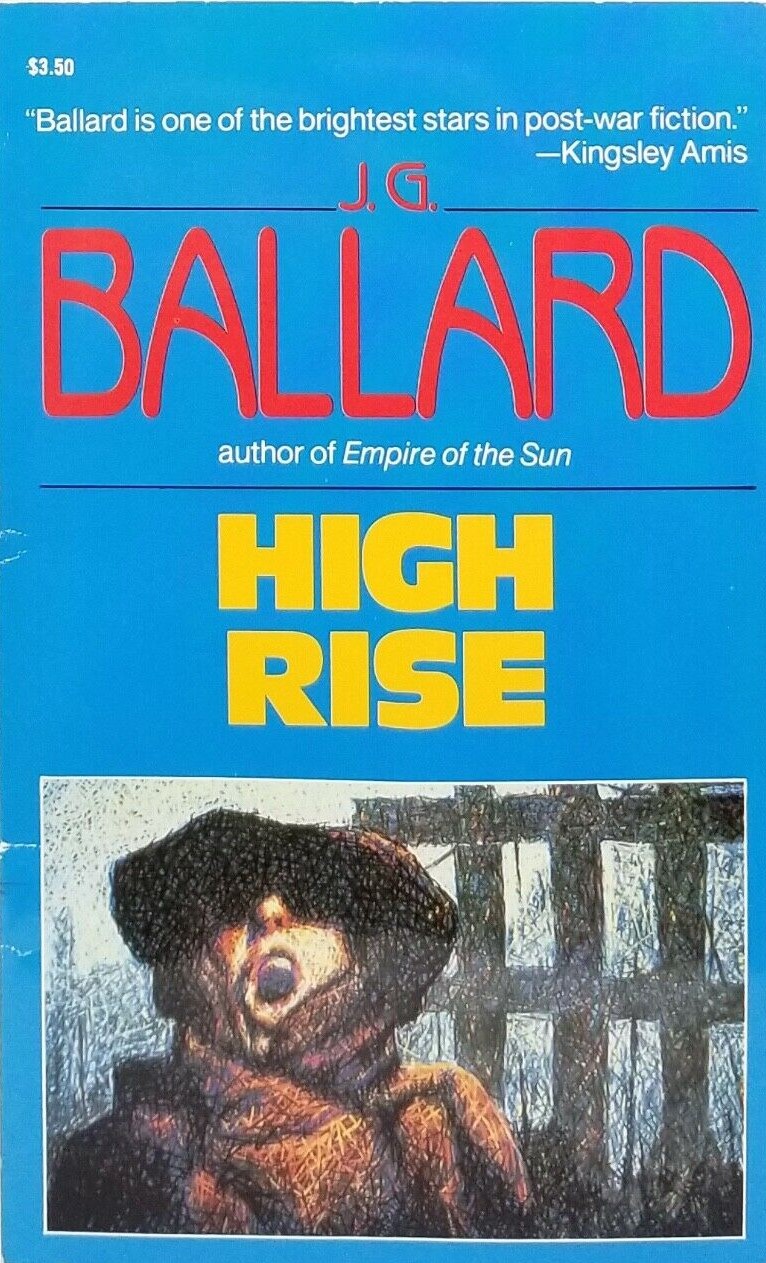
HIGH-RISE | J.G. BALLARD | 1975
J.G. Ballard’s High Rise (1975) reminds me of I.M. Pei’s Society Hill Towers, a glittering skyscraper complex that still looms heavy in the Philadelphia skyline today. Built almost 10 years before High Rise was published, their iconic hold on the landscape always served as a marker for me — of modernity, city living, a kind of “progress” beyond the picket fence American Dream to something more utopic and visionary. Those concrete pillars in the sky formed a ladder to the modern gods of advancement — clean, privileged living, and a convenience of the type that would free us mere humans from the bondage of our bodies so we might embrace our higher callings —intelligence, aesthetic living, designed life.
It’s as if High Rise were written as a riposte to these grandiloquent ideas. Here Ballard claims that despite the rarified living supposedly offered by life in the high rise, humans will always be at their very heart primal beings, liable to replicate the savage hierarchies so native to our species.
The eternal battle between the high and the low, the ultimate class warfare, is played out — the lower floors pitted against the upper, the privileges of the penthouse enacted with casual cruelty, the yearning and machinations of social climbers clambering to the top and scrabbling for coveted parking spots an expected element of the conflict. And likewise, the rabble, the lower floor agitators (often with troublesome, noisy children crowding the pool and elevators) demanding, but not receiving their rightful portion of water and electricity.
High Rise focuses on a few such characters in the struggle. The most prominent striver is Laing, on the surface a mild-mannered doctor, a middle-class middleman with some aspirations, but not enough to be overtly threatening. In contrast, there’s Wilder, a lower-class beast of a man, a documentarian, a man of the people, wily with ambition to meet the great maker of the high rise (the architect aptly named Royal), and unseat him from his palatial penthouse and all it represents.
Because this is J.G. Ballard, the society of the high rise quickly devolves. Parties morph into orgies, squabbles become fistfights and then out and out murder as the clashes between the floors escalate. Violence becomes the coin of the realm, the grand unifying communication, unmistakable, rooted in the body, reliably concrete and tribal. The killing of pets becomes a particular indicator of this primal savagery; the absence of empathy for fellow animals demonstrates no time for sentiment — the living all separated into food/not food.
And soon pets and then people become food sources as everyone, almost as if under a kind of medieval collective delusion, cling to the high rise, refusing to leave its confines even as the wear and tear on the building itself attests to the breakdown of order — the establishment of barricaded stairwells and disabled elevators speaking to territory gained and lost, the traversing of each corridor a risk to life, limb and agency. This is especially the case for women, who in this world become all forms of chattel, to be claimed and owned as the “weaker” and still (unbelievably) willing participants in the collective delusion.
But who is left in this struggle for dominance and survival? It’s not who you expect and that’s where Ballard’s point of view shines. It’s not the Wilders of this world, crafty and savage enough to climb to the top, but not self-reflective enough to navigate his own return to a primal, natural state. Nor is it Royal and his cadre of sycophants and cronies. In the end Royal is mired by a kind of sentimentality, trailing the last of the building’s dogs behind him, admiring the freedom of the seagulls wheeling precariously around his glass-encased penthouse. He may be the architect and master of the high rise, but he’s ultimately a neutered dreamer with a target on his back.
In the end it’s the women, the wives and mothers of the high rise, who become the ultimate survivors. They fulfill the traditional role of re-establishing society in the form of the family — raising the lost children of the building, and reinstating a kind of order after the men flame out.
It’s also Laing, the modern man with modern anxieties and neuroses (far too deep to go into here) who’s capable of tapping into, but not succumbing to, his violent impulses, and who survives and even thrives in the twilight world of the high rise. A competent planner, he activates each impulse strategically and purposefully, enjoying the convoluted games he plays with himself as he’s unleashed and fully himself in the world of the high rise. He has, in his own way, skipped the line to the endgame — his satisfaction is unmediated by anyone else, or whatever role they may have in the high rise — none of that matters in face of his own meticulous self-awareness and discovery. To win the game is to step out of it entirely.
OMAC YOUR ENTHUSIASM: INTRODUCTION by Josh Glenn | Mark Kingwell on RIDDLEY WALKER | Carlo Rotella on THE FACE | Sara Ryan on DREAMSNAKE | Matthew Battles on THE WORD FOR WORLD IS FOREST | Ramona Lyons on HIGH-RISE | Adam McGovern on SHADRACH IN THE FURNACE | Deb Chachra on THE HITCHHIKER’S GUIDE TO THE GALAXY | Tom Nealon on DHALGREN | Michael Grasso on FLOW MY TEARS, THE POLICEMAN SAID | Stephanie Burt on BRIGHTNESS FALLS FROM THE AIR | Nikhil Singh on SABRE | Gordon Dahlquist on VALIS | Miranda Mellis on THE DISPOSSESSED | Marc Weidenbaum on SOFTWARE | Peggy Nelson on THE TRANSMIGRATION OF TIMOTHY ARCHER | Josh Glenn on ENGINE SUMMER | Mimi Lipson on A SCANNER DARKLY | Douglas Wolk on THRILLER | David Hirmes on ARZACH | Anthony Miller on THE SHOCKWAVE RIDER | Annie Nocenti on JIMBO | Seth on MR. MACHINE | Alex Brook Lynn on JUDGE DREDD | Joe Alterio on THE INCAL | Jason Grote on JOSIE AND THE ELEVATOR.
JACK KIRBY PANELS | CAPTAIN KIRK SCENES | OLD-SCHOOL HIP HOP | TYPEFACES | NEW WAVE | SQUADS | PUNK | NEO-NOIR MOVIES | COMICS | SCI-FI MOVIES | SIDEKICKS | CARTOONS | TV DEATHS | COUNTRY | PROTO-PUNK | METAL | & more enthusiasms!