
THE RETURN
By:
January 30, 2026
A series dedicated to poems, published c. 1900–1935, the Radium Age sf-adjacent themes of which include: dystopia and utopia, far-out mathematics and the fourth dimension, Afro-futurism, catastrophe, future war, new technologies, scientific breakthrough, dehumanization, cosmic awe, disenchantment and unseen forces, unknowable aliens and singularity. Research and selection by Joshua Glenn; thematic index here.
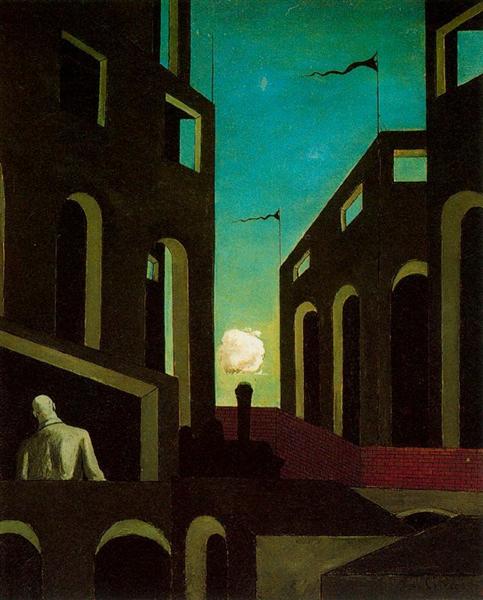
(After a phrase by Giorgio de Chirico)
Night and we heard heavy cadenced
hoofbeats
Of troops departing; the last cohorts left
By the North Gate. That night some
listened late
Leaning their eyelids toward Septentrion.
Morning blared and the young tore down
the trophies
And warring ornaments: arches were
strong
And in the sun but stone; no longer
conquest
Circled our columns; all our state was down
In fragments. In the dust, old men with
tufted
Eyebrows whiter than sunbaked faces
gulped
As it fell. But they no more than we
remembered
The old sea-fights, the soldiers’ names and
sculptors’.
We did not know the end was coming: nor
why
It came; only that long before the end
Were many wanted to die. Then vultures
starved
And sailed more slowly in the sky.
We still had taxes. Salt was high. The
soldiers
Gone. Now there was much drinking and
lewd
Houses all night loud with riot. But only
For a time. Soon the taverns had no roofs.
Strangely it was the young, the almost
boys,
Who first abandoned hope; the old still
lived
A little, at last a little lived in eyes.
It was the young whose child did not
survive.
Some slept beneath the simulacra, until
The gods’ faces froze. Then was fear.
Some had response in dreams, but
morning restored
Interrogation. Then O then, O ruins!
Temples of Neptune invaded by the sea
And dolphins streaked like streams
sportive
As sunlight rode and over the rushing
floors
The sea unfurled and what was blue raced
silver.
— first published 1936, I think.
Giorgio de Chirico created several paintings featuring “Return” (or Il Ritorno) in the title, often exploring themes of nostalgia, memory, and mythology, including The Joy of Return (1915), The Return of the Poet (1911), The Return of Ulysses (various, notably 1968), and Il Ritornante — the Return (1928).
Much like de Chirico’s “Piazza d’Italia” series, the poem evokes a sense of despairing torpor and eerie, silent landscapes. Both the poem and de Chirico’s art utilize classical imagery — such as statues and architectural fragments — to represent the collapse of Western civilization.
PS: Bishop was deeply influenced by the way painters manipulated space; his other poems, such as “Ballet,” have been described as imitating de Chirico’s style of using long shadows and receding perspectives to create psychological tension.
RADIUM AGE PROTO-SF POETRY: Stephen Spender’s THE PYLONS | George Sterling’s THE TESTIMONY OF THE SUNS | Archibald MacLeish’s EINSTEIN | Thomas Thornely’s THE ATOM | C.S. Lewis’s DYMER | Stephen Vincent Benét’s METROPOLITAN NIGHTMARE | Robert Frost’s FIRE AND ICE | Aldous Huxley’s FIFTH PHILOSOPHER’S SONG | Sara Teasdale’s “THERE WILL COME SOFT RAINS” | Edith Södergran’s ON FOOT I HAD TO… | Robert Graves’s WELSH INCIDENT | Nancy Cunard’s ZEPPELINS | D.H. Lawrence’s WELLSIAN FUTURES | & many more.