
THE HEAD
By:
October 22, 2026
A series dedicated to poems, published c. 1900–1935, the Radium Age sf-adjacent themes of which include: dystopia and utopia, far-out mathematics and the fourth dimension, Afro-futurism, catastrophe, future war, new technologies, scientific breakthrough, dehumanization, cosmic awe, disenchantment and unseen forces, unknowable aliens and singularity. Research and selection by Joshua Glenn; thematic index here.
The guillotine is the masterpiece of the
plastic arts
Its click
Creates perpetual motion
Everyone knows the egg of Christopher
Columbus
which was a flat egg, a fixed egg, the egg of
an inventor
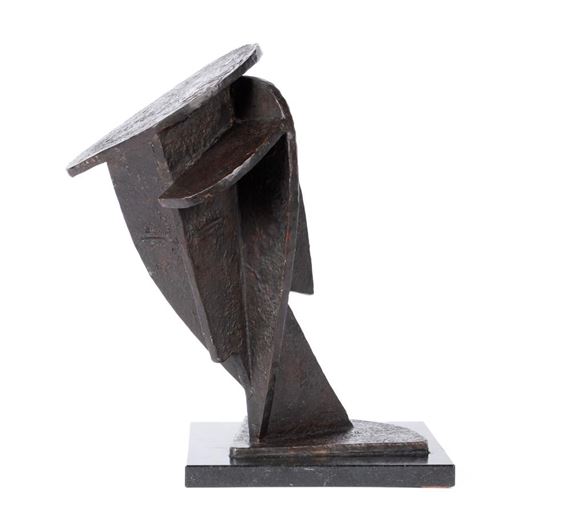
The sculpture of Archipenko is the first
ovoid egg
Maintained in intense equilibrium
Like a motionless top
On its spinning point
Speed
It strips itself
Of its many-colored waves
Of its zones of color
And turns in depth
Naked.
New.
Total.
— From Dix-neuf poèmes élastiques. Cendrars wrote the short poems comprising his collection Nineteen Elastic Poems between 1913 and 1918, before they were published together in 1919. Cendrars regarded the early modernist movement from roughly 1910 to the mid-1920s as a period of genuine discovery in the arts. Several of the poems in this collection are tributes to the Paris-based artists with whom Cendrars was close. Inspired by Archipenko’s Head: Construction with Crossing Planes (the 1913 original wood-and-sheet metal version of which is believed to have been destroyed), Cendrars wrote this poem to celebrate its “perpetual motion” and unprecedented geometry. Head is widely cited as the earliest known construction composed of open, intersecting planes.
PS: “The egg of Columbus” is an apocryphal story and idiom used to describe a brilliant or simple solution to a problem that seems obvious only after someone has already done it.
From the 1995 anthology The Cubist Poets in Paris (ed. and trans. LeRoy C. Breunig). You can hear Ron Padgett read his translation of the poem here.
RADIUM AGE PROTO-SF POETRY: Stephen Spender’s THE PYLONS | George Sterling’s THE TESTIMONY OF THE SUNS | Archibald MacLeish’s EINSTEIN | Thomas Thornely’s THE ATOM | C.S. Lewis’s DYMER | Stephen Vincent Benét’s METROPOLITAN NIGHTMARE | Robert Frost’s FIRE AND ICE | Aldous Huxley’s FIFTH PHILOSOPHER’S SONG | Sara Teasdale’s “THERE WILL COME SOFT RAINS” | Edith Södergran’s ON FOOT I HAD TO… | Robert Graves’s WELSH INCIDENT | Nancy Cunard’s ZEPPELINS | D.H. Lawrence’s WELLSIAN FUTURES | & many more.