
CANTO XXVII
By:
July 30, 2026
A series dedicated to poems, published c. 1900–1935, the Radium Age sf-adjacent themes of which include: dystopia and utopia, far-out mathematics and the fourth dimension, Afro-futurism, catastrophe, future war, new technologies, scientific breakthrough, dehumanization, cosmic awe, disenchantment and unseen forces, unknowable aliens and singularity. Research and selection by Joshua Glenn; thematic index here.
Formando di disio nuova persona
One man is dead, and another has rotted
his end off
Et quant au troisième
Il est tombé dans le
De sa femme, on ne le reverra
Pas, oth fugol ouitbaer:
“Observed that the paint was
Three quarters of an inch thick and
concluded,
As they were being rammed through, the
age of that
Cruiser.” “Referred to no longer as
The goddamned Porta-goose, but as
England’s oldest ally.” “At rests in calm zone
If possible, the men are to be fed and
relaxed,
The officers on the contrary …”
Ten million germs in his face,
“That is part of the risk and happens
“About twice a year in tubercular research,
Dr. Spahlinger …”
“J’ai obtenu” said M. Curie, or some other
scientist
“A burn that cost me six months in curing,”
And continued his experiments.
England off there in black darkness,
Russia off there in black darkness,
The last crumbs of civilization …
And they elected a Prince des Penseurs
Because there were so damn many princes,
And they elected a Monsieur Brisset
Who held that man is descended from
frogs;
And there was a cracked concierge that
they
Nearly got into the Deputies,
To protest against the earthquake in
Messina.
The Bucintoro sang it in that year,
1908, 1909, 1910, and there was
An old washerwoman beating her
washboard,
That would be 1920, with a cracked voice,
Singing “Stretti!” and that was the last
Till this year, ’27, Hotel Angioli, in Milan,
With an air Clara d’Ellébeuse,
With their lakelike and foxlike eyes,
With an air “Benette joue la Valse des Elfes”
In the salotto of that drummer’s hotel,
Two young ladies with their air de province:
“No, we are Croat merchants,
commercianti,
“There is nothing strange in our history.”
“No, not to sell, but to buy.”
And there was that music publisher,
The fellow that brought back the shrunk
Indian head
Boned, oiled, from Bolivia, said:
“Yes, I went out there. Couldn’t make out
the trade,
Long after we’d melt up the plates,
Get an order, 200 copies, Peru,
Or some station in Chile.”
Took out Floradora in sheets,
And brought back a red-headed mummy.
With an air Clara d’Ellébeuse, singing
“Stretti.”
Sed et universus quoque ecclesiae populus,
All rushed out and built the duomo,
Went as one man without leaders
And the perfect measure took form;
“Glielmo ciptadin” says the stone,” the
author
“And Nicolao was the carver”
Whatever the meaning may be.
And they wrote for year after year.
Refining the criterion,
Or they rose as the tops subsided;
Brumaire, Fructidor, Petrograd.
And Tovarisch lay in the wind
And the sun lay over the wind,
And three forms became in the air
And hovered about him,
so that he said:
This machinery is very ancient,
surely we have heard this before.
And the waves like a forest
Where the wind is weightless in the leaves
But moving,
so that the sound runs upon sound.
Xarites, born of Venus and wine.
Carved stone upon stone.
But in sleep, in the waking dream,
Petal’d the air;
twig where but wind-streak had been;
Moving bough without root,
by Helios.
So that the Xarites bent over tovarisch.
And these are the labours of tovarisch,
That tovarisch lay in the earth,
And rose, and wrecked the house of the
tyrants,
And that tovarisch then lay in the earth
And the Xarites bent over tovarisch.
These are the labours of tovarisch,
That tovarisch wrecked the house of the tyrants,
And rose, and talked folly on folly,
And walked forth and lay in the earth
And the Xarites bent over tovarisch.
And that tovarisch cursed and blessed
without aim,
These are the labours of tovarisch,
Saying:
“Me Cadmus sowed in the earth
And with the thirtieth autumn
I return to the earth that made me.
Let the five last build the wall;
I neither build nor reap.
That he came with the gold ships, Cadmus,
That he fought with the wisdom,
Cadmus, of the gilded prows. Nothing I
build
And I reap
Nothing; with the thirtieth autumn
I sleep, I sleep not, I rot
And I build no wall.
Where was the wall of Eblis
At Ventadour, there now are the bees,
And in that court, wild grass for their
pleasure
That they carry back to the crevice
Where loose stone hangs upon stone.
I sailed never with Cadmus,
lifted never stone above
stone.”
“Baked and eaten tovarisch!
“Baked and eaten, tovarisch, my boy,
“That is your story. And up again,
“Up and at ’em. Laid never stone upon
stone.”
“The air burst into leaf.”
“Hung there flowered acanthus,
“Can you tell the down from the up?”
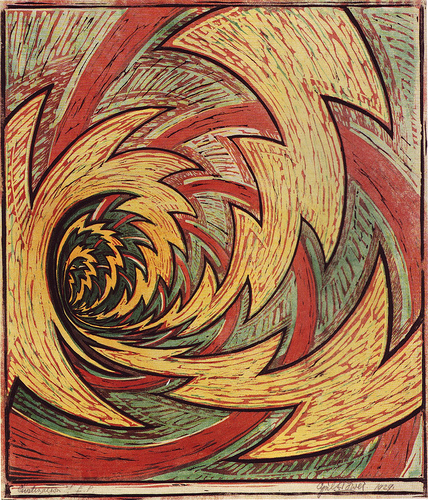
— Pound’s Canto XXVII (written c. 1927) is a melancholic, elegiac reflection on the early 20th century, exploring the collapse of European civilization through the imagery of war, revolution, and decay. It juxtaposes modern, fractured scenes — such as the Russian Revolution and WWI — with mythological references to Cadmus, evoking a sense of lost beauty and failed order. (Cadmus, the Phoenician hero who founded Thebes and brought the alphabet to Greece, represents for Pound the birth of urbanization, writing, and structured society.)
From Mark Steven’s Red Modernism (2017), about the lines from “Refining the criterion” to “sound runs upon sound”:
Written in the mid-1920s, this is a belated (and not the poem’s first) response to the revolutionary leveling of Russia, in particular to the dictatorship of the proletariat, which “rose as the tops subsided,” thus completing the socialist reversal of class relations. These lines present an immaterial abstraction (“three forms became in the air”), they refer to a technology from which that abstraction remains distinct (“This machinery is very ancient”), and they consciously allude to “Oread” by H. D. (“the waves like a forest”). They are another localized instantiation of vorticism, and the utopianism of the vortex is here made to harmonize explicitly with communism or at least with a socialist revolution waged in the name of communism.
The business about a technology and an immaterial abstraction, in Steven’s passage quoted above, has to do with the distinction Steven draws between the “turbine” and the “vortex” in Pound’s thinking. The turbine — figure for mechanized modernity — makes visible what Hugh Kenner, writing about Pound and Vorticism, describes as “a patterned integrity,” i.e., the vortex, which is the making-visible of modernity’s determining forces. Unlike the Italian Futurists, who worshipped the machine itself, the Vorticists are ambivalent about the machine — they recognize its ability to enslave workers and degrade life, but they also recognize its utopian potential. The energies or patterns created by machines allow us to catch sight of the forces that determine us; this is the goal of Vorticism.
The turbine, as Steven puts it, for Pound operates as a figure for an enslaving mode of production and its teleology. But the vortex created by the turbine briefly, temporarily makes visible the possibility of a life in which one is not ensnared, exploited, or obliterated by capitalism.
RADIUM AGE PROTO-SF POETRY: Stephen Spender’s THE PYLONS | George Sterling’s THE TESTIMONY OF THE SUNS | Archibald MacLeish’s EINSTEIN | Thomas Thornely’s THE ATOM | C.S. Lewis’s DYMER | Stephen Vincent Benét’s METROPOLITAN NIGHTMARE | Robert Frost’s FIRE AND ICE | Aldous Huxley’s FIFTH PHILOSOPHER’S SONG | Sara Teasdale’s “THERE WILL COME SOFT RAINS” | Edith Södergran’s ON FOOT I HAD TO… | Robert Graves’s WELSH INCIDENT | Nancy Cunard’s ZEPPELINS | D.H. Lawrence’s WELLSIAN FUTURES | & many more.