
VOYAGE TO FAREMIDO (5)
By:
April 28, 2026
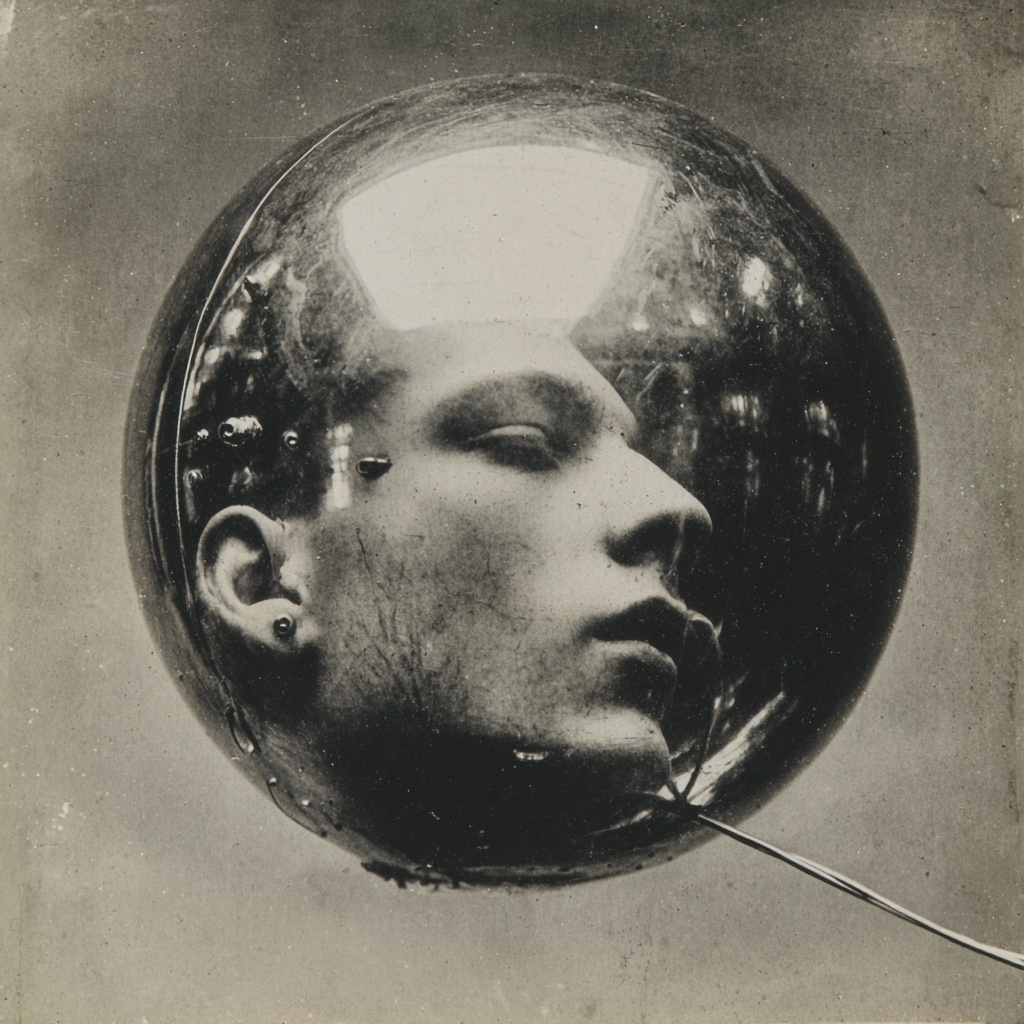
Frigyes Karinthy’s Voyage to Faremido: Gulliver’s Fifth Voyage was published in 1916, in Hungarian. Jonathan Swift’s Lemuel Gulliver signs on as a surgeon on a British ship, only to be torpedoed, then picked up by a UFO and transported to Faremido, a planet ruled by intelligent, utterly benevolent machine-folk. In this excerpt, Gulliver accepts an injection of their own brain-matter — quicksilver and minerals — into his head. HiLoBooks is pleased to serialize the story for HILOBROW’s readers.
ALL INSTALLMENTS: 1 | 2 | 3 | 4 | 5.
CHAPTER EIGHT
The author excuses himself for providing only a sketchy account of his momentous voyage — His master takes the author to a mountain-top, where he is startled by amazing revelations — The author returns to his country and finds his family in good health
I could have filled several volumes and composed a hundred symphonies about all that I learned in Faremido; but it has all boiled down to this brief sketch which I am hardly likely to touch again. The lesson which I learned there in wind and storm, in the disembodied music of heat and electricity, I could never explain in its final truth here on Earth. For the only language, in which I could express myself, would be a strange and unintelligible stammer. We call it the mystique of music. We guess and sense only as much of it as a sleeper of the speech of those who stand near his bed.
Let the memory of my voyage to Faremido, told in human words, remain just a confused and incoherent fragment, a modest signal, a blackened piece of meteorite in a museum — to proclaim to those who dare believe it that once a human being visited the shores of that distant star.
Let me jot down in a few words, rather for myself than for anybody else, an account of my last day in Faremido, and how I returned to Earth.
One day Midore, my master, took me to a lofty mountain and made me sit down beside him. Wherever I looked, an endless ocean stretched into infinity; an ocean without a horizon, merging all around us into the sky as if the mountain itself, on which we sat, rose from infinite space.
There, close to my master, I felt once again as I felt the first time when I saw him on the soil of Faremido, the delight of endless beauty; the ecstasy the artist feels when he has sculpted his beloved, a creature of flesh and blood, into marble far more enduring than flesh and blood and far more worthy of her beauty. And now I was filled with a strange, by no means tormenting but rather agreeable sadness. I thought of all Midore had told me of Organic Life as a disease, and I felt no longer inclined to argue with him. I recalled that confused and impossible panorama of misery, suffering, sickness, murder, death-rattles and dying, blood and hate, horror and gloom, evasions and lies, conflicting and evil desires which all human knowledge termed the History of Life.
After all this I looked into Midore’s face which, according to our terrestrial knowledge, was shaped of dead and lifeless matter, gold and cold stones — and yet it was the embodiment of the finest rhythm, the most purposeful movement, the most dazzling light, the purest warmth and the sweetest sound. I could not help feeling clearly that I (and with me all human intellect) was wrong. I began to sob. Haltingly and stammeringly I told Midore of my doubts and of my conversion. I begged him on my bended knees to rescue me from my valueless and stupid life which was only a sickness and burden both for others and for myself.
I cried desperately that once diseased life had perished on Earth, and the true law of Existence, heat, energy, magnetic force and light, came into their rightful power, I did not want to become like those desiccated, suffering trees along the highway of Faremido. I reminded him that my miserable, sick body also contained pure and precious materials: inorganic elements, carbon and water and sulphur. Let him destroy me, consume me in fire, filter me through an alembic, extract from me all that was worth something and utilize it as he pleased to shape a solasi‘s eyes or mouth or ears; and let him scatter the rest in the winds so that it could never again combine together. Or if this was impossible, could he not add something to my body and wash me in some solution that would petrify and solidify me. (After all, they, the solasis, were omniscient and could do anything; they had existed for many millions of years, and nature had no longer any secrets for them.) Surely I need not die in torment and misery — as a punishment for having come into this world.
Midore smiled and pointed out in his kindly and calm fashion how wrongly I had expressed myself when I said that the solasis had solved all the secrets of nature. The solasis had no need to do this, for they themselves were the secrets of nature or nature herself. True enough, to understand this I would need their intellect which was pure and transparent, consisting of immutable matter and moved by direct forces — so different from my steamy, blood-driven brain, maturing into decomposition and destruction. As for my wish that he should cure my body and utilize it for some purpose, this was very logical and right, and it showed that I was beginning to understand a little of the essence of Being. A cure could be discussed, for it was a simple chemical process; he would have to employ certain reagents, filters and furnaces for the course of oxidation.
In its present form, however, my body was not yet ripe for this; if he carried out this procedure now, he would cause me unnecessary pain. Nor was there any need for it — considering that within a short time (which we, humans, called ten or twenty years) this process would automatically start within me, and I would not have to suffer any pain thereby. He would quickly prove to me what confusion and suffering it would cause now. He had a certain liquid with him, which he was proposing to inject into my medulla oblongata. My intellect would be to some extent purified for a few minutes, and my senses would perceive phenomena somewhat more clearly.
Midore produced a glass syringe and pricked my neck. I felt the cool liquid enter my veins. For a few seconds the world grew dark; then I awakened to an even louder and more triumphant music. I can give only a very confused word-picture of all that I experienced emotionally within these few minutes. I heard the music of many different, sharply individual and yet commingling instruments. Midore then demonstrated them to me, one by one, and in these few minutes I saw what no human eyes had been given to see before. I saw heat, thermal energy flowing around me in a multicoloured, wavering stream, lapping over my body; I saw magnetic attraction as the bodies shot out tipped feelers and antennae probing, grasping and moving towards one another. But the most important thing was understanding through my sensations that all I saw with my eyes now had been living within me before, within me and within all human beings, for untold centuries. It was this tangible and simple world which we called inexpressible, metaphysical and superhuman. Though it had been within and around us, only our senses, these dull and imperfect instruments, had not presented the proper images to our intellects.
Like someone stumbling in darkness who suddenly sees the sun prostrates himself and calls it god — in the same way the being we call divine was he who, lo and behold, stood right in front of me, and who was merely what I should have become if I had been taken up by the right hands; what I must turn into if I achieved the right conception of myself and cleansed my body of all corruptible elements. I looked into Midore’s eye and realized now that it was this eye which I saw from Earth and called a star; a perfect instrument created by an intellect. And I took his hand, and I felt as I did once in my childhood when I awoke screaming one night because I thought a cold and damp and alien hand had clutched my arm; and when my parents rushed to my cot, they reassured me, and laughed and pointed out that it was my own hand I had lain on in my sleep, and it had become numb.
And as I realized all this, a great confusion and uneasiness filled my heart, and I shouted loudly. “Why? why?” I cried, “why did all have to happen as it did? Why did we not understand immediately the clear and simple message of the spheres?” But no one answered, and the effect of the magic liquid slowly started to fade. Around me the music of the elements grew fainter and fainter, and a dim curtain of fog covered my eyes.
Then I accepted Midore’s judgment that my body and mind were not yet mature enough to discard them without pain and sadness for the sake of a nobler purpose, a purer harmony. I asked him what to do, and he advised me to return to Earth and lead the human life until up here they would judge me ready to undergo the chemical process Midore had mentioned. He promised that as long as I remained on Earth they would constantly watch me through their magnificent instruments. This might reassure me if, after all I had seen here, I lost heart in my own world. Midore said this because I represented to him, anxious and sceptical, that I could not bear after my time in Faremido the society of men and beasts-the whole breed of dosires which I had learned to loath so deeply after I had observed them through the solasi instruments. When I asked how I could get back, my master smiled and said I could leave that entirely to him.
That day, with an aching heart and with hopeless sorrow in my soul, I said good-bye to the solasis whom I had the good fortune to number among my acquaintances. My master placed me in a machine and gave me a pill to make me sleep and escape the rigours of the long journey.
When I recovered from this deep sleep, I found myself on a rocky shore. My master was no longer with me. I looked around and discovered that I was once again on Earth, and the memory of the time spent in Faremido hovered like a distant beautiful dream in time and space. I bowed my head over the hard dust and wept bitterly.
The same evening I was found by a Norwegian farmer. I was told that I was in a neutral country, not far from Christiania, and I had no cause to fear any harm until I reached the frontier. Whether I could get home without a passport was highly doubtful — for Britain, at war with Germany, happened to be on bad terms with the Scandinavian states. The Norwegian farmer was much surprised by my total indifference to the development of the World War during the past eighteen months; what territories the belligerent powers had occupied, how many men they had lost, how many they had enslaved, what was the number of those who had perished of the plague, how many planes had been shot down, how many cities bombed, how many generals decorated and how many dismissed from command.
I have no intention of boring the reader with the details of my homecoming; nor with the description of how hard it was for me to get used to intercourse with the dosires whose forms I found intolerable.
At first they considered me mad when I winced in terror and disgust from outstretched hands or when living beings were approaching my body. The doctors diagnosed a serious allergy. How could they have known that I had come to consider life as a contagious and repugnant disease; that I felt all contact with it threatened deadly danger? I did not argue with them. I decided to wait peacefully and patiently for the day of liberation, trusting the promise of my kind master who had told me that he would gather me to himself as soon as he considered me worthy of this distinction.
Until then I look from time to time with confidence and secret inner joy up at the blue sky. In his kindly warm eye which human beings call the Sun I seem to read sometimes encouragement and a message intended only for me: that he still remembers his promise not to forget me.
Measured in terrestrial time, my voyage to Faremido lasted almost a year and a half. I landed in Christiania on January 18, 1916 and reached Redriff two weeks later, on February 2nd. I found my wife and children in good health.
RADIUM AGE PROTO-SF: “Radium Age” is Josh Glenn’s name for the nascent sf genre’s c. 1900–1935 era, a period which saw the discovery of radioactivity, i.e., the revelation that matter itself is constantly in movement — a fitting metaphor for the first decades of the 20th century, during which old scientific, religious, political, and social certainties were shattered. More info here.
SERIALIZED BY HILOBOOKS: James Parker’s Cocky the Fox | Annalee Newitz’s “The Great Oxygen Race” | Matthew Battles’s “Imago” | & many more original and reissued novels and stories.