
VOYAGE TO FAREMIDO (3)
By:
April 18, 2026
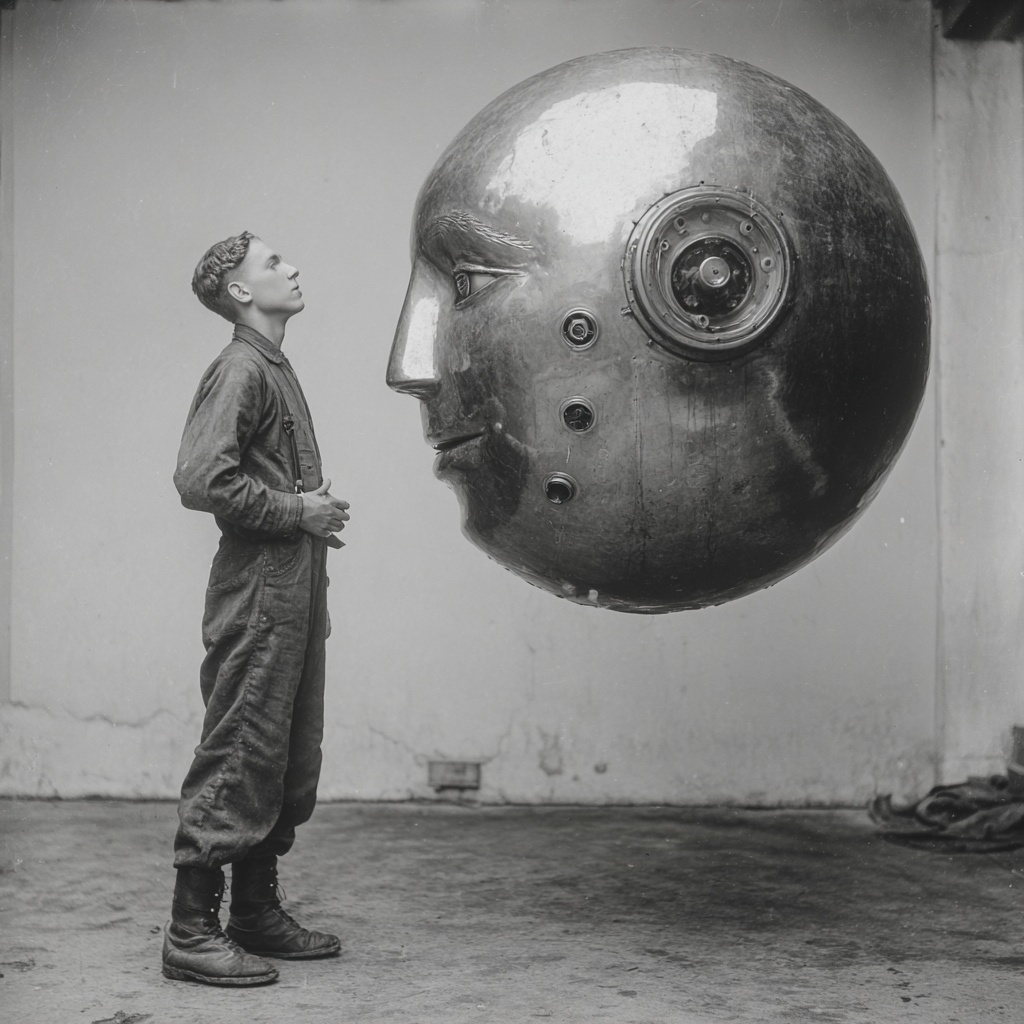
Frigyes Karinthy’s Voyage to Faremido: Gulliver’s Fifth Voyage was published in 1916, in Hungarian. Jonathan Swift’s Lemuel Gulliver signs on as a surgeon on a British ship, only to be torpedoed, then picked up by a UFO and transported to Faremido, a planet ruled by intelligent, utterly benevolent machine-folk. In this excerpt, Gulliver accepts an injection of their own brain-matter — quicksilver and minerals — into his head. HiLoBooks is pleased to serialize the story for HILOBROW’s readers.
ALL INSTALLMENTS: 1 | 2 | 3 | 4 | 5.
CHAPTER SIX
The author finds out how he got to Faremido — Dosire or the malady of the universe — The author expresses his indignation as a representative of the human race
As soon as I was able to make myself understood in his tongue — offkey and imperfect though I was — I asked Midore: what strange accident brought me to Faremido, where and how did they find and pick me up?
My master explained that their lungs were driven by electric power (this is the name I would give to the engine they had built into the upper part of their trunks) and enabled them to roam Space, seeking purer and wider harmonies. On their travels they often entered the atmospheres of alien planets and stellar systems. Once, when his friend Sido was crossing the orbit of the planet Lasomi (this is how solasis called the Earth), he was surprised to discover a creature in its atmosphere, with the appearance of an almost intelligent being. This creature was hovering at a height at which, according to the Faremidoan knowledge of Lasomi, no material being had ever appeared. Sido addressed this creature but received no answer. Rising above it, he observed two dosires in the interior of the seemingly intelligent being. One of them no longer moved, was no longer septic — but the other did and was. The shape of the latter dosire being interesting and novel, Sido removed it from the interior of the creature, to bring it for a microscopic examination to Faremido. This dosire was me — in whom they discovered peculiar and intelligent signs, and now I was being studied as a fami-dosire, a living or intelligent germ.
I listened to these words with the greatest surprise; then I respectfully asked my master what they meant by dosire; why did they think that I was one; how could they have had any conception of beings similar to myself — considering the tremendous differences between them and human beings? Also, what did he intend to express by using the word ‘septic’? For if I understood his words correctly, his friend Sido made the peculiar error of looking upon the aeroplane as an intelligent being — and considering me inside it as something else.
My master replied that Lasomi, the Earth, had been known to them thoroughly for a long time. They had examined its surface with a telescope over a considerable period and in great detail. There was hardly anything upon it that had escaped their attention. (I must say that on this occasion, at least, he spoke the truth. Later I was shown such a telescope trained upon the Earth in different positions and at various angles. I can vouch that through its lens one could see distinctly not only houses but also people and all their doings.) The solasis had established that there were no intelligent beings on Lasomi in the Faremidoan sense. This was all the more surprising because spectral analysis showed that some of the materials, such as iron, gold, mercury and many other metals necessary to produce intelligent beings, were present on Lasomi. On the other hand, they had for a long time observed a strikingly large number of moving, that is, contagious, infectious dosires, upon Earth, in different forms and of many kinds. It could be assumed that these pathogenic germs had destroyed the possibilities of the existence of the solasis on Lasomi. This was very likely because wherever the solasis of Faremido had discovered a creature that appeared to be intelligent — of iron and steel motivated by electricity or heat — it was always surrounded or infested by a multitude of dosires, that is, parasites.
When I asked why they considered me a dosire, my master referred with a smile to the strange plants that had so much surprised me on the day of my arrival, and which I had called humanoid trees. He told me that these were a variety of dosires which had for a long time existed as rudimentary parasites upon the otherwise healthy soil of Faremido, contaminating the simple and pure elements needed for the manufacture of solasis. They represented a peculiar compound whose elements the solasi chemists had not yet established. They only knew of their destructive and pathological effect, for wherever such a dosire appeared, matter was decomposed, malodorous liquids were produced and a shapeless, itching tumor developed. By the word dosire the Faremidoans generally meant poison, infectious matter, a parasite; and whenever such a germ invaded the components of a solasi, it caused confusion and illness. Thank God, it was very easily removable and exterminable with the aid of some acids, and, in any case, it was a decomposing material, a sick sickness which destroyed itself through the pernicious and corrosive elements which it created and decomposed. When I, Gulliver, arrived in Faremido, they immediately examined me thoroughly under a microscope — far more thoroughly than they were able to do while I was living on Earth. They established, alas, that in essence I was the same dosire that occurred sporadically in their soil, and with which Earth was teeming. The scientists of Faremido had already classified me properly among the pathogenic germs. Sido, my discoverer, named me remisolami-sidore which in rough translation meant an ‘imitation-human germ’ — a bacillus which, as a parasite, took on qualities similar to those of living, inorganic beings in order to approach them more closely. Thus it emitted sounds, and in the upper, head-shaped part of its body produced some material whose secretion, called thought, resembled superficially the intellectual product of the solasis. Apart from this I was the same sort of dosire — and this was proved by the fact that in my organism they found no valuable materials, metal or mineral. Therefore, and indubitably, I must be a disease, that is, a transitory phenomenon (it was interesting that the two expressions meant the same thing in the solasi language) and some pathogenic matter that consumed itself. How correct this theory was had been proved by myself. They had observed that I always became restless at a certain period of the day. On this occasion I visited a dosire of Faremido, tore off some of its excrescences (Midore meant fruit by this) and destroyed them by absorbing them in a greedy and disgusting manner. It was therefore obvious that I belonged to the inferior creatures who could support their evanescent lives solely by destroying some kindred organism — only to be destroyed themselves by some subsequent generation.
My master told me all this quite calmly and coldly. Strangely enough, by some peculiar accident, the song-words, independently of their meaning, mingled into such a wonderful melody that when he finished his lecture with the word ‘generation’ on a fading chord, I stood there for several minutes, enchanted and wordless, my soul lulled and rocked into a sweet excitement. The spell only passed slowly — but when it did, I recalled, horrified and indignant the meaning of Midore’s words; the whole ignorant and wicked conception of the position which the human race, that is, including the citizens of my beloved country, occupied in nature. At the same time I felt joyful that I had the opportunity to refute the untrue and humiliating slanders spread about us and to reveal the glorious and supreme superiority of our species. I asked myself, though swollen with pride: what are these machines, these corkscrew-necked and pulley-headed pincers and phonographs, compared to the magnificent riddle of life?
I begged my master to listen to me calmly until we had clarified certain matters. I summed up briefly all I knew of the question. I started with Adam and Eve but I tried to avoid being verbose and going into excessive detail. Throughout my exposition I followed the guideposts of modern natural science. I related how dreary and deserted the globe had been until Life appeared upon it. I described a prehistoric landscape — the writhing, shapeless blobs of metals and minerals surrounded by cooling gases and phosphorescent flashes, rolling in all the colours of the rainbow under the copper-tinted sky; volcanoes spewing fire and white clouds of smoke exploding into the heights. Then all this settled, blue waters covered the Earth, the burning Sun smiled down, and in the shallow waters something began to stir. Strange new shapes appeared, and Life made its entry upon the Earth. For untold centuries it strove to prevail in hundreds of different forms. It assumed the shape of fishes, then stuck on wings and rose into the air. Sometimes it had ten legs and many mouths; at other times it lengthened its neck, to reach the fruit of the palm-trees; and then again it grew a sharp spade in front of its muzzle, to dig food from the mud. It grew a gigantic body in order to produce a great many offspring; or it developed razor-sharp teeth for protection and for the preservation of its species. Finally, after lengthy experiments, it started to think about one particular possibility — a four-handed animal with a wrinkled face. Under the bushy eyebrows of this creature the eyeballs shifted restlessly. The back of its head contained the marrow, the organ of instinct that moved its limbs and performed all the functions in order to assure its survival. When a beast of prey lunged at its eyes, it closed them involuntarily. This was our ancestor, the ape. Life chose this animal to make something perfect out of. It was the organ of instinct that had to be developed so that all the things that had been unconscious and automatic should become conscious and self-knowledgeable. A few thousand years, and the task was completed. The new organ, the Organ of Consciousness, began to develop slowly within the skull. It understood both internal and external phenomena and adjusted itself to them — not in a dream-like ignorance but in the flaming torchlight of understanding and volition. And lo and behold, here was Man, Conscious Life, sensing all the joys of existence and subduing the forces hidden in crude and stupid matter — in order to make individual lives as beautiful and happy as possible; to shout with exultation at the blue, distant sky and the rising sun!
My master listened to me with close attention. He seemed to be especially interested in the first part of my lecture — though I had intended the very end to be the most impressive. I was worried that he might have failed to understand me and was about to go into details, but he stopped me with a gesture, and from his words I was surprised to discover that he had with his profound understanding caught the gist of my explanation. It had taken him only a few minutes to form a comprehensive picture of the whole problem — which had occupied us for a good many thousand years. I shall try to sum up his answer in the next chapter.
RADIUM AGE PROTO-SF: “Radium Age” is Josh Glenn’s name for the nascent sf genre’s c. 1900–1935 era, a period which saw the discovery of radioactivity, i.e., the revelation that matter itself is constantly in movement — a fitting metaphor for the first decades of the 20th century, during which old scientific, religious, political, and social certainties were shattered. More info here.
SERIALIZED BY HILOBOOKS: James Parker’s Cocky the Fox | Annalee Newitz’s “The Great Oxygen Race” | Matthew Battles’s “Imago” | & many more original and reissued novels and stories.