
DECLINE & FALL
By:
April 12, 2026
An installment in EMANATIONS, a series of posts featuring 10 of Josh Glenn’s favorite examples of Radium Age-era fine art that explore a particular proto-sf-adjacent theme. In this case, that theme is CATASTROPHE. The sub-theme, meanwhile, is…
MAN
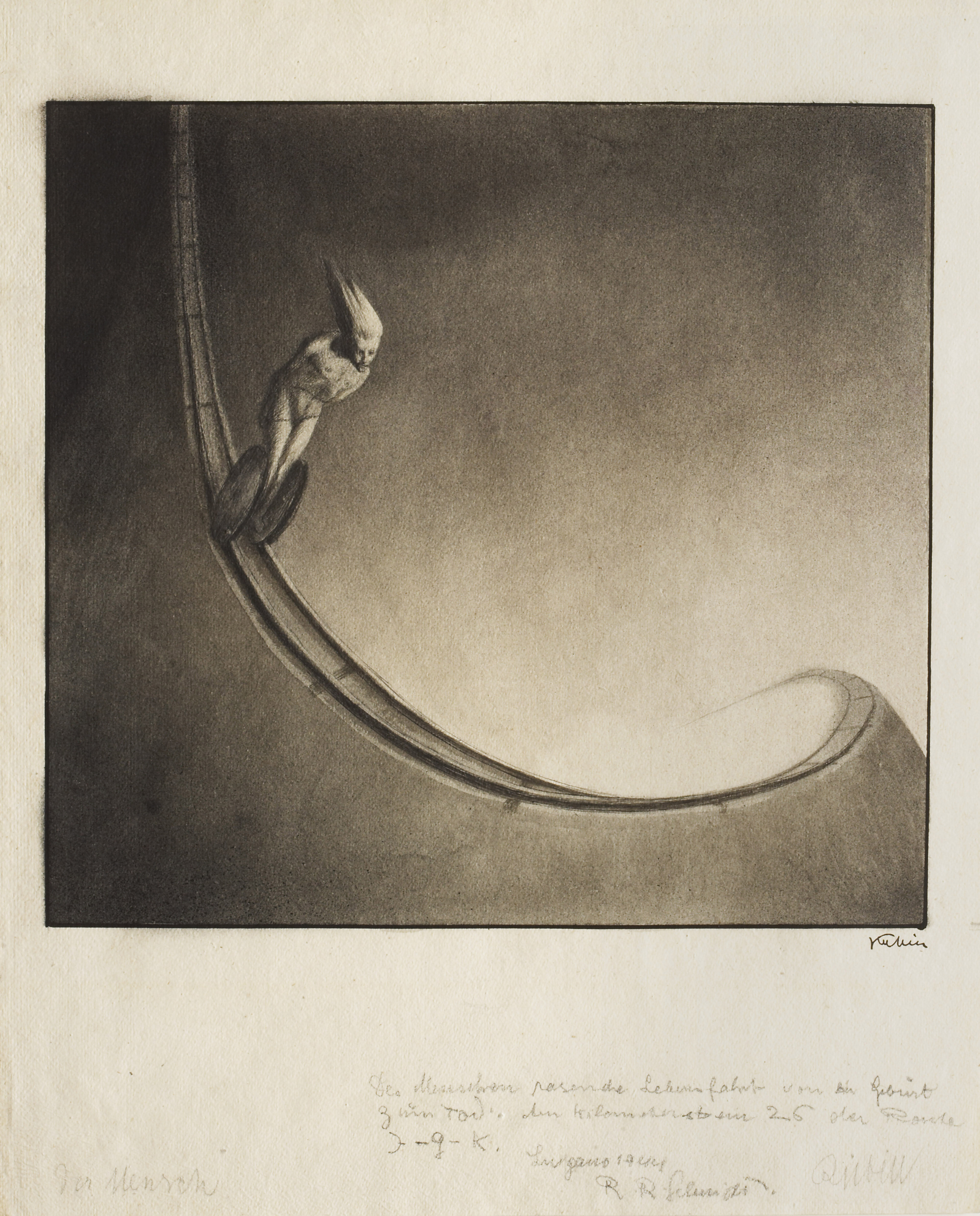
“As if on the tracks of a roller coaster, whose course seems to draw our eyes in elegant curves and sways into a depth of blinding light, an anthropomorphic little figure mounted on a double wheel is racing downwards from a dizzying height at breath-taking speed,” we read at the Leopold Museum’s website. “In the following moments it will need to master a dangerous curve in the tracks and will subsequently disappear from our sight, vanishing in the glaring background.”
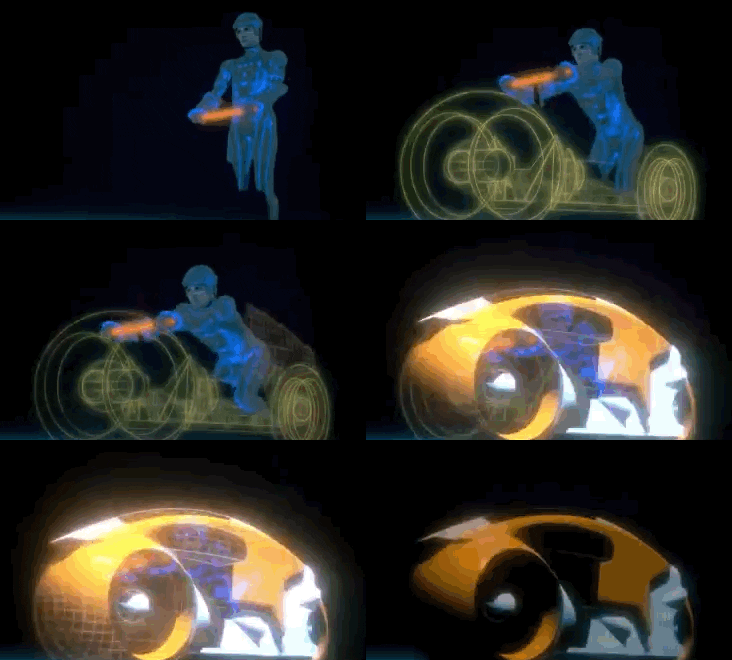
There’s something Tron-like about Kubin’s allegorical scenario, isn’t there?
THE LAST JUDGMENT
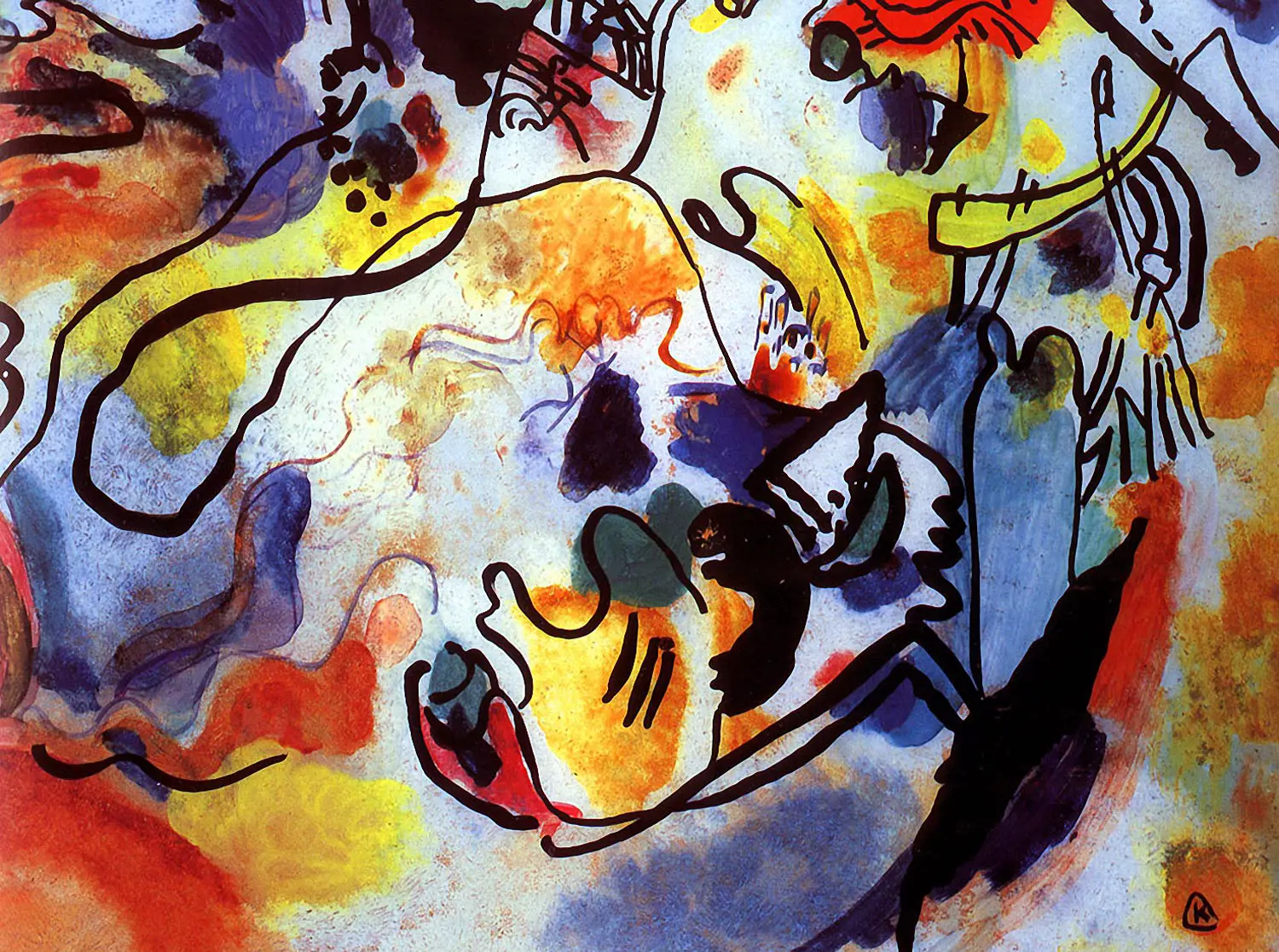
In his 2020 book Abstract Art: A Global History, which I stumbled upon at RISD’s library, Pepe Karmel suggests that this is a joyful apocalypse. That’s because Kandinsky, a Theosophist, hoped for an immanent cosmic-spiritual transformation; this isn’t a literal depiction of a biblical event, but a symbolic representation of a great spiritual transition. “The world is coming to an end,” writes Karmel, “but only so that it can be reborn as an animated cosmos, one in which there is no longer such a thing as dead matter.”
Kandinsky himself described the imagery of collapse in works such as this one as a “living paean of praise” or a “hymn of the new creation” — once the viewer allows him- or herself to hear its “inner sound.”
PS: Karmel directs us to compare this highly (though not purely) abstract paintings with Kandinsky’s more obviously figurative 1911 painting All Saints Day II, shown below.
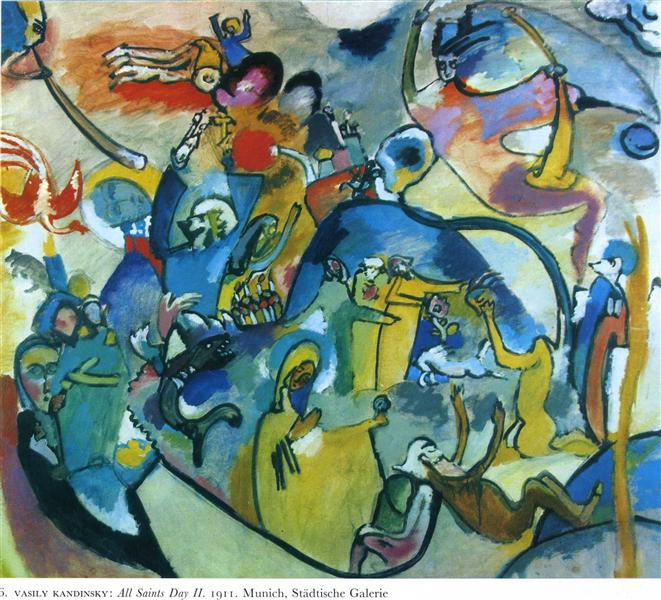
In The Last Judgment still detectable, though in a more abstract, and horizontally reversed, fashion, are various features of the earlier painting. In the upper right, for example, the shining trumpet of an angel; in the upper left, the horses that in the earlier painting can be seen pulling a haloed saint’s chariot; and the hilltop walls and towers of New Jerusalem. The Leviathan, a beast emerging its way from the sea and surging up the hill towards New Jerusalem in All Saints Day II, here becomes a black, sock puppet-like blob with a sinister red eye facing in the opposite direction.
THE ANXIOUS JOURNEY
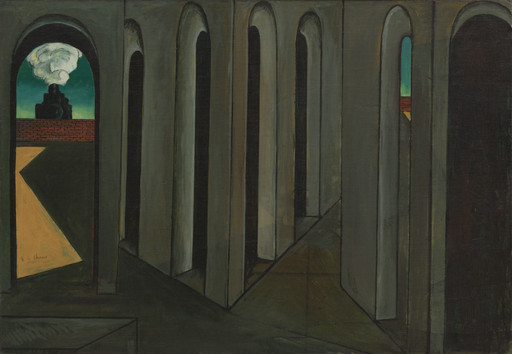
A key proto-Surrealist work from de Chirico’s so-called Metaphysical Art period. Although the painting uses Renaissance-style perspective, corridors lead to nowhere, and walls block paths, creating a psychological and emotional tension that mirrors the feeling of being trapped or lost in a dream. Pepe Karmel, again: “Emotionally, the architectural imagery of abstract art is haunted by de Chirico’s vision of the modern city as an empty stage set, where the drama of humanism has come to an end but nothing else has arrived to take its place.”
LANDSCAPE OF RUINS AND FIRES
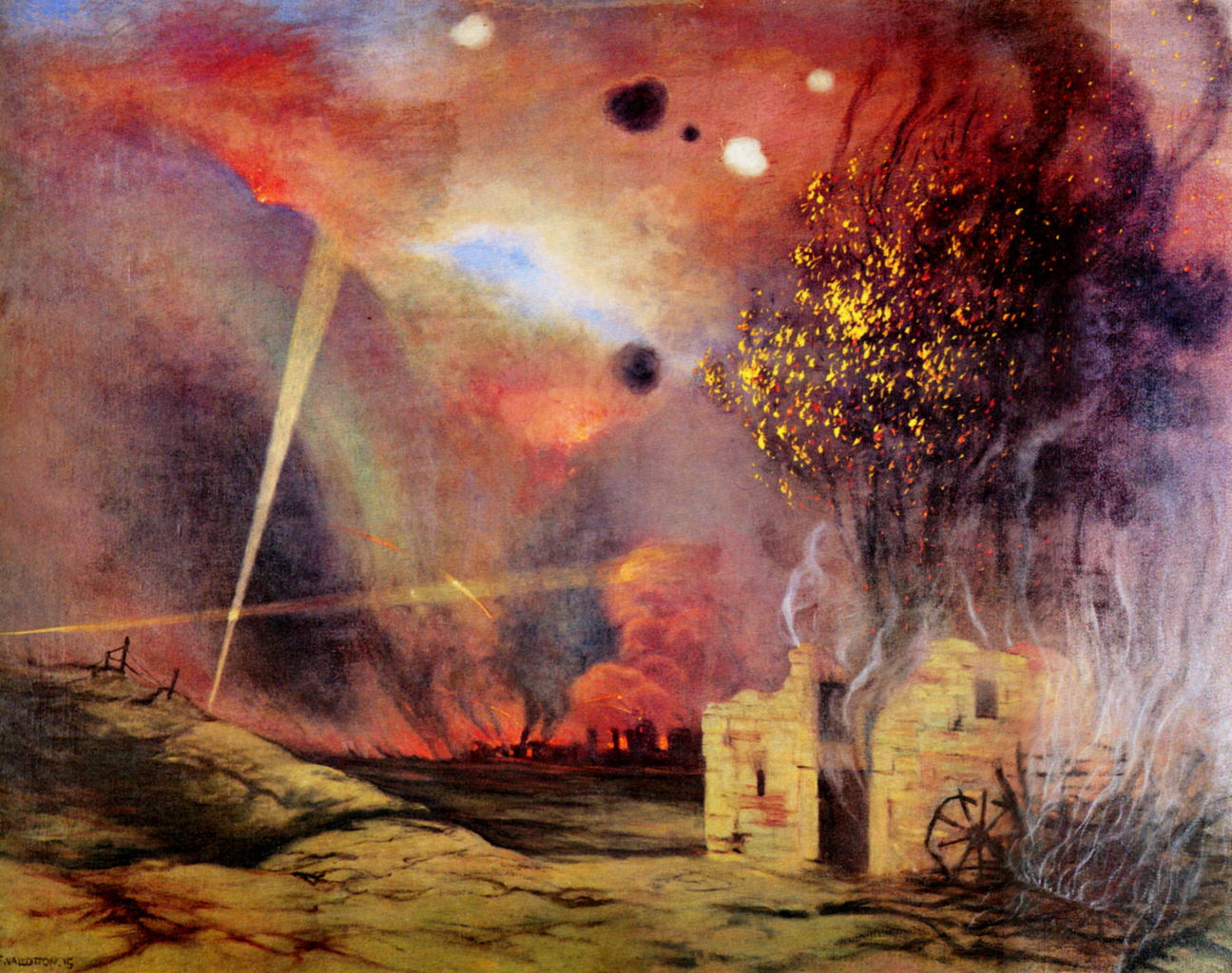
Thank you, Lucy Sante, for bringing this extraordinary painting to my attention.
At the outbreak of war in 1914, the former Nabi painter and print-maker Félix Vallotton volunteered for the army; because he was almost 50, he was rejected. Landscape of Ruins and Fires captures the destruction on the ground and proto-psychedelic displays in the sky.
Vallotton returned to making woodcut prints, which he assembled into his last print series, This is War. In 1917, he was commissioned as a war artist to tour and paint the front line in Champagne.
THE KISS
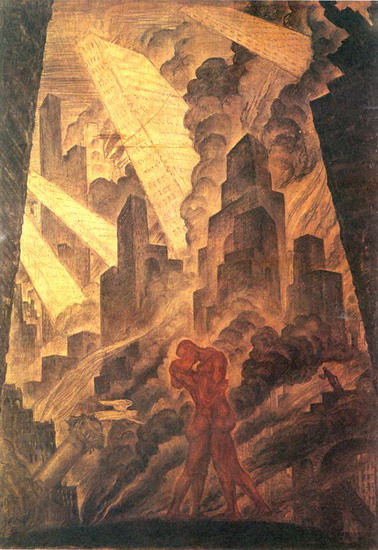
A Symbolist drawing — in lead pencil and red chalk — from Dobuzhinsky’s Urban Dreams series. Like much of the artist’s work from this era, it is set against the backdrop of a dystopian, collapsing city (Petrograd, formerly St. Petersburg). Dobuzhinsky was a key member of the Mir Iskusstva (World of Art) movement, which rejected the rational and the mechanical.
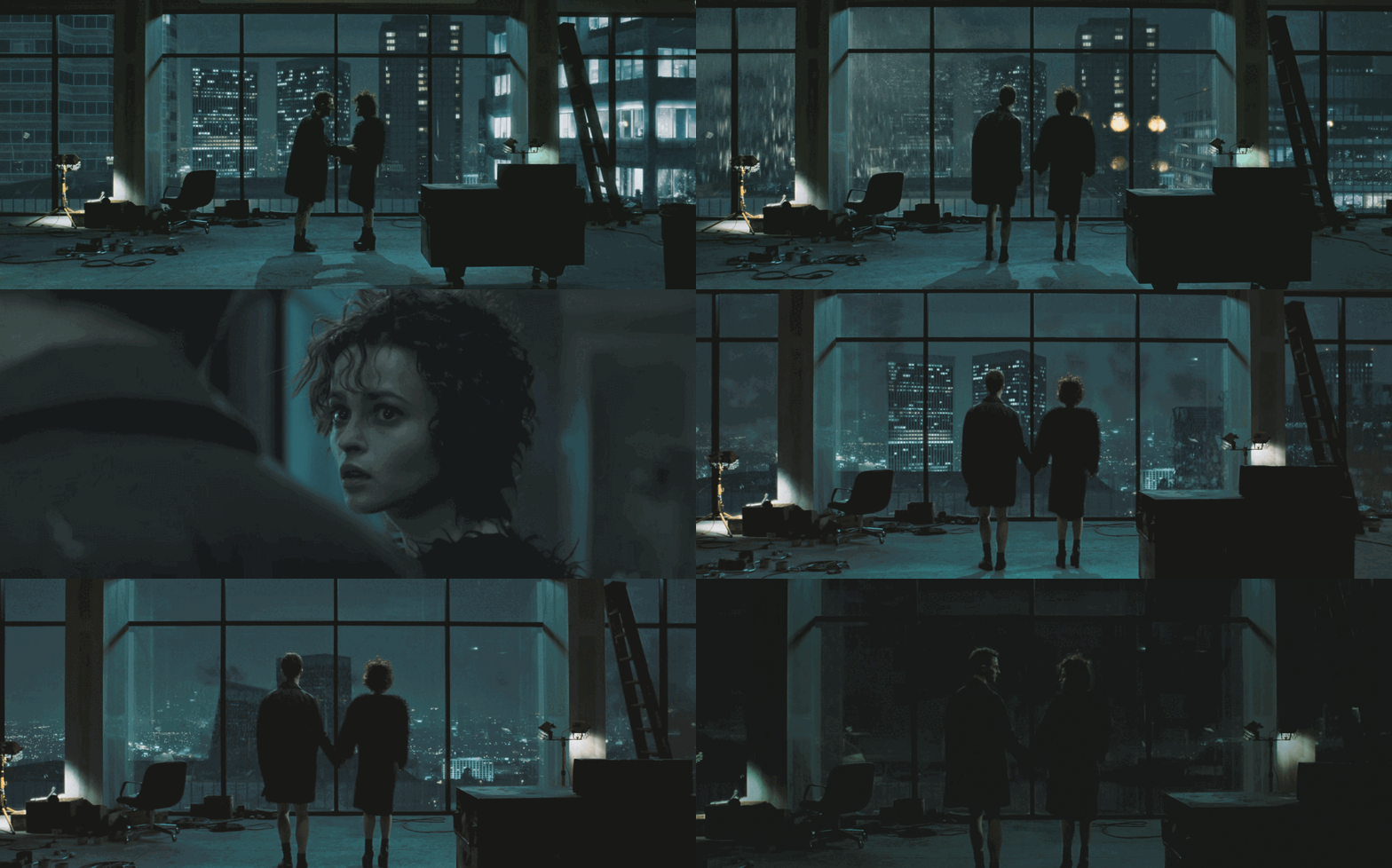
Dobuzhinsky’s painting is sometimes described as a hymn to freedom and personal dignity amidst social breakdown… which puts me in mind of the apocalyptic final scene in Fight Club.
EXPLOSION
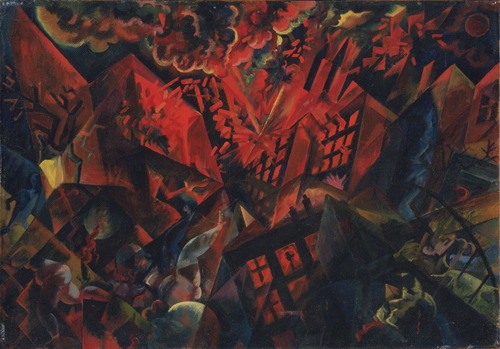
Explosion recalls the apocalyptic paintings of Ludwig Meidner, whose studio Grosz frequented in Berlin; we will see Meidner’s work elsewhere in this series. The multiple, shifting perspectives, meanwhile, seem inspired by the Italian Futurists.
From MoMA’s website:
George Grosz’s Explosion transports the horrors of World War I home, to Berlin. With a fiery glow in the background, collapsing high-rise buildings pinwheel around a black vortex. Windows shatter and smoke pours into the nighttime sky. Slices of half-naked body parts, embracing couples, and shadowy faces appear amid the chaos brought about by man-made, not natural, disaster. Grosz welcomed the purge of old society in this and other paintings showing cities in the throes of destruction that he made after he was discharged from the German army, in spring 1917, as “permanently unfit.”
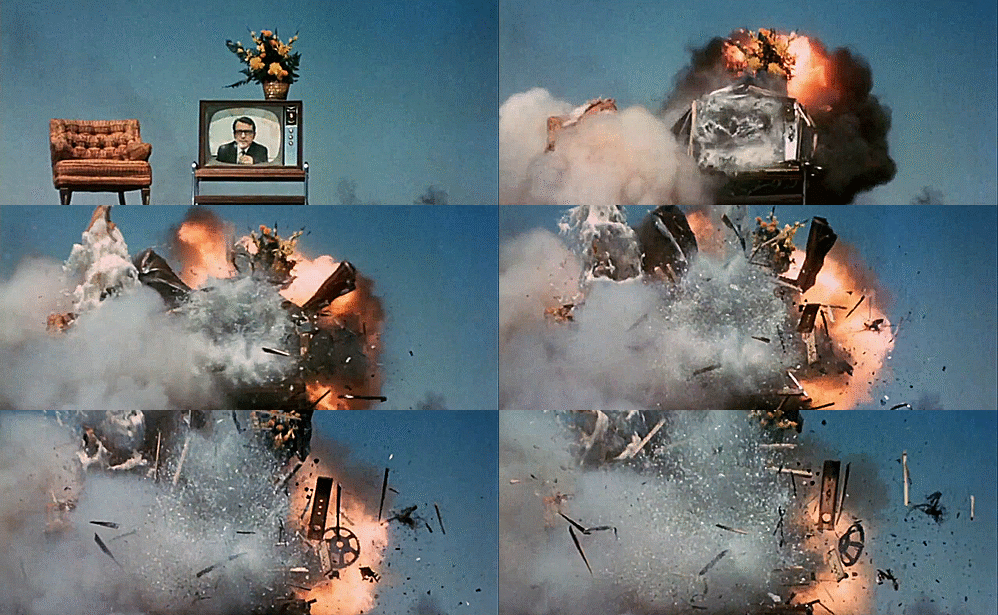
“Grosz welcomed the purge of old society”: I’m getting a Zabriskie Point vibe.
WE ARE MAKING A NEW WORLD

A biting, satirical, somber condemnation of the destruction caused by World War I. Using Cubist and Vorticist techiques, Nash depicts a desolate, post-apocalyptic no-man’s-land of mud, shell holes, and shattered, skeletal trees (based on the Ypres Salient) under a cold sun. His painting’s title mocks the ambitions of the war — but it is also a more universal reference. One critic, writing in 1994, likened the painting to a nuclear winter.
Nash wrote to his wife that he was a “messenger” bringing back word of the devastation for those who wanted the war to continue. Art critic Ben Lewis has described it as “one of Britain’s best paintings of the 20th century: our very own Guernica.” The painting is housed in the Imperial War Museum in London.
This painting in particular makes me think of Sara Teasdale’s 1918 poem “There Will Come Soft Rains”:
There will come soft rains and the smell of
the ground,
And swallows circling with their
shimmering sound;
And frogs in the pools singing at night,
And wild plum trees in tremulous white,
Robins will wear their feathery fire
Whistling their whims on a low fence-wire;
And not one will know of the war, not one
Will care at last when it is done.
Not one would mind, neither bird nor tree
If mankind perished utterly;
And Spring herself, when she woke at
dawn,
Would scarcely know that we were gone.
More DECLINE & FALL-themed Radium Age-era poems here.
CUT WITH THE DADA KNIFE…
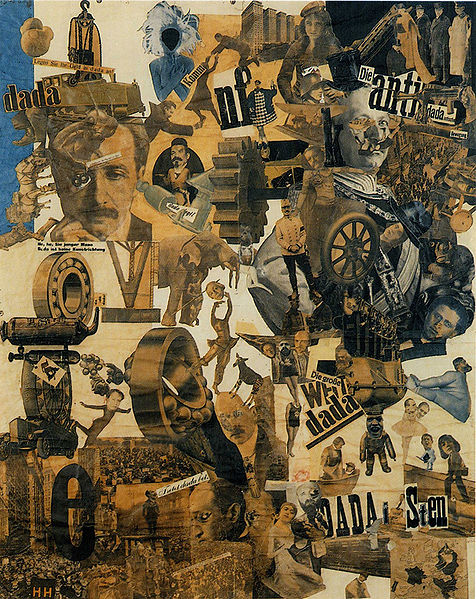
Here, Höch challenges the moral bankruptcy and chaotic political atmosphere of the post-WWI era. The term “beer-belly” mocks the perceived bloated, corrupt, and lazy nature of Weimar Germany’s social, economic, and political establishment.
I might well have instead included this piece in the Radium Age art category Diagrammatic Sublime, since it is more or less evenly divided between revolutionary, creative “Dada forces” (at bottom right) and militarized, violent “Anti-Dada forces” (at top right). Surrounded by machinery, heads and bodies, buildings and maps, Kaiser Wilhelm II, though reduced to a child’s action figure of sorts, presides over the Anti-Dada forces. Well-known female Weimar cultural figures such as the artist and activist Käthe Kollwitz, the dancer Niddy Impekoven, and the actress Asta Nielsen, meanwhile, are aligned with the Dada forces. A tiny photograph of Höch herself points toward the Dada scene. At top left, Albert Einstein makes the case that “dada is not an art trend”; and at bottom left, the assassinated Communist leader Karl Liebnecht urges us to “join Dada.”
Cut with the Kitchen Knife was shown publicly at the First International Dada Fair in Berlin in 1920.
ANGELUS NOVUS
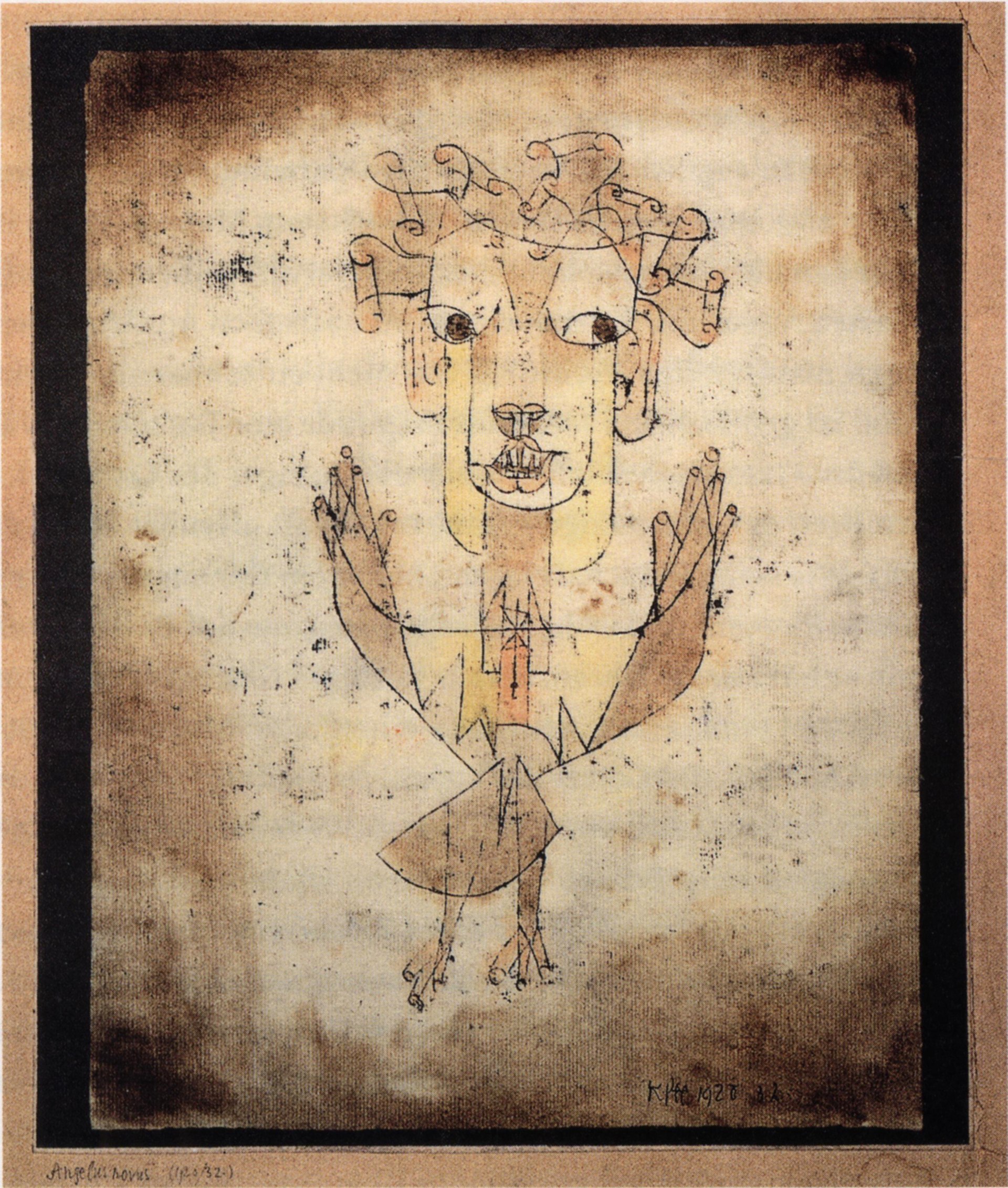
The artist’s friend Walter Benjamin purchased the oil-transfer monoprint in 1921. In the ninth thesis of his 1940 essay “Theses on the Philosophy of History”, Benjamin describes Angelus Novus as an image of the angel of history:
A Klee painting named Angelus Novus shows an angel looking as though he is about to move away from something he is fixedly contemplating. His eyes are staring, his mouth is open, his wings are spread. This is how one pictures the angel of history. His face is turned toward the past. Where we perceive a chain of events, he sees one single catastrophe which keeps piling wreckage upon wreckage and hurls it in front of his feet. The angel would like to stay, awaken the dead, and make whole what has been smashed. But a storm is blowing from Paradise; it has got caught in his wings with such violence that the angel can no longer close them. The storm irresistibly propels him into the future to which his back is turned, while the pile of debris before him grows skyward. This storm is what we call progress.
Before he tried to flee when the Nazis invaded France, Benjamin entrusted Klee’s drawing, together with other important papers, to Georges Bataille, who hid it at the Bibliothèque Nationale in Paris where he worked. Benjamin himself was caught at the Spanish border and committed suicide in September 1940. After World War II, Bataille gave the print to T.W. Adorno in Frankfurt, who per Benjamin’s wishes sent it on to Gershom Scholem, a distinguished scholar of Jewish mysticism who had emigrated from Germany to Palestine in 1923. The painting is now in the Israel Museum, Jerusalem.
PS: I once wrote for HILOBROW about Martin Sheen’s character, in Apocalypse Now, as a kind of horrified / transfixed angel figure.
BREAD LINE
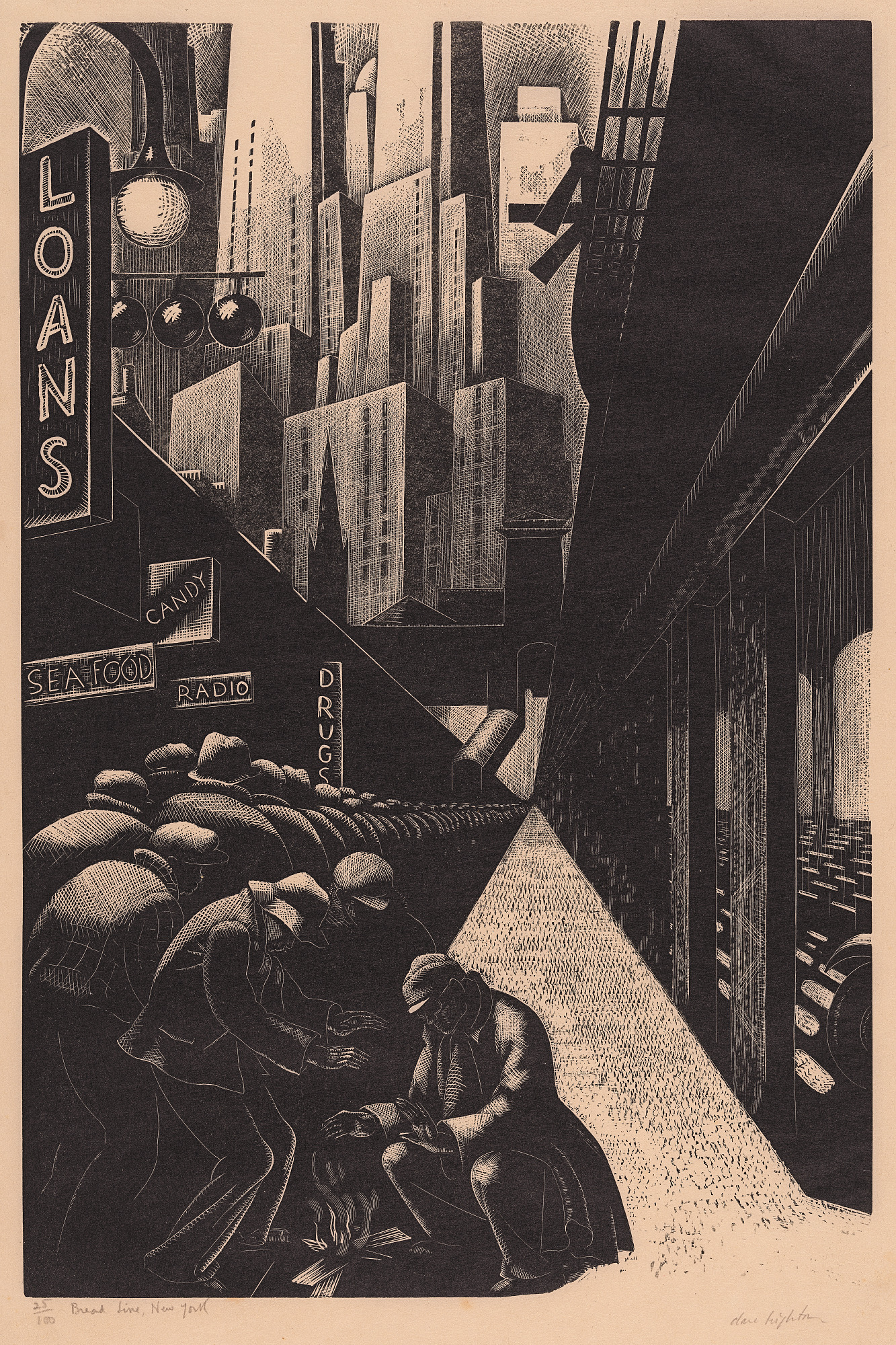
A wood engraving that depicts the dehumanizing effects of mass unemployment in New York City during the early 1930s. Leighton, an English-American artist and illustrator primarily known for her romantic portrayals of rural English farming life, here uses stark light and heavy black contrasts to convey a somber, hopeless atmosphere. The composition leads the viewer’s eye into an “endless line.”
From John P. Murphy’s excellent 2025 book New Deal Art:
A huddled group in the foreground warm their hands over a makeshift fire. Above them, glowing advertisements and stair-stepped skyscrapers rise like an inaccessible dream.
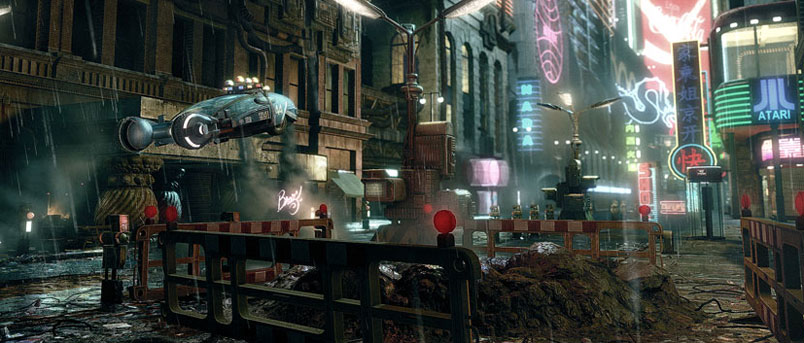
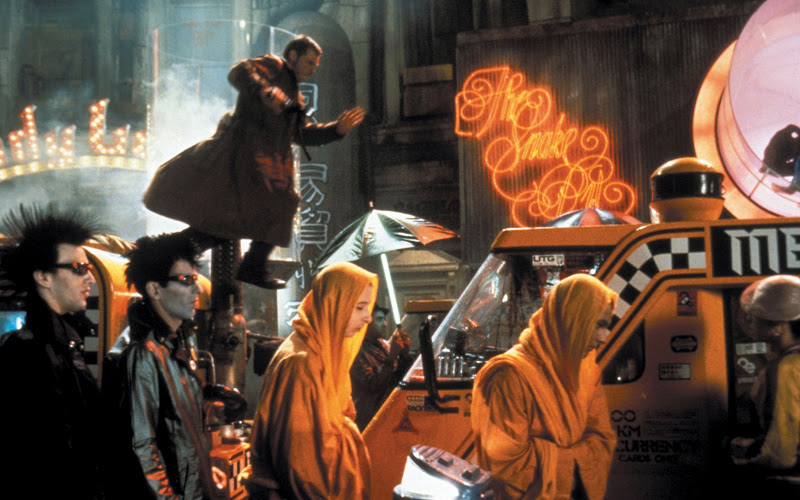
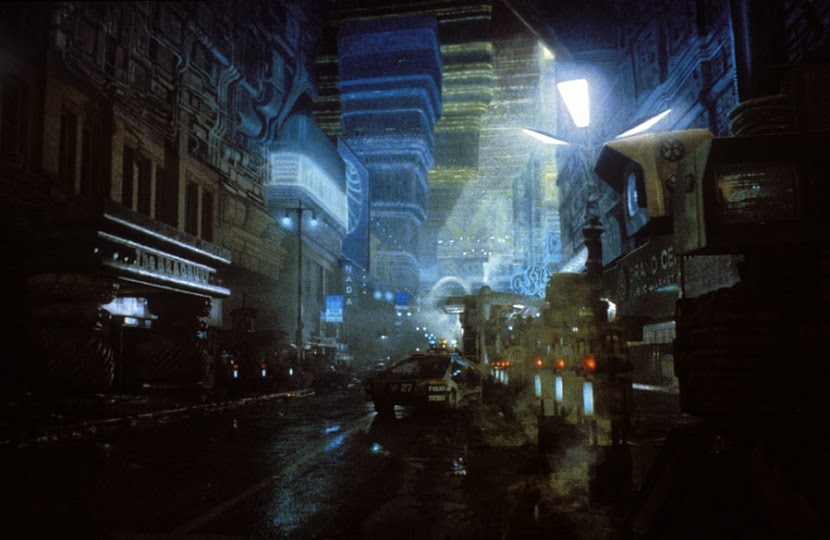
Puts one in mind of Lawrence G. Paull’s production design for Blade Runner. Though it’s difficult to single out a frame from that movie capturing both the extraordinary skyscrapers and advertisements overhead and the squalor at street level.
Josh Glenn’s EMANATIONS series includes the following installments: CATASTROPHE: DECLINE & FALL | DYING EARTH | ECO-CATASTROPHE. COSMIC AWE: DEEP TIME | STARS WHEEL IN PURPLE | IS THERE LIFE ON MARS. DEHUMANIZATION: CYBORG MANIFESTO | MECHANIZATION. & many others.
MORE RADIUM AGE SCI FI ON HILOBROW: RADIUM AGE SERIES from THE MIT PRESS: In-depth info on each book in the series; a sneak peek at what’s coming in the months ahead; the secret identity of the series’ advisory panel; and more. | RADIUM AGE: TIMELINE: Notes on proto-sf publications and related events from 1900–1935. | RADIUM AGE POETRY: Proto-sf and science-related poetry from 1900–1935. | RADIUM AGE ART: Proto-sf and science-related fine art from 1900–1935. | RADIUM AGE 100: A list (now somewhat outdated) of Josh’s 100 favorite proto-sf novels from the genre’s emergent Radium Age | SISTERS OF THE RADIUM AGE: A resource compiled by Lisa Yaszek.