
GOLIAH (3)
By:
July 22, 2026
Goliah is a 1908 proto-sf novella by Jack London. It depicts a world transformed by a mysterious figure who ushers in a global, socialist utopia — forcing industrialists and politicians to comply. It originally appeared in The Red Magazine (December 1908). HiLoBooks is pleased to serialize the story for HILOBROW’s readers.
ALL INSTALLMENTS: 1 | 2 | 3 | 4 | 5.
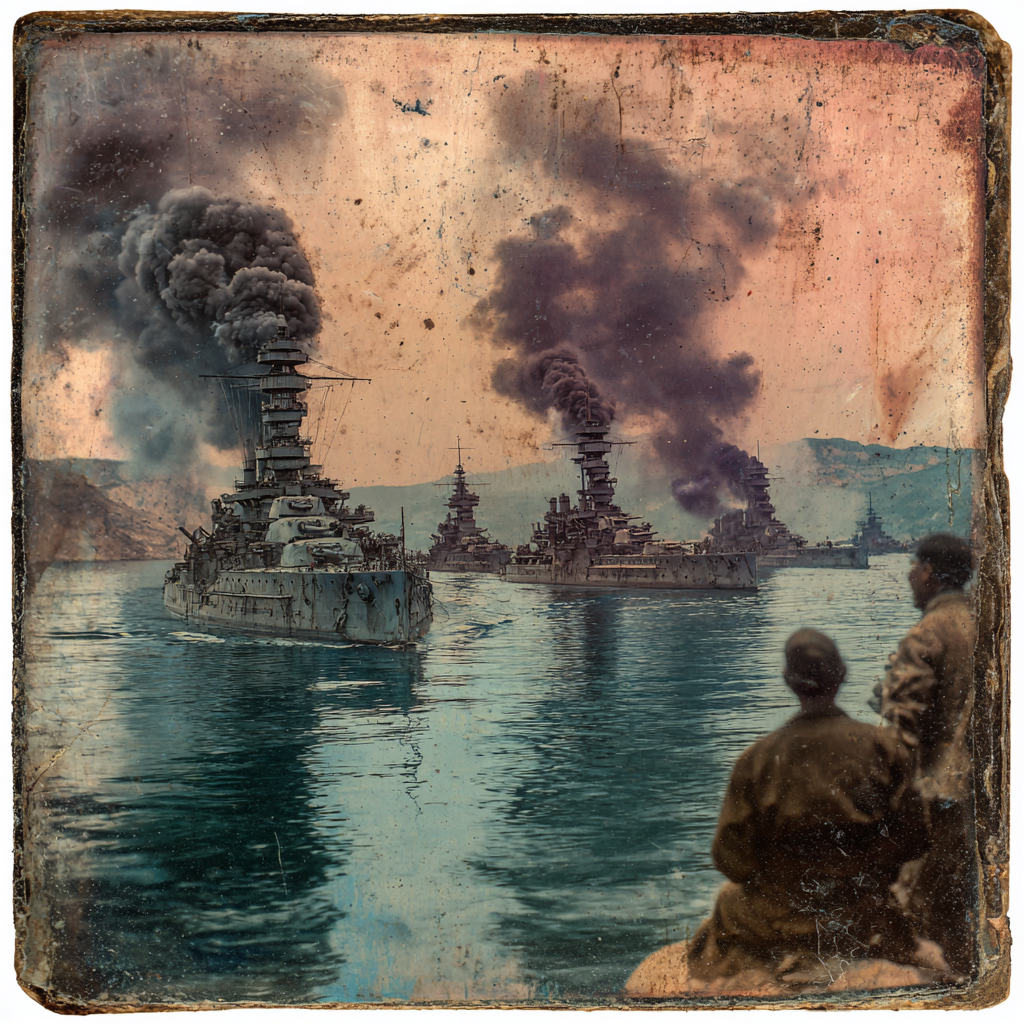
“Blow Palgrave Island out of the water!” was the head-line retort of the newspapers. The government was of the same frame of mind, and the assembling of the fleets began. Walter Bassett broke out in ineffectual protest, but was swiftly silenced by the threat of a lunacy commission. Goliah remained silent. Against Palgrave Island five great fleets were hurled — the Asiatic Squadron, the South Pacific Squadron, the North Pacific Squadron, the Caribbean Squadron, and half of the North Atlantic Squadron, the two latter coming through the Panama Canal.
“I have the honour to report that we sighted Palgrave Island on the evening of April 29,” ran the report of Captain Johnson, of the battleship North Dakota, to the Secretary of the Navy. “The Asiatic Squadron was delayed and did not arrive until the morning of April 30. A council of the admirals was held, and it was decided to attack early next morning. The destroyer, Swift VII, crept in, unmolested, and reported no warlike preparations on the island. It noted several small merchant steamers in the harbour, and the existence of a small village in a hopelessly exposed position that could be swept by our fire.
“It had been decided that all the vessels should rush in, scattered, upon the island, opening fire at three miles, and continuing to the edge of the reef, there to retain loose formation and engage. Palgrave Island repeatedly warned us, by wireless, in the international code, to keep outside the ten-mile limit; but no heed was paid to the warnings.
“The North Dakota did not take part in the movement of the morning of May 1. This was due to a slight accident of the preceding night that temporarily disabled her steering-gear. The morning of May 1 broke clear and calm. There was a slight breeze from the south-west that quickly died away. The North Dakota lay twelve miles off the island. At the signal the squadrons charged in upon the island, from all sides, at full speed. Our wireless receiver continued to tick off warnings from the island. The ten-mile limit was passed, and nothing happened. I watched through my glasses. At five miles nothing happened; at four miles nothing happened; at three miles, the New York, in the lead on our side of the island, opened fire. She fired only one shot. Then she blew up. The rest of the vessels never fired a shot. They began to blow up, everywhere, before our eyes. Several swerved about and started back, but they failed to escape. The destroyer, Dart XXX, nearly made the ten-mile limit when she blew up. She was the last survivor. No harm came to the North Dakota, and that night, the steering-gear being repaired, I gave orders to sail for San Francisco.”
To say that the United States was stunned is but to expose the inadequacy of language. The whole world was stunned. It confronted that blight of the human brain, the unprecedented. Human endeavour was a jest, a monstrous futility, when a lunatic on a lonely island, who owned a yacht and an exposed village, could destroy five of the proudest fleets of Christendom. And how had he done it? Nobody knew. The scientists lay down in the dust of the common road and wailed and gibbered. They did not know. Military experts committed suicide by scores. The mighty fabric of warfare they had fashioned was a gossamer veil rent asunder by a miserable lunatic. It was too much for their sanity. Mere human reason could not withstand the shock. As the savage is crushed by the sleight-of-hand of the witch doctor, so was the world crushed by the magic of Goliah. How did he do it? It was the awful face of the Unknown upon which the world gazed and by which it was frightened out of the memory of its proudest achievements.
But all the world was not stunned. There was the invariable exception — the Island Empire of Japan. Drunken with the wine of success deep-quaffed, without superstition and without faith in aught but its own ascendant star, laughing at the wreckage of science and mad with pride of race, it went forth upon the way of war. America’s fleets had been destroyed. From the battlements of heaven the multitudinous ancestral shades of Japan leaned down. The opportunity, God-given, had come. The Mikado was in truth a brother to the gods.
The war-monsters of Japan were loosed in mighty fleets. The Philippines were gathered in as a child gathers a nosegay. It took longer for the battleships to travel to Hawaii, to Panama, and to the Pacific Coast. The United States was panic-stricken, and there arose the powerful party of dishonourable peace. In the midst of the clamour the Energon arrived in San Francisco Bay and Goliah spoke once more. There was a little brush as the Energon came in, and a few explosions of magazines occurred along the war-tunnelled hills as the coast defences went to smash. Also, the blowing up of the submarine mines in the Golden Gate made a remarkably fine display. Goliah’s message to the people of San Francisco, dated as usual from Palgrave Island, was published in the papers. It ran:
“Peace? Peace be with you. You shall have peace. I have spoken to this purpose before. And give you me peace. Leave my yacht Energon alone. Commit one overt act against her and not one stone in San Francisco shall stand upon another.
“To-morrow let all good citizens go out upon the hills that slope down to the sea. Go with music and laughter and garlands. Make festival for the new age that is dawning. Be like children upon your hills, and witness the passing of war. Do not miss the opportunity. It is your last chance to behold what henceforth you will be compelled to seek in museums of antiquities.
“I promise you a merry day,
“GOLIAH.”
The madness of magic was in the air. With the people it was as if all their gods had crashed and the heavens still stood. Order and law had passed away from the universe; but the sun still shone, the wind still blew, the flowers still bloomed — that was the amazing thing about it. That water should continue to run downhill was a miracle. All the stabilities of the human mind and human achievement were crumbling. The one stable thing that remained was Goliah, a madman on an island. And so it was that the whole population of San Francisco went forth next day in colossal frolic upon the hills that overlooked the sea. Brass bands and banners went forth, brewery wagons and Sunday-school picnics — all the strange heterogeneous groupings of swarming metropolitan life.
On the sea-rim rose the smoke from the funnels of a hundred hostile vessels of war, all converging upon the helpless, undefended Golden Gate. And not all undefended, for out through the Golden Gate moved the Energon, a tiny toy of white, rolling like a straw in the stiff sea on the bar where a strong ebb-tide ran in the teeth of the summer sea-breeze. But the Japanese were cautious. Their thirty- and forty-thousand-ton battleships slowed down half a dozen miles offshore and manoeuvred in ponderous evolutions, while tiny scout-boats (lean, six-funnelled destroyers) ran in, cutting blackly the flashing sea like so many sharks. But, compared with the Energon, they were leviathans. Compared with them, the Energon was as the sword of the arch-angel Michael, and they the forerunners of the hosts of hell.
But the flashing of the sword, the good people of San Francisco, gathered on her hills, never saw. Mysterious, invisible, it cleaved the air and smote the mightiest blows of combat the world had ever witnessed. The good people of San Francisco saw little and understood less. They saw only a million and a half tons of brine-cleaving, thunder-flinging fabrics hurled skyward and smashed back in ruin to sink into the sea. It was all over in five minutes. Remained upon the wide expanse of sea only the Energon, rolling white and toylike on the bar.
Goliah spoke to the Mikado and the Elder Statesmen. It was only an ordinary cable message, despatched from San Francisco by the captain of the Energon, but it was of sufficient moment to cause the immediate withdrawal of Japan from the Philippines and of her surviving fleets from the sea. Japan the sceptical was converted. She had felt the weight of Goliah’s arm. And meekly she obeyed when Goliah commanded her to dismantle her war vessels and to turn the metal into useful appliances for the arts of peace. In all the ports, navy-yards, machine-shops, and foundries of Japan tens of thousands of brown-skinned artisans converted the war-monsters into myriads of useful things, such as ploughshares (Goliah insisted on ploughshares), gasolene engines, bridge-trusses, telephone and telegraph wires, steel rails, locomotives, and rolling stock for railways. It was a world-penance for a world to see, and paltry indeed it made appear that earlier penance, barefooted in the snow, of an emperor to a pope for daring to squabble over temporal power.
Goliah’s next summons was to the ten leading scientists of the United States. This time there was no hesitancy in obeying. The savants were ludicrously prompt, some of them waiting in San Francisco for weeks so as not to miss the scheduled sailing-date. They departed on the Energon on June 15; and while they were on the sea, on the way to Palgrave Island, Goliah performed another spectacular feat. Germany and France were preparing to fly at each other’s throats. Goliah commanded peace. They ignored the command, tacitly agreeing to fight it out on land where it seemed safer for the belligerently inclined. Goliah set the date of June 19 for the cessation of hostile preparations. Both countries mobilized their armies on June 18, and hurled them at the common frontier. And on June 19, Goliah struck. All generals, war-secretaries, and jingo-leaders in the two countries died on that day; and that day two vast armies, undirected, like strayed sheep, walked over each other’s frontiers and fraternized. But the great German war lord had escaped — it was learned, afterward, by hiding in the huge safe where were stored the secret archives of his empire. And when he emerged he was a very penitent war lord, and like the Mikado of Japan he was set to work beating his sword-blades into ploughshares and pruning-hooks.
But in the escape of the German Emperor was discovered a great significance. The scientists of the world plucked up courage, got back their nerve. One thing was conclusively evident — Goliah’s power was not magic. Law still reigned in the universe. Goliah’s power had limitations, else had the German Emperor not escaped by secretly hiding in a steel safe. Many learned articles on the subject appeared in the magazines.
The ten scientists arrived back from Palgrave Island on July 6. Heavy platoons of police protected them from the reporters. No, they had not see Goliah, they said in the one official interview that was vouchsafed; but they had talked with him, and they had seen things. They were not permitted to state definitely all that they had seen and heard, but they could say that the world was about to be revolutionized. Goliah was in the possession of a tremendous discovery that placed all the world at his mercy, and it was a good thing for the world that Goliah was merciful. The ten scientists proceeded directly to Washington on a special train, where, for days, they were closeted with the heads of government, while the nation hung breathless on the outcome.
RADIUM AGE PROTO-SF: “Radium Age” is Josh Glenn’s name for the nascent sf genre’s c. 1900–1935 era, a period which saw the discovery of radioactivity, i.e., the revelation that matter itself is constantly in movement — a fitting metaphor for the first decades of the 20th century, during which old scientific, religious, political, and social certainties were shattered. More info here.
SERIALIZED BY HILOBOOKS: James Parker’s Cocky the Fox | Annalee Newitz’s “The Great Oxygen Race” | Matthew Battles’s “Imago” | & many more original and reissued novels and stories.