
CANOPUS
By:
July 10, 2026
A series dedicated to poems, published c. 1900–1935, the Radium Age sf-adjacent themes of which include: dystopia and utopia, far-out mathematics and the fourth dimension, Afro-futurism, catastrophe, future war, new technologies, scientific breakthrough, dehumanization, cosmic awe, disenchantment and unseen forces, unknowable aliens and singularity. Research and selection by Joshua Glenn; thematic index here.
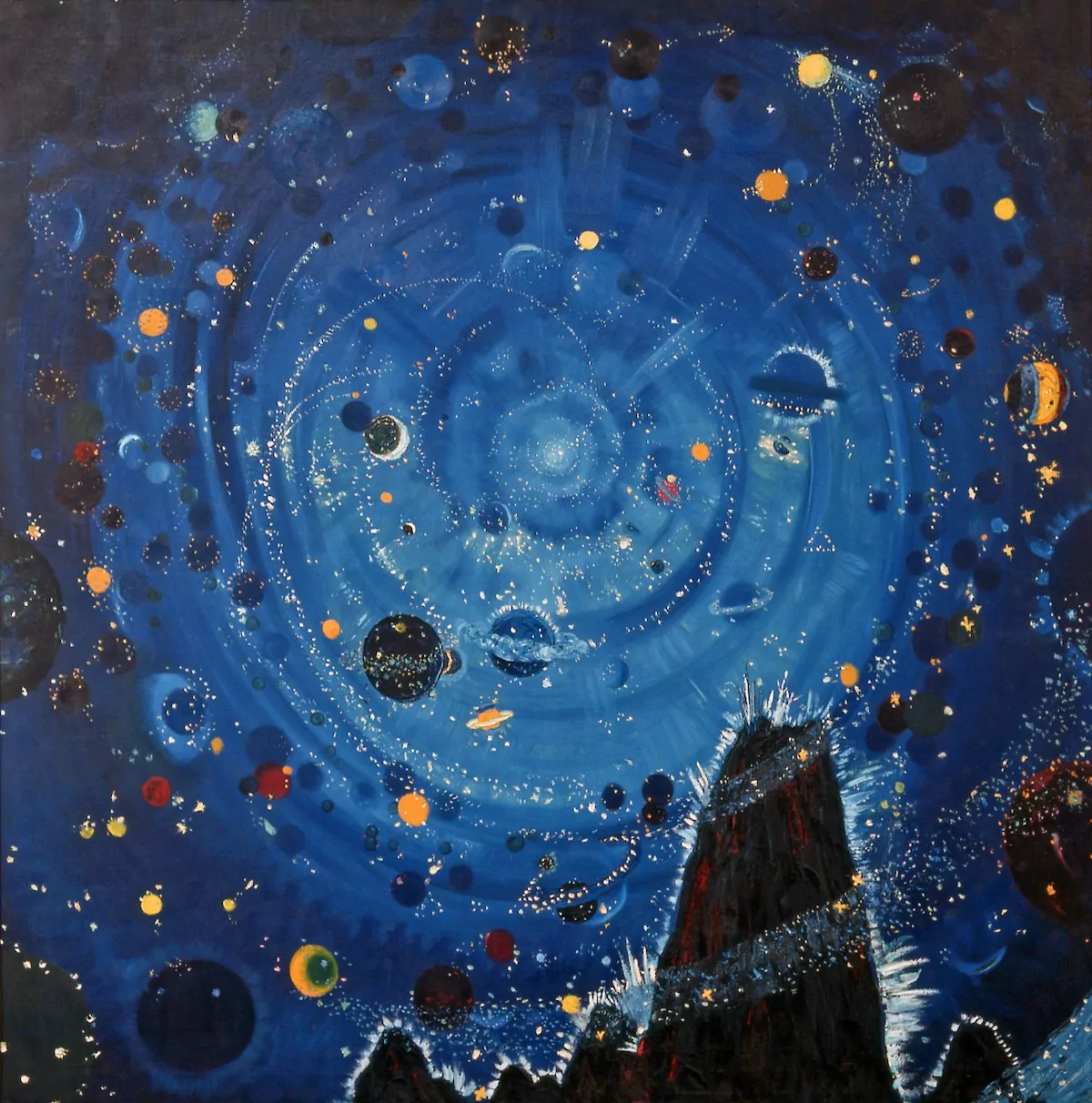
When quacks with pills political would dope
us,
When politics absorbs the livelong day,
I like to think about that star Canopus,
So far, so far away.
Greatest of visioned suns, they say who list
’em;
To weigh it, science almost must despair.
Its shell would hold our whole dinged solar
system,
Nor even know ’twas there.
When temporary chairmen utter speeches,
And frenzied henchmen howl their battle
hymns,
My thoughts float out across the cosmic
reaches
To where Canopus swims.
When men are calling names and making
faces,
And all the world’s ajangle and ajar,
I meditate on interstellar spaces
And smoke a mild seegar.
For after one has had about a week of
The argument of friends as well as foes,
A star that has no parallax to speak of
Conduces to repose.
— The poem was featured in Taylor’s column “A Line-o’-Type or Two” in the Chicago Tribune in 1911; it was later included in his collection A Line-o’-Verse or Two. I came across it in Modern American Poetry (revised and enlarged edition), ed. Louis Untermeyer, 1919 and 1921.
Canopus is the second-brightest star in the night sky, outshone only by Sirius — though Canopus is by far the larger star. It has a luminosity over 10,000 times the luminosity of the Sun, and is nine to ten times as massive. Fun fact: The fictional planet Arrakis, of Frank Herbert’s 1965 novel Dune, orbits Canopus.
Alas for the “repose” of folks who share Taylor’s proclivities, the parallax of Canopus was successfully measured in the early 1990s. Because the star is so far away, Earth-based telescopes were not precise enough to detect its tiny shift in position — stellar parallax is the apparent shifting of a nearby star against the backdrop of distant, fixed stars as Earth orbits the Sun — until the 1989 launch of the European Space Agency’s Hipparcos satellite.
PS: In the author’s posthumous 1922 book The So-Called Human Race, which includes excerpts from his “A Line-o’-Type or Two” column, we read:
Our readers, we swear, know everything. One of them writes from La Crosse that Debussy’s “Canope” has nothing to do with the planet [sic] Canopus, but refers to the ancient Egyptian city of that name. Mebbe so (we should like proof of it), but what of it? — as Nero remarked when they told him Rome was afire. The Debussy music does as well for the star as for the city. It is ethereal, far away, and it leaves off in mid-air.
RADIUM AGE PROTO-SF POETRY: Stephen Spender’s THE PYLONS | George Sterling’s THE TESTIMONY OF THE SUNS | Archibald MacLeish’s EINSTEIN | Thomas Thornely’s THE ATOM | C.S. Lewis’s DYMER | Stephen Vincent Benét’s METROPOLITAN NIGHTMARE | Robert Frost’s FIRE AND ICE | Aldous Huxley’s FIFTH PHILOSOPHER’S SONG | Sara Teasdale’s “THERE WILL COME SOFT RAINS” | Edith Södergran’s ON FOOT I HAD TO… | Robert Graves’s WELSH INCIDENT | Nancy Cunard’s ZEPPELINS | D.H. Lawrence’s WELLSIAN FUTURES | & many more.