
OMAC YOUR ENTHUSIASM (14)
By:
May 21, 2026
One in a series of enthusiastic posts, contributed by 25 HILOBROW friends and regulars, analyzing and celebrating our favorite… Seventies (1974–83) sci-fi novels and comics! Series edited by Josh Glenn.
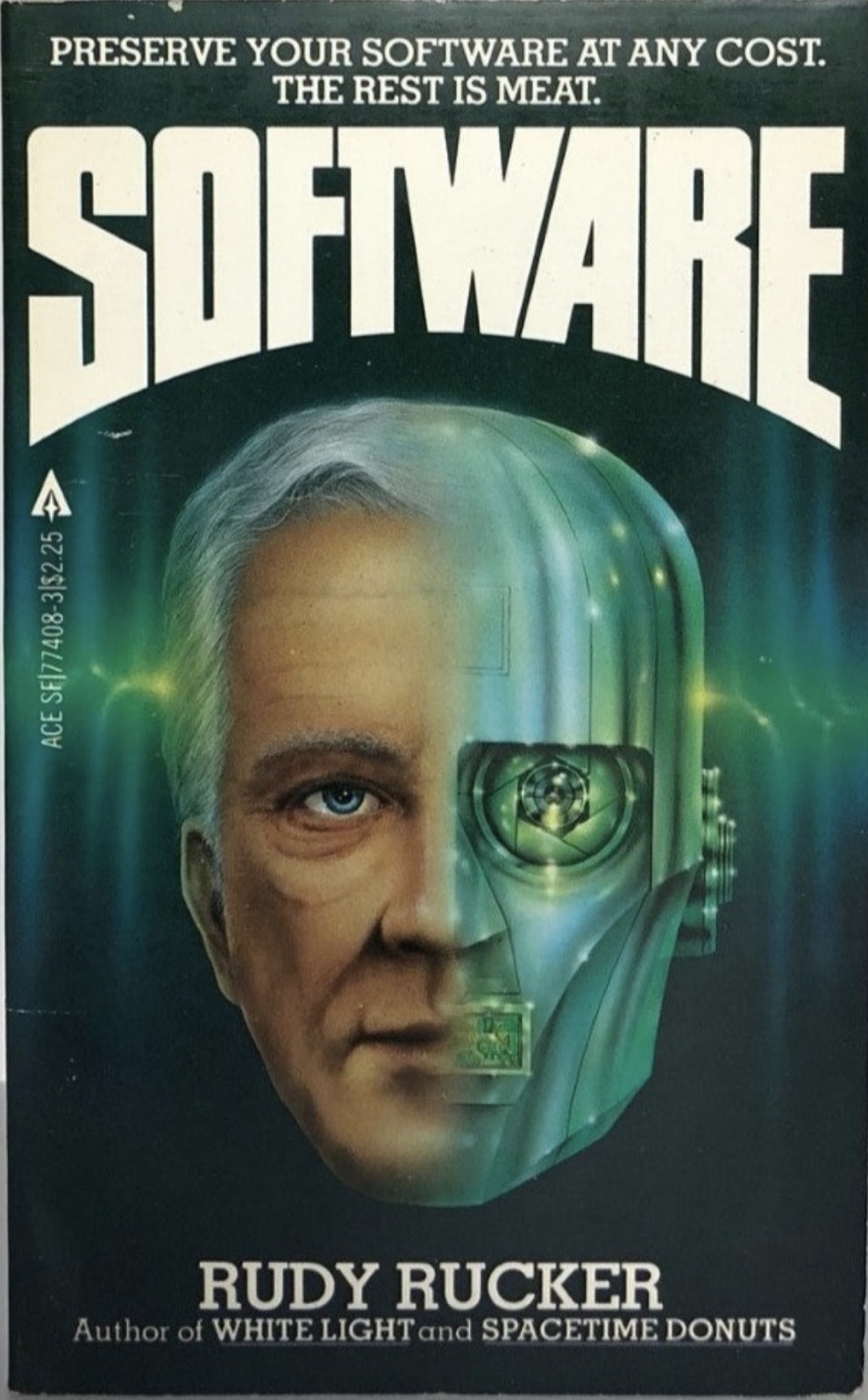
SOFTWARE | RUDY RUCKER | 1982
If you arrive fresh to Rudy Rucker’s classic early cyberpunk novel quartet — the Ware Tetralogy as he terms it, with a nerdy Euclidean flourish — you still might be able to deduce the sequence of the books from the titles of the individual volumes: Software, Wetware, Freeware, Realware.
You also might not, which is fine, because a deliberate messiness is essential to Rucker’s fiction overall, and to this series in particular. The books concern themselves with the rise and liberation of digital sentience, and of sentience in general, and of its eventual incarnation in increasingly strange forms amid an increasingly weird and expansive reality. Unexpected consequences don’t so much lurk as leap from around every corner.
Disorientation, you see, is inherent to Rucker’s modus operandi. Software, the rambunctious and anarchic first volume of the Ware books, reads like a sequel itself. A lot went down before computer scientist Cobb Anderson finds himself, at the start of the story, semi-enjoying a low-level louche retirement in Florida. Despite a prominent career, he fell from grace after granting self-awareness and personhood to machines (called “boppers” in the books), which learned to self-replicate, if not outright reproduce. Those machines eventually fled Earth to take refuge on the Moon, where inevitable social divisions ruptured any hope for cohesion, even with us humans 200,000-plus miles away. By the time we readers arrive on the scene, the situation is a mess, and Anderson’s life even more so. Rucker wouldn’t have it any other way.
What follows is as outrageous as it is existentially precarious — all vivid deaths, body swapping, and cross-species hanky-panky. The sheer messiness of flesh and blood (and data and robotics) is essential to Software’s role in the birth of cyberpunk as a genre. The first of the Ware books, Software arrived in 1982, two years before William Gibson’s Neuromancer, four years before Bruce Sterling’s Mirrorshades anthology of cyberpunk short stories, and a full decade before Neal Stephenson’s Snow Crash. Now, there is plenty of software in Software, but ultimately the operative term is the first half of the title, not the second. What’s really at work in this first book isn’t a tale of mere technological singularity — in which data rules supreme, outpacing human cognition, blah blah blah — but quite the contrary, one in which embodiment is explored as the essence of life. How punk is that?
Much of the pleasure in Software comes from how Rucker probes the expressiveness and malleability of bodies, where it is that the “soft” and the “’ware” rub up against each other, and what such friction generates. Cobb is gifted a body double and finds himself faced with how much healthier it looks simply for not carrying around his woes: “The face seemed right and there was even the scar from the heart transplant. The only difference between them was how alert and healthy the copy looked.” A bopper named Ralph turns out to be much more nuanced on the inside than out: “Ralph had few visible lights or dials, and it was hard to tell what he was thinking.” Sta-Hi Mooney, a stoner lassoed into Cobb’s hijinks, wrestles with what’s at stake when you canoodle with a woman you know is a machine, sentient or not: “[H]e’d start thinking of the wires behind her eyes, and he’d be screwing a machine, an inanimate object, a public toilet. His relations with women were a mess.” Again, Rucker wouldn’t have it any other way.
Much as the book starts in medias res, it ends careening toward new adventures. The three subsequent volumes arrived between 1988 and 2000. And with the unused title Firmware just left hanging out there, perhaps we can hope for a potential career-capping quintet entry — or pentalogy — at some point in our collective cyberpunk future.
OMAC YOUR ENTHUSIASM: INTRODUCTION by Josh Glenn | Mark Kingwell on RIDDLEY WALKER | Carlo Rotella on THE FACE | Sara Ryan on DREAMSNAKE | Matthew Battles on THE WORD FOR WORLD IS FOREST | Ramona Lyons on HIGH-RISE | Adam McGovern on SHADRACH IN THE FURNACE | Deb Chachra on THE HITCHHIKER’S GUIDE TO THE GALAXY | Tom Nealon on DHALGREN | Michael Grasso on FLOW MY TEARS, THE POLICEMAN SAID | Stephanie Burt on BRIGHTNESS FALLS FROM THE AIR | Nikhil Singh on SABRE | Gordon Dahlquist on VALIS | Miranda Mellis on THE DISPOSSESSED | Marc Weidenbaum on SOFTWARE | Peggy Nelson on THE TRANSMIGRATION OF TIMOTHY ARCHER | Josh Glenn on ENGINE SUMMER | Mimi Lipson on A SCANNER DARKLY | Douglas Wolk on THRILLER | David Hirmes on ARZACH | Anthony Miller on THE SHOCKWAVE RIDER | Annie Nocenti on JIMBO | Seth on MR. MACHINE | Alex Brook Lynn on JUDGE DREDD | Joe Alterio on THE INCAL | Jason Grote on JOSIE AND THE ELEVATOR.
JACK KIRBY PANELS | CAPTAIN KIRK SCENES | OLD-SCHOOL HIP HOP | TYPEFACES | NEW WAVE | SQUADS | PUNK | NEO-NOIR MOVIES | COMICS | SCI-FI MOVIES | SIDEKICKS | CARTOONS | TV DEATHS | COUNTRY | PROTO-PUNK | METAL | & more enthusiasms!