
UMBRA VITAE
By:
January 21, 2026
A series dedicated to poems, published c. 1900–1935, the Radium Age sf-adjacent themes of which include: dystopia and utopia, far-out mathematics and the fourth dimension, Afro-futurism, catastrophe, future war, new technologies, scientific breakthrough, dehumanization, cosmic awe, disenchantment and unseen forces, unknowable aliens and singularity. Research and selection by Joshua Glenn; thematic index here.
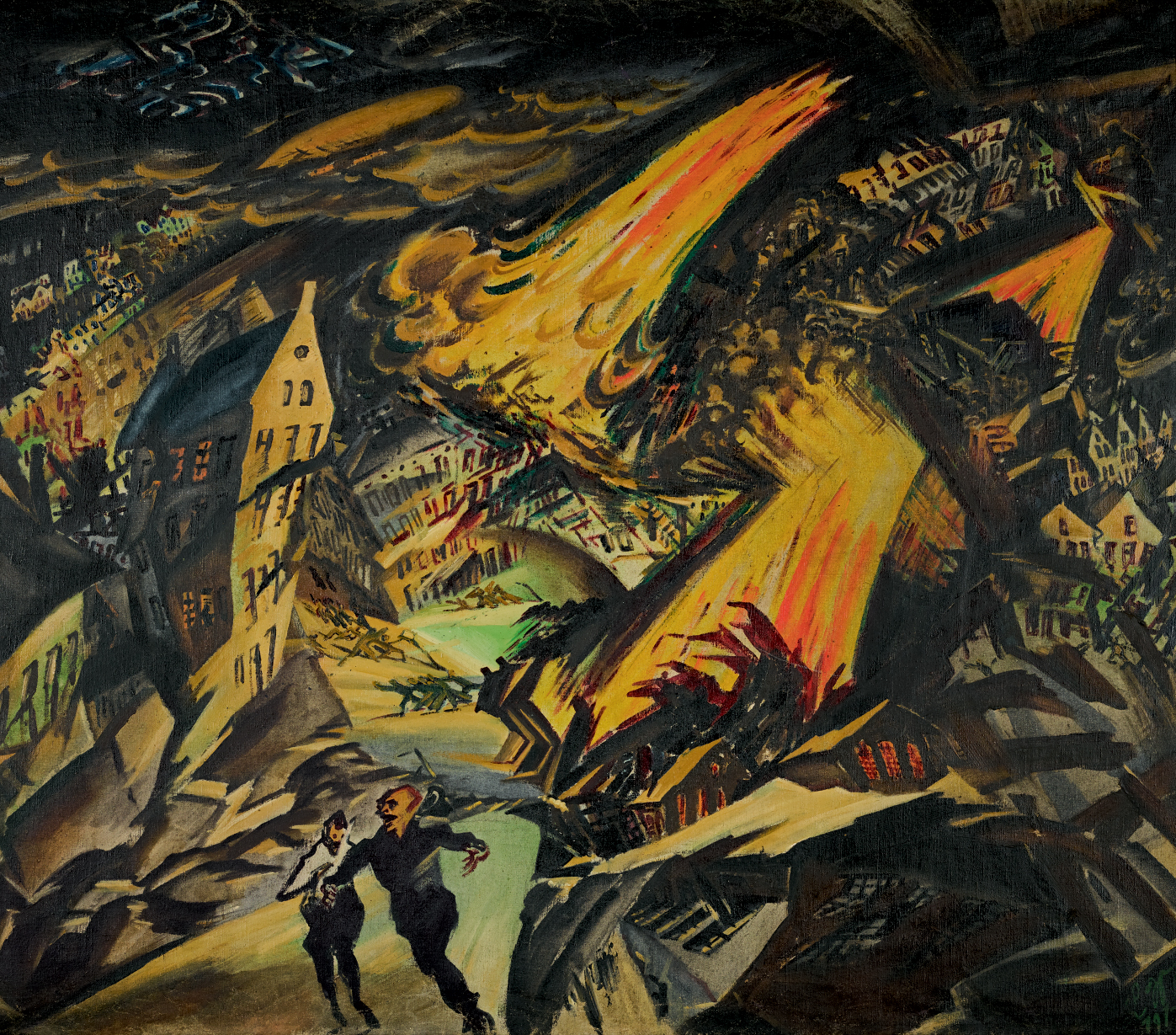
The people stand forward in the streets
They stare at the great signs in the heavens
Where comets with their fiery trails
Creep threateningly about the serrated
towers.
And all the roofs are filled with stargazers
Sticking their great tubes into the skies
And magicians springing up from the
earthworks
Tilting in the darkness, conjuring the one
star.
Sickness and perversion creep through the
gates
In black gowns. And the beds bear
The tossing and the moans of much
wasting
They run with the buckling of death.
The suicides go in great nocturnal hordes
They search before themselves for their
lost essence
Bent over in the South and West and the
East and North
They dust using their arms as brooms.
They are like dust, holding out for a while
The hair falling out as they move on their
way,
They leap, conscious of death, now in
haste,
And are buried head-first in the field.
Yet occasionally they twitch still. The
animals of the field
Blindly stand around them, poking with
their horn
In the stomach. They lie on all fours
Buried under sage and thorn.
The year is dead and emptied of its winds
That hang like a coat covered with drops of
water
And eternal weather, which bemoaning
turns
From cloudy depth again to the depths.
But the seas stagnate. The ships hang
Rotting and querulous in the waves,
Scattered, no current draws them
And the courts of all heavens are sealed.
The trees fail in their seasonal change
Locked in their deadly finality
And over the decaying path they spread
Their wooden long-fingered hands.
He who dies undertakes to rise again,
Indeed he just spoke a word.
And suddenly he is gone. Where is his life?
And his eyes are like shattered glass.
Many are shadows. Grim and hidden.
And dreams which slip by mute doors,
And who awaken, depressed by other
mornings,
Must wipe heavy sleep from grayed lids.
— first published in Umbra Vitae (1912). Also appears in the 1919/20 expressionist anthology Menschheitsdämmerung (ed. Kurt Pinthus), which in 1933 was banned by the Nazis.
This translation by Scott Horton.
Writing for Harper’s, Horton tells us:
[This is] one of the most accomplished of the German Expressionist poems. It paints a dark, mysterious and painful portrait of life. It is filled with great foreboding, a sense of impending doom, a society on the brink of destruction. And perhaps the author’s sense is that this destruction is well-earned. The poem dates from 1912. Shortly after it was composed, Heym died from a freakish accident which had been foreshadowed in a strange dream he had recorded a year and a half earlier.
[…]
The first two stanzas … introduce a very curious element of astronomy. People are obsessed with observing the heavens, with a fiery-tailed comet, he writes. They conjure the one star. In a sense he is describing something well documented. In 1910, Haley’s Comet returned, but unexpectedly a series of further comets were noted, including the great January 1910 comet which caught the northern hemisphere by surprise. Newspapers recorded it as a sensational affair all across the globe. Sales of telescopes were brisk, and people did indeed gather on rooftops and focus their lenses on the heavens to watch the comet’s approach. Noted scientists speculated on whether the earth would be struck by one of these comets, with unpredictable but likely catastrophic results.
[…]
But Heym’s comets are not the stuff of science. Note how they wind or creep (schleichen) around the towers. Clearly he is using the comet as a metaphor for something else. But what? Is it superstition? An unwarranted faith in science? Is it people filling their lives with meaningless knowledge, the passion of the German Bildungsbürgertum? Each of these is a plausible construction.
RADIUM AGE PROTO-SF POETRY: Stephen Spender’s THE PYLONS | George Sterling’s THE TESTIMONY OF THE SUNS | Archibald MacLeish’s EINSTEIN | Thomas Thornely’s THE ATOM | C.S. Lewis’s DYMER | Stephen Vincent Benét’s METROPOLITAN NIGHTMARE | Robert Frost’s FIRE AND ICE | Aldous Huxley’s FIFTH PHILOSOPHER’S SONG | Sara Teasdale’s “THERE WILL COME SOFT RAINS” | Edith Södergran’s ON FOOT I HAD TO… | Robert Graves’s WELSH INCIDENT | Nancy Cunard’s ZEPPELINS | D.H. Lawrence’s WELLSIAN FUTURES | & many more.